电力设备

Search documents
挖掘经济潜能系列一:纵深推进全国统一大市场建设的方向、举措、效果推演
East Money Securities· 2026-01-25 13:30
Group 1: National Unified Market Construction - The construction of a national unified market has been elevated to a core economic strategy, emphasizing the need to eliminate market barriers and facilitate economic circulation[8] - The central economic work conference in 2025 highlighted the importance of deepening the construction of a unified market, marking a transition from framework establishment to systematic implementation[9] - The construction process has seen significant progress, with improvements in property rights protection, market access, fair competition, and social credit systems[9] Group 2: Key Areas and Policies - The modern service industry is expected to be a crucial driver in the unified market construction, with coastal regions likely to be the first to pilot reforms[1] - Tax incentives and government subsidies have been adjusted, primarily affecting key industries such as electronics, automotive, and pharmaceuticals, which may accelerate industry restructuring[1] - The establishment of a unified market will require reforms in the fiscal and tax systems, as well as optimization of local performance evaluation systems[1] Group 3: Economic Impact and Participation - The participation of different provinces in the unified market varies significantly, with coastal provinces showing higher engagement levels[1] - The share of external factors in total inputs is over 50% for resource-related and some high-tech manufacturing industries, indicating smoother domestic flow of factors[14] - Service industries show lower external factor input ratios, with public administration, accommodation, and comprehensive technical services at 7.23%, 11.54%, and 11.99% respectively, suggesting potential bottlenecks in factor circulation[14]
公募去年四季度亏超千亿终结七连盈,科技周期成加仓核心
第一财经· 2026-01-25 13:23
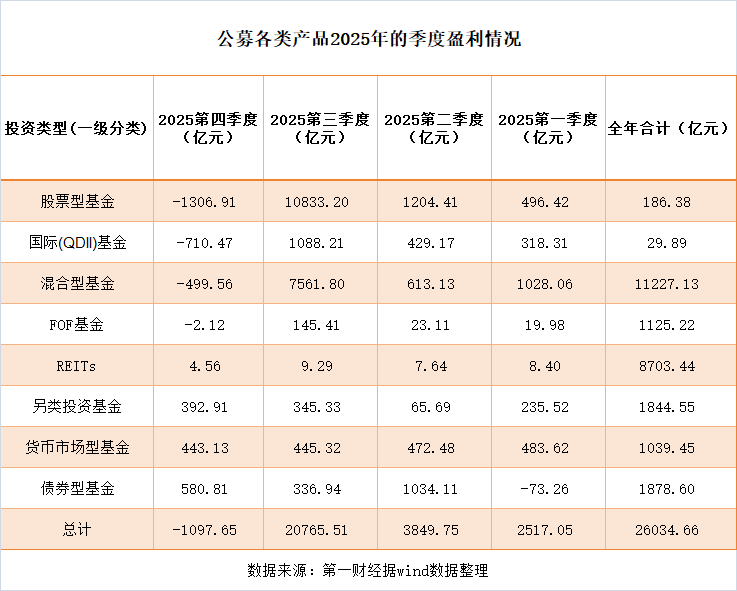
Core Viewpoint - The A-share market experienced significant fluctuations around the 4000-point mark, leading to a loss of profitability for public funds in the fourth quarter of 2025, marking the first loss after seven consecutive profitable quarters. However, the overall annual profit reached a record 2.6 trillion yuan, recovering losses from previous years [3][6]. Fund Performance - In Q4 2025, public funds reported a total loss of approximately 1.1 billion yuan, ending a streak of profitability. Despite this, the annual profit of 2.6 trillion yuan set a historical record, covering cumulative losses of 1.87 trillion yuan from 2022 to 2023 [6][8]. - Equity funds were the hardest hit in Q4, with a combined loss of 1.81 trillion yuan, while mixed funds also faced losses. In contrast, bond and money market funds continued to perform well, contributing significantly to overall profits [6][9]. Fund Adjustments - Public funds actively adjusted their holdings in response to market conditions, increasing their positions in technology and cyclical sectors. Notably, Zhongji Xuchuang replaced Ningde Times as the top holding among active funds [3][11]. - The top ten heavy stocks saw minimal changes in total market value, but individual rankings shifted significantly, with Zhongji Xuchuang and Xinyi Sheng surpassing Guizhou Moutai in holdings [12][13]. Sector Focus - The electronic sector emerged as the largest area of investment for public funds, with a total market value of 741 billion yuan. The power equipment sector followed closely, while the communication sector became the third-largest focus, overtaking the pharmaceutical sector [17]. - Public funds increased their positions in oil, non-bank financials, and metals, with significant additions in stocks like Industrial Bank and China Petroleum [15][16]. Market Outlook - Analysts suggest that while sectors like new consumption and AI show strong fundamentals, valuation concerns may arise due to market liquidity tightening. Dividend investments are expected to perform better in 2026 compared to the previous year [17].


每周研选 | 如何看待当前市场的分化格局?
Xin Lang Cai Jing· 2026-01-25 13:14
Core Viewpoint - The A-share market is experiencing a volatile upward trend, with significant recovery in profitability, while major indices show mixed performance and increasing market style differentiation [1][11]. Group 1: Market Trends - The recent market has shown a high trading volume and a clear recovery in profitability, with small-cap indices like the CSI 500 and CSI 1000 outperforming large-cap indices such as the SSE 50 and CSI 300 [1][11]. - The implementation of counter-cyclical adjustment policies is expected to influence the spring market dynamics, with a focus on structural differentiation continuing [1][11]. Group 2: Institutional Insights - CITIC Securities indicates that market confidence is steadily recovering, suggesting that sectors with low valuations and growth potential, particularly in the consumer chain, are prime for allocation from now until March [1][12]. - Industrial and thematic ETFs are seeing positive subscriptions despite large-scale redemptions in broad-based ETFs, indicating a resilient market structure [3][13]. Group 3: Performance Predictions - Historical data suggests that February is one of the months with the highest win rates for major indices, with expectations for upward market elasticity as liquidity remains abundant [2][12]. - The current spring market is anticipated to have further room for development, with short-term fluctuations providing good investment opportunities [3][14]. Group 4: Sector Focus - Key sectors for investment include chemicals, non-ferrous metals, new energy, and power equipment, with a focus on high-growth areas such as semiconductor equipment and materials [1][12][20]. - The performance of high-growth sectors like AI, commercial aerospace, and other technology-driven industries is expected to continue, with potential for expansion into other high-growth areas [19][20]. Group 5: Earnings Outlook - As of January 23, over 900 listed companies have disclosed earnings forecasts, with a 37.7% positive forecast rate, indicating a potential acceleration in corporate profit recovery [5][15]. - The median year-on-year growth rate for total A-share net profit is projected to reach 17.8% for 2025, with significant growth expected in sectors like computing, communication, lithium batteries, and energy storage [5][15].
公募去年四季度亏超千亿终结七连盈,科技周期成加仓核心
Di Yi Cai Jing· 2026-01-25 12:00
Core Insights - The public fund industry in China achieved a record profit of 2.6 trillion yuan in 2025, recovering from a cumulative loss of 1.87 trillion yuan from 2022 to 2023 [1][2] - Despite a loss of approximately 110 billion yuan in Q4 2025, the overall annual performance marked a significant recovery for the industry [2][3] Fund Performance - In Q4 2025, public funds reported a total loss of 1,097.65 billion yuan, ending a streak of seven consecutive profitable quarters [2][3] - Equity funds were the hardest hit, with a combined loss of 1,306.91 billion yuan in Q4, while mixed funds lost 499.56 billion yuan [3][4] - For the entire year, equity funds still managed to generate a profit of 1.99 trillion yuan, despite the Q4 downturn [4] Product Categories - QDII funds and FOF funds also faced losses in Q4, amounting to 710.47 billion yuan and 2.12 billion yuan respectively, but ended the year with profits of 1,125.22 billion yuan and 186.38 billion yuan [4] - Fixed-income products, including bond and money market funds, contributed significantly to profits, with bond funds earning 580.81 billion yuan and money market funds 443.13 billion yuan [4] Fund Company Performance - Among 167 fund companies, 108 reported positive profits, with over 60% achieving profitability [5] - Notable performers included Guotou Ruijin Fund, which led the industry with a profit of 72.82 billion yuan [5] Stock Holdings Adjustments - Public funds increased their holdings in 83 new stocks by the end of Q4 2025, with a focus on technology and cyclical sectors [7] - Ningde Times remained the top holding stock, despite a reduction of 1,993 million shares, while Zhongji Xuchuang became the most held stock among active funds [10][11] Sector Focus - The communication sector, particularly in optical modules, saw increased institutional investment, with Zhongji Xuchuang and Xinye Technology becoming top holdings [10] - The top three sectors for public fund investments were electronics, power equipment, and communication, with significant capital allocated to these areas [13]



机构论后市丨市场信心持续恢复 A股维持震荡偏强趋势
Di Yi Cai Jing· 2026-01-25 12:00
Core Viewpoint - The A-share market shows mixed performance with the Shanghai Composite Index up 0.84% and the Shenzhen Component Index up 1.11%, while the ChiNext Index is down 0.34% and the Sci-Tech Innovation Board Index up 2.41% [1] Group 1: Market Analysis - CITIC Securities reports that market confidence is gradually recovering, suggesting that sectors with logical narratives at relatively low valuations may see recovery [1] - Zhongtai Securities indicates that the short-term market will continue to exhibit a differentiated pattern, supported by high elasticity sectors attracting new capital and a stable RMB exchange rate [2] - Huajin Securities notes that the short-term economic and profit recovery trends are weak, with PPI expected to rise and A-share profits maintaining a structural recovery trend [3] Group 2: Investment Strategy - CITIC Securities recommends increasing allocations in non-bank sectors (securities, insurance) and enhancing returns through domestic demand or high-growth sectors [1] - Zhongtai Securities anticipates that after the Spring Festival, the market's pricing logic will shift from risk preference and valuation expansion to performance verification and profit growth [2] - Everbright Securities advises investors to maintain a steady approach and hold stocks through the holiday, predicting a new upward momentum post-Spring Festival [4] Group 3: Sector Focus - Everbright Securities highlights sectors such as electronics, power equipment, and non-ferrous metals as key areas of focus, depending on market style [4] - The commercial aerospace sector is noted for its recent recovery, with specific sub-sectors like space computing and upstream materials expected to remain active [5]
北美缺电--HRSG产业逻辑梳理
傅里叶的猫· 2026-01-25 11:58
Core Insights - The article discusses the differences between gas internal combustion engines and gas turbines, highlighting the efficiency, cost, and application differences between them [2]. Comparison of Gas Internal Combustion Engines and Gas Turbines - Gas internal combustion engines have an efficiency of 42%-45%, while standalone gas turbines have about 30% efficiency, and combined cycle gas turbines exceed 50% efficiency [2]. - The lifecycle cost of gas internal combustion engines is approximately 0.3-0.4 RMB per kWh, while standalone gas turbines are more expensive due to lower fuel utilization rates [2]. - The power output of gas internal combustion engines ranges from 2-4 MW, compared to 10-20 MW for both standalone and combined cycle gas turbines [2]. - The delivery capacity for gas internal combustion engines is sold out until 2026, with total delivery capacity around 1 GW, while major gas turbine brands in the U.S. have delivery times extending to 2028 [2]. - Typical applications for gas internal combustion engines include AI data centers in North America, while gas turbines are used in scenarios requiring high deployment speed and energy density [2]. - Core advantages of gas internal combustion engines include high efficiency, low cost, mature technology, and simple operation, whereas gas turbines offer high energy density and fast deployment [2]. HRSG Boiler Updates - The demand for Heat Recovery Steam Generators (HRSG) is driven by the scarcity of gas turbine capacity and the increasing power supply needs of data centers [4]. - The economic difference in annualized performance between using HRSG and not using it can reach several billion USD per GW based on current industrial electricity prices in North America [4]. - New EPA regulations have increased deployment requirements for gas turbines, making HRSG a necessity for power generation in North America [5]. Profitability and Price Expectations - Profit margins for HRSG orders are over 30% in North America, 20-30% in Europe, and 15-20% in emerging markets like the Middle East and Africa [5]. - Price increases for HRSG orders in North America are expected to exceed 15-20%, with optimistic projections reaching up to 30% [5]. - Initial price increase expectations for HRSG orders in the Middle East are around 10-15%, potentially exceeding 20% [5].

中信证券:本周宽基ETF的赎回规模继续放大 目前仍然未见放缓迹象
Zhi Tong Cai Jing· 2026-01-25 10:13
Core Viewpoint - The redemption scale of broad-based ETFs continues to expand without signs of slowing down, impacting various industries and individual stocks differently, with a notable effect on sectors and stocks that institutions are underweighting [1][2][3] Group 1: ETF Redemption Dynamics - The redemption of broad-based ETFs has led to a significant change in the ETF market structure, with cumulative net redemptions of 8,458 billion yuan since October 2024, while industry/theme ETFs have seen net subscriptions of 5,864 billion yuan [3] - As of January 23, 2026, the total scale of broad-based ETFs is approximately 20,574 billion yuan, with industry/theme ETFs at 15,115 billion yuan, representing 42% of the total [3] - The redemption behavior of broad-based ETFs is perceived more as a profit-taking strategy rather than a means to cool down the market, indicating strong market sentiment and active trading [4] Group 2: Sector Performance and Opportunities - During the recent redemption period, 86 stocks in the CSI 300 index outperformed the index by over 2%, primarily in the electronics, electric new energy, and chemical sectors, while 121 companies underperformed, mainly in non-bank financials and pharmaceuticals [5] - The consumer chain is expected to see increased allocation from now until the Two Sessions, with travel consumption leading the recovery, and the market is pricing in positive changes in consumer sentiment [7][8] - The real estate chain may also experience significant recovery, with signs of market stabilization in new home transactions and rental yields in major cities [9] Group 3: Investment Strategies - A strategy focusing on "resources + traditional manufacturing pricing power" is recommended, emphasizing sectors like chemicals, non-ferrous metals, new energy, and power equipment, which are expected to provide stable returns amid market fluctuations [10] - Investors are encouraged to increase allocations to non-bank financials and select domestic demand sectors, such as duty-free, aviation, and quality real estate developers, to capture potential policy changes and enhance returns [10]

机构论后市丨市场信心持续恢复;A股维持震荡偏强趋势
Di Yi Cai Jing· 2026-01-25 10:13
Core Viewpoint - The A-share market is experiencing a mixed performance, with various institutions providing insights on future trends and investment strategies. Group 1: Market Trends and Predictions - CITIC Securities indicates that market confidence is gradually recovering, suggesting that sectors with logical narratives and not heavily weighted in broad indices may see a recovery [1] - Zhongtai Securities notes that the short-term market will continue to show a differentiated pattern, supported by high elasticity sectors attracting new capital, while the overall liquidity remains relatively loose [2] - Huajin Securities states that the short-term spring market is ongoing, with A-shares maintaining a strong trend amid weak economic recovery and potential increases in profitability [3] Group 2: Investment Strategies - CITIC Securities recommends focusing on a combination of resources and traditional manufacturing sectors, particularly in chemicals, non-ferrous metals, new energy, and power equipment, while also suggesting to increase allocations in non-bank sectors [1] - Zhongtai Securities emphasizes that the market's pricing logic may shift from risk preference and valuation expansion to performance verification and profit growth as companies begin to disclose annual reports [2] - Everbright Securities advises investors to maintain a steady approach and hold stocks through the holiday period, predicting a new upward momentum post-Spring Festival [4] Group 3: Sector Focus - Everbright Securities highlights sectors such as electronics, power equipment, and non-ferrous metals as key areas of interest, depending on market styles [4] - The commercial aerospace sector is noted for its recent recovery, with specific sub-sectors like space computing and upstream materials expected to remain active despite overall limited upward potential [5]
光大证券:近期以稳为主 但仍应持股过节
Xin Lang Cai Jing· 2026-01-25 10:00
Core Viewpoint - The report from Everbright Securities suggests maintaining a steady investment approach while holding stocks through the holiday season, anticipating market fluctuations before the Spring Festival [1] Market Outlook - The market is expected to remain volatile before the Spring Festival, with a decline in trading enthusiasm among investors and a tightening of micro liquidity [1] - Historical data indicates that the probability of major indices rising in the 20 trading days leading up to the Spring Festival is less than 50% [1] - After the Spring Festival, a new upward momentum is anticipated, with higher probabilities and average gains for major indices in the subsequent 20 trading days [1] Investment Recommendations - Investors are advised to adopt a cautious approach while still holding stocks during the holiday period [1] - Key sectors to focus on include electronics, electrical equipment, and non-ferrous metals [1] Industry Performance - If the market style in January is growth-oriented, the top-scoring industries based on a five-dimensional industry comparison framework are electronics, electrical equipment, telecommunications, non-ferrous metals, automotive, and defense [1] - If the market style is defensive, the leading industries are non-bank financials, electronics, non-ferrous metals, electrical equipment, automotive, and transportation [1] - There is a notable similarity in the top-scoring industries under both growth and defensive market scenarios [1]

【广发宏观王丹】需求端补短板,驱动力再优化:2026年中观环境展望
郭磊宏观茶座· 2026-01-25 09:59
Core Viewpoint - The article analyzes the performance of China's assets in 2025, highlighting a 27.6% increase in the Wind All A Index, with significant gains in sectors such as non-ferrous metals, electronics, and defense industries, driven by global narratives and high-end manufacturing [1][12][13]. Group 1: Asset Performance and Industry Analysis - In 2025, the Wind All A Index rose by 27.6%, with leading sectors including non-ferrous metals (94.7%), electronics (47.9%), and defense (34.3%) [1][13]. - The profitability of industrial enterprises showed a positive trend, particularly in high-end manufacturing and related raw materials, with notable profit growth in non-ferrous metals (32.3%) and computer communication electronics (15.0%) [1][14]. - The performance of various industries was influenced by global trends, with precious metals and the AI industry chain showing remarkable results [1][12]. Group 2: Demand Drivers and Economic Structure - The demand side in 2025 was driven by three main factors: consumer spending on durable goods (e.g., home appliances), exports of electromechanical and high-tech products, and investment in equipment [2][16]. - Exports of electromechanical products and high-tech goods grew by 8.4% and 7.5%, respectively, outpacing overall export growth of 5.5% [2][18]. - Investment in construction and infrastructure declined by 8.4%, while equipment investment increased by 11.8% due to policy incentives [2][16]. Group 3: Industrial Price Trends - The Producer Price Index (PPI) fell by 2.6% in 2025, with traditional raw material sectors contributing significantly to this decline [3][20]. - The PPI decline was primarily driven by upstream traditional industries, which accounted for 66% of the decrease, while emerging manufacturing sectors contributed 23% [3][21]. - In the second half of 2025, PPI showed signs of recovery, with month-on-month increases observed in several industries, including coal and non-ferrous metals [3][22]. Group 4: Inventory Dynamics - The inventory-to-sales ratio in the industrial sector rose to 0.58 by November 2025, indicating a trend of increasing inventory levels [4][24]. - The inventory cycle showed a pattern of active replenishment at the beginning of the year, followed by passive accumulation later in the year [4][25]. - By November 2025, nominal and actual inventory levels had increased by 4.6% and 6.8%, respectively, compared to the previous year [4][24]. Group 5: Policy Outlook for 2026 - The core policy focus for 2026 is to address demand shortfalls, with an emphasis on optimizing supply-demand relationships [5][27]. - If fixed asset investment recovers to around 3.8%, the economic supply-demand ratio is expected to improve significantly [5][28]. - The 2026 policy aims to enhance consumer spending and investment, particularly in the service sector, to stimulate economic growth [5][35]. Group 6: Export and Consumption Trends - The export environment in 2026 is expected to remain stable, with structural highlights in midstream manufacturing [6][30]. - The IMF projects a global economic growth of 3.1% for 2026, with emerging economies in Asia and Africa leading the growth [6][31]. - Policies aimed at increasing consumer spending, particularly in the service sector, are anticipated to drive economic recovery [6][35]. Group 7: Investment Recovery and Infrastructure - Investment in infrastructure is projected to recover in 2026, with significant funding allocated for various projects [8][39]. - The early 2026 investment outlook is positive, with a notable increase in the scale of funding for key projects compared to 2025 [8][38]. - Central enterprises are expected to play a crucial role in driving investment, with substantial planned expenditures in infrastructure [8][39]. Group 8: Emerging Industries and Technological Development - The "14th Five-Year Plan" emphasizes the development of emerging industries, including artificial intelligence and quantum technology [9][40]. - Significant growth was observed in sectors such as drone technology and satellite communications, indicating a robust expansion of new industries [9][40]. - The application of advanced technologies in industrial enterprises has increased dramatically, reflecting a shift towards more innovative practices [9][40].