
有色

Search documents
研究所晨会观点精萃-20251015
Dong Hai Qi Huo· 2025-10-15 02:09
Report Industry Investment Ratings No specific industry investment ratings are provided in the given content. Core Views of the Report - Overseas, the game between China and the US persists, the Fed's balance - sheet reduction may near an end, the employment market has a downward risk, leading to a decline in the US dollar index and US Treasury yields, and a rise in global risk appetite. Domestically, economic growth accelerates, multiple industry stability - growth plans are introduced, but short - term Sino - US game and domestic risk - aversion sentiment exist. The market focuses on domestic incremental policies and Sino - US game, with weak short - term upward macro drivers [2]. - Different asset classes have different trends: stocks are in short - term high - level adjustment, bonds are in short - term oscillation, and different commodity sectors have different short - term trends such as oscillation or adjustment [2]. Summary by Relevant Catalogs Macro - finance - **Macro**: Overseas, the game between China and the US, Fed's balance - sheet reduction plan, and employment market situation affect the US dollar index and US Treasury yields. Domestically, economic growth accelerates, policies support multiple industries, and the market focuses on domestic policies and Sino - US game. Assets like stocks, bonds, and various commodities have different short - term trends [2]. - **Stock Index**: Affected by semiconductor, energy metal, and AI sectors, the domestic stock market falls. The economy grows, policies support, but short - term upward drivers are weak. Short - term cautious observation is recommended [3]. - **Precious Metals**: The precious metals market rises, with gold and silver prices increasing. Affected by trade uncertainty and Fed rate - cut expectations, they are in a short - term strong and long - term upward trend. Short - term, hold long positions or reduce at high prices; long - term, buy at low prices [3]. Black Metals - **Steel**: The domestic steel market is weak, with low - volume trading. Cost support weakens, and prices are expected to continue the weak trend in the short term [4]. - **Iron Ore**: The price of iron ore futures and spot falls. As steel mills' profits narrow, ore demand may decline. Supply shows a mixed trend, and a short - term bearish view is recommended [6]. - **Silicon Manganese/Silicon Iron**: The spot prices of silicon manganese and silicon iron are stable, and the futures prices fall. Supply and demand are in a certain state, and the futures prices are expected to oscillate in a range [7]. - **Soda Ash**: The soda ash contract is weak. Supply is in the capacity - expansion period, demand increases marginally in the peak season. In the long - term, a bearish view is recommended due to supply - side contradictions [8]. - **Glass**: The glass contract is weak. Supply increases, and the new policy provides support. Demand improves marginally in the peak season but slows down after the holiday. It is expected to run weakly in the short - term range [8]. Non - ferrous Metals and New Energy - **Copper**: Affected by trade concerns, copper prices fluctuate. The global copper output is expected to grow in 2026. The US economy and copper demand have uncertainties. Short - term, the domestic output is high, and demand faces challenges [9]. - **Aluminum**: Aluminum prices fall. Inventory increases, supply is rigid, demand weakens, and the price is difficult to rise significantly [10]. - **Tin**: The global tin supply is tight, and demand is weak. The price is expected to oscillate at a high level, with support and pressure coexisting [10]. - **Lithium Carbonate**: The lithium carbonate contract rises slightly. Trade conflicts and warehouse - receipt cancellation bring pressure, and the price is expected to oscillate in a range [11]. - **Industrial Silicon**: The industrial silicon contract falls. Production reaches a new high, and the price is expected to oscillate in a range, with attention to cost support [11]. - **Polysilicon**: The polysilicon contract rises. Warehouse - receipt cancellation and supply - demand imbalance bring pressure, and the price is expected to oscillate, with attention to spot price support [12]. Energy and Chemicals - **Crude Oil**: Oil prices are affected by trade signals, geopolitical factors, and port sanctions. Short - term, they oscillate; long - term, they are bearish [13][14]. - **Asphalt**: Asphalt is in a weak oscillation. The peak - season demand is near the end, inventory pressure increases, and it depends on crude - oil cost support [14]. - **PX**: PX oscillates weakly with the polyester sector. It has certain demand support but is likely to continue the weak trend [14]. - **PTA**: PTA prices are weak. Supply is high, demand is under pressure, and inventory increases [15]. - **Ethylene Glycol**: The inventory of ethylene glycol rises, demand is weak, and it is expected to accumulate inventory in October and run at a low price [15]. - **Short - fiber**: Short - fiber adjusts with the polyester sector. Terminal orders improve slightly, and it is expected to oscillate weakly [15]. - **Methanol**: Methanol prices oscillate weakly. Supply exceeds demand, inventory is high, and it is under pressure [16]. - **PP**: PP prices are weak. Supply and demand both increase, but new - capacity and trade - war factors bring pressure [16][17]. - **LLDPE**: LLDPE prices are expected to oscillate weakly. Supply pressure increases, demand recovers slowly, and it is affected by oil prices and trade [17]. - **Urea**: Urea prices rise slightly. Supply is strong, demand is weak, and it depends on export - policy implementation [18]. Agricultural Products - **US Soybeans**: US soybeans oscillate weakly due to demand uncertainty and lack of USDA reports [19]. - **Soybean Meal/Rapeseed Meal**: Domestic soybean meal contracts oscillate. In the long - term, the price may rise; in the short - term, inventory pressure exists, and it may oscillate at a low level [19]. - **Soybean Oil/Rapeseed Oil**: Soybean oil may accumulate inventory after the holiday and run weakly. Rapeseed oil inventory is being depleted and forms support [20]. - **Palm Oil**: Palm oil production increases in October, and exports also increase. The implementation of B50 in Indonesia has an impact on the market, and short - term demand growth is difficult [20][21]. - **Pigs**: Pig prices fall to a record low due to increased supply. With the expectation of consumption recovery in autumn and winter, prices may stabilize [21].
国家发改委:支持供热、算力等基础设施节能降碳改造
Zheng Quan Ri Bao· 2025-10-15 01:18
Core Viewpoint - The National Development and Reform Commission (NDRC) has released the "Special Management Measures for Energy Conservation and Carbon Reduction Central Budget Investment" to enhance and standardize the management of central budget investments for energy conservation and carbon reduction, aiming for high-quality project implementation and improved fund utilization efficiency [1][2]. Group 1: Management Measures - The management measures focus on promoting "soft construction" to establish effective mechanisms for solving practical problems and advancing green and low-carbon circular development [1][2]. - The emphasis on "soft construction" marks a significant shift from merely hardware investment to building long-term mechanisms, ensuring that financial inputs translate into sustainable emission reduction benefits [1][2]. Group 2: Project Support and Focus Areas - The NDRC will support energy conservation and carbon reduction projects based on project characteristics, regional economic development levels, and local carbon reduction goals, with a focus on areas excelling in carbon peak and neutrality, energy conservation, and circular economy [2]. - Key supported sectors include energy conservation and carbon reduction in major industries such as electricity, steel, non-ferrous metals, building materials, petrochemicals, chemicals, and machinery, as well as projects related to clean coal consumption replacement and low-carbon demonstration [2]. Group 3: Importance of Computing Infrastructure - Supporting energy conservation and carbon reduction in computing infrastructure is deemed necessary and forward-looking, as the rapid growth of the digital economy leads to increased energy consumption in data centers [3]. - Enhancements in energy efficiency in this sector will directly promote the application of green technologies such as liquid cooling and AI intelligent scheduling, thereby strengthening the green foundation of the digital industry and improving its environmental compliance and competitiveness in the international market [3].
万联晨会-20251015
Wanlian Securities· 2025-10-15 00:36
Market Overview - The A-share market experienced a pullback on Tuesday, with the Shanghai Composite Index falling by 0.62% to 3865.23 points, the Shenzhen Component Index down by 2.54%, the ChiNext Index down by 3.99%, and the Sci-Tech 50 Index down by 4.26%. The total trading volume in the Shanghai and Shenzhen markets was 2.58 trillion yuan [2][8] - In terms of sector performance, banking, coal, and food & beverage sectors led the gains, while communication, electronics, and non-ferrous metals sectors lagged [2][8] - Concept sectors such as cultivated diamonds, liquor, and the China-South Korea Free Trade Zone saw increases, while sectors like national big fund holdings, lithography machines, and advanced packaging experienced declines [2][8] - The Hong Kong market also saw declines, with the Hang Seng Index closing down 1.73% at 25441.35 points and the Hang Seng Tech Index down 3.62% [2][8] - Internationally, the U.S. stock indices showed mixed results, with the Dow Jones up 0.44%, the S&P 500 down 0.16%, and the Nasdaq down 0.76% [2][8] Important News - Premier Li Qiang hosted a meeting with economic experts and entrepreneurs to discuss the current economic situation and future economic work. He emphasized the need to accurately grasp the economic resilience from the perspective of international changes, strengthen confidence, and face issues head-on. He called for enhanced efforts in counter-cyclical adjustments and expanding domestic demand [9] - The central bank stated that the macroeconomic fundamentals are stable, and there is a solid foundation for medium- to long-term exchange rate stability. The bank will continue to maintain market-determined exchange rates and prevent excessive fluctuations [3][9]
逆势大涨,托市资金来了?
Ge Long Hui· 2025-10-14 12:58
Market Overview - On October 14, A-shares experienced significant volatility, with major indices closing down by 0.62%, 2.54%, and 3.99% respectively, and a total market turnover of 2.6 trillion yuan, an increase of 222.4 billion yuan from the previous trading day [1][2] - The semiconductor sector saw a net outflow of 17.932 billion yuan, with stocks like Yandong Micro and Chipone falling over 11% [1][2] Sector Performance - Traditional sectors such as banking, insurance, public utilities, and food and beverage showed resilience, with increases of over 2%, contrasting sharply with the declines in high-growth sectors like semiconductors and CPO [1][7] - The gold and silver futures market also experienced significant fluctuations, with gold prices initially rising nearly 5% before settling at a 2.7% increase, while silver saw a similar pattern [6][8] Specific Company Impact - Wenta Technology, a key player in the semiconductor sector, faced a sharp decline, with its stock hitting the daily limit down for two consecutive days, reflecting investor concerns over its control of Nexperia due to a Dutch government order freezing assets [3][5] - The company held an investor meeting to reassure stakeholders that its core operations remain unaffected, although the loss of governance control may impact operational efficiency in the short term [5][12] Investment Sentiment - There is a growing trend of risk aversion among investors, leading to a shift from high-growth stocks to more stable, traditional assets [12][14] - Analysts suggest that the banking sector, particularly state-owned and regional banks, may become a preferred choice for risk-averse investors due to their stable earnings and attractive dividend yields [15][16] Future Outlook - The upcoming U.S.-China tariff negotiations are expected to influence market dynamics, with potential volatility as investors await clearer signals [17] - The banking sector is projected to show stable growth, with expected revenue growth of 0.6% and net profit growth of 0.8% year-on-year for the first three quarters of 2025, indicating a resilient financial landscape [14][15]



兴业证券:10月13日ETF重点流入哪些领域?
Zhi Tong Cai Jing· 2025-10-14 12:09
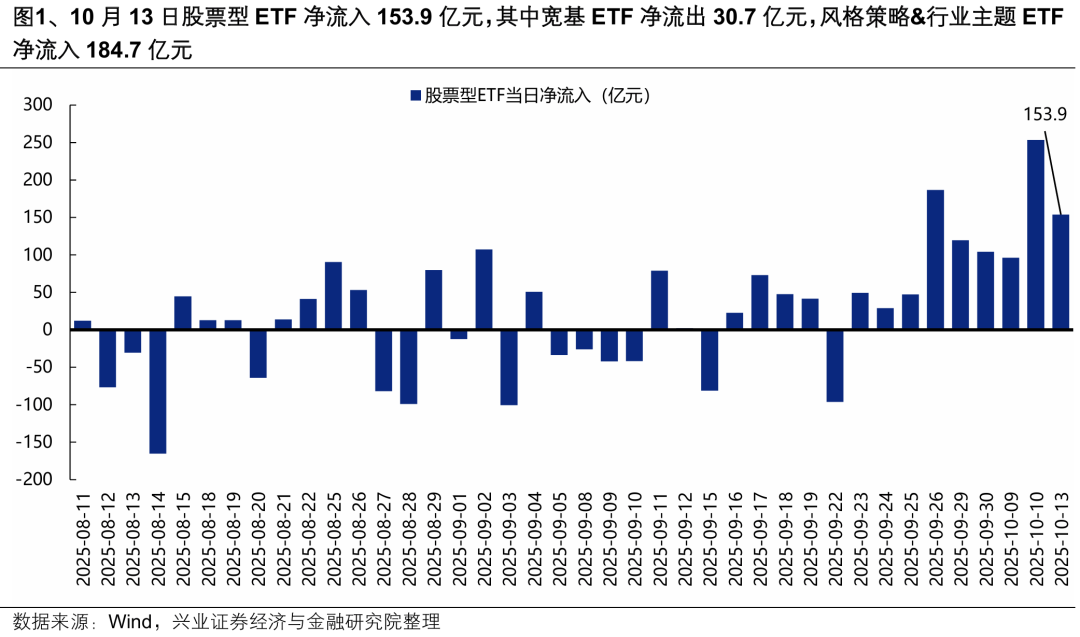
Group 1 - On October 13, the net inflow of equity ETFs was 15.39 billion, with broad-based ETFs experiencing a net outflow of 3.07 billion and style strategy & industry theme ETFs seeing a net inflow of 18.47 billion [1] - Among broad-based ETFs, the CSI 300 saw significant inflows, while the STAR Market, CSI A500, and CSI 1000 experienced outflows [4] - In terms of industry theme ETFs, the major inflow directions were concentrated in cyclical (non-ferrous), large finance (non-bank, banks), self-controllable (electronics, military, computers), advanced manufacturing (new energy, pharmaceuticals), and consumption, while the outflow directions were mainly in real estate, telecommunications, free cash flow, machinery, media, and chemicals [8]

逆势大涨!托市资金来了?
格隆汇APP· 2025-10-14 10:42
Market Overview - On October 14, A-shares experienced significant volatility, with major indices closing down by 0.62%, 2.54%, and 3.99% respectively, and total market turnover reaching 2.6 trillion yuan, an increase of 222.4 billion yuan from the previous trading day [2] - The semiconductor sector saw a substantial outflow of 17.932 billion yuan in net capital, with many stocks, including Yandong Micro and Huahai Qingke, dropping over 10% [5][7] - Traditional sectors such as banking, insurance, and utilities showed resilience, with significant gains, contrasting sharply with the declines in high-growth sectors [14][16] Sector Performance - The semiconductor sector faced a collective decline of 4.36%, with a net outflow of 17.932 billion yuan, while energy metals dropped by 5.08% [7] - The insurance sector led the gains with a rise of 3.47%, driven by favorable regulatory news, indicating a shift towards traditional blue-chip stocks as safe havens [15][25] - Precious metals like gold and silver initially surged but later experienced significant pullbacks, reflecting market volatility and profit-taking behavior [12][19] Investment Sentiment - Market sentiment has shifted towards caution, with increasing concerns over potential risks associated with trade negotiations and sector valuations, particularly in technology [16][18] - The banking sector is viewed as a potential safe haven, with expectations of stable earnings growth and attractive dividend yields, making it appealing for risk-averse investors [23][24] - Analysts suggest that the insurance sector's performance is closely tied to banking stocks, as improved bank valuations could enhance insurance stock returns [25][26] Future Outlook - The upcoming trade negotiations are expected to significantly influence market dynamics, with investors advised to balance defensive and growth-oriented strategies [28] - The banking sector is projected to see a rebound in valuations, particularly for state-owned and regional banks, which could attract more investment [22][24] - Overall, the market is likely to remain volatile, with a focus on sectors that can provide stability amidst uncertainty [28]

国家发改委关于印发《节能降碳中央预算内投资专项管理办法》的通知(发改环资规〔2025〕1228号)
Sou Hu Cai Jing· 2025-10-14 08:16
Core Points - The article outlines the management measures for central budget investments aimed at energy conservation and carbon reduction, emphasizing the importance of these projects in achieving carbon peak and carbon neutrality goals [3][4][30] - The National Development and Reform Commission (NDRC) will prioritize projects that align with national strategies and have significant potential for energy savings and carbon reduction [4][7] Investment Management - The NDRC will organize annual investment plans based on national priorities and the 14th Five-Year Plan, focusing on projects that contribute to carbon neutrality and energy conservation [3][4] - The investment will support both "hard investments" and "soft construction," aiming to establish long-term mechanisms for green and low-carbon development [4][5] Support Scope and Standards - The investment will target key industries such as electricity, steel, non-ferrous metals, building materials, petrochemicals, and machinery for energy-saving transformations [6][7] - Specific projects include clean replacement of coal consumption, circular economy initiatives, low-carbon demonstration projects, and foundational capacity building for carbon peak and neutrality [5][6][7] Application and Approval Process - Provincial development and reform departments are responsible for project application and must ensure that projects meet the specified criteria and are included in the national major construction project database [8][9] - Applications must include detailed project information, including economic indicators, expected benefits, and compliance with national standards [10][11] Performance Monitoring and Evaluation - The NDRC will conduct performance evaluations of funded projects, focusing on energy-saving and carbon reduction outcomes, and will adjust funding based on project performance [16][19][23] - Projects must adhere to strict management regulations, including independent accounting and dedicated use of funds [20][22] Compliance and Accountability - There are strict penalties for projects that fail to meet performance targets or engage in fraudulent activities, including potential suspension of funding and legal consequences [24][25][28] - Regular audits and oversight will be conducted to ensure compliance with investment regulations and project execution standards [27][29]
FICC日报:A股市场先抑后扬,关注市场预期-20251014
Hua Tai Qi Huo· 2025-10-14 05:37
Report Industry Investment Rating No relevant content provided. Core Viewpoints - The A-share market showed a pattern of first decline and then rise, with attention on policy expectations and the possible correction of the current off-peak season expectation. There are risks such as intensified China-US tariff friction, the US government shutdown, and geopolitical risks, while there are also investment opportunities in commodities like gold, non-ferrous metals, etc. [1][2][3] Summary by Related Catalogs Market Analysis - In China, the gap between strong expectations and weak reality has widened. In August, the economic pressure increased marginally, with economic data showing characteristics of "slow industry, weak investment, and sluggish consumption", and external tariff pressure rising. To counter the external pressure, China has frequently mentioned stable growth policies, with new policy-based financial instruments totaling 500 billion yuan. In the first three quarters, China's goods trade imports and exports reached 33.61 trillion yuan, a year-on-year increase of 4%, and in September, exports (in RMB) increased by 8.4% year-on-year, and imports increased by 7.5%. On October 13, the A-share market opened lower and closed higher, with sectors such as rare earths leading the rise. [1][5] - China-US tariff friction has intensified. As the postponement of China-US tariffs is about to expire on November 10, the US has taken measures such as adding Chinese enterprises to the entity list and imposing additional tariffs on various imported products. China has responded with export control measures on the rare earth industry chain. There are concerns about the risk of tariff escalation before the South Korea APEC Summit from October 28 to November 1. [2] - The US government shutdown has entered its third week after the Senate rejected the temporary funding bill in the sixth round of voting on October 8. Trump has repeatedly said he will use the shutdown to dismiss federal employees, and US economic data releases have been affected. The market may have underestimated the severity of the shutdown. [2] Commodity Analysis - In the commodity market, attention is mainly on gold, non-ferrous metals, etc. The black sector is still dragged down by downstream demand expectations. The long-term supply constraint in the non-ferrous sector remains unresolved, and it has been boosted by global easing expectations recently. The energy supply is expected to be relatively loose in the medium term, with OPEC+ planning to increase production by 137,000 barrels per day in November. The first-phase ceasefire agreement in Gaza has taken effect. In the chemical sector, the "anti-involution" space of varieties such as methanol, PVC, caustic soda, and urea is worth noting. Agricultural products are driven by tariff and inflation expectations in the short term but need signals from the fundamentals and attention to the impact of China-US negotiations. Precious metals, especially gold, are expected to continue to strengthen, with the spot gold rising 2% on October 13 and COMEX silver rising 6% to a high since the end of 2012, mainly driven by risk aversion. [3] Strategy - For commodities and stock index futures, it is recommended to allocate long positions in industrial products and precious metals on dips. [4] Key News - In the first three quarters, China's goods trade exports were 19.95 trillion yuan, a year-on-year increase of 7.1%, and imports were 13.66 trillion yuan, a year-on-year decrease of 0.2%. In September, exports (in RMB) increased by 8.4% year-on-year, and imports increased by 7.5%. The trade surplus was 645.47 billion yuan. In September, exports (in US dollars) increased by 8.3% year-on-year, and imports increased by 7.4%. The trade surplus was 90.45 billion US dollars. [5] - China's rare earth exports in September were 4,000.3 tons, and imports were 6,864.7 tons. From January to September, the total rare earth exports were 48,355.7 tons. [5] - On October 13, the Shanghai Composite Index fell 0.19% to 3,889.5 points, the Shenzhen Component Index fell 0.93%, the ChiNext Index fell 1.11%, the Beijing Stock Exchange 50 fell 1.29%, and the STAR 50 rose 1.4%. The A-share market turnover was 2.37 trillion yuan. Sectors such as rare earths and lithography machines led the rise, while consumer electronics, robotics, and CRO concepts led the decline. [5] - In the first three quarters, due to the decline in the prices of some international commodities, the import growth rate and data performance were affected. However, in terms of quantity, the import quantity index increased by 0.6% year-on-year. As of September, imports had increased for four consecutive months. Driven by domestic production and consumption demand, the imports of crude oil and metal ore sands increased by 2.6% and 4.2% respectively, and the imports of food, tobacco, alcohol, and cultural and entertainment products increased by 10.2% and 9.4% respectively. With the removal of restrictions on foreign investment access in the manufacturing sector, the imports of foreign-invested enterprises increased by 1.1%. [5]
国家发改委发布通知!
中国能源报· 2025-10-14 03:08
Core Viewpoint - The article discusses the implementation of the "Central Budget Investment Management Measures for Energy Conservation and Carbon Reduction," which aims to support key industries in energy conservation and carbon reduction projects, focusing on sectors such as electricity, steel, non-ferrous metals, building materials, petrochemicals, chemicals, and machinery [1][3][4]. Group 1: Investment Focus Areas - The measures support energy conservation and carbon reduction projects in key industries, including electricity, steel, non-ferrous metals, building materials, petrochemicals, chemicals, and machinery [10][11]. - Projects for clean replacement of coal consumption are supported, including low-carbon transformation of coal power units and coal chemical projects, as well as clean energy alternatives for coal-fired boilers in various industries [10][11]. - The initiative promotes circular economy projects, including the construction and transformation of resource recycling bases and the utilization of agricultural and forestry waste [11][12]. Group 2: Support Standards and Funding - The support ratio for energy conservation and carbon reduction projects in key industries, clean coal consumption replacement projects, and circular economy projects is set at 20% of the approved total investment [12]. - For local government investment projects focused on carbon peak and carbon neutrality capacity building, the support ratios vary by region, with eastern, central, western, and northeastern regions receiving 60%, 70%, 80%, and 80% respectively [12]. Group 3: Project Application and Management - Provincial development and reform departments are responsible for project application and must establish a dynamic project reserve mechanism to ensure quality and compliance with national standards [14][15]. - The application for investment funds must include detailed project information, including basic conditions, construction scale, total investment, and expected economic and social benefits [16][17]. - Projects must adhere to strict management and reporting requirements, including performance evaluation and compliance with national laws and regulations [18][19].

广发期货日评-20251014
Guang Fa Qi Huo· 2025-10-14 02:11
1. Report Industry Investment Ratings - No specific industry investment ratings are provided in the report. 2. Core Viewpoints - Trade friction disturbs the stock index, which opens lower but is expected to rebound after the initial decline, with the long - term upward trend remaining unchanged. The bond market influence is complex, and the 10 - year Treasury bond has increased allocation value when the interest rate rises above 1.8%. Gold has large fluctuations before the APEC meeting in South Korea at the end of October. Different commodities have different trends and corresponding trading suggestions based on their fundamentals and market conditions [3]. 3. Summary by Related Catalogs Financial Sector - **Stock Index**: Affected by trade friction, the stock index opens lower. It is recommended to sell put options near MO2512 - P - 7000 to collect premiums [3]. - **Treasury Bonds**: With the cooling of risk - aversion sentiment, the spot bond interest rate rises. The T2512 oscillation range may be between 107.4 - 108.3, and it is advisable to wait for oversold opportunities [3]. - **Precious Metals**: Due to the continuous fermentation of Sino - US trade friction concerns, precious metals reach new highs. It is recommended to buy gold at a light position above 910 yuan and maintain a long - silver strategy above 50 dollars [3]. - **Shipping Index (European Line)**: Given macro uncertainties, it is recommended to observe cautiously [3]. Black Sector - **Steel**: Affected by Sino - US friction, steel prices are weakly sorted. It is recommended to wait and see on a single - side basis and conduct reverse arbitrage on the monthly spread [3]. - **Iron Ore**: Supply disturbances weaken, and it is recommended to go long on iron ore 2601 at low prices, with a reference range of 780 - 850, and conduct arbitrage by going long on iron ore and short on hot - rolled coils [3]. - **Coking Coal**: After the festival, coking coal prices have a phased correction. It is recommended to go short on coking coal 2601 at high prices, with a reference range of 1050 - 1200, and conduct arbitrage by going long on iron ore and short on coking coal [3]. - **Coke**: The first round of price increases has been implemented before the festival, and there is limited room for further increases. It is recommended to go short on coke 2601 at high prices, with a reference range of 1550 - 1700, and conduct arbitrage by going long on iron ore and short on coke [3]. Non - ferrous Sector - **Copper**: With the easing of tariff concerns, copper prices are strongly running. It is recommended to take profits on long positions at high prices and pay attention to the support at 84000 - 85000 [3]. - **Alumina**: The market supply is sufficient, and the spot price continues to fall. The main operation range is 2850 - 3050 [3]. - **Aluminum**: The macro - environment boosts the price center to around 21000, and the main reference range is 20700 - 21300 [3]. - **Aluminum Alloy**: The scrap aluminum quotation is firm, and the finished ingot price rises with the aluminum price. The main reference range is 20200 - 20800 [3]. - **Zinc**: The fundamentals have limited support for prices, and zinc prices oscillate. The main reference range is 21500 - 22500 [3]. - **Tin**: With the repair of the macro - sentiment, tin prices rise slightly. It is recommended to wait and see [3]. - **Nickel**: The macro - expectations are volatile, and the main reference range is 120000 - 126000 [3]. - **Stainless Steel**: The macro - risk increases, and the industrial demand is still insufficient. The main reference range is 12500 - 13000 [3]. Energy and Chemical Sector - **Crude Oil**: The macro - sentiment repair promotes the oil price rebound, but the loose fundamentals suppress the oil price. It is recommended to take a short - selling approach on a single - side basis [3]. - **Urea**: The market trading sentiment improves, but the short - term rebound lacks fundamental support. It is recommended to take a short - selling approach on a single - side basis and reduce the implied volatility at high prices on the option side [3]. - **PX**: The supply - demand expectation is weak, and the oil price support is limited. It is recommended to wait and see on PX11 and look for short - selling opportunities on rebounds, and conduct reverse arbitrage on the monthly spread [3]. - **PTA**: The supply - demand expectation is weak, and the driving force is limited. It is recommended to wait and see on TA and pay attention to the support near 4500, and conduct rolling reverse arbitrage on TA1 - 5 [3]. - **Short - fiber**: The inventory pressure is not large, and there is short - term support. It is recommended to increase the spread at low positions, but the driving force is limited [3]. - **Bottle Chip**: The supply - demand pattern of bottle chips remains loose, but the cost side is weak, and the short - term processing fee improves. The trading suggestions are the same as those for PTA, and the main processing fee is expected to fluctuate between 350 - 500 yuan/ton [3]. - **Ethanol**: The port inventory accumulates, and the supply - demand structure of MEG in the far - month is weak. It is recommended to short - sell EG01 at high prices, hold the seller of the out - of - the - money call option EG2601 - C - 4350, and conduct reverse arbitrage on EG1 - 5 at high prices [3]. - **Caustic Soda**: The spot price is stable with a slight decline, and the short - term downstream demand for alumina is average. It is recommended to hold short positions [3]. - **PVC**: The spot procurement enthusiasm is average, and the disk continues to weaken. It is recommended to wait and see [3]. - **Benzene**: The supply - demand is relatively loose, and the price driving force is limited. BZ2603 is expected to oscillate following benzene ethylene and the oil price in the short term [3]. - **Styrene**: The supply - demand expectation is weak, and the benzene ethylene price may be under pressure. It is recommended to short - sell on the rebound of EB11 and increase the spread at the low level of the EB - BZ spread [3]. - **Synthetic Rubber**: The cost support weakens, and the supply - demand is relatively loose. It is recommended to hold the seller of the call option BR2511 - C - 11400 [3]. - **LLDPE**: The disk price drops, and the arbitrage transaction is average. It is recommended to pay attention to the inventory - reduction inflection point [3]. - **PP**: The PDH profit is significantly repaired, and the transaction improves. It is recommended to wait and see [3]. - **Methanol**: The basis strengthens significantly, and the transaction is acceptable. It is recommended to pay attention to the positive spread arbitrage opportunity between March and May [3]. Agricultural Sector - **Soybean and Related Products**: Affected by the changing Sino - US trade expectations, the supply pressure suppresses domestic prices. It is recommended to pay attention to the support of 01 near 2900 [3]. - **Live Pig**: The slaughter pressure of the breeding end is large, and the pig price remains low, showing a weak oscillating trend [3]. - **Corn**: As the supply increases, the disk price is under pressure and runs weakly [3]. - **Palm Oil**: Supported by the fundamentals, palm oil stops falling and recovers. The main short - term oscillation range may be between 9000 - 9500 [3]. - **Sugar**: The overseas supply outlook is broad, and the raw sugar price drops sharply. It is recommended to take a short - selling approach in the short term [3]. - **Cotton**: With the new cotton gradually coming onto the market, the supply pressure increases. It is recommended to hold short positions [3]. - **Egg**: After the festival, the demand weakens, and it maintains a short - bias trend. It is recommended to close short positions on the 2511 contract at low prices and pay attention to the monthly spread reverse arbitrage opportunity [3]. - **Apple**: The redness of late - Fuji apples is relatively light, and the high - quality apples have a significant price advantage. The main price runs near 8600 [3]. - **Jujube**: As the harvest time approaches, the long - short game intensifies, and it is bearish in the long - term [3]. - **Soda Ash**: The supply - demand surplus is difficult to reverse, and the soda ash price runs weakly. It is recommended to take a short - selling approach on the rebound [3]. Special Commodity Sector - **Glass**: The production and sales performance is average, and the logic of the off - peak season in the peak season continues. It is recommended to observe cautiously [3]. - **Rubber**: It is recommended to pay attention to the raw material price increase situation during the peak production season and wait and see [3]. - **Industrial Silicon**: The supply increases, and with cost support, the price oscillates between 8300 - 9000 yuan/ton [3]. New Energy Sector - **Polysilicon**: The supply increases, and polysilicon is under pressure. It is recommended to try to go long at low prices when the price returns to the lower edge of the range, and pay attention to the implementation of capacity storage [3]. - **Lithium Carbonate**: The macro - environment is weak, the fundamentals maintain a tight balance, and the main price center is expected to be in the range of 7 - 7.5 million [3].