
钢铁

Search documents
马克龙一语道破:特朗普加税漠视法治,欧洲联手反制单边霸凌
Sou Hu Cai Jing· 2026-02-25 13:28
Core Viewpoint - The recent Supreme Court ruling against Trump's global taxation strategy has led to an immediate increase in temporary tariffs on imports from 10% to 15%, reflecting a direct challenge to judicial authority and escalating international trade tensions [1][3]. Group 1: Tariff Changes and Legal Context - Trump has invoked the Trade Act of 1974 to justify the increase in tariffs, claiming it is a legal and validated action despite the Supreme Court's ruling that limited his authority under the International Emergency Economic Powers Act [1][9]. - The new 15% tariff is not universally applied, with exemptions for certain key minerals, metals, and pharmaceuticals, as well as Canada and Mexico due to the USMCA [1][3][15]. Group 2: Economic Implications - The tariffs have generated approximately $130 billion in revenue, but studies indicate that 90% of this burden falls on American businesses and consumers, leading to increased prices and costs [3][16]. - The uncertainty surrounding tariff changes is described as "poison" for the economies of both the US and Europe, with businesses seeking stability rather than frequent policy shifts [1][13]. Group 3: Political Dynamics - Trump's approach to tariffs is seen as a power play rather than an economic strategy, aiming to reshape the narrative around trade and authority [3][12]. - The response from European leaders indicates a growing concern over unilateral actions that could undermine global trade agreements and stability [1][13][20]. Group 4: Legal and Institutional Reactions - Legal experts suggest that the application of the Trade Act of 1974 is narrow and may face challenges in court, but Trump is leveraging the lengthy legal process to maintain his policies [9][19]. - The Supreme Court's decision has highlighted the fragility of institutional checks in the face of extreme political actions, raising concerns about the future of judicial independence [20][21].


A股放量冲高!这些板块表现亮眼→
Guo Ji Jin Rong Bao· 2026-02-25 13:13
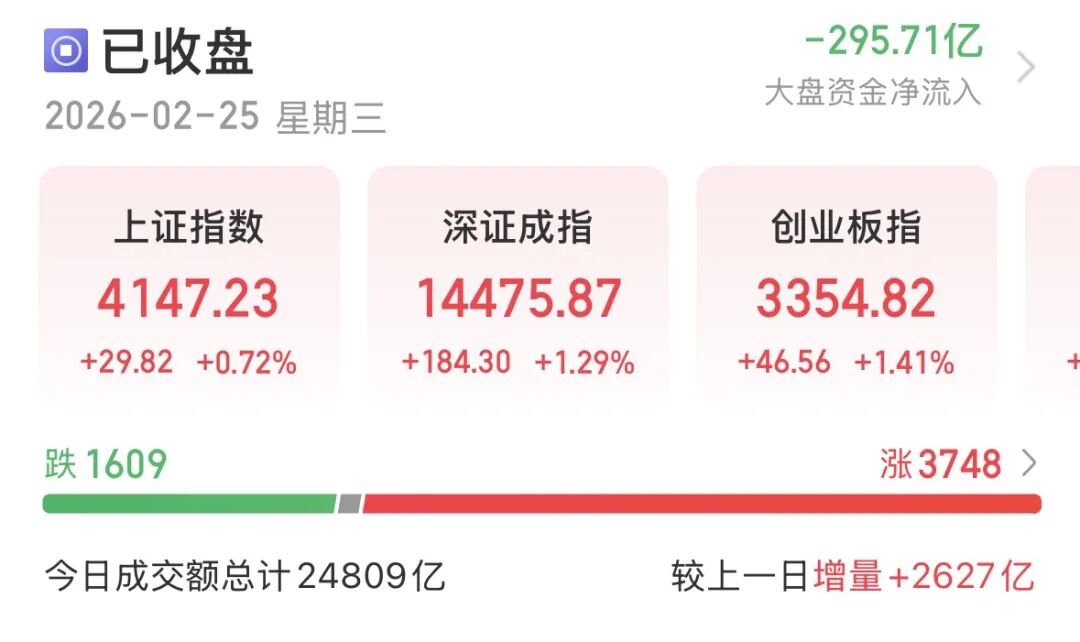
Core Viewpoint - The A-share market continues to show a strong upward trend, driven by resource stocks, while the media sector remains weak due to profit-taking and insufficient earnings expectations [3][12]. Market Performance - On February 25, the A-share market saw 3,748 stocks rise, with the Shanghai Composite Index up 0.72% to 4,147.23 points, and the ChiNext Index up 1.41% to 3,354.82 points [4][5]. - The total trading volume increased by 262.8 billion yuan, reaching 2.48 trillion yuan, with margin trading balances in the three major markets rising to 2.62 trillion yuan [4][5]. Sector Analysis - Resource stocks, particularly in non-ferrous metals and steel, are leading the market due to favorable policies, improved supply-demand dynamics, and rising product prices [3][12]. - The media sector is experiencing a downturn, attributed to continuous adjustments in the film and theater sector, weakening AI application concepts, and profit-taking after significant prior gains [3][12]. Investment Recommendations - The market is expected to maintain a structurally rotating trend in the short term, with a focus on technology and resource stocks as key investment directions [3][12][15]. - Analysts suggest that the core investment themes should revolve around resource stocks (steel, non-ferrous metals, chemicals) and hard technology (semiconductors, commercial aerospace) [15].


【国际动态】安赛乐米塔尔尼普敦钢铁公司推出两款高端品牌钢材产品
Sou Hu Cai Jing· 2026-02-25 12:49
Core Insights - AM/NS India has launched two high-end steel products, AM/NS Vibrance and AM/NS Optima, as part of its strategy to achieve a 75% revenue share from high-value steel products [1] - The company aims to strengthen its market position in high-profit downstream sectors, particularly in coated steel for appliances and industrial applications [1] Product Focus - AM/NS Vibrance is designed for appliance manufacturers, targeting the production needs of refrigerators, washing machines, and microwaves [2] - AM/NS Optima is a zero-zinc galvanized steel suitable for air conditioning systems, industrial panels, and cleanroom facilities [2] - The introduction of these products aims to reduce OEMs' reliance on imported coated steel, promoting domestic substitution and enhancing supply chain resilience [2] Market Growth Potential - The current annual consumption of coated steel in India is approximately 11.1 million tons, with an expected annual growth rate of 8%-10% [3] - The demand for coated steel in the appliance sector is projected to grow at around 10% annually, driven by urbanization, changing consumer preferences, and government incentives like the Production Linked Incentive (PLI) scheme [3] - In the industrial application sector, coated steel demand is expected to grow at a rate of 8%-12% annually until 2030, aligning with ongoing infrastructure development and manufacturing growth in India [3] Product Matrix Expansion - The new products complement AM/NS India's existing coated steel product matrix, which includes Optigal, Magnelis, Optiga Prime, and Optiga Pinnacle [4] - The durable consumer goods market in India is projected to rank fourth globally by the fiscal year 2026-2027, providing strong support for the company's transition to high-profit, high-value steel products [4] - This growth trend will further solidify AM/NS India's long-term expansion strategy in the domestic market [4]


ETF日报:当前钢铁板块或是弹性大且有预期差的底部板块,关注钢铁ETF
Xin Lang Cai Jing· 2026-02-25 12:30
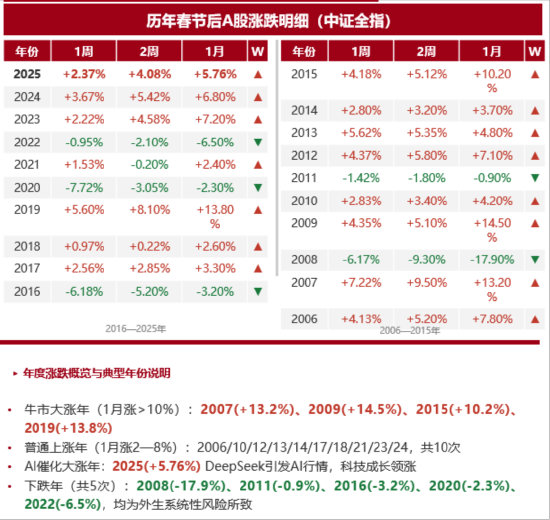
Market Overview - A-shares opened higher and closed with gains, with the Shanghai Composite Index rising by 0.72% to 4147.23 points, Shenzhen Component Index up 1.29%, and ChiNext Index up 1.41% [1][17] - The total trading volume for the day was 2.48 trillion yuan, compared to 2.22 trillion yuan the previous day, indicating a neutral to strong risk appetite in the market [1][17] - Over 3700 stocks in the market saw an increase, with small-cap stocks outperforming large-cap stocks, and growth stocks lagging behind value stocks [1][17] Spring Festival Market Trends - Historical data from 2006 to 2025 shows a consistent trend of gains in the A-share market following the Spring Festival, with an average increase of 1.6% in the first week, 2.5% in the second week, and 4.6% in the first month [3][19] - The success rate of the post-Spring Festival rally is notable, with a 76% win rate in the first two weeks and a 71% win rate in the first month, significantly higher than the annual average of about 52% [3][19] Semiconductor Equipment Sector - The Semiconductor Equipment ETF (159516) saw a significant increase of 4.56% after a volatile trading session [21] - Chinese top chip manufacturers plan to increase advanced chip production from less than 20,000 units currently to 100,000 units within 1-2 years, with a long-term goal of adding 500,000 units by 2030 [7][23] - The semiconductor equipment sector is expected to benefit from the expansion of advanced processes and storage, driven by global AI demand, making it a strong growth narrative [8][24] Real Estate Policy Impact - Shanghai's new real estate policy, "沪七条," aims to lower the threshold for home purchases, which is expected to stabilize housing prices in the outer ring of the city [8][9] - The policy includes reducing the social security requirement for non-local families from three years to one year and increasing the public housing loan limit from 1.6 million to 2.4 million yuan [8][9] - The new policy is anticipated to stimulate demand in the real estate market, benefiting related sectors such as building materials and real estate [9][25] Steel Sector Dynamics - The steel sector experienced a significant rise, with the Steel ETF (515210) increasing by 4.27%, driven by both demand and supply-side catalysts [11][27] - The Ministry of Industry and Information Technology released new guidelines for the steel industry, which are expected to lead to a phase of consolidation and resource allocation towards stronger companies [12][28] - Current low inventory levels and cautious market sentiment suggest potential upward price elasticity for steel if demand catalysts emerge [12][28]
中国开始真反内卷了?这背后是一场产业革命级重构!
Sou Hu Cai Jing· 2026-02-25 11:52
Core Viewpoint - The manufacturing industry is facing intense price wars, leading to thinner profit margins and inadequate R&D investment, which in turn affects product quality. Despite impressive international surplus figures, increasing anti-dumping measures and tariffs from Europe and the U.S. pose significant challenges for domestic industries [2]. Group 1: Price Competition and Regulatory Actions - The Central Financial Committee's meeting on July 1, 2025, emphasized the need to regulate low-price competition and promote quality improvement while facilitating the exit of outdated production capacity [4]. - Major companies in the photovoltaic glass industry agreed to collectively reduce production by 30%, lowering supply to approximately 45 GW [5]. - The automotive industry introduced compliance guidelines for pricing, while the Ministry of Agriculture held discussions on capacity regulation in the pig farming sector [7]. Group 2: Capacity Reduction and Market Regulation - The governance of overcapacity is being effectively addressed, with companies in the photovoltaic glass sector reducing output through various methods, and the steel and cement industries adopting staggered production practices [12]. - Regulatory bodies are actively checking local financial subsidies, correcting violations, and ensuring that resources are concentrated in more efficient sectors [12][14]. - The exit of outdated capacity is being managed with precision, supported by industry associations providing cost reference data and regulatory enforcement against below-cost sales [14]. Group 3: Development of New Productive Forces - The shift from low-end price competition to high-quality development is being prioritized, with resources redirected towards key sectors such as chip manufacturing and quantum computing [16]. - Increased R&D investment and enhanced collaboration between academia and industry are accelerating the transformation of technological achievements [16]. - The manufacturing sector is experiencing marginal improvements in investment, with traditional industries undergoing digital transformation and emerging industries expanding [16]. Group 4: Economic and Market Implications - The combined efforts to combat internal competition and build a unified market are alleviating supply-demand mismatches, leading to moderate price increases and improved corporate profits [18]. - Structural policies are being precisely targeted at key areas, with macroeconomic policies maintaining a stable expansion, which is expected to enhance A-share corporate profit growth [19]. - The overall process aims to transition from a reliance on scale and low prices to a market-driven resource allocation, fostering a healthier industry ecosystem [21].
多重利好叠加,房地产板块及黑色商品期货大涨
Qi Huo Ri Bao· 2026-02-25 11:07
Core Viewpoint - The recent announcement of the "Shanghai Seven Measures" aims to optimize the city's real estate policies by reducing housing purchase restrictions and increasing financial support for homebuyers, thereby stimulating market demand and stabilizing expectations in the real estate sector [1][2]. Policy Adjustments - The new policy allows non-Shanghai residents who have paid social insurance or individual income tax for at least one year to purchase unlimited housing outside the outer ring and one unit within the inner ring. Those with three years of contributions can buy two units in the inner ring, while holders of a Shanghai residence permit for over five years can buy one unit citywide [1]. - The policy also raises the public housing fund loan limit for first-time buyers to 2.4 million yuan, with a maximum of 3.24 million yuan, and optimizes loan conditions to alleviate financial pressure on families [1]. Market Impact - The announcement is expected to boost housing transactions during the traditional peak season of "Golden March and Silver April," with the real estate sector and related industries, such as steel, experiencing significant stock price increases [2][3]. - The real estate sector accounts for approximately 25% of domestic steel consumption, making it a crucial demand driver for the black metal sector [3]. Inventory and Production Insights - As of February 23, 2026, social steel inventory was reported at 10.52 million tons, a year-on-year decrease of 10.8%, while member companies of the China Iron and Steel Association reported a steel inventory of 15.11 million tons, down 6.8% year-on-year [4]. - The reduction in high furnace loads in northern steel mills due to environmental regulations is expected to lead to a decrease in daily iron output, coinciding with the seasonal increase in downstream demand [5]. Future Outlook - The market sentiment is cautiously optimistic, with expectations of a stable demand environment as the policy effects take time to materialize. The focus will be on the sales data for March and April to determine if the anticipated demand growth is realized [6]. - The steel market is expected to maintain a strong performance due to cost support from supply constraints, although the potential for significant price increases will depend on the speed of demand recovery [6].
策略点评:周期股领涨市场
Tebon Securities· 2026-02-25 11:00
Market Overview - The A-share market continues to show a strong upward trend, with the three major indices collectively rising. The cyclical sectors, including real estate services, non-ferrous metals, and steel, lead the market, while the technology growth sector shows mixed performance [3][6] - As of the market close, the Shanghai Composite Index rose by 0.72% to 4147.23 points, the Shenzhen Component Index increased by 1.29% to 14475.87 points, and the ChiNext Index climbed by 1.41% to 3354.82 points. The total market turnover reached approximately 2.48 trillion, indicating a good profit effect with 3742 stocks rising and 1609 falling [2][3] Sector Performance - The cyclical stocks have shown significant strength, with steel, non-ferrous metals, real estate, building materials, and basic chemicals rising by 4.26%, 3.53%, 2.51%, 2.41%, and 2.37% respectively. The recent policy adjustments in Shanghai's real estate sector have further boosted these sectors [6][8] - The rare earth sector also experienced a surge, with prices for various rare earth products increasing significantly post-holiday. For instance, the average price of praseodymium and neodymium oxide rose by 4.16 million yuan/ton, while neodymium metal increased by 8 million yuan/ton [6][8] Investment Themes - The report identifies several key investment themes, including AI applications, commercial aerospace, nuclear fusion, quantum technology, brain-machine interfaces, robotics, consumer sectors, brokerage firms, precious metals, and non-ferrous metals. Each theme has specific core logic and follow-up points for future monitoring [9][10] - The AI application sector is highlighted for its potential growth driven by product application acceleration and technological upgrades. The commercial aerospace sector is supported by the establishment of a commercial aerospace office, while nuclear fusion and quantum technology are gaining traction due to industrialization and policy support [9][10] Market Sentiment and Future Outlook - The report suggests a shift in market sentiment from "concept-driven" to "price-driven" profit enhancement, indicating a balanced allocation between technology and consumer sectors. The upcoming "Two Sessions" may further influence the cyclical sectors, particularly in real estate policy implementation and commodity prices [8][11] - The bond market is experiencing adjustments, with the long-end bonds leading the decline. The report notes that the LPR rates remain unchanged, and the market is expected to maintain a stable liquidity environment in the short term [8][11]
黑色产业链日报-20260225
Dong Ya Qi Huo· 2026-02-25 10:57
黑色产业链日报 2026/02/25 咨询业务资格:沪证监许可【2012】1515号 研报作者:许亮 Z0002220 审核:唐韵 Z0002422 【免责声明】 本报告基于本公司认为可靠的、已公开的信息编制,但本公司对该等信息的准确性及完整性不作任何保证。本报告所载的意见、结论及预测仅反映报告发布时的观点、结论 和建议。在不同时期,本公司可能会发出与本报告所载意见、评估及预测不一致的研究报告。本公司不保证本报告所含信息保持在最新状态。本公司对本报告所含信息可在不发出通知的情 形下做出修改, 交易者(您)应当自行关注相应的更新或修改。本公司力求报告内容客观、公正,但本报告所载的观点、结论和建议仅供参考,交易者(您)并不能依靠本报告以取代行 使独立判断。对交易者(您)依据或者使用本报告所造成的一切后果,本公司及作者均不承担任何法律责任。本报告版权仅为本公司所有。未经本公司书面许可,任何机构或个人不得以翻 版、复制、发表、引用或再次分发他人等任何形式侵犯本公司版权。如征得本公司同意进行引用、刊发的,需在允许的范围内使用,并注明出处为"东亚期货",且不得对本报告进行任何有 悖原意的引用、删节和修改。本公司保留追究相 ...
钢材&铁矿石日报:政策利好提振,钢矿低位回升-20260225
Bao Cheng Qi Huo· 2026-02-25 10:49
投资咨询业务资格:证监许可【2011】1778 号 核心观点 作者声明 本人具有中国期货业协会 授予的期货从业资格证书,期 货投资咨询资格证书,本人承 诺以勤勉的职业态度,独立、 客观地出具本报告。本报告清 晰准确地反映了本人的研究观 点。本人不会因本报告中的具 体推荐意见或观点而直接或间 接接收到任何形式的报酬。 钢材&铁矿石 | 日报 2026 年 2 月 25 日 钢材&铁矿石日报 专业研究·创造价值 政策利好提振,钢矿低位回升 期货研究报告 姓名:涂伟华 宝城期货投资咨询部 从业资格证号:F3060359 投资咨询证号:Z0011688 电话:0571-87006873 邮箱:tuweihua@bcqhgs.com 螺纹钢:主力期价低位回升,录得 1.72%日涨幅,量增仓缩。现阶段, 供稳需弱局面下螺纹钢产业矛盾累积,钢价仍将承压,相对利好的是政 策预期与成本支撑,预期现实博弈下钢价延续震荡运行,关注国内政策 情况。 钢材&铁矿石 | 日报 一 产业动态 (1)崔东树:全国乘用车行业 2026 年 1 月末库存 357 万辆、库存 70 天 热轧卷板:主力期价有所走强,录得 1.19%日涨幅,量增仓稳 ...
2月25日盘后播报:午后上海官宣楼市新政,建材板块活跃
Mei Ri Jing Ji Xin Wen· 2026-02-25 10:25
Group 1: A-Share Market Performance - The A-share market opened high and closed higher, with the Shanghai Composite Index rising by 0.72% to 4147.23 points, the Shenzhen Component Index increasing by 1.29%, and the ChiNext Index up by 1.41% [1] - The total trading volume for the day was 2.48 trillion yuan, compared to 2.22 trillion yuan the previous day [1] Group 2: Semiconductor Equipment Sector - The Semiconductor Equipment ETF (159516) experienced a significant increase, closing up by 4.56% after an initial drop, driven by expectations of major customer orders in the storage segment [1] - This cycle of semiconductor equipment is characterized by benefits from global AI-driven high demand, differing from previous cycles focused on recovery or domestic substitution [1] Group 3: Shanghai Real Estate Policy - Shanghai introduced new real estate policies, including reducing the social security requirement for non-local families from 3 years to 1 year for purchasing homes within the outer ring, allowing an additional purchase for non-local families, and increasing the first home provident fund loan limit from 1.6 million to 2.4 million yuan [2] - The new policies are expected to stimulate demand for housing and lower financial barriers for homebuyers, potentially boosting the building materials and real estate sectors [2] Group 4: Steel Sector Insights - The steel sector saw a significant rise, with the Steel ETF (515210) increasing by 4.27%, driven by both demand-side and supply-side catalysts [2] - Demand is expected to be supported by favorable real estate policies in key cities, while supply is anticipated to contract by 2026, with low inventory levels potentially leading to upward price elasticity if demand increases [2]