
核聚变

Search documents
贵金属迎来修复
Tebon Securities· 2026-03-31 11:21
1. Report Industry Investment Rating No information about the report industry investment rating is provided in the given content. 2. Core Viewpoints of the Report - The Middle - East situation and oil price shocks will continue to disrupt global risk appetite. A - share market is difficult to completely shake off external emotional suppression in the short term, and it is necessary to closely monitor the evolution of the Middle - East situation, international oil price trends, and the further transmission of external market fluctuations to A - share sentiment [8][15] - The inter - bank liquidity in the bond market is still relatively abundant. The central bank's open - market operations continue to send signals of care. Treasury bond futures are generally strong, with the long - end performing better, and the short - term bond market may maintain a strong and volatile pattern [11][15] - The core logic of the commodity market is the parallel evolution of geopolitical risk premium and domestic fundamental repair. Precious metals are strong due to the Middle - East situation and macro - expectation repricing, while industrial metals such as tin benefit from the marginal recovery of manufacturing prosperity. The commodity market may still have a structural market in the short term [9][15] 3. Summary by Relevant Catalogs Market行情Analysis Stock Market - A - share market indices were under pressure, and the trading volume exceeded 2 trillion yuan. The Shanghai Composite Index closed at 3891.86 points, down 0.80%; the Shenzhen Component Index closed at 13478.06 points, down 1.81%; the ChiNext Index closed at 3184.95 points, down 2.70%; the STAR 50 Index closed at 1256.33 points, down 2.59%. The total A - share trading volume was about 2.01 trillion yuan, up 4.1% from the previous trading day [7] - The market showed a pattern of more falling stocks than rising stocks, with 1008 rising stocks and 4372 falling stocks. The growth technology direction adjusted significantly, while sectors such as home appliances, banks, and food and beverages were relatively resistant to decline [6][7] Bond Market - The treasury bond futures market showed a pattern of strong long - end and stable short - end. The 30 - year treasury bond futures TL2606 rose 0.15%, closing at 111.69 yuan, with a trading volume of 852.75 billion yuan; the 10 - year treasury bond futures T2606 rose 0.04%, closing at 108.40 yuan, with a trading volume of 881.23 billion yuan; the 5 - year treasury bond futures rose 0.03%, and the 2 - year treasury bond futures were flat compared with the previous day [11] - The central bank carried out 325 billion yuan of 7 - day reverse repurchase operations, with a net injection of 150 billion yuan. Except for the 7 - day Shibor, other term Shibor rates declined, indicating that the liquidity was further relaxed [11] Commodity Market - The commodity index declined, but non - ferrous metals performed strongly. The Nanhua Commodity Index closed at 3074.6 points, down 0.91%. Leading gainers included Shanghai silver, soybean No.1, Shanghai gold, Shanghai aluminum, and double - gum paper, while leading losers included PVC, LPG, coking coal, container shipping index (European line), and lithium carbonate [9] Trading Hotspot Tracking Recent Hot - Product Review - Artificial intelligence: Global industrialization is accelerating, and new applications are emerging. Key points to follow include changes in capital expenditure of leading enterprises, transformation of application scenarios, and product technology upgrades [14] - Commercial space: With the establishment of commercial space companies and strong support for development, key points to follow include domestic recoverable rocket launches and technological breakthroughs of overseas leaders such as SPACEX [14] - Nuclear fusion: Industrialization is accelerating, and artificial intelligence drives the increase in power demand. Key points to follow include project progress and industry bidding [14] - Big consumption: Policy promotes consumption upgrading. Key points to follow include economic recovery and further stimulus policies [14] - Securities firms: A - share trading volume is running at a high level. Key points to follow include A - share trading volume and possible changes in trading systems [14] - Precious metals: Central banks continue to increase holdings, and the Federal Reserve is expected to cut interest rates. Key points to follow include further interest - rate cut expectations of the Federal Reserve and geopolitical risks [14] - Energy and chemicals: The Middle - East geopolitical situation affects supply. Key points to follow include the progress of the conflict and changes in crude oil prices [14] - Shanghai silver strengthened significantly. Due to the uncertainty in the Middle - East and the game of macro - expectations, precious metals recovered. Shanghai tin strengthened oscillatingly, supported by the recovery of manufacturing prosperity [14] Recent Core Idea Summary - In the equity market, focus on the impact of the Middle - East situation, oil prices, and external market fluctuations on A - share sentiment [15] - In the bond market, the short - term bond market may maintain a strong and volatile pattern, with the long - end of treasury bonds performing better [15] - In the commodity market, it may show a structural market in the short term. Pay attention to the evolution of the Middle - East situation, oil price trends, and the sustainability of domestic demand recovery [15]
十五五-规划纲要火线解读
2026-03-16 02:20
Summary of Key Points from the "Fifteen Five" Planning Outline Industry or Company Involved - The document discusses the "Fifteen Five" planning outline, which focuses on China's economic and industrial development strategies for the upcoming five years. Core Points and Arguments 1. **Economic Growth Target**: The economic growth center is set at approximately 4.5%, with a clear goal of doubling per capita GDP by 2035, emphasizing high-quality development to address external uncertainties [1][2][3]. 2. **Focus on New Industries**: The planning emphasizes the development of new productivity sectors such as AI, 6G, quantum technology, low-altitude economy, and nuclear fusion, indicating a shift towards high-quality growth [1][2][3]. 3. **Green Development Shift**: The focus has shifted from "dual control of energy consumption" to "dual control of carbon emissions," with a target of 25% non-fossil energy by 2030, promoting the use of green electricity and supporting the development of renewable energy and grid upgrades [1][3]. 4. **Increased Security Emphasis**: The planning highlights the importance of food and energy security, with production capacity targets raised significantly, reflecting heightened geopolitical risks [1][3][4]. 5. **Real Estate Sector Reform**: A new model for real estate development is introduced, focusing on project company systems and financing main banks, which aims to distribute risks from real estate companies to individual projects [1][4][14][16]. 6. **Consumer Policy Evolution**: The approach to consumer policy has shifted from short-term subsidies to systemic measures aimed at boosting service consumption and addressing global competitiveness [1][2][19]. Important but Possibly Overlooked Content 1. **Investment Strategy for A-Share Market**: The investment strategy is to focus on "seeking quality through new initiatives," targeting new momentum and emerging industries, aligning with the modernization of the industrial system [1][6][7]. 2. **Strategic Emerging Industries**: Key areas include new generation information technology, renewable energy, high-end equipment, and commercial aerospace, with a clear emphasis on low-altitude economy and domestic aircraft manufacturing [1][6][24][26]. 3. **Debt Market Implications**: The planning outlines a quantitative target system that will influence the bond market, particularly in terms of innovation-driven financing and green transition, indicating a shift towards new energy and technology sectors [8][9][12][14]. 4. **Housing Security System**: The planning details a comprehensive housing security system, categorizing housing needs into three groups and emphasizing the management of affordable housing [14][15][18]. 5. **Consumer Market Recovery**: Recent data indicates a weak recovery in the consumer market, particularly in service consumption, with signs of increased domestic tourism and spending [20][21]. This summary encapsulates the critical aspects of the "Fifteen Five" planning outline, highlighting the strategic focus areas and potential implications for various sectors and the overall economy.
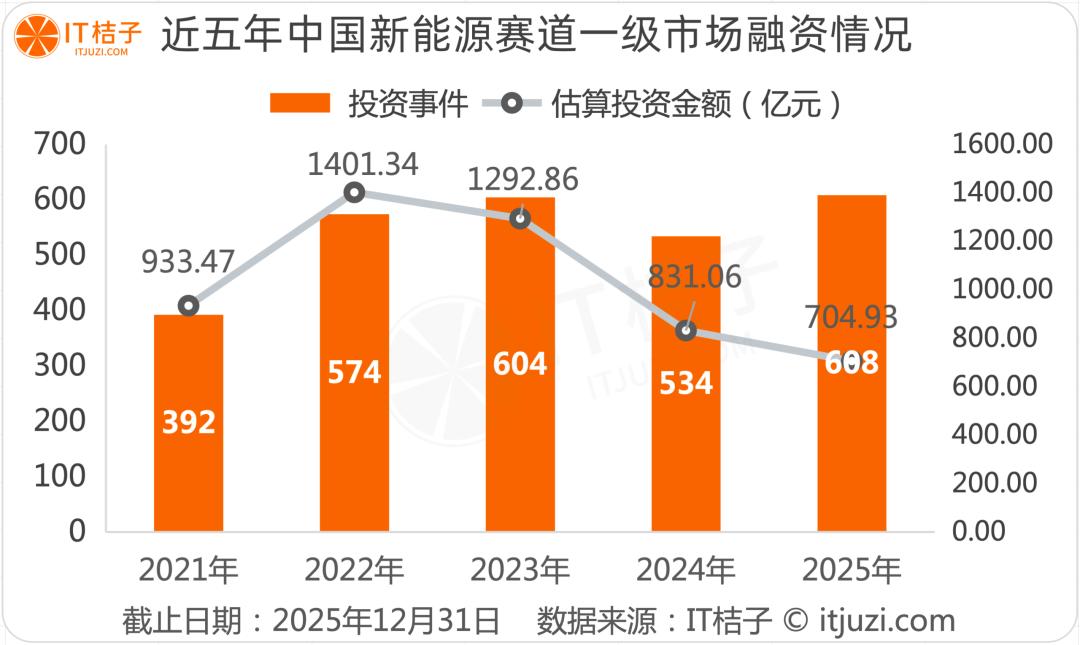
中西部力压长三角,改写2025年新能源融资格局
3 6 Ke· 2026-02-10 12:58
Core Insights - The Chinese renewable energy industry is at a critical juncture in 2025, with over 608 financing events and approximately 70.5 billion RMB injected, reflecting a significant reduction in investment compared to the peak in 2022, indicating a shift from enthusiasm to rationality in the sector [1][4][10] Overall Situation - The financing landscape in 2025 shows a distinct "volume up, price down" characteristic, highlighting structural differentiation in the industry and capital logic [2][4] Financing Trends - In 2025, the number of financing events in the renewable energy sector increased by 14% year-on-year, totaling over 608 events, while the total financing amount dropped nearly by half compared to the peak in 2022, indicating a fundamental shift in industry dynamics due to the gradual withdrawal of domestic subsidies [4][5] - The previous decade's reliance on policy subsidies as a core driver for attracting capital has diminished, leading to stricter investor requirements for project profitability and technological barriers [4][5] Regional Dynamics - The financing distribution in 2025 shows a significant shift, with the central and western regions of China rising in prominence, challenging the traditional dominance of the Yangtze River Delta [5][9] - The Yangtze River Delta remains the leader in financing events, accounting for nearly half with 296 events, while the central and western regions, particularly Sichuan and Hubei, have shown strong performance in financing scale [7][9] Capital Allocation - In 2025, the central and western regions received 43% of total capital investment, surpassing the Yangtze River Delta in financing scale, with Inner Mongolia and Sichuan attracting significant capital in wind and solar energy sectors [9] - Major financing events in the central and western regions are focused on mature enterprises and heavy asset projects, reflecting a higher pursuit of certainty and scale effects during the industry adjustment period [9][11] Emerging Sectors - Smaller financing amounts are increasingly directed towards innovative startups in emerging fields such as sodium-ion batteries, hydrogen energy, and nuclear fusion, primarily located in traditional financial hubs like Shanghai, Jiangsu, and Guangdong [9][11] Conclusion - The 2025 Chinese renewable energy financing market is evolving uniquely, characterized by rational maturity, the rise of the central and western regions, and the emergence of new sectors, presenting both challenges and opportunities for industry players and investors [10][11]

华金证券:春季行情未完 继续聚焦成长
Xin Lang Cai Jing· 2026-01-18 06:33
Group 1 - The core viewpoint is that the A-share market may continue to strengthen after a volume increase in the spring market, influenced by policies, external events, liquidity, and sentiment [1][8] - Historical data shows that in the past 16 spring markets since 2010, there were 11 instances where the total A-share trading volume increased by over 100% from the low to the high, and in 9 of those instances, the Shanghai Composite Index continued to rise [1][8] - Key factors affecting whether A-shares can continue to rise after a volume increase include policies and external events, liquidity, and sentiment of leading sectors prior to the volume increase [1][8] Group 2 - Currently, the A-share market is expected to continue a strong but volatile trend, with the spring market not yet over [2][9] - Short-term policies remain positive, with a dual easing of fiscal and monetary policies, and external risks are relatively limited, particularly in US-China relations and Middle Eastern geopolitical risks [2][9] - Short-term liquidity expectations are still loose, with the macro liquidity likely to remain accommodative, and the central bank has already implemented structural interest rate cuts [2][9] Group 3 - In the spring market, sectors that are likely to outperform include technology growth and certain cyclical industries, with historical trends indicating that sectors with low valuation sentiment may experience a rebound after a volume increase [3][10] - Current sectors expected to perform well include pharmaceuticals, machinery, and new energy, while media, military, and electronics may experience slight corrections before continuing to rise [3][10] - The ongoing trends in AI and commercial aerospace are expected to support the upward movement of related sectors such as TMT and military [3][10] Group 4 - Short-term recommendations suggest accumulating positions in technology growth and certain cyclical sectors that are currently undervalued [4][11] - Sectors such as machinery (robots), electronics (semiconductors, AI hardware), and pharmaceuticals (innovative drugs) are highlighted for their positive policy and industry trends [4][11] - Non-bank financials and consumer sectors (food, retail, and services) are also suggested for potential rebound and marginal improvement in fundamentals [4][11]
华金证券:春季行情主升时行业如何轮动?
Zhi Tong Cai Jing· 2026-01-10 11:27
Core Viewpoint - The current spring market is expected to favor technology growth and certain cyclical industries, with commercial aerospace and brain-computer interfaces emerging as key investment themes for the season [1][5]. Group 1: Spring Market Trends - The main phase of the spring market may witness a rebound, with industries benefiting from positive policies and trends likely to perform strongly [2]. - Historical data indicates that during the main phase of the spring market, sectors with low valuation sentiment and significant inflows of financing tend to experience a rebound [2]. - Industries such as communication, social services, and beauty care have shown strong performance during previous spring market phases due to favorable policies and industry trends [2]. Group 2: Technology and Cyclical Industries - Technology growth sectors like media, computing, and pharmaceuticals are expected to rebound in the upcoming spring market due to low valuations and sentiment [3]. - Supportive policies for technology growth and cyclical industries are likely to continue, with initiatives in commercial aerospace and artificial intelligence being implemented [3]. - The upward trend in industries related to commercial aerospace and artificial intelligence is anticipated to persist in the short term [3]. Group 3: Economic and Liquidity Outlook - The economy is expected to continue its weak recovery, with profit growth likely to rebound, as indicated by the rising PPI year-on-year growth [4]. - Macro liquidity is projected to further loosen, with potential interest rate cuts from the Federal Reserve and domestic central banks [4]. - Risk appetite in the market may continue to improve due to the implementation of positive policies and limited overseas risks [4]. Group 4: Investment Strategy - The focus should remain on technology growth and cyclical growth sectors, as theme indices typically outperform primary industry indices during the main phase of the spring market [5]. - Commercial aerospace and brain-computer interfaces are highlighted as key investment themes, with the space economy projected to reach $1.8 trillion by 2035 [5]. - Industries such as military (commercial aerospace), new energy (nuclear fusion, energy storage), media (AI applications, gaming), and computing (AI applications, brain-computer interfaces) are recommended for low-cost allocation [5].
春季行情主升时行业如何轮动?
Huajin Securities· 2026-01-10 11:19
Group 1: Market Trends - The spring market's main rising phase may see a rebound in growth sectors, particularly those with low valuation sentiment and significant future financing inflows[1] - Historical data shows that during the main rising phases, the Shanghai Composite Index has increased by approximately 4% to 22%, averaging around 19 trading days[10] - Key sectors that performed well during previous main rising phases include media, electronics, and non-ferrous metals, which experienced substantial financing inflows[1] Group 2: Sector Performance - In the current spring market, technology growth sectors such as media, computing, and pharmaceuticals are expected to rebound due to low valuations and sentiment[2] - Financing inflows since December 17, 2025, have been significant in sectors like electronics, non-ferrous metals, and defense, driven by ongoing industry trends[18] - The main rising phase typically sees theme indices outperforming primary industry indices, with notable gains in sectors like integrated circuits and digital marketing[42] Group 3: Economic Indicators - Short-term economic recovery remains weak, with CPI growth recorded at 0.8% and PPI at -1.9%, indicating a gradual improvement in industrial profitability[23] - The short-term liquidity environment is expected to loosen further, with potential interest rate cuts from the Federal Reserve and domestic central bank actions[31] - Risk appetite is likely to increase due to positive policy implementations and limited overseas risks, such as the anticipated Fed rate cut[38]
华金证券:节后春季行情进行中 聚焦成长
Xin Lang Cai Jing· 2026-01-04 08:42
Group 1 - The short-term performance of A-shares after the New Year is mainly influenced by policies, external events, liquidity, and overseas market trends [1][6] - Since 2010, in 16 years, the Shanghai Composite Index has risen in 11 instances during the 10 trading days before the holiday and has shown similar patterns after the holiday [1][6] - Positive policies and external events are core influencing factors for post-holiday A-share performance, with examples including the resolution of the "fiscal cliff" in the US in January 2013 and the easing of US-China trade tensions in early 2019 [1][6] Group 2 - Current observations suggest that the A-share spring market is ongoing, with potential for a strong but volatile performance post-New Year [1][6] - There is a likelihood of further positive policy implementation after the holiday, including the rollout of guidelines for equipment updates and trade-in policies, as well as local government meetings to stimulate consumption [1][6] Group 3 - External risks post-holiday are expected to be limited, with a high probability of a Federal Reserve rate cut in January and stable US-China relations, although tensions with Japan may persist [2][7] - Liquidity is anticipated to further loosen, with potential for accelerated capital inflow into the stock market [2][7] Group 4 - The economic recovery remains weak, with industrial profits continuing to decline, but there is potential for recovery in certain sectors, particularly in technology and cyclical industries [2][7] - Historical trends indicate that industries driven by upward policies and trends before the holiday are likely to maintain their strength afterward [3][8] Group 5 - Recommendations for post-holiday investment include focusing on technology, certain cyclical sectors, and consumer industries, with specific mention of machinery, military, new energy, media, computing, electronics, telecommunications, and pharmaceuticals [4][9] - Current PEG ratios for growth sectors like power equipment and media are relatively low, indicating potential for investment [4][9]
2026年度策略:破晓,军工逐步进入复苏期
GOLDEN SUN SECURITIES· 2025-12-31 12:30
Group 1: Core Insights - The report predicts that the defense industry will gradually enter a recovery phase in 2026, driven by increased military spending and the release of backlog orders from the previous five-year plan [2][19][20] - The military expenditure is expected to rise significantly, with a notable increase in defense budgets across various countries, indicating a positive trend for the global military market [23][22] - The report emphasizes the importance of military trade, particularly in light of recent geopolitical events that have opened up long-term growth opportunities for the industry [15][46] Group 2: Focus Areas - Key areas of focus include main battle equipment such as missiles, unmanned systems, and new production models, as well as military trade which is anticipated to reshape the global market [3][25] - In the realm of new combat capabilities, attention is directed towards military AI, aerospace satellites, and deep-sea technology, which are expected to drive innovation and growth [4][25] - The report highlights the significance of military-civilian integration, particularly in sectors like nuclear fusion and large aircraft manufacturing, which present substantial market opportunities [5][26] Group 3: Investment Strategies - The investment strategy for 2026 emphasizes the importance of focusing on companies that are well-positioned in the market, have strong pricing power, and are likely to benefit from military trade and new equipment production [6][38] - Specific companies to watch include those involved in missile production, unmanned systems, and new equipment, which are expected to experience significant growth in the coming years [27][29] - The report suggests that the military trade sector is poised for a transformation, with increased global military spending driving demand for military equipment and services [41][46]
玄元投资2026年市场展望及投资策略:跃龙在渊 进无咎 重点关注的三大方向
Xin Lang Cai Jing· 2025-12-26 03:07
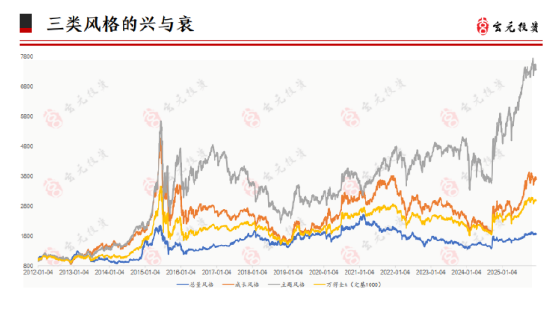
Core Viewpoint - The market is currently in a position where it can either advance or retreat, with the emphasis on the need for economic fundamentals to improve for sustained growth [1][4]. Investment Framework and Style Tracking - The investment framework is based on the equation "Stock Price = EPS × PE," highlighting that valuation (PE) fluctuations are typically larger than earnings (EPS) changes in the A-share market [2][20]. - The market opportunities can be categorized into three styles: macro style, growth style, and thematic style, with macro style being influenced by the China-US interest rate differential [2][21]. Judgments for 2026 - The market is still in a bull phase, but the rhythm of growth will differ from the past, with the current A-share market capitalization to household savings ratio at approximately 0.65, indicating that the bull market is not over yet [7][25]. - The current market is driven by liquidity and risk appetite, but this type of market has a clear "ceiling," as seen in historical liquidity-driven markets [8][26]. - Economic fundamentals are expected to gradually improve in the second half of next year, which may trigger a style switch from growth and thematic to value and cyclical stocks [9][27]. - Bull markets may experience more severe pullbacks, with historical data showing that pullbacks in bull markets are typically around 10% at the index level, but certain broad indices may see declines exceeding 20% [9][28]. Key Areas for Fundamental Improvement - Exports have been growing, but the "price for volume" model is unsustainable, with China's export price index down approximately 20% compared to developed countries, which may suppress long-term profit margins [11][28]. - Fixed asset investment has seen a decline for the first time in 36 years, influenced by various factors including a significant drop in land revenue [11][28]. - The real estate market shows high inventory levels, particularly in second-tier cities, indicating a need for stronger demand-side policies [11][29]. - There is a shift towards service consumption, with a focus on sectors such as cultural tourism, elderly care, and emotional consumption [11][29]. Policy Perspective - The current policy focus includes addressing "involution" competition, promoting technological innovation, and expanding domestic demand, with expectations for substantial policy implementation around mid-next year [14][33]. - Historical patterns suggest that policy effects are gradual and may take time to manifest, as seen in past housing reform policies [12][31]. Style Switching Considerations - A sustainable style switch from growth and thematic to value requires solid fundamental data support, as historical trends indicate a strong correlation between total style relative returns and revenue growth rates [15][34]. - Short-term style switches may occur due to trading factors, but these are often less sustainable without fundamental backing [16][34]. Focus Areas for 2026 - Key investment opportunities will revolve around three main themes: addressing involution competition, fostering new productive forces, and expanding domestic demand, with a particular emphasis on service consumption [17][35][36].
摩根士丹利邢自强:未来五年中国前沿行业将“再拔头筹”
Zhong Guo Xin Wen Wang· 2025-12-18 17:38
Core Viewpoint - The next five years will see China leading in advanced industries such as 6G networks, quantum technology, brain-computer integration, nuclear fusion, and next-generation biomanufacturing, driven by significant advantages in industrial capabilities, talent, and domestic market utilization [1][2] Group 1: Industrial Advantages - China has a first-mover advantage in electric vehicles, lithium batteries, next-generation smart cars, and future nuclear fusion technologies, attributed to three main advantages [1] - The first advantage is the industrial chain clustering capability, where regions like the Yangtze River Delta and Pearl River Delta can quickly access various components and engineers within a few dozen kilometers, a unique advantage not replicable by any other economy [1] - The second advantage is the talent reserve, with China producing a large number of graduates in artificial intelligence each year, providing a foundational talent pool for industrial and innovative development [1] Group 2: Market Utilization - The third advantage is the effective use of the domestic market, where most Chinese companies start locally, leveraging strong domestic demand to enhance product competitiveness before expanding internationally [1] - These three advantages are expected to continue to evolve and be leveraged during the 14th Five-Year Plan period [2]