
纳斯达克综合指数

Search documents
2026年春节假期期间国际品种涨跌幅
Ge Lin Qi Huo· 2026-02-24 08:03
Report Summary 1. Core View - The report presents the price changes of various international varieties from February 13th, 15:00 to February 23rd, 18:00 in 2026, including stock indices, commodities, and currency indices [3]. 2. Key Points by Category Stock Indices - The FTSE A50 Index rose from 14,684 to 14,919, a 1.60% increase [3]. - The Hang Seng Index increased from 26,595.15 to 27,081.91, a 1.83% rise [3]. - The Dow Jones Industrial Index went up from 49,451.98 to 49,625.97, a 0.35% increase [3]. - The S&P 500 Index climbed from 6,832.76 to 6,909.51, a 1.12% gain [3]. - The NASDAQ Composite Index advanced from 22,597.15 to 22,886.07, a 1.28% increase [3]. - The Nikkei 225 Index dropped from 56,941.97 to 56,825.7, a 0.20% decline [3]. Commodity Indices - The Baltic Dry Index decreased from 2,083 to 2,043, a 1.92% fall [3]. Energy Commodities - Brent Crude Oil rose from $67.55 to $71.04, a 5.17% increase [3]. - US Crude Oil increased from $62.83 to $66.23, a 5.41% rise [3]. Precious Metals - CMX Gold climbed from $4,986.7 to $5,170.1, a 3.68% gain [3]. - CMX Silver advanced from $77.105 to $86.515, a 12.20% increase [3]. Base Metals - LME Copper rose from $12,894.5 to $12,966, a 0.55% increase [3]. - LME Aluminum increased from $3,062.5 to $3,102.5, a 1.31% rise [3]. - LME Zinc went up from $3,352.5 to $3,377.5, a 0.75% increase [3]. - LME Lead dropped from $1,976.5 to $1,963, a 0.68% decline [3]. - LME Nickel advanced from $17,255 to $17,600, a 2.00% increase [3]. - LME Tin climbed from $46,940 to $47,500, a 1.19% gain [3]. Iron Ore - TSI Iron Ore decreased from $97.15 to $95.85, a 1.34% fall [3]. Agricultural Commodities - CBOT Soybeans rose from $1,134.75 to $1,146.75, a 1.06% increase [3]. - CBOT Soybean Meal increased from $308.6 to $309.7, a 0.36% rise [3]. - CBOT Soybean Oil advanced from $57.26 to $59.67, a 4.21% increase [3]. - CBOT Corn climbed from $430.25 to $438.75, a 1.98% gain [3]. - CBOT Wheat rose from $550.75 to $575.75, a 4.54% increase [3]. - MDE Crude Palm Oil increased from 3,996 to 4,084, a 2.20% rise [3]. - ICE No. 2 Cotton advanced from 64.26 to 65.46, a 1.87% increase [3]. - ICE No. 11 Sugar climbed from 13.53 to 13.9, a 2.73% gain [3]. Currency Indices - The US Dollar Index rose from 97.0775 to 97.6349, a 0.57% increase [3]. Currency Pairs - The US Dollar against Offshore RMB decreased from 6.908 to 6.8852, a 0.33% decline [3].
日本股市创历史新高
财联社· 2026-02-09 01:10
Core Viewpoint - The recent election results in Japan indicate that the ruling coalition led by Prime Minister Kishi Sanae has maintained control over the House of Representatives, which is expected to influence the financial markets positively, particularly in terms of the yen, Japanese stocks, and bonds [1][2]. Currency Market Impact - Following the election results, the yen experienced a short-term sell-off, dropping approximately 0.3% to 157.76 yen per dollar, marking its lowest level in over two weeks [3]. - The rise of Kishi Sanae as Japan's first female Prime Minister has previously led to significant stock market gains but also substantial sell-offs in Japanese bonds and the yen [2]. Economic Policy Expectations - Kishi has promised to implement aggressive fiscal and monetary policies to stimulate economic growth, raising concerns about potential overspending and increasing Japan's already high debt burden [4]. - Analysts predict that her decisive election victory will likely reinforce expectations for aggressive fiscal policies, leading to further short-term depreciation of the yen [5]. Stock Market Reaction - The Japanese stock market opened significantly higher, with the Nikkei 225 index reaching a new historical intraday high, reflecting strong investor confidence in Kishi's government [6][7]. - The recent performance of the Japanese stock market has been bolstered not only by domestic political developments but also by a rebound in U.S. stock markets, which saw significant gains [8]. Bond Market Concerns - The potential for increased government spending under Kishi's administration raises concerns among bond investors, particularly given Japan's already substantial debt load [9]. - Analysts suggest that Kishi's election victory could lead to upward pressure on Japanese government bond yields, as the market anticipates a revival of "Kishi trading" [10]. Balancing Fiscal Policies - Experts believe that Kishi will need to maintain a delicate balance between aggressive fiscal policies and fiscal discipline to manage the rising bond yields effectively [11].

国际金融市场早知道:2月2日
Sou Hu Cai Jing· 2026-02-01 23:56
Group 1 - The U.S. government has entered a technical partial "shutdown" due to the inability to complete the legislative process before the budget authorization deadline on January 31, despite the Senate passing a $1.2 trillion funding bill [1] - The Indian government plans to borrow a record ₹17.2 trillion for the fiscal year 2026-27, with a projected reduction in the fiscal deficit from 4.4% to 4.3% and a decrease in debt-to-GDP ratio from 56.1% to 55.6% [2] - South Korea's semiconductor exports surged by 102.7% year-on-year in January, reaching $20.5 billion, contributing to an overall export growth of 33.9% to $65.85 billion, setting a record for January [4] Group 2 - The U.S. Securities and Exchange Commission (SEC) has initiated an emergency operational plan due to the partial government shutdown, retaining only essential personnel to maintain basic functions until funding is restored [2] - The U.S. Senate Agriculture Committee is advancing a cryptocurrency federal regulatory framework bill, highlighting partisan divisions that may hinder its passage in the full Senate [1][2] - Japan's core CPI rose by 2% year-on-year in January, lower than the expected 2.2%, indicating a slowdown in inflation and reducing expectations for recent interest rate hikes by the Bank of Japan [3]
国际金融市场早知道:1月29日
Xin Hua Cai Jing· 2026-01-29 00:13
Group 1 - The Federal Reserve maintains the benchmark interest rate at 3.50% to 3.75%, ending a series of three consecutive rate cuts since last September. This decision aligns with market expectations but reveals internal dissent, as two members voted against it, advocating for a 25 basis point cut [1] - Fed Chairman Powell emphasizes that the current interest rate is at the upper end of the "neutral zone," indicating neither tightening nor significant easing. He reiterates that decisions will be strictly data-driven, suggesting that if inflation related to tariffs continues to decline, it may indicate a potential for policy relaxation [1] - U.S. Treasury Secretary Yellen supports a strong dollar policy, denying any intervention in the foreign exchange market to sell dollars and buy yen. She asserts that capital will flow in when policies are appropriate [1] Group 2 - The German government lowers its 2026 economic growth forecast from 1.3% to 1%, highlighting ongoing external pressures on Europe's largest economy due to underwhelming infrastructure investment and high tariffs affecting exports [2] - SpaceX, owned by Musk, plans to launch its initial public offering (IPO) in mid-June, targeting a valuation of approximately $1.5 trillion and aiming to raise up to $50 billion, potentially becoming one of the largest tech company listings in history [2] - The Bank of Thailand introduces restrictions on gold trading to address the strengthening of the Thai baht, requiring traders with annual transactions exceeding 10 billion baht to report and setting a daily online trading limit of 50 million baht [2] Group 3 - The Dow Jones Industrial Average rises by 0.02% to 49,015.6 points, while the S&P 500 index decreases by 0.01% to 6,978.03 points, and the Nasdaq Composite Index increases by 0.17% to 23,857.45 points [3] - COMEX gold futures increase by 6.46% to $5,411 per ounce, and COMEX silver futures rise by 10.06% to $116.62 per ounce [4] Group 4 - The main contract for U.S. oil rises by 1.78% to $63.5 per barrel, while the main contract for Brent oil increases by 1.56% to $67.63 per barrel [5] - The 2-year U.S. Treasury yield remains unchanged at 3.5964%, the 3-year yield decreases by 0.56 basis points to 3.640%, the 5-year yield increases by 25.90 basis points to 3.828%, the 10-year yield rises by 0.20 basis points to 4.243%, and the 30-year yield decreases by 0.31 basis points to 4.855% [5] Group 5 - The U.S. dollar index increases by 0.63% to 96.35, with the euro declining by 0.70% against the dollar to 1.1953, and the British pound decreasing by 0.28% to 1.3809. The Australian dollar rises by 0.42% to 0.7041, while the dollar strengthens by 0.81% against the yen to 153.4200 [6]
摩根大通交易部门:2026年初开始采取战术性看涨立场:原因及四大首选交易
摩根· 2026-01-07 03:05
Investment Rating - The report indicates a tactical bullish stance for 2026, with a focus on both bullish and bearish factors [2][20]. Core Insights - The macroeconomic environment is improving, characterized by strong earnings growth and a de-escalation of trade tensions [2][16]. - Consumer cash reserves have increased significantly, with the top 40% of income earners holding more cash than at the end of 2019, contributing to higher retail spending [3][6]. - The labor market shows signs of stability, although there are concerns about rising unemployment rates and potential economic slowdowns [10][12]. - Earnings growth is projected to continue, with expectations of a 7.2% revenue increase and a 15.0% rise in earnings per share for the fiscal year 2026 [11][13]. Summary by Sections Macroeconomic Overview - The overall economic outlook is positive, with strong earnings growth and a reduction in trade tensions expected to support market performance [2][16]. Consumer Insights - Adjusted for inflation, the cash reserves of the top 40% of income earners have increased, leading to a significant rise in retail spending, which is a key driver of GDP growth [3][6]. Labor Market Analysis - The labor market is stabilizing, with a slight increase in unemployment rates and a potential for economic slowdown if costs cannot be passed on to consumers [10][12]. Earnings Outlook - Projections for Q4 2025 indicate a revenue growth of 7.6% and an 8.3% increase in earnings per share, with a net profit margin of 12.8% [11][13]. Trade Relations - Improvements in trade relations, particularly between the U.S. and China, are expected to positively impact the market, with a decrease in effective tariff rates [16][35]. Technical Factors - The report highlights that stock buybacks are expected to reach approximately $1 trillion in fiscal year 2026, indicating strong corporate confidence [19][20]. Investment Themes - The report identifies key investment themes, including technology, media, and communications (TMT), as well as international markets, particularly in Asia and Latin America [48].

华尔街押注2026年美股延续涨势 即便估值已处高位
Xin Lang Cai Jing· 2026-01-05 00:37
Core Insights - The S&P 500 index surged by 16% last year, driven by economic resilience, interest rate cuts, and the AI boom, achieving 39 record highs [1][2] - Analysts predict continued growth, with Bank of America forecasting the S&P 500 to reach 7,100 points by year-end, a 3.7% increase from 2025's closing level [1][2] - Some investors express caution due to the rapid rise, noting an approximately 80% increase in the S&P 500 from the beginning of 2023 to New Year's Eve, which is often unsustainable [1][2] - Strong corporate earnings growth is anticipated, with analysts expecting a 15% increase in profits for S&P 500 companies this year, marking the highest annual growth rate since 2021 [1][2]
2026年卸任前,鲍威尔留给华尔街的一句话:美股价格已很昂贵
智通财经网· 2025-12-29 01:32
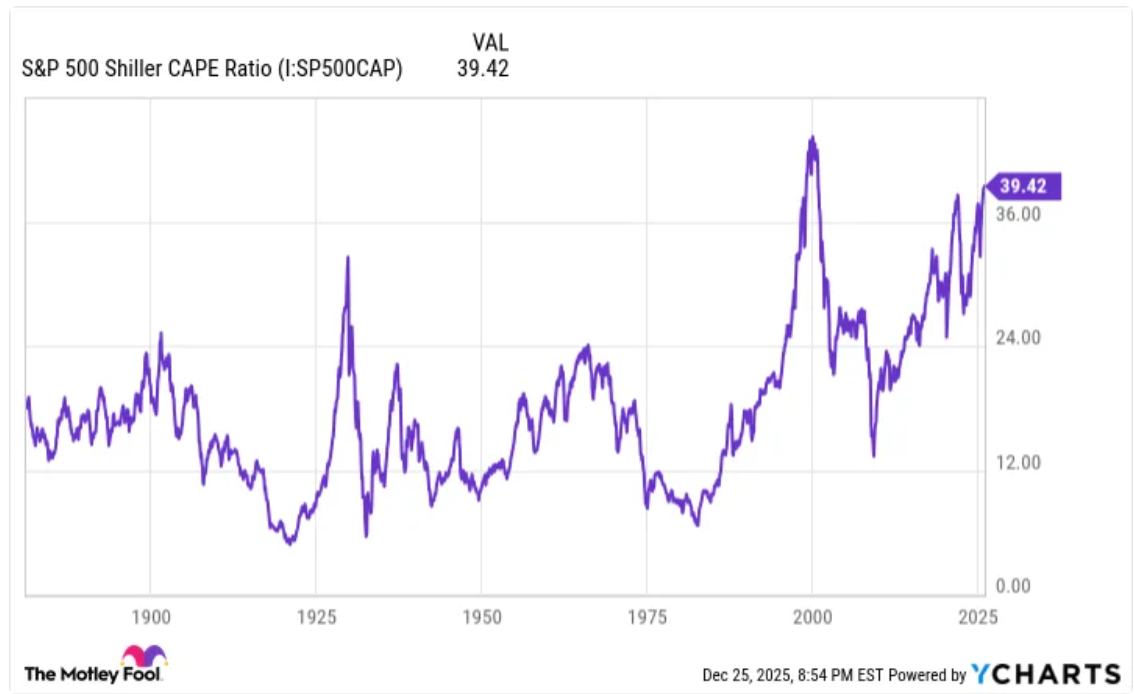
Core Viewpoint - The stock market has shown significant gains in 2025, with the Dow Jones Industrial Average, S&P 500, and Nasdaq Composite rising by 15%, 18%, and 22% respectively as of December 24. However, not all analysts share this optimism, particularly Federal Reserve Chairman Jerome Powell, who has highlighted the risks associated with high stock valuations [1][2]. Group 1: Stock Market Performance - As of December 24, 2025, the Dow Jones Industrial Average, S&P 500, and Nasdaq Composite have increased by 15%, 18%, and 22% respectively [1]. - Powell's comments suggest that the Federal Reserve is aware of the potential impact of stock market valuations on monetary policy [2]. Group 2: Valuation Concerns - Powell indicated that stock prices are at "quite high valuation levels," referencing the Shiller P/E ratio, which has reached 40.74, nearing historical highs [2][5]. - The Shiller P/E ratio has an average of 17.32 over 155 years, and the current level is close to the peak of 41.20 during the recent bull market and the 44.19 peak before the 1999 internet bubble [5]. Group 3: Historical Context - Historical data shows that the Shiller P/E ratio exceeding 30 has only occurred six times in 155 years, with subsequent declines in major indices ranging from 20% to 89% [5]. - The average bear market since 1929 lasts about 286 days, while bull markets average 1,011 days, indicating that markets spend more time in an upward trend [11].
国际金融市场早知道:12月24日
Zhong Guo Jin Rong Xin Xi Wang· 2025-12-24 00:11
Market Insights - President Trump calls for the next Federal Reserve chairman to lower interest rates decisively when the economy and markets are performing strongly, rather than tightening policy too early due to inflation concerns. He criticizes the current market logic, stating that "good news has become bad news," and emphasizes that low interest rates can boost the stock market, stimulate the economy, and alleviate housing burdens. He suggests that a thriving stock market could lead to a GDP growth of 10% to 20% in the U.S. [1][6] - The U.S. third-quarter GDP annualized growth rate is reported at 4.3%, significantly exceeding the market expectation of 3.3%, marking the fastest growth rate in 2023 and indicating strong economic resilience [1][6]. - The core PCE price index for the third quarter shows an annualized quarter-on-quarter increase of 2.9%, consistent with expectations and up from the second quarter's final value of 2.6%. The overall PCE price index also rises by 2.8%, indicating that inflation remains on a moderate upward trajectory [1][7]. Manufacturing Sector - U.S. durable goods orders fell by 2.2% month-on-month in October, significantly worse than the expected decline of 1.5%, with the previous value revised down from +0.5%, highlighting weakened manufacturing momentum [2][7]. - U.S. industrial production increased by 0.2% month-on-month in November, slightly above the market expectation of 0.1%, marking the second consecutive month of expansion and indicating a slow recovery in manufacturing activity [2][7]. - The Richmond Fed manufacturing index for December improved to -7, better than the expected -10 and the previous value of -15, suggesting a slowdown in the pace of regional manufacturing contraction, although it has not yet returned to expansion [2][7]. Global Market Dynamics - The Dow Jones Industrial Average rose by 0.16% to 48,442.41 points, the S&P 500 increased by 0.46% to 6,909.79 points, and the Nasdaq Composite gained 0.57% to 23,561.84 points [3][8]. - COMEX gold futures increased by 1.09% to $4,518.20 per ounce, reaching a new intraday historical high, while COMEX silver futures rose by 4.40% to $71.585 per ounce, also setting a new historical peak [3][8]. Oil and Bond Markets - U.S. crude oil futures rose by 0.79% to $58.47 per barrel, while Brent crude oil futures increased by 0.62% to $61.96 per barrel [4][9]. - The 2-year U.S. Treasury yield rose by 3.18 basis points to 3.532%, the 3-year yield increased by 3.63 basis points to 3.583%, the 5-year yield rose by 2.65 basis points to 3.734%, the 10-year yield increased by 0.40 basis points to 4.165%, and the 30-year yield fell by 1.12 basis points to 4.824% [4][9].
国际金融市场早知道:12月23日
Sou Hu Cai Jing· 2025-12-22 23:55
Group 1: Federal Reserve and Economic Outlook - President Trump plans to nominate the next Federal Reserve Chair in the first week of January 2026, with current Chair Powell's term ending in May 2026. Trump emphasizes the need for a successor who supports "growth-friendly" monetary policy to promote economic expansion [1] - Treasury Secretary Becerra states that inflation is steadily approaching the Fed's 2% target, predicting that 2026 will see simultaneous improvement in economic growth and price stability. He notes that government efficiency improvements will further optimize the overall economic situation [1] - Fed Governor Milan warns that pausing interest rate cuts in 2026 could increase the risk of recession. He emphasizes that rising unemployment should prompt policymakers to maintain an accommodative stance [1] - Cleveland Fed President Harmack suggests that after three consecutive rate cuts, interest rate policy should remain stable in the coming months, arguing that the primary risk remains stubborn inflation rather than a weak job market [1] Group 2: EU Sanctions and Currency Intervention - The EU has decided to extend comprehensive economic sanctions against Russia for six months, effective until July 31, 2026, covering key areas such as trade, finance, energy, technology, and transportation. The EU is also implementing special measures to combat sanction evasion [2] - Japan's Finance Minister Katayama asserts that Japan retains the discretion to take decisive action in response to significant currency fluctuations that deviate from economic fundamentals, emphasizing the potential for "bold intervention" if necessary [2] Group 3: Market Dynamics - The Dow Jones Industrial Average rose by 0.47% to 48,362.68 points, the S&P 500 increased by 0.64% to 6,878.49 points, and the Nasdaq Composite gained 0.52% to 23,428.83 points [3] - COMEX gold futures increased by 2.13% to $4,480.60 per ounce, while COMEX silver futures rose by 2.37% to $69.09 per ounce [4] - Crude oil prices saw an increase, with the main US oil contract rising by 2.53% to $57.95 per barrel and Brent crude rising by 2.45% to $61.52 per barrel [5] - US Treasury yields increased across various maturities, with the 2-year yield rising by 2.96 basis points to 3.507%, and the 10-year yield increasing by 2.74 basis points to 4.165% [5] - The US dollar index fell by 0.46% to 98.26, while the euro and British pound appreciated against the dollar [5]
国际金融市场早知道:12月22日
Xin Hua Cai Jing· 2025-12-21 23:57
Market Overview - The Chinese foreign exchange market is operating steadily, with cross-border capital flows stabilizing. In November, the bank's foreign exchange settlement and sales surplus was $15.7 billion, remaining stable compared to October. The cross-border payment surplus was $17.8 billion, slightly lower than the average of $24 billion in September and October [1] - The U.S. Treasury Secretary expressed optimism about the economic outlook for 2026, indicating that inflation is gradually aligning with the Federal Reserve's 2% target, and expects improvements in economic growth and inflation trends [1] - The New York Fed President stated there is no urgent need for interest rate cuts based on the latest employment and inflation data, reinforcing market expectations for the Fed to pause rate cuts in the short term [1] Global Monetary Policy - The Bank of Japan raised its policy interest rate by 25 basis points to 0.75%, the highest level in 30 years, in response to persistent inflation pressures. The Governor indicated a willingness to continue raising rates if economic and price trends align with expectations [2] - The Bank of Korea announced a six-month exemption from foreign exchange stability tax for banks and will pay interest on excess foreign exchange reserves to enhance market liquidity and stabilize exchange rate expectations [2] - The Reserve Bank of India approved a reform plan to shift from a uniform premium deposit insurance model to a risk-based differentiated pricing system to enhance the financial system's risk sensitivity [2] Financial Market Dynamics - Major global financial markets are entering a "Christmas mode," with stock markets in the U.S., Europe, and Hong Kong closing on December 25, leading to a significant slowdown in trading activity as investors focus on post-holiday policy and economic data guidance [3] - The Dow Jones Industrial Average rose by 0.38% to 48,113.49 points, the S&P 500 increased by 0.88% to 6,834.5 points, and the Nasdaq Composite climbed by 1.31% to 23,307.62 points [4] - Gold futures increased by 0.1% to $4,368.7 per ounce, while silver futures surged by 3.34% to $67.395 per ounce, reaching a historical high [4] Commodity and Bond Market - U.S. crude oil futures rose by 0.96% to $56.54 per barrel, and Brent crude oil futures increased by 1.01% to $60.1 per barrel [5] - U.S. Treasury yields saw an uptick across various maturities, with the 10-year yield rising by 2.74 basis points to 4.147% [5] - The U.S. dollar index increased by 0.28% to 98.71, with mixed movements against other currencies, including a 1.39% rise against the Japanese yen [5]