
Zhong Guo Neng Yuan Wang

Search documents
美股三大指数集体收跌,加密货币概念股跌幅居前
Zhong Guo Neng Yuan Wang· 2025-12-02 00:25
来源:智通财经 美股三大指数集体收跌,道指跌0.89%,纳指跌0.38%,标普500指数跌0.53%,热门科技股多数下跌, 博通跌超4%,谷歌、微软跌超1%,英伟达、苹果涨超1%。加密货币、太阳能板块跌幅居前,Sunrun跌 超8%,Bit Digital跌超5%,Coinbase跌超4%。白银股、货运、鞋服、油气涨幅居前,美洲白银公司涨超 6%,纳伯斯实业涨超3%,耐克、卡骆驰涨超1%。芯片设计软件公司新思科技涨超4%,英伟达投资20 亿美元购入该公司股票。 ...

鄂尔多斯:多气源协同发力 冬供“底气”十足
Zhong Guo Neng Yuan Wang· 2025-12-01 09:30
Core Viewpoint - The news highlights the comprehensive efforts in Inner Mongolia to ensure natural gas supply during the winter heating season, emphasizing the collaboration among various oil and gas companies and the implementation of emergency response mechanisms to maintain energy security [2][5][9]. Group 1: Emergency Response and Supply Assurance - An emergency drill for natural gas supply was conducted in Inner Mongolia, simulating a reduction in gas supply and testing the emergency response capabilities of the gas supply system [2]. - The region is entering a critical period for energy supply as it prepares for the winter heating season, with a focus on coordinated efforts among gas companies to ensure sufficient supply [2][5]. Group 2: Production and Capacity - The Longqing Oilfield's gas production is operating efficiently, with a daily output exceeding 24 million cubic meters, and a target to complete the production of 80 new wells [3]. - Sinopec's North China Oil and Gas Company has produced 232 million cubic meters of natural gas since November 1, marking a 16.5% year-on-year increase, with a daily capacity of 13.7 million cubic meters [5]. Group 3: Storage and Preparedness - Gas storage facilities in the region have completed their annual injection tasks, ensuring adequate reserves for the winter heating peak [6]. - The Su Dong 39-61 gas storage facility has begun its fourth cycle of gas extraction, with a total storage capacity of 750 million cubic meters, marking a new high for annual reserves [8]. Group 4: Transportation and Distribution - Key companies like Western Gas and New Saint Gas are actively ensuring the stability of gas supply to end-users, with Western Gas conducting practical drills to strengthen supply foundations [9]. - The energy bureau in Ordos is closely monitoring supply and demand dynamics, with major oil and gas companies achieving a cumulative production of 26.455 billion cubic meters of natural gas from January to October, fulfilling 83.9% of the annual target [9].


消息称“动力电池老大”宁德时代基层员工月薪上调150元
Zhong Guo Neng Yuan Wang· 2025-12-01 08:45
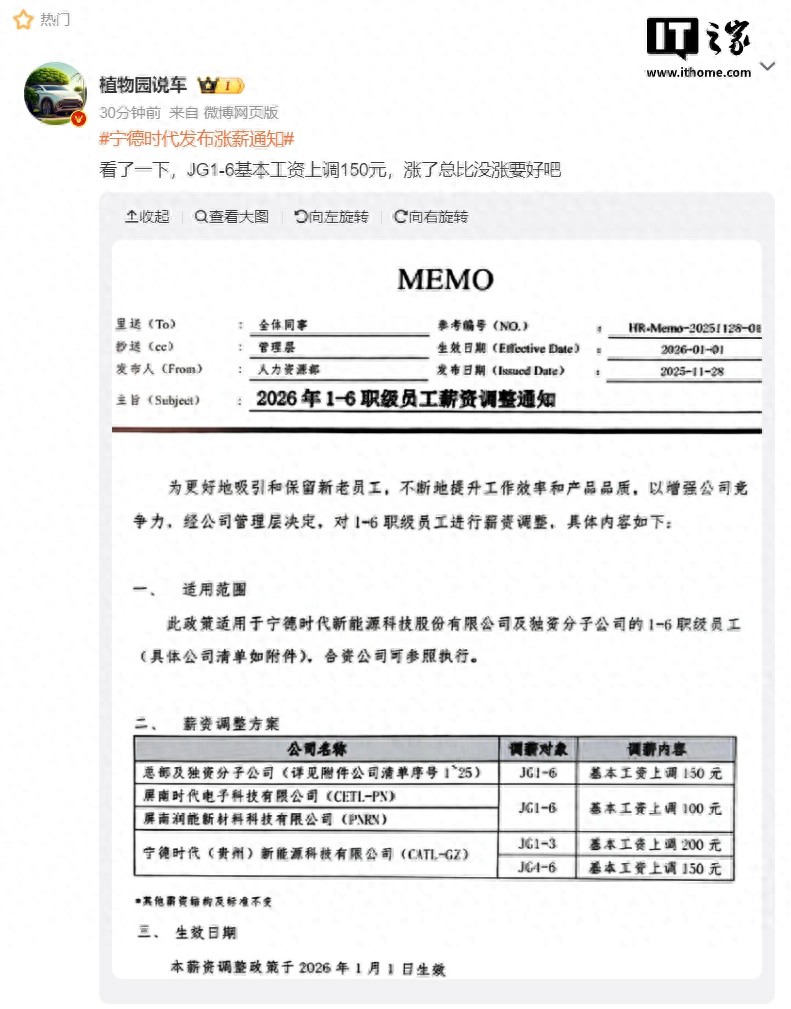
通知称,为更好地吸引和保留新老员工,不断地提升工作效率和产品品质,以增强公司竞争力,经公司管理层决定,2026/1/1 起对 1-6 职级员工进行薪资调整。 一、适用范围 此政策适用于宁德时代新能源科技股份有限公司及独资分子公司的 1-6 职级员工。 二、薪资调整方案 JG1-6 基本工资上调150 元,其他薪资结构及标准不变。 有网友日前爆料称,宁德时代发布涨薪通知。 三、生效日期 本薪资调整政策于 2026 年 1 月 1 日生效。 此次宁德时代涨薪涉及的员工职级为基层员工。而宁德时代去年财报显示,公司全体员工数为 13.2 万人,人均薪酬为 23.63 万元,较 2023 年上涨 1.06 万元。 此外,宁德时代 2025 年三季度财报显示,2025 前三季度,公司营收 2831 亿元,同比增长 9.28%;归母净利润 490 亿元,同比增长 36.20%。 IT之家注意到,中国汽车动力电池产业创新联盟数据显示,今年 10 月,宁德时代以 36.14GWh 的装车量、43% 的市场份额稳居榜 首,是国内最大的动力电池供应商,在三元动力、磷酸铁锂动力方面均排第一。 | 序号 | 企业名称 | 装车量(GW ...

隆基三防组件银川实证:行业首张证书背后的“极限测试”
Zhong Guo Neng Yuan Wang· 2025-12-01 08:17
Core Viewpoint - The recent fire incidents linked to photovoltaic modules have raised significant concerns about their safety, prompting the industry to focus on the performance and reliability of these components in real-world conditions [1][3]. Group 1: Fire Safety and Component Testing - Multiple fire incidents in Jiangsu, Henan, and Zhejiang were traced back to photovoltaic modules, highlighting the urgent need for improved safety standards [1]. - A gathering of industry representatives took place at the CPVT testing center to evaluate the performance of Longi's newly certified "three-proof" modules under real-world conditions [3][6]. - The CPVT has established 12 outdoor testing bases across China to ensure that testing results accurately reflect the performance of components in various environmental scenarios [9]. Group 2: Performance Metrics of Three-Proof Components - Longi's three-proof components demonstrated a significant temperature difference compared to TOPCon components, with temperatures reaching 97.1°C for three-proof modules versus 169.1°C for TOPCon under the same conditions [13]. - The three-proof components showed a 6.3% increase in average power generation compared to BC components, indicating their superior efficiency [6]. - In scenarios with shading, three-proof components outperformed TOPCon modules, achieving a 50% increase in power generation under certain conditions [17][25]. Group 3: Market Response and Innovation - Despite a higher price point of 0.1 yuan per watt compared to mainstream products, the sales proportion of Longi's three-proof components has surged to over 70% in the distributed business segment, reflecting strong market demand [38]. - The successful testing and validation of three-proof components have established a new standard for safety and efficiency in the photovoltaic industry, moving beyond mere price competition [38].

从制动到全域:盛昊“精灵2.0技术平台”构建智慧出行新生态
Zhong Guo Neng Yuan Wang· 2025-12-01 07:58
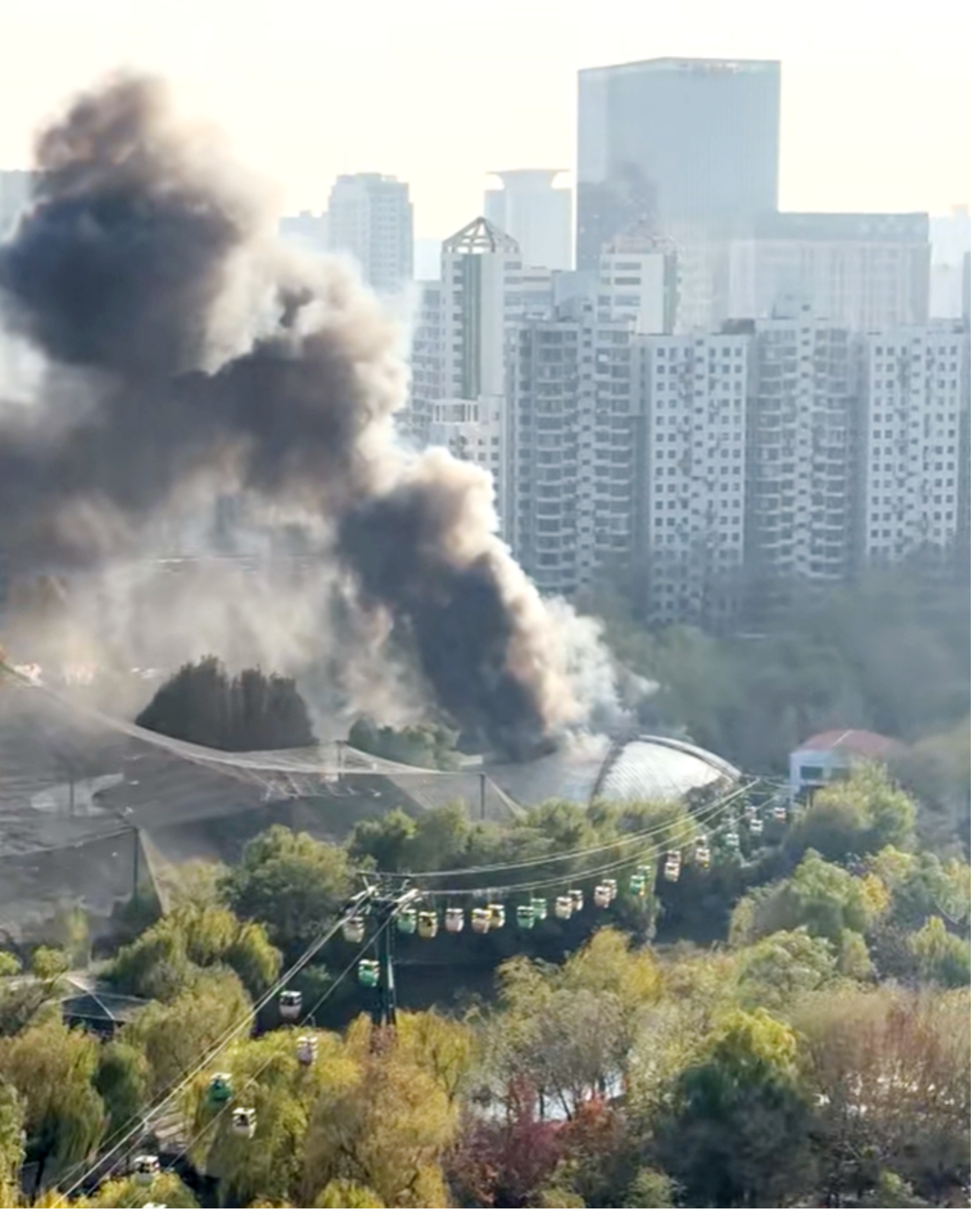
11月28日,盛昊篷车举办全新"定力"技术发布会,正式推出核心安全技术——"SSS迅停技术",更首次向公众展示了面向未来出行生态的"精灵2.0全域技术 平台",并同步上市搭载该平台技术的首款力作——为多娃家庭打造的"全能生活舱"盛昊G7。 同日,盛昊在山东菏泽F3国际赛车场组织媒体、经销商及达人实地测试,以权威数据验证技术实力。此次发布会通过技术创新、用户洞察与行业责任的三 重表达,重新定义了电动篷车的安全标准与出行价值,为千万家庭带来更可靠、舒适、智能的移动生活解决方案。 聚焦安全本质,用"定力"回应用户核心关切 发布会伊始,盛昊篷车董事长周高峰先生从三个真实的用户故事切入,揭示了"定力"的深层内涵——它并非冰冷的技术参数,而是车辆在危急时刻能够"稳 稳站住"的能力,是用户可感知的安全与信任。周高峰指出,在追求速度与效率的时代,盛昊选择回归车辆最朴素也最重要的价值:为家庭构筑底层的安全 保障。基于对上千家庭用户出行需求的深入洞察,盛昊将"刹得住,更安心"确立为产品研发的核心目标,致力于将用户出行中的每一个"差一点"变成未来旅 途的"安心点"。 第二重:至迅响应:采用毫秒级信号传输协议与集成式电控架构,使刹车 ...
从惊涛救援到光明永续,舟山电力续写跨越八十年的守护誓言
Zhong Guo Neng Yuan Wang· 2025-12-01 04:53
Core Insights - The article highlights the historical and modern significance of electricity supply on Dongji Island, emphasizing the transition from life-threatening rescue missions during wartime to the current role of electricity providers as guardians of the community [1][5]. Group 1: Historical Context - Over 80 years ago, fishermen on Dongji Island risked their lives to rescue British POWs during the "Lisbon Maru" incident, showcasing the spirit of humanity [1]. - The current generation of electricity providers, represented by State Grid Zhoushan Power Company, continues this legacy by ensuring reliable power supply in the same region [2]. Group 2: Role of Electricity Providers - The commitment of electricity workers on Dongji Island has evolved from merely providing power to becoming essential community support, responding to emergencies and assisting residents in need [2][3]. - The phrase "People's electricity for the people" encapsulates the dedication of these workers, who are available 24/7 to assist the local population [2]. Group 3: Generational Transition - The mentorship between seasoned workers and their apprentices ensures the continuity of this commitment, with younger generations inheriting the responsibility of safeguarding the community [3]. - The transformation of electricity workers into life guardians reflects a broader role that extends beyond technical services to encompass emotional and social support for island residents [3]. Group 4: Technological Advancements - The establishment of the first "self-healing island smart microgrid" in the country marks a significant upgrade in the electricity supply system, allowing for rapid self-diagnosis and restoration of power during faults [4]. - This innovative system, along with a robust connection to the mainland grid, represents a major leap towards sustainable and reliable energy supply, achieving "zero-carbon 24-hour power" for the island [4]. Group 5: Future Implications - The reliable electricity supply has revitalized Dongji Island, leading to the emergence of boutique accommodations and encouraging young entrepreneurs to return, thus fostering economic growth [5]. - The article concludes that the spirit of goodwill has transformed from emergency responses to ongoing community support, with electricity serving as a vital lifeline for development and sustainability [5].
北京君发科技集团低浓度瓦斯综合利用技术再度入选国家级先进适用技术目录
Zhong Guo Neng Yuan Wang· 2025-12-01 03:33
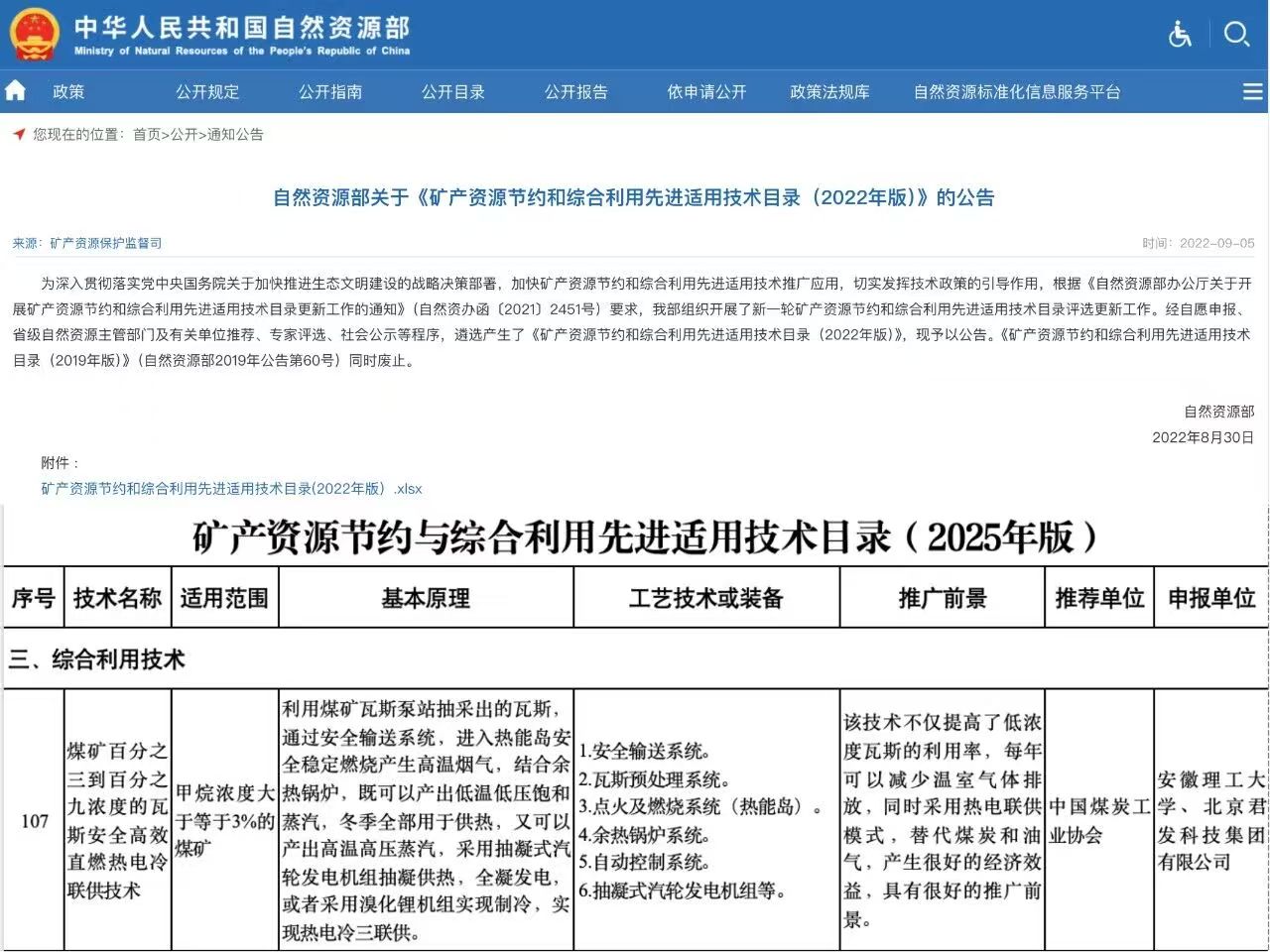
Core Viewpoint - The Ministry of Natural Resources of China has officially released the "Directory of Advanced Applicable Technologies for Mineral Resource Conservation and Comprehensive Utilization (2025 Edition)", recognizing the technology developed by Junfa Technology Group Co., Ltd. and Anhui University of Science and Technology for its efficient utilization of low-concentration methane in coal mines [1] Group 1: Technology Recognition - Junfa Technology's "Direct Combustion Combined Heat, Power, and Cooling Technology for Methane Concentrations of 3% to 9%" has been included in the national directory for the second consecutive year, highlighting its innovative capabilities in methane reduction and resource utilization [1][7] - The technology integrates innovations such as "Direct Current Heat Storage Oxidation" and "New Composite Oxidation", achieving significant improvements in energy conversion efficiency, operational stability, and safety assurance [7] Group 2: Industry Impact - The successful implementation of this technology in demonstration projects across Shanxi, Ningxia, and Anhui has validated its high adaptability and safety value under complex gas source conditions, providing a mature model for large-scale promotion [7] - The chairman of Junfa Technology emphasized the importance of this recognition as both an honor and a responsibility, indicating the company's commitment to further strategic cooperation with coal enterprises and the continuous optimization and large-scale application of its technologies [7]
大唐林州热电有限责任公司:央企担当暖民心 全力护航冬季供暖
Zhong Guo Neng Yuan Wang· 2025-12-01 03:15
Core Viewpoint - The company, as the sole heat supply entity in Linzhou City, is committed to ensuring winter heating for residents, demonstrating its responsibility and reliability during critical times [1][2]. Group 1: Equipment and Maintenance - The company adopts a "prevention first" approach, initiating comprehensive preparations before the heating season, focusing on equipment management and risk identification [1]. - Customized maintenance plans are implemented for outdoor equipment and key systems, with increased inspection and maintenance efforts to ensure stable operation during extreme cold [1]. Group 2: Energy Supply and Resource Management - The company optimizes its coal procurement strategy by combining long-term contracts with reasonable supplementary purchases to enhance inventory security [2]. - Efficient processes are established for coal unloading and storage, ensuring a continuous supply of coal for heating [2]. - An emergency response mechanism is set up to ensure timely and efficient supply of emergency materials during adverse weather conditions [2]. Group 3: Commitment to Public Welfare - The company emphasizes the importance of heating for public sentiment and plans to adjust heating parameters based on temperature changes and residents' needs to improve heating quality [2]. - The company remains dedicated to its mission, implementing stricter standards and better services to ensure effective winter heating support [2].
大唐林州热电有限责任公司:创新监督机制 筑起工程建设“廉洁墙”
Zhong Guo Neng Yuan Wang· 2025-12-01 03:15
Core Viewpoint - The company is implementing a comprehensive supervision system for the construction of the Ruanan Wind Power Phase I project, ensuring efficient, standardized, and clean project execution through innovative mechanisms and full-cycle supervision [1][2][3] Group 1: Supervision Mechanisms - The company has adopted a "full-cycle supervision" concept, establishing 4-5 core supervision items and multiple necessary supervision contents during the project preparation, construction, and handover phases [1] - An innovative "transition-style" and "bi-weekly supervision report" mechanism has been introduced, aligning "main responsibility + supervisory responsibility" to enhance management and efficiency [1] - Since the implementation of project-based supervision, 35 issues have been identified, with 33 corrective measures developed, promoting continuous management and efficiency improvements [1] Group 2: Public Participation and Reporting - The company has created a QR code for project-based supervision reporting, allowing employees to report issues via a dedicated platform, fostering a culture of collective supervision [2] - Regular reminders and risk analysis sessions are conducted before major holidays to reinforce discipline and compliance among employees [2] - A quarterly meeting is held to coordinate the "big supervision" system, integrating project-based supervision issues into a comprehensive management framework [2] Group 3: Compliance and Progress Monitoring - The company closely monitors key project milestones, particularly land permit processes, to ensure compliance and smooth project advancement [3] - Mechanism innovations are aimed at embedding supervision into the project framework, ensuring integrity is a fundamental aspect of project construction [3] - Future plans include enhancing the "full-cycle supervision" model to transition from "tangible coverage" to "effective coverage," providing robust disciplinary support for timely project completion [3]
供给收缩推动钨价创历史新高,出口修复预期锑价或底部反转 | 投研报告
Zhong Guo Neng Yuan Wang· 2025-12-01 03:05
Group 1: Rare Earths - The supply and demand for rare earths are both weak, with neodymium oxide prices rebounding by 3.94% to 566,500 CNY/ton [1] - Dysprosium oxide prices decreased by 1.99% to 1,480,000 CNY/ton, while terbium oxide prices fell by 0.84% to 6,525,000 CNY/ton [1] - Some production companies are controlling output due to cost pressures, and the recent raw material supply tightness has eased [1] - Downstream magnetic material companies have not seen a significant increase in order volumes, maintaining low demand levels, with price fluctuations expected [1] - Recommended companies to watch include Guangsheng Nonferrous, China Rare Earth, Northern Rare Earth, Jieli Permanent Magnet, Ningbo Yunsheng, and Zhenghai Magnetic Materials [1] Group 2: Molybdenum - Molybdenum prices are experiencing fluctuations, with molybdenum concentrate prices down by 2.69% to 3,615 CNY/ton and molybdenum iron (Mo60) prices down by 1.26% to 235,500 CNY/ton [2] - Supply signals for molybdenum concentrate are showing signs of contraction, while weak terminal demand is dragging down industry profitability [2] - The industry is facing a supply-demand tug-of-war, with short-term price adjustments expected [2] - Recommended company to watch is Jintong Molybdenum [2] Group 3: Tungsten - Tungsten prices have reached historical highs due to supply contraction and price increases for long-term contracts, with black tungsten concentrate prices up by 6.96% to 338,000 CNY/ton and ammonium paratungstate prices up by 4.10% to 495,000 CNY/ton [2] - The reduction in tungsten concentrate mining quotas and slowed production rates are tightening industry circulation [2] - Domestic demand remains stable, primarily driven by essential purchases, with PCB tool demand showing positive trends [2] - Companies to watch include Zhongtung High-tech, Xiamen Tungsten, Xianglu Tungsten, and Zhangyuan Tungsten [2] Group 4: Tin - Tin prices are strengthening due to ongoing supply disruptions, with SHFE tin prices up by 4.66% to 305,000 CNY/ton and LME tin prices up by 5.97% to 39,100 USD/ton [3] - Supply-side issues include deteriorating safety conditions in major tin mining areas in the Democratic Republic of Congo and ongoing crackdowns on illegal mining in Indonesia [3] - Traditional consumer electronics demand is weak, while emerging fields like AI are performing well, leading to strong price expectations [3] - Recommended companies to watch are Tin Industry Co., Huaxi Nonferrous, and Xingye Silver Tin [3] Group 5: Antimony - Antimony prices are showing signs of bottom reversal, with antimony ingot prices up by 9.52% to 172,500 CNY/ton and antimony concentrate prices up by 10.75% to 154,500 CNY/ton [3] - Antimony ingot production has rebounded, but overall operating rates remain low due to raw material shortages [3] - Expectations for export recovery are boosting terminal purchasing confidence, with tight inventories for antimony ore and ingots [3] - Companies to watch include Huaxi Nonferrous, Hunan Gold, and Huayu Mining [3]