
Qi Huo Ri Bao

Search documents
我国桑蚕茧产量约占全球75%
Qi Huo Ri Bao· 2025-11-27 23:06
Core Viewpoint - The silk industry in China is experiencing significant growth and international competitiveness, with a focus on optimizing regional production and enhancing technological innovation [1][2]. Group 1: Industry Performance - China's silk production accounts for approximately 75% of global output, with silk exports exceeding 60% of the global market [1]. - During the "14th Five-Year Plan" period, the average annual production of silkworm cocoons reached 744,000 tons, marking an 11% increase compared to the end of the "13th Five-Year Plan" [2]. - The number of new patents in the silk industry increased by 45.2% compared to the previous five-year period, indicating a strong emphasis on technological innovation [2]. Group 2: Regional Development and Policy Initiatives - The Ministry of Commerce has initiated the "East Silk, West Solid" program to promote the transfer of the silk industry to central and western regions, optimizing the industrial layout [1][2]. - The program aims to enhance the overall quality and efficiency of the silk industry while creating new international competitive advantages [1]. Group 3: International Market Expansion - China's silk exports are projected to reach $1.44 billion in 2024, representing a growth of over 30% compared to the end of the "13th Five-Year Plan," with exports covering around 120 countries and regions [2]. - The reputation of "Chinese Silk" is being strengthened, contributing to the expansion of international market share [2]. Group 4: Industry Standards and Consumer Trends - A total of 57 standards related to the silk industry have been revised or established, and six new silk enterprises have been added to the "Chinese Time-honored Brand" list [2]. - The promotion of traditional silk products such as Shu Brocade, Yun Brocade, and Song Brocade is driving the "national trend" in consumer preferences [2].
工具创新+案例赋能:瑞达期货以金融力量筑牢实体经济稳定器
Qi Huo Ri Bao· 2025-11-27 09:33
Core Insights - The global economic landscape is undergoing significant adjustments, with commodity prices experiencing increased volatility due to supply-demand restructuring, geopolitical conflicts, and policy regulations [1] - Ruida Futures is committed to empowering the real economy through innovative financial tools and customized solutions, exemplified by successful case studies in various industries [1] Group 1: Case Studies and Innovations - Ruida Futures' subsidiary, Ruida New Control, won recognition for its "Accumulated Purchase + Accumulated Sale" model, which effectively addresses risk management for cold-rolled processing enterprises [2] - A cold-rolled processing company faced dual challenges of inventory price fluctuation and rising raw material costs, prompting Ruida to implement a cost-optimization hedging strategy [3] - The innovative "zero-cost cumulative option" mechanism allows the enterprise to hedge risks without incurring additional option costs, establishing a positive cycle of risk hedging and cost compensation [3] Group 2: Regional Economic Support - Ruida Futures' Jiangxi branch has served over 100 enterprises since its establishment, helping them achieve additional profits through customized risk management solutions [4] - The Jiangxi team developed a "basis-inclusive hedging" model for a steel company facing winter storage risks, allowing the company to secure risk protection at a low cost [5][6] - This tailored approach has proven effective, enabling the company to avoid significant losses during price downturns and maintain stable operations [6] Group 3: Broader Economic Impact - Ruida Futures extends its services beyond industrial sectors to agriculture and rural revitalization, providing personalized risk management tools to over 1,000 clients across various industries [7] - The company has initiated "insurance + futures" projects to mitigate agricultural price volatility, thereby supporting rural income stability [7] - Ruida Futures emphasizes a proactive service model, offering training and value-added services to enhance clients' risk management capabilities [7] Group 4: Future Directions - Ruida Futures aims to deepen its service offerings by innovating financial tools and expanding into strategic sectors such as renewable energy and agriculture [8] - The company plans to enhance service precision and efficiency through technological empowerment and collaboration with government and industry associations [8] - As market volatility increases, Ruida Futures remains committed to providing high-quality customized services to strengthen enterprises' risk management frameworks [8]
供需紧平衡玉米价格重心上移
Qi Huo Ri Bao· 2025-11-27 03:11
Core Insights - The corn market has shown a strong linkage between futures and spot prices, with new corn prices rising by 6% to 8% year-on-year due to structural supply tightness, boosting market confidence [1] - The planting area for corn in China is expected to increase steadily, reaching 44.87 million hectares by 2025, with total production estimated at approximately 29.616 million tons, a year-on-year increase of 1.24 million tons [1] - The consumption of corn for feed accounts for 65% to 70% of total demand, with a 2% year-on-year increase in the national pig stock and a 6% increase in compound feed production over the past 10 months [3][4] - The deep processing capacity for corn has exceeded 125 million tons, supporting industrial consumption, with a 6.3% year-on-year increase in deep processing corn consumption from January to October [4] Group 1: Market Dynamics - The new corn harvest has seen smooth inventory digestion, with major processing enterprises' corn stocks down about 20% year-on-year, and stocks at northern ports down 78% year-on-year, leading to rising prices [1] - The winter season is expected to bring increased snowfall, which may hinder corn transportation from Northeast China, leading to higher transportation costs and potentially higher corn prices [4] - Domestic corn imports are expected to be significantly lower than the 7.2 million tons tariff quota, maintaining a tight supply-demand balance in the corn market [5] Group 2: Demand Factors - The substitution advantage of wheat over corn has weakened, further boosting corn feed demand, with projected feed consumption for the 2025/2026 season expected to remain high at 193 to 195 million tons [4] - The proactive purchasing by state-owned enterprises like China Grain Reserves Corporation has reduced supply pressure during the new corn harvest season, effectively stabilizing market prices [4]


沙钢7月下旬暴涨220 现货市场上涨乏力
Qi Huo Ri Bao· 2025-11-27 02:29
永钢7月下旬螺纹上调170、普线和盘螺上调220。现螺3950,高线4080,盘螺4080,7-3旬订货比例维持 全折。 中天7月下旬螺纹上调220、普线和盘螺上调250。现螺纹3950,高线4080,盘螺4080,7-3旬订货比例: 螺纹6折(上期8折),线盘7折(上期8折)。(上海有色网 张轶超) 沙钢本期调价强势上涨220,钢厂挂牌价格3950,杭州市场库提成本3900,厂提成本3850,对上期螺纹 无补。此番调价明显超出市场预期,昨日收盘杭州市场报价3780-3800,期螺更是大幅走弱,即钢厂基 于贸易商倒挂100-120的情况下依然大幅拉涨,对贸易商情绪冲击较大。站在钢厂的角度,上期螺纹出 厂价格3730(库提成本3680),而市场7月中旬实际平均售价达3760,贸易商平均盈利超80,因此本期 价格的大幅上调一方面是对上一期价格的追补,另一方面才是对于本旬市场价格的领涨(两旬平均出厂 价格为3840)。钢厂上调价格后,华东市场表现混乱,申特钢厂甚至发布封盘文件,要求贸易商停止销 售所有申特资源,同时钢厂也停止对于各代理发货;杭州市场报价更是五花八门(沙钢3780-3900), 部分贸易商依然存有试探 ...

南华期货:以提升新质生产力为抓手 推进期货行业服务创新
Qi Huo Ri Bao· 2025-11-27 02:28
Core Viewpoint - The transformation of the futures industry is driven by new productive forces, leveraging advanced technologies such as big data, artificial intelligence, and blockchain to reconstruct industry infrastructure and service processes, shifting from a trading channel to a comprehensive risk management service provider [1] Group 1: Challenges in the Futures Industry - The development of new productive forces in the industry faces significant bottlenecks, including insufficient technological integration, a lack of AI-based real-time risk warning systems, and a high proportion of basic brokerage services that fail to meet the personalized hedging needs of enterprises [1] - There is a notable shortage of innovative derivative tools to address the complex risk exposures of emerging industries such as new energy and semiconductors [1] - The scarcity of high-end, cross-disciplinary talent proficient in financial engineering, industry logic, and technology applications poses a challenge to the industry's growth [1] Group 2: Technological Empowerment and Service Innovation - The company emphasizes the need to invest heavily in intelligent trading and risk control systems, deploying machine learning algorithms for real-time market monitoring and risk assessment [2] - Blockchain technology is being explored to enhance trust and efficiency in commodity financing and credit security through immutable records of warehouse receipts and delivery tracing [2] - A data hub is being developed to integrate diverse data sources, creating industry-specific risk maps to guide dynamic hedging strategies [2] Group 3: Product Innovation - The company is accelerating the development of innovative futures and options products linked to emerging fields such as new energy metals, electricity, and weather derivatives to provide tailored financial tools for various industries [4] - There is a focus on promoting "futures+" combination products, such as integrating minimum guaranteed return options into insurance and futures collaborations [4] Group 4: Service Model Restructuring - The company advocates for "embedded advisory" services, integrating professional teams into the decision-making processes of enterprises to offer comprehensive solutions for inventory management and cost locking [5] - A vertical industry service platform is being developed to consolidate price information and logistics resources, creating an ecosystem for industry risk management [5] Group 5: Risk Control System Enhancement - A multi-level stress testing matrix is being established to simulate the impact of unforeseen events on investment portfolios and market liquidity [7] - The company has developed a risk management system that effectively measures credit and price risks in real-time, enhancing risk control efficiency [7] Group 6: Talent Development and Innovation - The company is implementing a dual-track training mechanism to cultivate both traditional trading skills and industry-specific knowledge through hands-on experience [8] - The "Spark Program" aims to create a talent ecosystem in the financial derivatives field, fostering modern financial talent with cross-market analysis capabilities [9]

光伏产业能否开启盈利修复周期
Qi Huo Ri Bao· 2025-11-27 02:24
Core Insights - The core viewpoint of the articles is that the photovoltaic (PV) industry in China is experiencing a recovery due to the "anti-involution" initiative, which has led to improved financial performance for many companies, although challenges remain for sustainable high-quality development [1][5][6]. Industry Performance - The PV industry has shown signs of recovery in Q3 2025, with a significant reduction in net losses, and some companies have turned profitable [1][2]. - In Q3 2025, the SW photovoltaic equipment sector generated revenue of 403.1 billion yuan, a year-on-year decrease of 11%, with a net profit of -11 billion yuan, indicating a notable recovery compared to previous quarters [1][2]. - Among 21 listed companies in the PV main industry chain, 14 reported positive growth in net profit quarter-on-quarter, with notable recovery in the silicon material segment [2]. Price Trends and Market Dynamics - The prices of key materials in the PV industry have stabilized after a period of decline, with monocrystalline silicon wafer prices rising approximately 40% from earlier in the quarter [3]. - The average price of polysilicon increased by 8.6% quarter-on-quarter, indicating a recovery in material costs [3]. Challenges and Risks - Despite improvements, the industry still faces challenges such as low demand, price increases not fully covering cost rises, and ongoing losses in the battery and module segments [6][7]. - The overall revenue of 21 manufacturers in the PV main industry chain decreased by 784.73 million yuan year-on-year, primarily due to a decline in installation demand following a "rush installation" period [6]. Strategic Initiatives - The "anti-involution" initiative is seen as a critical strategy for the industry, focusing on technological innovation and collaborative development to enhance quality and sustainability [7][8]. - Industry leaders emphasize the need for self-discipline in pricing and capacity management to avoid unsustainable practices that could harm the sector [4][7]. Future Outlook - The long-term growth logic of the PV industry remains intact, with expectations for gradual recovery driven by ongoing reforms, technological advancements, and market expansion [9][14]. - The integration of futures markets is viewed as essential for stabilizing the industry and supporting the "anti-involution" efforts, providing tools for risk management and price stabilization [10][12].
铂、钯期货上市首日,南华资本首单铂场外期权交易落地
Qi Huo Ri Bao· 2025-11-27 02:13
Core Insights - The launch of platinum and palladium futures on November 27 at the Guangzhou Futures Exchange marks a significant breakthrough in China's precious metals derivatives system, providing domestic enterprises with independent risk management tools and reducing reliance on foreign futures instruments [1][2] - The introduction of these futures is expected to help establish a more comprehensive and authoritative domestic pricing system for platinum and palladium [1] Group 1: Industry Impact - Platinum and palladium are critical raw materials for the automotive, refining, and new energy industries, with their price fluctuations significantly affecting production costs for companies in these sectors [2] - Prior to the domestic futures launch, companies relied on NYMEX platinum and palladium futures for cross-border revenue swap transactions, indicating a need for more localized risk management solutions [2] Group 2: Company Initiatives - Nanhua Futures and its risk management subsidiary, Nanhua Capital, have actively responded to client needs, achieving the first off-exchange options transaction on the listing day of platinum futures [1] - The collaboration with a domestic high-tech enterprise specializing in advanced coating and functional materials demonstrates the effective use of financial derivatives to enhance product price competitiveness and operational efficiency [2] - Nanhua Futures and Nanhua Capital are committed to serving the real economy by providing comprehensive risk management services across the entire platinum and palladium industry chain, aiming to foster new productive forces in China's modernization efforts [2]
烧碱 下行空间收窄
Qi Huo Ri Bao· 2025-11-27 01:48
最近3个月,烧碱期货价格震荡下行,主力2601合约从2784元/吨下跌至2224元/吨,跌逾20%。 供应压力增加 图为国内氧化铝企业开工率 非铝需求方面,目前粘胶短纤企业开工率在90%左右,自9月份以来一直维持高开工率状态。不过,从季节性来看,粘胶短纤企业12月大概率会减产。纸浆 方面,目前我国阔叶浆企业开工率已经出现季节性回落,11月最低开工率为51%,环比下降逾20个百分点。氢氧化锂企业11月第四周开工率为37.38%,较月 初高点下降4个百分点。综合来看,虽然当前主力下游需求仍处于高位,但是后期有季节性走弱预期,且部分非铝需求已经明显下降,因此未来需求给价格 带来的支撑会逐步走弱。 出口存在不确定性 2025年1—9月,我国烧碱出口量约为294.45万吨,给上半年的期货和现货价格带来了一定的支撑。但是,东南亚产能扩张和海运费用上涨将削弱我国烧碱的 价格优势,四季度出口增量或有限,截至11月新的出口订单数量寥寥,因此出口给烧碱价格带来的支撑也会走弱。 2025年,烧碱新增产能集中投放,全年新增产能预计超过200万吨。前三季度,山东氢力新能源、青岛海湾、湖北宜化等企业新增产能超过100万吨,四季度 河北临 ...
供需错配 铜价仍有上涨空间
Qi Huo Ri Bao· 2025-11-26 23:26
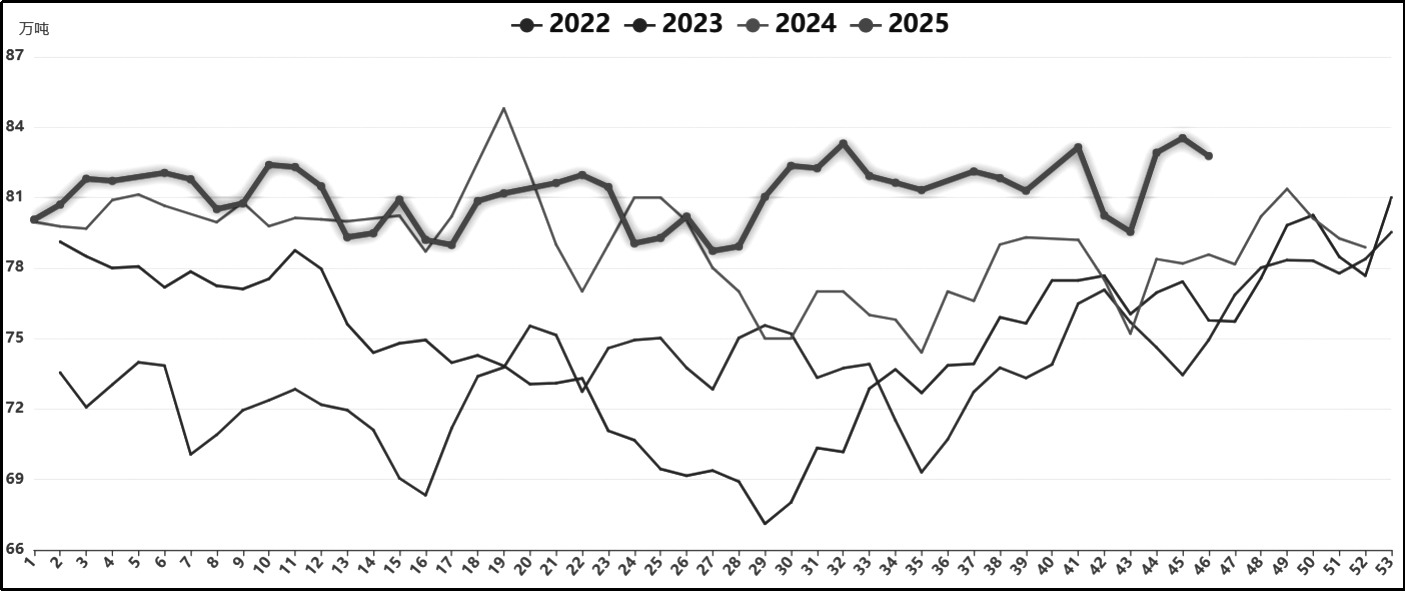
Group 1: Market Overview - Since late October, domestic and international commodity prices have experienced fluctuations, with copper and gold prices showing high volatility after strong performance earlier [1] - The potential for a Federal Reserve interest rate cut in December, driven by concerns over the job market, may stimulate a new upward trend in copper prices [1] - Supply shortages are a solid foundation for rising copper prices, particularly due to tight copper ore supply constraining refined copper production [1] Group 2: Copper Supply Dynamics - In 2025, global copper mine supply growth is expected to fall short of projections, with a predicted decline of 0.12% year-on-year [2] - The top twenty copper mines are projected to see a 6.5% year-on-year decrease in production in Q3 2025, primarily due to external disruptions and internal factors affecting most companies [2] - Significant production increases are anticipated from specific mines, such as Oyu Tolgoi and Las Bambas, while others like Kamoa-Kakula and Grasberg are facing production declines due to various incidents [2][3] Group 3: Future Production Challenges - The global copper mine output is unlikely to see substantial growth in 2026, with increases mainly coming from the resumption of Grasberg and the ramp-up of Oyu Tolgoi [3] - The average ore grade is continuously declining, and mining costs are rising, while new mine development cycles take 6 to 10 years, limiting the potential for rapid output increases [3] - Factors such as resource protectionism and rising development costs are likely to hinder copper mine production from meeting expectations, providing long-term support for copper prices [3] Group 4: Smelting and Refining Pressures - Copper mine shortages are constraining the expansion of refined copper output, with many smelters facing raw material inventory depletion and significant operational pressures [4] - Despite plans for new smelting capacity in China and the Democratic Republic of the Congo, delays are expected in their deployment [4] - Increased activity in overseas smelting plant tenders indicates a proactive approach to securing raw materials, but this further exacerbates the copper supply shortage [4] Group 5: Emerging Demand Drivers - Despite a significant rise in copper prices, traditional copper demand is being suppressed, while emerging sectors like photovoltaic, energy storage, and AI are driving strong demand growth [5] - The photovoltaic industry is projected to require approximately 217.3 to 220 thousand tons of copper due to anticipated global solar installation growth [5] - The energy storage market in China is expected to continue its rapid growth, with significant increases in installed capacity projected through 2027 [6] Group 6: Investment Outlook - The Federal Reserve's potential interest rate cut is expected to boost asset prices, including copper, which is increasingly viewed as a critical resource in the AI era [6] - The demand for copper foil is expected to rise significantly, indicating substantial potential for further price increases [6] - Downstream purchasing companies can utilize micro copper futures to hedge against rising procurement costs [6]
贸易企业利用“现货+期权”模式降本增效
Qi Huo Ri Bao· 2025-11-26 16:09
Core Viewpoint - The article discusses how Haitong Futures, through its subsidiary Haitong Resource Management, utilizes innovative "spot + options" business models to provide effective risk management services to Zhejiang Dingchi Energy Co., helping the company stabilize operations and achieve trade growth despite market volatility [1][2]. Group 1: Business Model and Strategy - Haitong Resource tailored a risk management solution centered on "cumulative put options" for Zhejiang Dingchi Energy, allowing the company to lock in sales prices and enhance operating profits [2]. - The collaboration led to a significant increase in trade volume, with Zhejiang Dingchi's average monthly trade volume rising to approximately 6,000 tons, a year-on-year increase of about 50% [2]. Group 2: Financial Performance - The transaction involving the purchase of RB2501 linear payout cumulative put options resulted in a profit of 123,000 yuan, contributing to the overall increase in sales profits for the company [2]. - By the end of 2024, the cumulative project cooperation scale reached 95,000 tons, with an effective nominal principal of approximately 350 million yuan, completing 62 transactions in over-the-counter derivatives [2]. Group 3: Market Insights and Future Outlook - The innovative approach of converting spot holdings into a "spot + options" holding model allows companies to secure high-price pre-sales during price increases and enhance profits during price declines [3]. - Haitong Resource emphasizes the importance of understanding the personalized needs of enterprises to design targeted trading strategies, contributing to the stability and high-quality development of the real economy [3].