Jin Shi Shu Ju

Search documents
每日投行/机构观点梳理(2026-01-05)
Jin Shi Shu Ju· 2026-01-05 10:37
2. 高盛:委内瑞拉未来石油产量可能会有所增加,油价风险偏向下行 高盛集团表示,美国介入之后,委内瑞拉的石油产量在未来有望进一步提高,这可能会最终对油价造成 压力。包括Daan Struyven和Yulia Zhestkova Grigsby在内的分析师表示:"产量的任何回升都可能会是缓 慢且有限的,因为基础设施已经受损,而且还需要强有力的激励措施来促进大规模的上游投资。"就近 期而言,该行维持了其对今年油价的平均预测不变,布伦特原油的均价预测仍为每桶56美元,WTI原油 的均价预测仍为每桶52美元。不过他们表示:"除了近期俄罗斯和美国的石油产量数据有所增长之外, 委内瑞拉长期产量可能会进一步攀升,这使得我们对2027年及以后的油价预测面临更大的下行风险。" 3. 凯投宏观:不认为委内瑞拉事件会改变石油市场 国外 1. 瑞银:上调黄金目标价至5000美元 "我们继续看好黄金,并将2026年3月、6月和9月的目标价由每盎司4500美元上调至5000美元。"瑞银财 富管理投资总监办公室最新观点指出,黄金价格近期创下历史新高,主要受美元走弱、地缘政治紧张加 剧、制度性不确定性持续以及季节性流动性偏紧等因素推动。多国 ...
特朗普向印度发出最后通牒:若再买俄油,就继续加税!
Jin Shi Shu Ju· 2026-01-05 10:30
AI播客:换个方式听新闻 下载mp3 音频由扣子空间生成 美国总统特朗普上周日表示,如果新德里不满足华盛顿关于遏制购买俄罗斯石油的要求,美国可能会提 高对印度的关税。目前贸易谈判仍无定论,这一表态加大了对这个南亚国家的压力。 "莫迪是个好人。他知道我不高兴,而让我高兴很重要,"特朗普在空军一号上告诉记者。 他指出,尽管制裁后印度炼油商减少了进口,但购买并未完全停止,这让印度处于一个"战略灰色地 带"。 印度市场周一对此作出反应,信息技术股票指数下跌约2.5%,创下一个多月以来的新低。投资者担心 紧张的贸易关系可能会进一步推迟美印贸易协议的达成。 特朗普的亲密盟友、随行的共和党参议员格雷厄姆表示,美国对俄罗斯石油公司的制裁以及对印度征收 的更高关税,已有助于遏制印度的石油进口。 格雷厄姆正在支持一项立法,旨在对印度等继续购买俄罗斯石油的国家征收高达500%的关税。 "如果你购买廉价的俄罗斯石油,(你)就是在维持普京的资金来源,"他说,并补充道,"我们正试图 通过关税赋予总统让这一选择变得艰难的能力。" 格雷厄姆称,特朗普的行动是印度目前购买"大幅减少的俄罗斯石油"的主要原因。 然而,贸易专家警告称,新德里采取的 ...
三星、SK海力士放量提价,服务器内存或大涨70%!
Jin Shi Shu Ju· 2026-01-05 10:04
Group 1 - The core viewpoint of the articles indicates that Samsung Electronics and SK Hynix are planning to increase server memory prices, particularly DRAM, by up to 70% in Q1 2026 due to surging AI demand and tightening global memory supply, marking a shift from a buyer's market to a seller's market [1][2]. - The proposed price adjustments primarily target server DRAM products, which are critical components for cloud service providers and large-scale AI data centers, as the demand for high-performance memory, especially DDR5 and high bandwidth memory (HBM), significantly exceeds current supply [1][2]. - The global memory supply is undergoing a structural change, with a supply shortage cycle beginning in 2024 driven by the substantial increase in AI infrastructure demand and a shift in production focus towards high-margin areas like HBM [1][2]. Group 2 - In response to the supply-demand tension, major memory suppliers like Samsung and SK Hynix are not only adjusting prices but also changing their supply strategies, prioritizing contracts for DDR5 DRAM to meet the needs of cloud services and major tech clients, reflecting characteristics of a "seller's market" [2]. - The anticipated price increase has raised widespread attention across the industry, as memory prices are a significant cost component for server and data center construction, potentially leading to higher overall investment costs for cloud service providers and enterprise computing infrastructure [2]. - The core driver of the current global memory market supply-demand restructuring is the explosive growth in AI computing demand, with AI data centers becoming the main driver for memory market dynamics, while traditional consumer electronics and enterprise PC markets are becoming less significant [2][3]. Group 3 - The overall supply side of the industry has not significantly expanded in the short term, as major memory manufacturers, including Samsung and SK Hynix, hold a concentrated global supply share, and expanding new capacity involves long-term investments and complex wafer manufacturing cycles [3]. - The price trends, actual contract execution, and responses from major server memory buyers will be key observation points in the market after 2026, with uncertainties surrounding whether Samsung and SK Hynix can successfully implement the 70% price increase and how this strategy may affect customer order structures or long-term supply agreements [3]. - The ongoing tightness in memory supply may prompt downstream companies to accelerate inventory strategy adjustments or seek alternative supply solutions, with industry observers closely monitoring pricing dynamics from other major memory manufacturers and the evolution of global memory supply-demand relationships in the coming months [3].
2026年AI狂欢下的隐忧:通胀“回马枪”或将刺破美股泡沫
Jin Shi Shu Ju· 2026-01-05 07:44
Group 1: Market Overview - The global stock market is experiencing a surge driven by artificial intelligence (AI) enthusiasm, but inflation risks may threaten this growth [1] - Major tech companies contributed to half of the gains in the US stock market last year, with significant increases in stock indices due to AI and monetary easing expectations [1] - Wall Street anticipates that government stimulus and AI prosperity will inject new growth into the global economy in 2026 [1] Group 2: Inflation Concerns - Fund managers are preparing for a potential resurgence of inflation, as economic growth from AI may lead central banks to end the interest rate cut cycle [1][2] - Tightening monetary policy could reduce investor interest in speculative tech stocks, increase financing costs for AI projects, and cut into tech companies' profits and stock prices [2] - Analysts predict that inflation rates will remain above the Federal Reserve's 2% target due to substantial corporate investments in AI [2] Group 3: Cost Pressures - Rising costs associated with chip and energy consumption are expected to contribute to inflation, as major tech firms invest heavily in new data centers [2][6] - Oracle's stock dropped due to rising expenditure, while Broadcom warned of profit margin pressures, indicating early signs of market tension regarding cost increases [4] - HP anticipates experiencing price and profit pressures in the latter half of 2026 due to increased demand for storage chips driven by data center needs [4] Group 4: Investment Strategies - Investment firms are increasingly concerned about inflation risks, prompting some to shift towards inflation-protected bonds [5] - The potential for rising interest rates may lead to a decrease in the price-to-earnings ratios for large AI stocks [5] - Deutsche Bank forecasts that capital expenditures for AI data centers could reach $4 trillion by 2030, raising concerns about supply bottlenecks and spiraling investment costs [6]
入局容易抽身难!特朗普或加剧美国“负担能力危机”
Jin Shi Shu Ju· 2026-01-05 06:19
Group 1 - The U.S. military intervention in Venezuela aims to assert influence in the region, with President Trump indicating intentions to "take over" Venezuela [1] - If the U.S. government follows through on controlling Venezuela, it must prepare for potential impacts on consumer purchasing power and inflation risks for businesses and investors [2] - The diesel market is particularly vulnerable, as Venezuela and Colombia are key suppliers of heavy crude oil, which is essential for diesel production [2][3] Group 2 - Disruptions in Venezuelan oil production and exports could lead to significant increases in diesel prices, impacting energy and food prices in the U.S., especially in rural areas [3] - The Gulf Coast refineries in the U.S. are configured to process Venezuelan crude, with approximately 4% of their raw material inputs coming from Venezuela and Colombia [3] - A military intervention could lead to a scenario where international crude oil prices rise by $5 to $8 per barrel, with diesel retail prices potentially increasing to $4.15 to $4.50 per gallon, a rise of 15% to 25% from previous levels [6] Group 3 - The potential for a swift military resolution is low, as Maduro's regime remains resilient, and external factors may hinder a quick turnaround in oil production [5] - The diesel market is already under pressure due to low inventories and structural supply shortages, which could exacerbate price increases [7] - The trucking industry, heavily reliant on diesel, is particularly at risk, with significant operational costs tied to fuel prices, impacting profitability [8] Group 4 - The U.S. government is advised against large-scale military intervention in Venezuela, as it may worsen financial pressures on American consumers and increase costs in diesel-dependent states [9] - Alternative non-military strategies are suggested to weaken Maduro's regime and alleviate immigration pressures in the Americas [9]
耶伦与多位业界泰斗齐发声:美国债务正逼近“悬崖边缘”!
Jin Shi Shu Ju· 2026-01-05 06:12
一众经济学界泰斗表示,不断攀升的联邦债务所引发的长期风险,是美国经济面临的首要难题。 这些风险中包括这样一种情况:庞大的债务规模迫使美联储维持低利率,以尽量降低偿债成本,而非抑 制通胀,这一概念被称为"财政主导"。 前美国财长兼美联储主席耶伦上周日在费城出席美国经济学会年会的小组讨论时表示:"'财政主导'出 现的前提条件显然正在增强。" 她表示:"虽然我不认为美国最终会走上'财政主导'的不归路,但我确信这些危险是真实存在的,必须 予以密切监控。" 加州大学伯克利分校的经济学家David Romer则表示,对于两党达成协议以避免"财政灾难"的前景,他 感到"不那么乐观"。 "我们面临着财政问题,"David Romer说道,"如果我们不解决它,这将给包括美联储在内的所有人带来 麻烦。" 耶伦此前曾表示,如果特朗普成功迫使美联储维持低利率以缓解政府债务负担,美国将面临沦为"香蕉 共和国"的风险。 同场出席的前克利夫兰联储主席梅斯特补充道,当前债务问题中"最可怕"的一点在于,特朗普政府的官 员似乎并不理解其中蕴含的威胁。 "历届政府都知道自己正处于悬崖边缘,"尽管它们最终并未采取负责任的行动来控制赤字,她说 道," ...
2026开年三连炸!美联储1月直面三大节点
Jin Shi Shu Ju· 2026-01-05 05:27
SHMET网讯: 美联储步入2026年,面临着一系列政治和政策挑战,其核心是新任主席人选问题,以及一个顺风与逆风 并存的经济环境,这些都将使政策制定者的抉择更为关键。 在连续三次降息之后,预计这家央行在未来一年将遵循一条更为温和的路径,考虑到对稳健增长和持续 通胀压力的预期,进一步的降息可能难以实现。 但有一点似乎可以确定:在经历了围绕美联储异常动荡的一年之后,2026年看起来将延续相似的状况。 "我确实认为将会有巨大的关注焦点。其中会有许多复杂的纠葛,"全国保险公司(Nationwide)首席经 济学家凯西·博斯蒂安契克(Kathy Bostjancic)表示。"仍然存在许多不确定性,这使得美联储继续处于 聚光灯下,很可能也处于风口浪尖。" 过去一年,美联储以前所未有的方式成为焦点。 聚焦政策 尽管如此,在政策方面,华尔街多数人士预计美联储会将喧嚣置于脑后,继续沿着略微降低基准利率的 道路前进,直至更接近约3%的中性水平。中性水平被认为是一个既不刺激也不抑制经济活动的点位, 而目前的联邦基金利率仅比FOMC多数成员认为的长期目标利率高出半个百分点。 "鲍威尔主席帮助策划了连续三次25个基点的降息。他并没有阻 ...
马斯克晒与特朗普晚宴合照,数小时前马杜罗被捕
Jin Shi Shu Ju· 2026-01-05 04:50
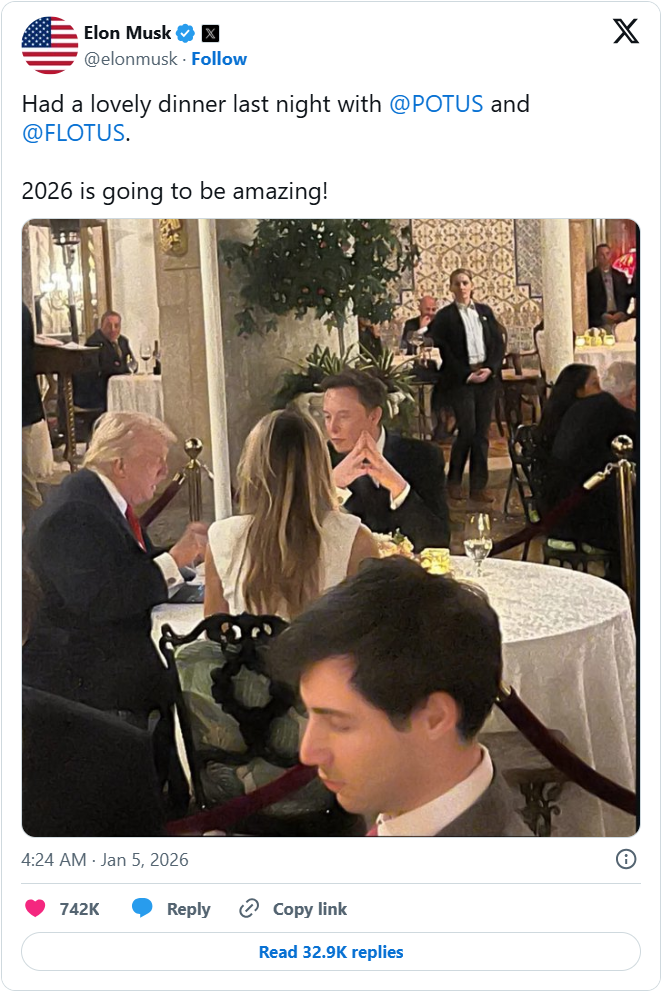
这位全球首富于当地时间周日发布了一张照片,画面中他与特朗普及第一夫人梅拉尼娅(Melania)在 海湖庄园亲密聚餐,他还随性配文称:"2026年将会精彩绝伦!" 该帖子发布后一小时内,浏览量便突破1000万;五小时内,浏览量更是飙升至2300万,且这一数字仍在 持续增长。但网友关注的焦点并不仅仅是这张合照,他们还翻出了两人过往的"恩怨旧账"。 据路透社报道,在2024年竞选之后,马斯克成为共和党最大的政治捐助者之一,贡献了数亿美元。特朗 普后来让马斯克为政府效率工作提供建议,并成立了政府效率部(DOGE),专注于减少联邦支出和精 简运营——但马斯克在越来越多的批评中于2025年中期退出了这一角色。 亿万富豪、特斯拉创始人埃隆・马斯克(Elon Musk)在X平台发布的帖子显示,美国总统特朗普与他 本人此前一度紧张的关系,如今似乎已经修复。 不出所料,特朗普的"让美国再次伟大"(MAGA)支持者们欣喜若狂。有用户配上人工智能生成的同人 图,发帖欢呼:"我们的组合回来了!"保守派评论员埃里克・多尔蒂(Eric Daugherty)则写道:"埃 隆,感谢你助力拯救2026年的美国!美国队冲啊!" 批评者们则抛出了其 ...

特朗普狠话不断:对哥伦比亚动武“听起来不错”,古巴“随时要完了”
Jin Shi Shu Ju· 2026-01-05 03:23
AI播客:换个方式听新闻 下载mp3 音频由扣子空间生成 在美国武力绑架委内瑞拉领导人后,美国总统特朗普向哥伦比亚总统古斯塔沃・佩特罗(Gustavo Petro)发出威胁,并称他认为古巴政府也可能很快倒台。 特朗普于当地时间周日晚间在 "空军一号" 专机上接受记者采访时发表了上述言论。 "委内瑞拉的状况糟糕透顶,哥伦比亚也好不到哪儿去,掌权的是个瘾君子,专靠生产可卡因并卖到美 国牟利。我可以告诉你,他这样的日子不会太久了。" 这位美国总统说道。 当被问及这番话是否意味着美国将对哥伦比亚采取军事行动时,特朗普回应称:"这个主意我听起来不 错。" 他还补充表示,美国不太可能对古巴进行军事干预,因为这个国家似乎正处于自行崩溃的边缘。 他还再次发出威胁,称如果委内瑞拉 "不守规矩",美国将再度向该国派驻军队。 特朗普从未掩饰其扩大美国在西半球影响力的野心,他试图重振19世纪的 "门罗主义"——该主义宣称 拉丁美洲属于美国的势力范围。 "古巴就快撑不住了,看上去随时都会垮台。我实在想不通他们要怎么维持下去,反正他们现在已经没 有任何收入来源了。过去古巴的所有收入都来自委内瑞拉,来自委内瑞拉的石油。" 特朗普称。 "如 ...
黄金去年的疯狂难以复制?投行目标价现巨大分歧
Jin Shi Shu Ju· 2026-01-05 02:52
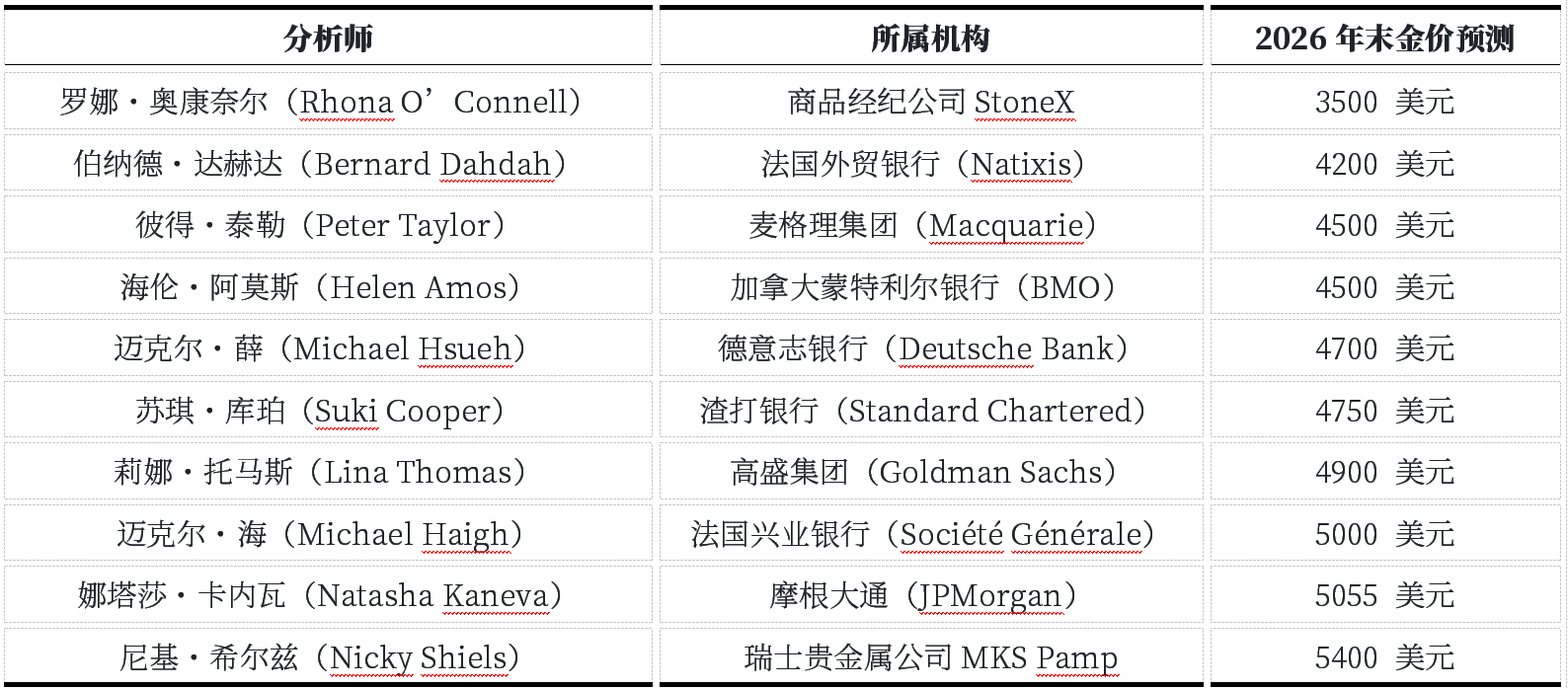
Core Viewpoint - The survey by the Financial Times indicates that gold prices are expected to continue their historic upward trend into 2026, reaching a new high, although analysts predict a slowdown in the pace of increase after a remarkable surge in 2025 [1] Group 1: Price Predictions - Analysts predict that gold prices, which surged by 64% in 2025, will rise nearly 7% by the end of 2026, reaching approximately $4,610 per ounce [1] - The most optimistic forecast comes from Nicky Shiels of MKS Pamp, who anticipates gold prices could reach $5,400 per ounce, representing a 25% increase [2] - The average predicted price for gold at the end of 2025 was underestimated, with actual closing prices significantly higher at $4,314 compared to the predicted $2,795 [3] Group 2: Influencing Factors - Continued demand from emerging market central banks and investor interest in safe-haven assets are expected to drive gold prices in 2026 [2] - Lina Thomas from Goldman Sachs notes that if investors diversify their asset allocations further, there could be significant upward potential for gold prices, with a potential year-end price of $4,900 [2] - Natasha Kaneva from JPMorgan forecasts that global central bank gold purchases will total around 755 tons in 2026, which, despite being lower than previous years, could still support prices approaching $6,000 by 2028 [3] Group 3: Diverging Opinions - There is a significant disparity between the most optimistic and pessimistic forecasts, with a $1,900 difference between the highest and lowest predictions [3] - The most pessimistic outlook from Rhona O'Connell of StoneX suggests that gold prices could drop to $3,500 due to a crowded market environment [4] - Factors such as declining jewelry demand and the anticipated end of the Federal Reserve's rate-cutting cycle are cited as potential downward pressures on gold prices [4][5]