Jin Shi Shu Ju

Search documents
2026年,黄金“疯牛”行情还能走多远?
Jin Shi Shu Ju· 2025-12-26 13:55
Core Viewpoint - In 2025, gold emerged as one of the best-performing assets globally, with a cumulative increase of over 70%, while the S&P 500 index rose by approximately 17% [1] Group 1: Federal Reserve and Interest Rates - The Federal Reserve restarted its easing cycle in September 2025, cutting rates by 25 basis points, followed by another similar cut in October [2] - Market expectations for a third consecutive rate cut in December increased due to signs of economic weakness and dovish signals from key policymakers [2] - The market anticipates an additional 60 basis points of easing in 2026, equivalent to two potential 25 basis point cuts and a possible third cut [2] Group 2: Geopolitical Tensions and Tariff Policies - Geopolitical tensions, including the ongoing Russia-Ukraine conflict and rising tensions between India and Pakistan, have significantly driven demand for gold as a safe-haven asset [3] - The imposition of comprehensive tariffs by the U.S. has further heightened demand for gold, as countries retaliate with their own tariff threats [3] - Despite some conflicts easing, gold continues to attract investment as a hedge against high-risk assets, particularly in a volatile stock market environment [3] Group 3: Central Bank Gold Reserves and De-dollarization - Central banks are increasingly accumulating gold to diversify their reserves, with significant purchases from countries like China and India [4] - In the first three quarters of 2025, global central bank net gold purchases reached 634 tons, significantly above pre-2022 averages, providing strong support for gold prices [4] - The trend of central banks increasing gold reserves is expected to continue into 2026 amid ongoing trade policy uncertainties [4] Group 4: Gold-Silver Ratio and Market Dynamics - The gold-silver ratio is approaching the 60 mark, which may trigger a rebound in gold prices as it indicates potential for gold to catch up with silver's performance [5][6] - Despite gold's strong performance, silver and platinum have outperformed gold, with silver's price increasing over 150% in 2025 [6] - The recent volatility in silver prices has raised questions about the sustainability of its upward trend, while gold remains strong [6] Group 5: 2026 Outlook and Price Projections - The factors driving gold's record highs in 2025 are expected to persist into early 2026, with bullish targets potentially reaching $5,000 to $5,200 per ounce [8] - Goldman Sachs forecasts gold prices could reach $4,900 per ounce by the end of 2026, with significant upside risks if private sector purchases exceed expectations [8] - However, potential challenges include cautious behavior from central banks and the possibility of the Federal Reserve's rate cuts being less aggressive than currently anticipated, which could slow gold's momentum in the latter half of 2026 [8]
一周热榜精选:贵金属全面失序狂飙!日本债务警报拉响?
Jin Shi Shu Ju· 2025-12-26 13:37
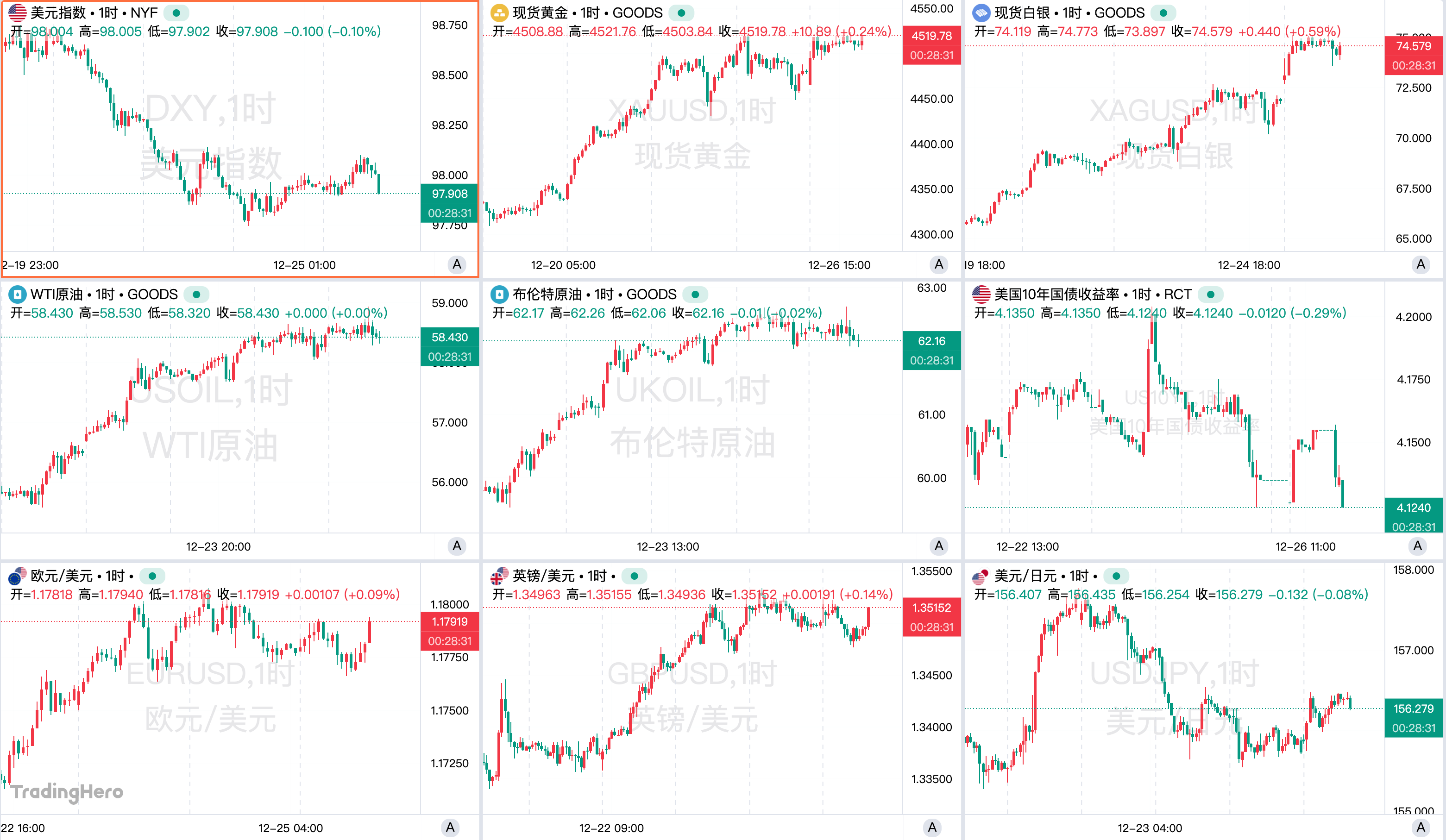
Market Overview - The US dollar index has shown a weak performance, dropping below the 98 mark, reflecting market expectations for potential interest rate cuts by the Federal Reserve next year. As of the report, the index stands at 97.93 [1] - Precious metals have been the standout performers this week, with gold reaching a historical high of over $4530 per ounce, marking a year-to-date increase of over 70%. Silver also surged, breaking the $75 per ounce barrier [1] - Non-US currencies, particularly the euro, pound, and Australian dollar, have strengthened against the US dollar due to its weakness, while the Japanese yen has shown signs of intervention [1] US Stock Market - The US stock market has continued its upward trend, with the S&P 500 index reaching new closing highs on Tuesday and Wednesday, driven by strong performances in the chip and tech sectors, despite some volatility in individual stocks [2] Investment Bank Insights - Barclays has raised its GDP growth forecast for the US in Q4. BlackRock believes that the Fed's rate cuts in 2026 may be limited. Mitsubishi UFJ predicts further weakening of the dollar by 2026. Societe Generale notes that the yen's recovery may be limited, while Morgan Stanley suggests the Bank of Japan may continue to raise rates [5] - UBS warns that FOMO and bubble anxiety may lead to increased volatility in the stock market in 2026 [6] Major Events - The precious metals market has experienced significant volatility, with gold maintaining high levels and silver breaking through key price points. The surge is attributed to central bank purchases, ETF inflows, and geopolitical uncertainties [7] - The National Investment Silver LOF experienced a dramatic reversal, going from consecutive gains to a sharp decline due to high premiums and market corrections [8] - The US economy showed unexpected growth in Q3, with a 4.3% annualized increase, but economists warn that this growth may not be sustainable into Q4 due to potential government shutdowns [9][10] - The US has increased military presence in the Caribbean amid rising tensions in Venezuela, with plans for potential military action against the Maduro government [12][13] - Ukraine's President Zelensky has proposed a new peace plan with Russia, focusing on ceasefire and humanitarian issues, but key political status questions remain unresolved [14][15][16] - The People's Bank of China has introduced a one-time credit repair policy to assist individuals with overdue debts, aiming to improve their credit status [17] - Japan's 2026 fiscal budget has raised concerns about fiscal sustainability, with a record budget of 122.3 trillion yen, driven by social security costs and defense spending [18][19] Corporate Developments - Nvidia has secured a non-exclusive licensing agreement with Groq for chip technology, aiming to enhance its position in the AI chip market, with plans to deliver H200 chips to Chinese customers before the Lunar New Year [22] - The acquisition battle for Warner Bros. has intensified, with Oracle founder Larry Ellison personally backing a $40.4 billion offer from Paramount, increasing competition with Netflix [23]


每日投行/机构观点梳理(2025-12-26)
Jin Shi Shu Ju· 2025-12-26 12:32
Group 1 - UBS Wealth Management predicts that the Chinese stock market will continue to have upward potential through 2026, driven by advanced manufacturing and technology as new growth engines [1] - The technology sector, which accounts for about half of the MSCI China Index, is becoming increasingly resilient to external shocks and U.S. economic cycles [1] - The Hang Seng Tech Index is expected to see a 37% growth in earnings per share by 2026, with approximately 7 trillion RMB in excess household savings likely to flow into the stock market [1] Group 2 - Barclays anticipates that the Bank of Japan will raise interest rates in July and December of 2026, influenced by the spring wage negotiation cycle [2] - The report emphasizes the importance of wage negotiations as a key factor in the Bank of Japan's monetary policy and its response to the risk of yen depreciation [2] Group 3 - OANDA reports that multiple factors are driving a historic surge in precious metals, with gold potentially reaching $5,000 per ounce and silver $90 per ounce in the coming year [3] - The report attributes the rise to speculative trading, low liquidity at year-end, expectations of long-term Fed rate cuts, a weaker dollar, and increased geopolitical risks [3] - Platinum and palladium prices have surged due to supply constraints and strong industrial demand, with platinum up approximately 165% and palladium over 90% year-to-date [3] Group 4 - CICC suggests focusing on asset trend changes rather than specific gold price predictions, as current gold prices are above short-term valuation models, indicating potential bubbles [4] - The report anticipates that the gold bull market may not end soon, but volatility is expected to increase as prices deviate from fundamental indicators [4] - CICC maintains an optimistic outlook on Chinese assets, emphasizing the benefits of the AI technology wave and ample liquidity, while suggesting a focus on technology growth in the short term [5][6] Group 5 - CITIC Securities highlights the importance of maintaining macro liquidity stability through tools like reserve requirement ratio cuts and interest rate reductions [6] - The report predicts a 5%-10% increase in the overall A-share market in 2026, with Hong Kong stocks expected to experience a rebound in performance [6] - The outlook for commodities includes expectations for gold to challenge $5,000 per ounce and copper prices to rise to $12,000 per ton due to supply constraints and demand drivers [6] Group 6 - CITIC Securities notes a trend of diminishing focus on quantitative targets by the People's Bank of China, with an emphasis on long-term structural reforms [7] - The report indicates that the central bank's policy may shift towards addressing supply-side issues and reducing financing costs [7] Group 7 - Huatai Securities states that the current appreciation of the RMB is likely to enhance foreign interest in RMB-denominated assets, creating a positive feedback loop for capital inflows [8] - The report suggests that the strengthening of the RMB will continue to support the valuation of both onshore and offshore RMB assets [8] Group 8 - CITIC Jin Investment reports that rising storage costs have begun to impact consumer electronics prices, with several manufacturers increasing product prices by 100-200 RMB [9] - The report indicates that the cost pressures from rising storage prices are likely to lead to a temporary decline in consumer electronics sales [9] Group 9 - Galaxy Securities notes that leading liquor companies are adjusting their strategies for 2026, focusing on maintaining price stability and channel profitability amid cyclical pressures [10] - The report emphasizes the importance of developing new consumer segments and adapting to new consumption trends as part of long-term transformation efforts [10]
特泽会再启动?泽连斯基:新年前夕或“解决很多事情”
Jin Shi Shu Ju· 2025-12-26 12:31
Core Viewpoint - Ukrainian President Zelensky announced a forthcoming meeting with U.S. President Trump, indicating a potential resolution to ongoing conflicts before the New Year [1] Group 1: Diplomatic Engagements - Zelensky reported successful talks with U.S. negotiators Steve Witkoff and Jared Kushner, reaching a consensus on accelerating peace efforts [1] - The Ukrainian delegation, led by Rustem Umerov, met with U.S. officials in Miami, indicating increased diplomatic activity between Ukraine and the U.S. [1] - A revised 20-point peace plan is nearing finalization, reflecting discussions between Ukrainian and U.S. representatives [2] Group 2: Territorial and Nuclear Issues - Ukraine and the U.S. have not yet reached an agreement on two critical issues: the cession of parts of the Donbas region and the future of the Zaporizhzhia nuclear power plant [2] - The latest draft of the peace plan proposes establishing an economic zone in parts of Donbas, an area claimed by Russia [2] - Russian President Putin expressed a willingness to exchange some territories but insists on retaining full control over the Donbas region [4] Group 3: Russian Position - Putin's conditions for a peace agreement include Ukraine's withdrawal from the entire Donbas, Zaporizhzhia, and Kherson regions, as well as abandoning NATO membership aspirations [5] - Discussions are ongoing regarding the joint management of the Zaporizhzhia nuclear power plant by Russia and the U.S., with potential U.S. interest in cryptocurrency mining near the facility [6]
“特朗普”级战列舰计划是闹剧一场?专家辣评:永不启航的纸老虎
Jin Shi Shu Ju· 2025-12-26 09:33
Core Viewpoint - The announcement of the "Trump-class" battleship by President Trump claims it will be the "fastest, largest, and most powerful" battleship, but experts argue that battleships are outdated and the project faces significant challenges [1][2]. Group 1: Project Overview - The "Trump-class" battleship is described as a super warship that aims to maintain U.S. military dominance and intimidate adversaries [1]. - The last U.S. battleship was built over 80 years ago, and the last Iowa-class battleships were retired nearly 30 years ago, indicating that the concept of battleships is outdated [1][2]. Group 2: Expert Opinions - Mark Cancian from CSIS believes the project is impractical due to its long design cycle, high costs, and misalignment with the Navy's current distributed firepower strategy [1][5]. - Bernard Loo compares the project to Japan's Yamato and Musashi battleships, suggesting it is more about prestige than practical military utility [2]. Group 3: Design and Functionality - The proposed battleship will have a displacement of over 35,000 tons and a length exceeding 840 feet, which could make it a target for enemy forces [2]. - Bryan Clark emphasizes that the effectiveness of a vessel relies more on its weaponry than its classification, noting that the Trump-class will include advanced weapon systems like electromagnetic railguns and laser weapons [4]. Group 4: Cost and Budget Implications - The estimated cost of the Trump-class battleship could exceed $8 billion, making it 2 to 3 times more expensive than current destroyers, which could strain the Navy's budget [6]. - Historical context shows that U.S. weapon projects often exceed their budgets and timelines, as seen with the Zumwalt-class destroyer, which was reduced from 32 to 3 units due to cost overruns [6].
史诗级信号!道指黄金比第四次拐点确立,财富大转移开启
Jin Shi Shu Ju· 2025-12-26 09:05
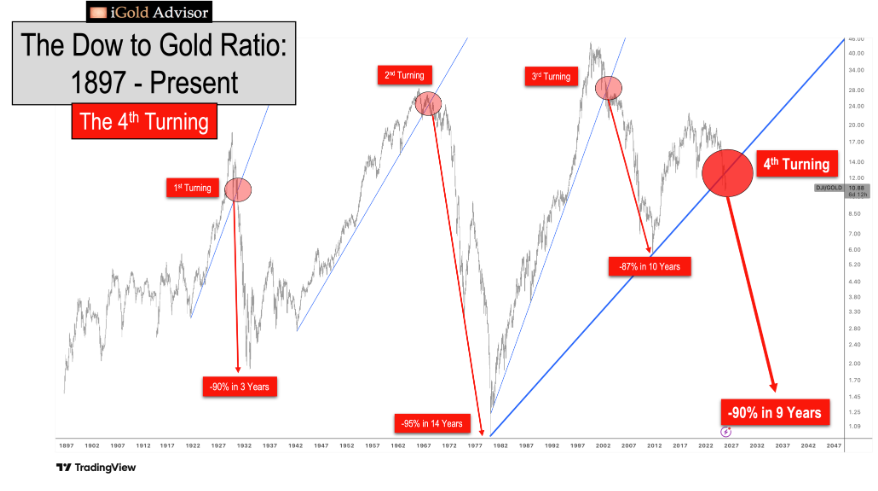
Core Insights - The Dow-Gold ratio has reached a significant turning point, indicating a potential multi-year rise in gold prices while industrial stocks like the Dow and S&P 500 may face prolonged losses [1][19][31] Group 1: Understanding the Dow-Gold Ratio - The Dow-Gold ratio measures the number of ounces of gold required to purchase one share of each of the 30 stocks in the Dow Jones Industrial Average [2] - This ratio reflects the comparative appreciation rates of industrial stocks versus gold, a traditional store of wealth [2] Group 2: Historical Turning Points - The first turning point occurred from 1930 to 1933, where the Dow-Gold ratio peaked at 18.6 in 1929, followed by a 90% drop in the ratio by 1933, while gold prices increased by 75% [6][7] - The second turning point from 1968 to 1980 saw the ratio peak at 24.5 in 1966, followed by a decline of over 95% by 1980, as gold prices surged from $35 to $850 [10][12] - The third turning point from 2002 to 2011 had the ratio drop from 45.0 to 5.7, with gold prices rising significantly during the global financial crisis [14][15] Group 3: Current and Future Projections - The fourth turning point has been established, with the Dow-Gold ratio currently at 10.9, suggesting a potential decline of at least 80% to a target of 2.1 by January 2028 [22][31] - The analysis indicates that the average decline from previous turning points suggests a similar trajectory for the current cycle, with gold likely to outperform industrial stocks significantly [20][30] - The ongoing global debt crisis is highlighted as a critical factor influencing the market, with gold expected to rise as a safe haven asset amidst currency devaluation [32][33] Group 4: Investment Strategy - Investors are advised to overweight precious metals and gold mining stocks in anticipation of a significant wealth transfer opportunity in the coming years [35]
2025财经大事记:特朗普2.0奠定动荡基调,贵金属开启史诗级牛市!
Jin Shi Shu Ju· 2025-12-26 07:45
Group 1: Global Trade and Economic Policies - Trump's return to the White House significantly altered global trade dynamics, introducing a "MAGA 2.0" policy that included a "reciprocal tariff" approach, leading to a 9% drop in the S&P 500 index [4] - The market adapted to Trump's unpredictable tariff announcements, leading to the emergence of the "TACO trade" strategy among investors [4] - The U.S. government faced a record shutdown lasting 43 days due to budget negotiations, highlighting deep-rooted issues in fiscal management, with national debt surpassing $38 trillion [13] Group 2: AI and Technology Developments - The launch of DeepSeek's open-source model R1 marked a pivotal moment in AI, challenging Western dominance and leading to a surge in Chinese tech stocks [5] - Oracle's $300 billion contract with OpenAI raised concerns about over-reliance on a single partner, with Oracle's stock experiencing a significant drop of over 40% from its peak [11][12] - Nvidia's market capitalization surpassed $5 trillion, becoming the first company to reach this milestone, although concerns about a potential bubble emerged as its stock faced volatility [15][16] Group 3: Precious Metals Market - The precious metals market experienced a historic bull run, with gold prices rising over 70% to exceed $4,500 per ounce, while silver prices surged nearly 160% [14] - The rise in precious metals was driven by multiple factors, including Fed rate cuts, geopolitical tensions, and concerns over national debt [14] Group 4: Leadership Changes and Market Reactions - Warren Buffett's retirement announcement and the appointment of Greg Abel as his successor led to a decline in Berkshire Hathaway's stock price by over 10% [6][7] - The political landscape in Japan shifted with the election of Prime Minister Kishi Sanae, whose expansive fiscal policies raised concerns about increasing national debt [17]

日本内阁批准创纪录7850亿美元预算,砍长债稳市场,芯片投资翻两番
Jin Shi Shu Ju· 2025-12-26 07:21
SHMET 网讯:日本首相高市早苗的内阁于周五批准了下一财年创纪录的近7850亿美元预算,旨在通过 限制新债发行,在其积极的财政政策与对债务失控的担忧之间取得平衡。 面对不断上升的政府债券收益率和疲软的日元,高市早苗政府已加紧努力向投资者保证,政府不会诉诸 不负责任的债务发行或减税。 这份将于明年年初提交国会的、从4月开始的新财年预算,总额将达到创纪录的122.3万亿日元(约合 7846.3亿美元),超过今年115.2万亿日元的初始预算。 尽管如此,新发行政府债券的额度仅将从今年的28.6万亿日元小幅增加至29.6万亿日元,债务依赖率将降 至24.2%,为1998年以来的最低水平。预计将创纪录地增加7.6%至83.7万亿日元的更高税收收入,将有助于为 增加的支出提供资金,尽管这并不能完全抵消激增的债务偿付成本,以及更高的社会福利和国防开支。 用于利息支付和债务偿还的偿债成本将跃升10.8%,达到31.3万亿日元,设定的假设利率为3.0%,这是29 年来的最高水平,因为日本央行正在退出超宽松货币政策。 日本已经是发达世界中债务负担最重的国家,其债务规模是其经济规模的两倍多,这使其对借贷成本的 上升高度敏感,并使 ...

繁荣之下的“定时炸弹”!盘点2026年还需小心的十大风险
Jin Shi Shu Ju· 2025-12-26 07:06
Group 1: AI Bubble and Market Valuation - The current valuation levels of US stocks, particularly in the AI sector, are approaching those seen during the 2000 dot-com bubble, raising concerns about sustainability [2] - Analysts predict a 10-13% earnings growth for the S&P 500 in 2025, with a 15% growth expected in 2026, but there are doubts whether this growth can support current valuations [2] - If major tech companies fail to deliver expected returns from AI investments, market confidence could collapse, leading to significant economic repercussions [2][3] Group 2: Consumer Spending and Economic Resilience - The top 20% of wealthy households in the US hold 70% of financial assets, and their spending accounts for nearly half of total US consumption [3] - A collapse of the AI bubble could lead to a rapid decrease in wealth for these households, resulting in a sharp contraction in consumer spending and a potential recession [3] Group 3: Labor Market and Inflation Risks - The construction of AI infrastructure has created numerous jobs, but a sudden halt in AI investment could lead to widespread job losses and a rise in unemployment [4] - Stricter immigration policies are exacerbating labor shortages, which could lead to increased wage inflation and further economic instability [5] Group 4: Fiscal and Trade Risks - The US federal budget deficit reached $1.8 trillion in the 2025 fiscal year, raising concerns about fiscal sustainability [6][7] - Proposed "tariff rebates" by the Trump administration could exacerbate the deficit, especially if they are not supported by corresponding revenue [6][7] Group 5: Federal Reserve Independence - The potential political influence over the Federal Reserve could undermine its independence, leading to uncontrolled inflation and rising long-term interest rates [10][11] - A loss of credibility for the Federal Reserve could result in a significant decline in the value of the US dollar and increased capital flight [12] Group 6: Bond Market Trust Crisis - The US federal deficit is expected to remain high, and any loss of investor confidence could trigger a sell-off in the bond market, affecting global financial stability [13] - European countries are also facing similar challenges, with rising defense spending and increasing public debt levels [14][15] Group 7: Japanese Policy and Global Impact - Japan's recent interest rate hikes could disrupt global financial markets, particularly affecting yen carry trades that have significant implications for liquidity [16][17] - A potential "rate hike-recession" cycle in Japan could further complicate global economic conditions [17] Group 8: Gold Valuation Risks - The significant disparity between the market value and the official valuation of US gold reserves poses risks if the government decides to revalue these assets [18][19] - A revaluation could lead to inflationary pressures and undermine the independence of the Federal Reserve [19][20] Group 9: Geopolitical Risks - The shift in US foreign policy could lead to increased volatility in global markets, particularly concerning energy prices and supply chains [21][22] - Ongoing conflicts in regions like the Middle East and Africa could disrupt critical trade routes, impacting global economic stability [23][25] Group 10: European Political Fragmentation - The rise of far-right parties in Europe and the erosion of EU unity could lead to increased political instability and economic challenges [26][27] - The potential for member states to act independently could weaken the EU's collective decision-making power and exacerbate existing tensions [28] Group 11: Private Credit Market Risks - The private credit market has grown significantly, but rising default rates and financial instability could lead to a broader financial crisis [29][30] - A collapse in this market could trigger a chain reaction affecting traditional financial systems and investor confidence [30]
碳酸锂期货持续上涨,一度突破13万大关!市场逻辑发生了哪些变化?
Jin Shi Shu Ju· 2025-12-26 05:51
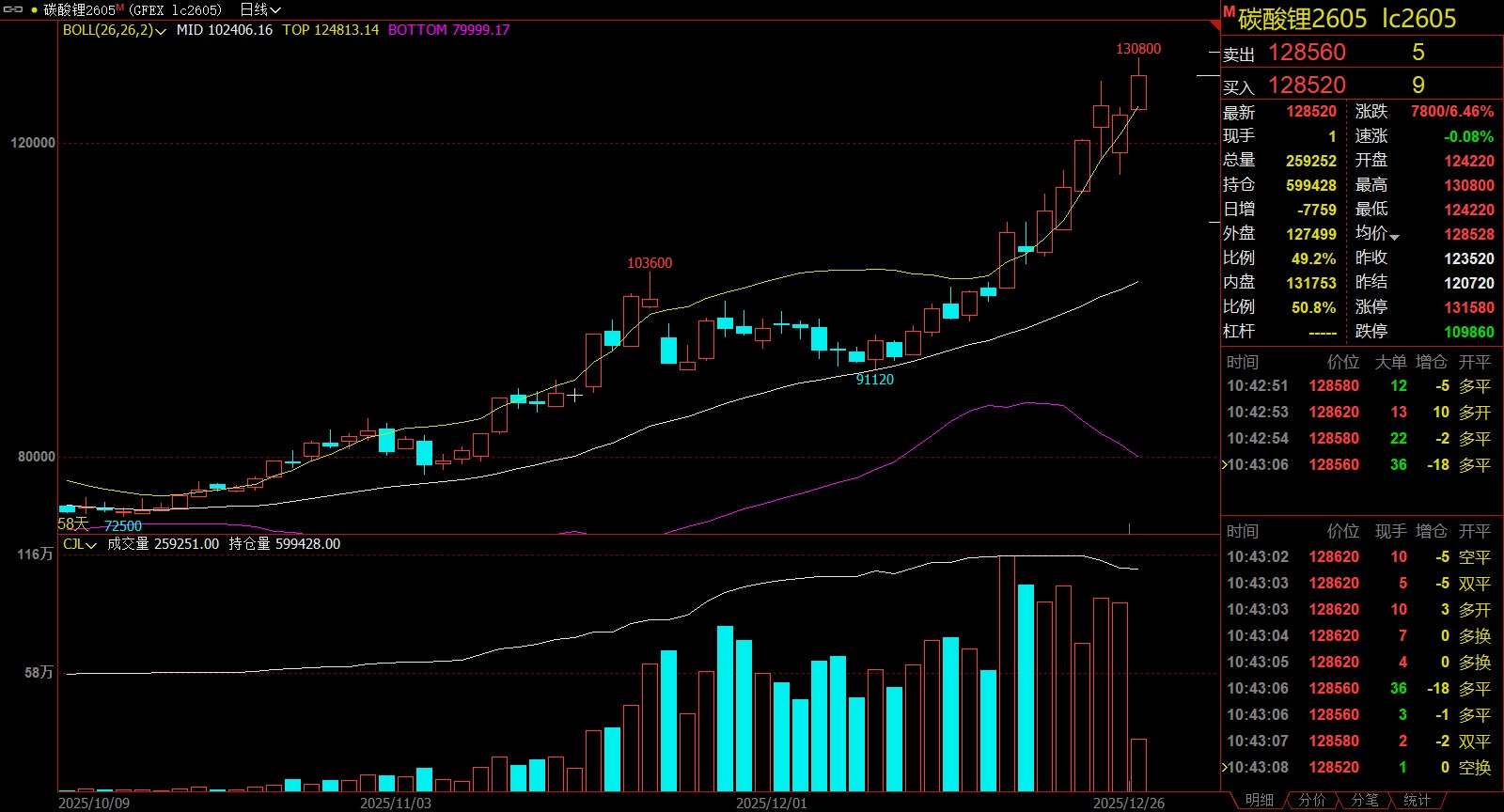
光大期货也在研报中提及此事,其指出,定价机制和价格传导方面对部分环节企业经营造成压力,关注明年强需求是否能够得到验证。 一德期货分析认为,材料厂万润、裕能表示部分产线将要减产,欲在长协谈判中获得主动权。 市场重点关注的碳酸锂的库存有何变化? 2025年12月26日,国内碳酸锂期货价格延续凌厉涨势,日内大幅上涨超过6%,盘中一度突破13万元/吨整数关口,创下2023年11月以来的新高。至此,碳酸 锂期货价格已实现连续三个月上涨,本周累计涨幅超过15%。 综合多家机构观点指出,此轮突破性上涨,是产业定价规则重塑、供应端扰动消息、低库存现实与市场乐观预期共同催化的结果。一方面,行业龙头企业宣 布改变现货定价基准,直接与期货价格挂钩,这一重大规则变化显著增强了期货价格对现货市场的锚定力和影响力。另一方面,下游正极材料企业宣布检修 减产计划,并可能在长协谈判中争取主动。 定价体系重大变革,期货价格影响力跃升 据21财经报道,12月25日,一份关于锂盐现货结算价调整的文件在行业内流传。文件显示,自2026年1月1日起,天齐锂业所有产品现货交易结算价将不再参 考现有标准,调整为参考Mysteel(上海钢联)的电池级锂盐价格 ...