Xin Lang Ji Jin

Search documents
红利低波ETF(512890)逆势走强!60个交易日吸金近13亿 机构:短期盯高股息 中期看TMT
Xin Lang Ji Jin· 2025-10-13 09:21
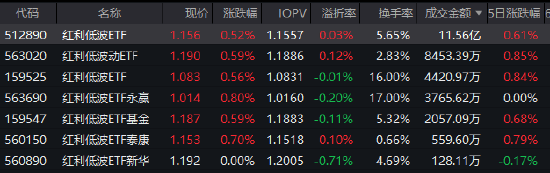
Core Viewpoint - The market experienced a collective decline in the three major stock indices on October 13, while the Science and Technology Innovation 50 index rose by over 1%. The Dividend Low Volatility ETF (512890) showed resilience, increasing by 0.52% despite the overall market downturn [1]. Fund Performance - The Dividend Low Volatility ETF (512890) had a closing price of 1.156, with a 5-day increase of 0.61% and a total trading volume of 1.156 billion CNY [2]. - Over the past five trading days, the ETF saw a net inflow of 158 million CNY, which increased to 346 million CNY over the last ten days, and reached a total net inflow of 1.299 billion CNY over the last sixty days, indicating strong investor interest [2][3]. Market Outlook - Huaxi Securities suggests that the market impact this month will be less severe than the "April 7 incident," with "turning points and opportunities" being key themes for October [4]. - The industry allocation is expected to favor sectors such as dividends, agriculture, military, and rare earths, while Everbright Securities indicates that the market may enter a phase of wide fluctuations due to multiple factors [4]. Investment Strategy - The Dividend Low Volatility ETF (512890) has achieved a cumulative return of 129.76% since its inception in December 2018, outperforming its benchmark and ranking 82nd among 502 similar products [4]. - The fund has consistently delivered positive returns for six consecutive years from 2019 to 2024, making it one of the few A-share market ETFs to achieve "annual positive returns" [4]. - Experts recommend that investors consider the Dividend Low Volatility ETF as a core component for stable returns in their asset allocation, suggesting a dollar-cost averaging approach to mitigate short-term volatility risks [4].

低开高走!“奇迹日”行情年内再现,稀土芯片板块逆势大涨 | 华宝3A日报(2025.10.13)
Xin Lang Ji Jin· 2025-10-13 09:18
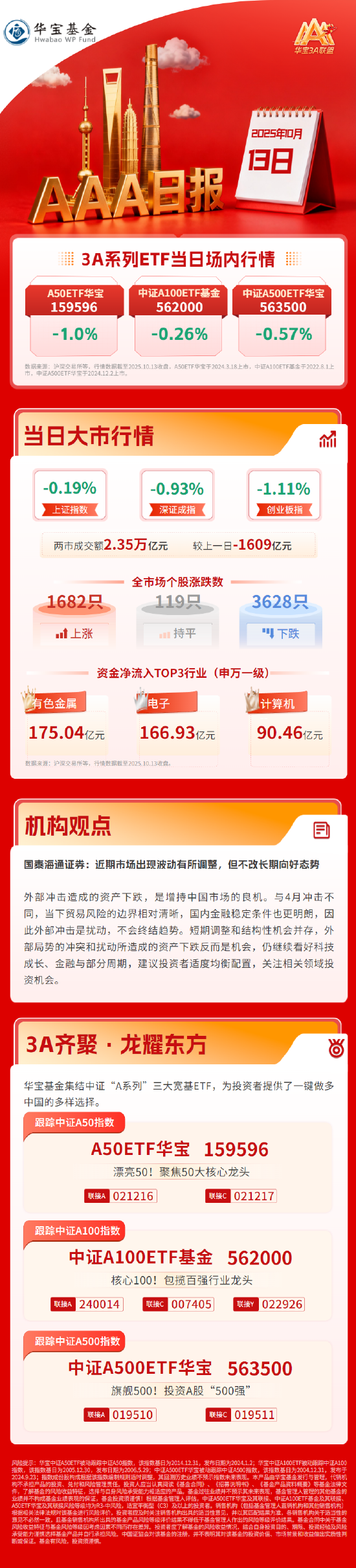
Group 1 - The market has experienced fluctuations and adjustments recently, but the long-term positive trend remains intact. External shocks leading to asset declines present a good opportunity to increase holdings in the Chinese market [2] - The current external trade risks are relatively clear compared to previous shocks, and domestic financial stability conditions are more apparent, indicating that external disturbances will not end the upward trend [2] - There are structural opportunities alongside short-term adjustments, with continued optimism for technology growth, finance, and certain cyclical sectors. Investors are advised to maintain a balanced allocation and focus on investment opportunities in these areas [2] Group 2 - Huabao Fund has launched three major broad-based ETFs tracking the China A-share market, providing investors with diverse options to invest in China [2] - The A50 ETF focuses on the top 50 core leading companies, while the A100 ETF encompasses the top 100 industry leaders, and the A500 ETF covers a broader range of 500 companies [2] - The total trading volume in the market reached 2.35 trillion yuan, a decrease of 160.9 billion yuan from the previous day, indicating a decline in market activity [1]
博时市场点评10月13日:沪深两市震荡,有色涨幅领先
Xin Lang Ji Jin· 2025-10-13 07:58
Market Overview - The three major indices in the A-share market adjusted, with the ChiNext index falling over 1% and total trading volume decreasing to 2.37 trillion yuan [1][2] - The non-ferrous metals sector led the gains among the Shenwan first-level industries [1] Trade Data - In September, China's total goods trade value reached 4.04 trillion yuan, a year-on-year increase of 8%, marking the highest monthly growth rate of the year [2][3] - Exports amounted to 2.34 trillion yuan, up 8.4% year-on-year, while imports were 1.70 trillion yuan, increasing by 7.5% [2] Economic Indicators - The rebound in both export and import growth indicates a synchronized improvement in domestic and external demand [3] - The resilience in exports is attributed to China's ongoing market diversification strategy and product structure optimization, enhancing overall competitiveness and value-added exports [3] Market Sentiment - The market is currently observing a high-risk preference, with attention on the changes in incremental capital, especially high-risk preference funds [1][2] - The Federal Reserve's continued interest rate cuts and manageable tariff risks contribute to maintaining a high market risk appetite [1][2] Sector Performance - On October 13, the A-share market saw declines in major indices, with the Shanghai Composite Index down 0.19% and the Shenzhen Component Index down 0.93% [4] - The non-ferrous metals, environmental protection, and steel sectors showed notable gains, while the automotive, home appliances, and beauty care sectors experienced significant declines [4]
低利率时代,“低波固收 +” 正当时!富国稳健添荣今日首发→
Xin Lang Ji Jin· 2025-10-13 07:08
Core Viewpoint - The investment landscape is shifting towards "low-volatility fixed income +" products, which combine bonds as a stable base with a small allocation to equities for enhanced returns, appealing to investors seeking stability with some growth potential [1][2][3] Market Trends - The yield on pure bond products has been declining, with medium to long-term pure bond funds averaging only 0.34% returns this year, while short-term pure bond funds are at 0.91% [2] - In contrast, "equity-inclusive" fixed income products have performed well, with secondary bond funds averaging a 4.7% increase, mixed bond funds at 5.62%, and convertible bond funds soaring by 18.98% [2] Product Features - The newly launched "Fuguo Stable Growth Bond Fund" emphasizes a strategy of 80% bond allocation and 20% equity to balance stability and growth [5] - The bond portion focuses on short to medium duration, high-grade credit bonds to minimize risk, while the equity portion targets undervalued blue-chip stocks with high dividend yields [5][6] - The fund incorporates a flexible "toolkit" allowing for ETF investments to capitalize on short-term opportunities in high-volatility sectors [6] Risk Management - The fund employs a three-tiered risk control mechanism, including valuation control, dynamic rebalancing, and individual stock monitoring to mitigate potential losses [8] Management Expertise - The fund is managed by Zhu Chenjie, who has 12 years of experience and a strong track record in various bond fund categories, enhancing the fund's credibility [9][12] Target Audience - The fund is suitable for investors with cash savings seeking better returns than traditional savings accounts, those wary of stock market volatility, and individuals looking for a stable asset allocation tool [13]
长城基金张棪:“固收+”配置价值凸显
Xin Lang Ji Jin· 2025-10-13 07:01
Group 1 - The core viewpoint is that "fixed income +" funds are in a favorable investment environment due to the positive performance of equity markets and the downward trend of bond market interest rates [1][2] - The macroeconomic recovery is supported by policies aimed at expanding domestic demand and a projected GDP growth of 5.3% in the first half of 2025, which provides a foundation for equity market opportunities [1] - The bond market is transitioning towards high-quality development with a determined downward trend in interest rates, as evidenced by the 10-year government bond yield entering the "1 era," indicating good allocation opportunities for "fixed income +" funds [1] Group 2 - There is a notable trend of capital migration, with a decrease of 1.11 trillion yuan in resident deposits and an increase of 2.14 trillion yuan in non-bank deposits in July, reflecting investors' search for higher yields in a low-interest-rate environment [2] - "Fixed income +" funds are becoming increasingly popular for stable investment, with their total scale recovering to 1.73 trillion yuan by the end of the second quarter this year, according to CITIC Securities [2]
当货币基金收益率“破1”,怎么办?
Xin Lang Ji Jin· 2025-10-13 07:01
Core Insights - The average seven-day annualized yield of money market funds in China is approaching or even falling below 1%, reflecting a downward trend in low-risk asset yields due to a sustained low interest rate environment [1] - Despite the declining yields, money market funds maintain three core advantages: low risk, strong liquidity, and low investment thresholds [1][2] - As of July 2025, the total scale of money market funds in China reached 14.6 trillion yuan, an increase of 1 trillion yuan since the beginning of the year, indicating continued growth in this investment category [1] Summary by Category Investment Environment - The decline in money market fund yields is primarily influenced by macroeconomic factors such as loose monetary policy and falling market interest rates, rather than inherent risks of the products themselves [1] Advantages of Money Market Funds - Low Risk: Investments are primarily in high-quality short-term money market instruments like bank deposits, interbank certificates of deposit, government bonds, and central bank bills [1] - Strong Liquidity: Most products support T+0 or T+1 redemption, with some funds integrated into payment scenarios for immediate use [1] - Low Investment Threshold: Typically, investments can start from as low as 1 yuan, making them accessible for ordinary investors [1] Investment Strategy - Investors are encouraged to adjust their yield expectations and manage idle funds scientifically, balancing safety and liquidity while seeking moderate returns through layered asset allocation [2] - For short-term idle funds (within 3 months), continuing to hold money market funds is advisable to maintain liquidity and safety [2] - For funds not needed for 3 months or more, investors may consider allocating to interbank certificate index funds or short-term bond funds for potentially higher returns [2]
自主可控逻辑崛起,国防军工ETF(512810)持续溢价交易!长城军工、奥普光电封死涨停板!
Xin Lang Ji Jin· 2025-10-13 06:54
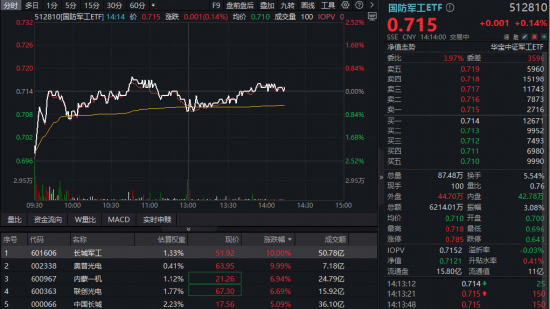
Group 1 - The defense and military industry showed resilience in the market, with the popular defense ETF (512810) experiencing significant trading volume of over 62 million yuan and multiple instances of premium pricing [1] - Key stocks such as Changcheng Military Industry and Aopu Optoelectronics reached their daily limit up, while Inner Mongolia First Machinery Group saw a rise of 6.94% [1] - The AG600 amphibious aircraft entered mass production, marking a breakthrough in domestic large civil aircraft self-supply, with the successful test flight of the second aircraft and the delivery of the third [3] Group 2 - The unveiling of the J-6 drone at the Changchun Airshow highlights the trend towards unmanned and intelligent equipment, which is expected to boost orders in upstream materials and electronics within the defense sector [3] - The defense industry is closely tied to national five-year plans, with upcoming significant meetings likely to clarify the focus areas for the 15th five-year plan, emphasizing the development of unmanned and intelligent equipment [3] - The defense and military sector is benefiting from industrial upgrades and the trend towards self-sufficiency, with sustained high demand for core equipment and an overall high industry prosperity [3] Group 3 - The defense ETF (512810) passively tracks the CSI Military Index, with its top ten weighted stocks including China Shipbuilding, AVIC Shenyang Aircraft, and Guoke Technology [3]

杨德龙:特朗普挑起关税战不得人心 不会改变本轮牛市大趋势
Xin Lang Ji Jin· 2025-10-13 06:50
Group 1 - The market experienced a significant drop followed by a rebound, influenced by Trump's proposal for a 100% tariff, which is seen as a negotiation tactic rather than a long-term threat [1] - The impact of the tariff proposal on the market is expected to be less severe than previous instances, with investor confidence remaining relatively stable [1] - China's export dependence on the US has decreased from 19% in 2018 to below 10% currently, indicating a strengthening of its economic position [1] Group 2 - The current market rally is supported by strong economic policies and an influx of retail investors, with nearly 300 million new stock accounts opened in September [2] - The low-interest-rate environment is driving residents to invest in stocks and funds, potentially shifting 20-30 trillion yuan into the capital market over the next few years [2] - Foreign investment in Chinese assets is increasing, with $4.6 billion inflow in September and expectations for continued growth [2] Group 3 - The bull market is characterized by a divergence between sectors, with technology and innovation-driven industries seeing significant gains while traditional sectors lag [3] - Investors are advised to hold quality stocks during market adjustments and consider reducing positions in overvalued tech stocks [3] - The overall trend of the bull market is expected to continue despite short-term fluctuations [3] Group 4 - International gold prices have surpassed $4,000, reflecting concerns over US government credit and increasing debt levels, which have reached $37 trillion [4] - The rise in gold prices is accompanied by a significant increase in silver prices, driven by industrial demand, particularly in the photovoltaic sector [4] - The gold-silver ratio remains stable, with silver's price increase exceeding 70% this year compared to gold's over 50% [4] Group 5 - The current slow bull market in A-shares and Hong Kong stocks is anticipated to continue, marking a shift from real estate investment to stock market opportunities [5] - Investors are encouraged to focus on value investing and hold quality stocks for the medium to long term to capitalize on technological innovation [5]
自主可控提速再上日程,关注科创半导体设备ETF(588710)布局窗口!
Xin Lang Ji Jin· 2025-10-13 06:21
Core Viewpoint - The semiconductor sector is experiencing significant downward pressure due to intensified international competition, particularly following the U.S. House of Representatives' report on semiconductor export controls related to China, which emphasizes the urgency for domestic semiconductor industry self-sufficiency [1] Group 1: Semiconductor Industry Dynamics - The urgency for domestic semiconductor industry self-sufficiency is reinforced by the recent U.S. report, highlighting the need to accelerate the development of a controllable local chip supply chain [1] - The equipment and materials segments of the semiconductor industry are positioned upstream and are crucial for overall industry development, possessing strong bargaining power and likely to expand first amid the domestic substitution wave [1] Group 2: ETF Performance and Market Trends - The Sci-Tech Semiconductor Equipment ETF (588710) has seen a trading volume of 331 million yuan as of 14:12, indicating strong market interest [1] - The ETF closely tracks the Shanghai Stock Exchange Sci-Tech Board Semiconductor Materials and Equipment Index, with a significant focus on semiconductor equipment and materials, which together account for 84.45% of the index [2] - Since September, the Sci-Tech Semiconductor Equipment ETF has attracted 799 million yuan in new investments, increasing its total size to 1.048 billion yuan, a 516% increase compared to the end of August [2] Group 3: Fund Management and Strategy - The fund manager, Huatai-PB Fund, is one of the first ETF managers in China with over 18 years of experience, managing the largest ETF in the A-share market, the CSI 300 ETF [2] - Huatai-PB Fund has developed a comprehensive suite of ETFs focused on the Sci-Tech sector, including the Sci-Tech Board ETF and others, aiming to help investors benefit from technological advancements [2]
“反内卷”再发力,哪些行业ETF或将受益?
Xin Lang Ji Jin· 2025-10-13 06:21
Core Insights - Recent policies in China aim to combat "involution" and promote high-quality economic development through various measures targeting ten key industries [1][3][7] - The Ministry of Industry and Information Technology has released new growth plans for ten major industries, which collectively account for approximately 70% of the industrial economy [1][3] - The National Development and Reform Commission and the State Administration for Market Regulation have issued guidelines to address chaotic pricing competition, emphasizing fair market practices [1][3] Group 1: Policy Initiatives - The ten industries targeted for growth include steel, non-ferrous metals, petrochemicals, chemicals, building materials, machinery, automotive, electrical equipment, light industry, and electronic information manufacturing [1] - Each industry has been assigned specific quantitative growth targets, such as a 5% annual increase in value added for the petrochemical and non-ferrous metals sectors from 2025 to 2026 [1][3] - The recent announcement of measures to regulate pricing competition indicates a systematic approach to governance, moving from recognition to execution at both central and local levels [1][3] Group 2: Economic Indicators - In August, profits of industrial enterprises showed a significant turnaround, increasing by 20.4% year-on-year, marking the highest growth rate since December 2023 [3][4] - The Producer Price Index (PPI) remained stable in August, ending an eight-month decline, with a narrowing year-on-year drop of 0.7 percentage points [3][4] - Profit growth was particularly noted in upstream industries such as coal, steel, non-metallic minerals, and chemicals, suggesting a positive impact from the "involution" policies [3][4] Group 3: Investment Opportunities - Investors are encouraged to consider ETFs that align with the sectors benefiting from the "involution" policies, as these can provide efficient exposure to the relevant industries [5][6] - Specific ETFs are highlighted for sectors such as non-ferrous metals, petrochemicals, coal, and new energy vehicles, reflecting the anticipated benefits from the policy measures [6][7] - The ongoing "involution" policies are expected to enhance gross margins and capacity utilization, thereby improving the long-term investment value of related sectors [7]