
Xin Lang Ji Jin

Search documents
寒武纪股价跌5.15%,尚正基金旗下1只基金重仓,持有370股浮亏损失2.37万元
Xin Lang Ji Jin· 2026-02-03 02:14
Group 1 - The core point of the news is that Cambricon Technologies experienced a decline of 5.15% in stock price, reaching 1178.00 CNY per share, with a trading volume of 6.053 billion CNY and a turnover rate of 1.20%, resulting in a total market capitalization of 496.745 billion CNY [1] - Cambricon Technologies, established on March 15, 2016, and listed on July 20, 2020, is based in Haidian District, Beijing, and specializes in the research, design, and sales of artificial intelligence core chips for various cloud servers, edge computing devices, and terminal equipment [1] - The company's main business revenue composition is as follows: cloud products account for 99.62%, other (supplementary) 0.32%, edge products 0.05%, and IP licensing and software 0.00% [1] Group 2 - From the perspective of fund holdings, one fund under Shangzheng Fund has a significant position in Cambricon Technologies, with the Shangzheng CSI A500 Index Fund A (023399) holding 370 shares, representing 1.2% of the fund's net value, making it the ninth largest holding [2] - The Shangzheng CSI A500 Index Fund A (023399) was established on September 24, 2025, with a latest scale of 34.3512 million CNY, and has achieved a year-to-date return of 1.69%, ranking 3192 out of 5562 in its category [2] - The fund managers, Li Rui and Wang Fei, have different tenures and performance metrics, with Li Rui having a tenure of 351 days and a best return of 61.09%, while Wang Fei has a tenure of 191 days with a best return of 7.29% [2]

航天工程股价涨5.17%,东方阿尔法基金旗下1只基金重仓,持有22.15万股浮盈赚取39.65万元
Xin Lang Ji Jin· 2026-02-03 02:12
Group 1 - Aerospace Engineering stock increased by 5.17% on February 3, reaching a price of 36.39 yuan per share, with a trading volume of 550 million yuan and a turnover rate of 2.89%, resulting in a total market capitalization of 19.505 billion yuan [1] - The stock has experienced a continuous rise for three days, accumulating a total increase of 2.98% during this period [1] - Aerospace Engineering Co., Ltd. specializes in gasification technology and key equipment development, with its main business revenue composition being 49.87% from industrial gas operations, 46.17% from clean and efficient coal utilization, 3.91% from high-end equipment manufacturing, and 0.06% from other sources [1] Group 2 - The Oriental Alpha Fund holds a significant position in Aerospace Engineering, with the Oriental Alpha Rui Feng Mixed Fund A (018362) owning 221,500 shares, accounting for 7.71% of the fund's net value, making it the second-largest holding [2] - The fund has realized a floating profit of approximately 396,500 yuan today, with a floating profit of 221,500 yuan during the three-day increase [2] - The Oriental Alpha Rui Feng Mixed Fund A was established on May 12, 2023, with a current scale of 56.221 million yuan, achieving a year-to-date return of 19.58% and a one-year return of 36.27% [2]

重启雄风!有色ETF华宝盘中猛拉4%!地缘事件扰动,现货黄金重回4800美元
Xin Lang Ji Jin· 2026-02-03 02:01
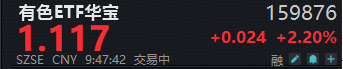
值得关注的是,今日现货黄金开盘反弹,截至发稿,重回4800美元/盎司,日内涨超3%。分析指出,量 化基金去杠杆化、杠杆ETF和趋势跟踪策略头寸调整所引发的强制抛售潮,其主体部分可能已基本释 放。 消息面上,特朗普称正在与伊朗对话。当地时间2月2日,针对伊朗问题,美国总统特朗普表示,美方已 向相关地区调动大型军舰,同时与伊朗保持沟通,"将观察事态如何发展"。 新湖期货认为,黄金价格中长期支撑仍存,指出沃什获提名及由此引发的汇率波动属于短期扰动,中期 市场焦点仍将集中于地缘政治风险升温与特朗普政府政策的高度不确定性;而长期来看,全球债务可持 续性恶化与去美元化趋势的深化,是支撑黄金结构性走强的核心变量。目前,上述中长期逻辑并未发生 根本性逆转。 中信证券指出,在经历2025年的大涨行情后,有色金属价格与股票行情的上涨动能依然充足,供应扰 动、需求局部高景气和囤货行为为金属价格带来强支撑,流动性宽松带来的交易活跃度上升以及地缘冲 突带来的避险情绪升温有望放大金属的价格弹性。看好贵金属、工业金属、电池金属和战略金属板块的 配置价值。 今日(2月3日)揽尽有色金属行业龙头的有色ETF华宝(159876)场内价格盘中涨超 ...





志特新材股价涨5.21%,国泰基金旗下1只基金位居十大流通股东,持有137.83万股浮盈赚取271.52万元
Xin Lang Ji Jin· 2026-02-03 02:01
Group 1 - The core viewpoint of the news is that Zhite New Materials Co., Ltd. experienced a stock price increase of 5.21%, reaching 39.77 CNY per share, with a trading volume of 688 million CNY and a turnover rate of 4.28%, resulting in a total market capitalization of 16.384 billion CNY [1] - Zhite New Materials, established on December 8, 2011, and listed on April 30, 2021, is located in Zhongshan City, Guangdong Province. The company specializes in providing comprehensive services related to the research, design, production, sales, leasing, and technical guidance of building aluminum formwork systems [1] - The main business revenue composition of Zhite New Materials includes aluminum formwork at 55.53%, other services at 29.77%, and prefabricated PC series products at 14.70% [1] Group 2 - Among the top ten circulating shareholders of Zhite New Materials, a fund under Guotai Fund, Guotai Regional Advantage Mixed A (020015), entered the top ten in the third quarter, holding 1.3783 million shares, which accounts for 0.33% of the circulating shares. The estimated floating profit today is approximately 2.7152 million CNY [2] - Guotai Regional Advantage Mixed A (020015) was established on May 27, 2009, with a current scale of 244 million CNY. Year-to-date, it has incurred a loss of 1.71%, ranking 8423 out of 8874 in its category; over the past year, it has achieved a return of 20.57%, ranking 4915 out of 8124; since inception, it has generated a return of 376.76% [2]
亨通光电股价涨5.22%,中信建投基金旗下1只基金重仓,持有8.11万股浮盈赚取14.76万元
Xin Lang Ji Jin· 2026-02-03 01:49
2月3日,亨通光电涨5.22%,截至发稿,报36.67元/股,成交9.45亿元,换手率1.08%,总市值904.55亿 元。 资料显示,江苏亨通光电股份有限公司位于江苏省苏州市吴江区中山北路2288号,成立日期1993年6月5 日,上市日期2003年8月22日,公司主营业务涉及通信网络和能源互联领域高端技术、产品研发生产及 系统集成服务,全球海缆通信网络的建设业务。主营业务收入构成为:智能电网36.98%,铜导体 25.02%,工业与新能源智能11.28%,光通信10.94%,海洋能源与通信9.57%,其他5.33%,其他(补 充)0.88%。 从基金十大重仓股角度 数据显示,中信建投基金旗下1只基金重仓亨通光电。中信建投趋势领航两年持有期混合A(016265) 四季度持有股数8.11万股,占基金净值比例为2.14%,位居第六大重仓股。根据测算,今日浮盈赚取约 14.76万元。 声明:市场有风险,投资需谨慎。 本文基于第三方数据库自动发布,不代表新浪财经观点,任何在本 文出现的信息均只作为参考,不构成个人投资建议。如有出入请以实际公告为准。如有疑问,请联系 biz@staff.sina.com.cn。 责任编 ...

白酒猛攻!“茅五泸汾洋”逆市走强,食品饮料ETF华宝(515710)上探3.28%!机构:白酒板块或迎十年大底
Xin Lang Ji Jin· 2026-02-02 12:08
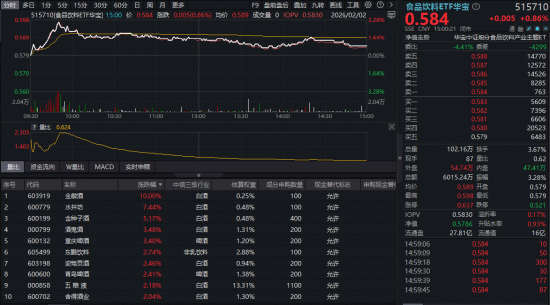
Core Viewpoint - The food and beverage sector showed resilience in the market, with the Huabao Food and Beverage ETF (515710) experiencing a price increase of 0.86% by the end of trading on February 2, 2026, despite an initial surge of 3.28% during the day [1][4]. Group 1: Market Performance - The food and beverage ETF Huabao (515710) opened strong, reaching a peak increase of 3.28% before closing up 0.86% [1]. - Major liquor stocks saw significant gains, with Jinhuijiu hitting the daily limit, Shuijingfang rising by 7.44%, and Jinzongzi Jiu increasing by 5.17% [1]. - Leading liquor brands such as Kweichow Moutai, Wuliangye, Luzhou Laojiao, Shanxi Fenjiu, and Yanghe also closed in the green [1]. Group 2: Industry Insights - CITIC Construction pointed out that the surge in the liquor sector is driven by Moutai's sales price exceeding expectations, recognized reforms, and easing real estate policies, alongside a positive outlook for PPI [1]. - Moutai's payment and delivery progress has surpassed last year's levels, and industry reforms are advancing, with expectations for the industry to bottom out by 2026, potentially increasing market share for leading brands [1]. - Current valuations in the food and beverage sector remain low, with the PE ratio of the Huabao ETF at 19.81, placing it in the 3.33% percentile of the last decade, indicating strong medium to long-term investment potential [1][3]. Group 3: Future Outlook - Xiangcai Securities noted that the food and beverage industry's valuation is at a historical low, despite weak market data such as retail sales and consumer confidence [3]. - The prolonged adjustment period has led to a pricing of pessimistic expectations, and with inflation showing signs of mild recovery, investment opportunities in the consumption sector are emerging [3]. - Investors are encouraged to focus on core assets within the food and beverage sector, particularly the Huabao ETF, which has a significant allocation to leading high-end liquor stocks and other beverage segments [3].






世纪华通股价连续3天上涨累计涨幅6.21%,鑫元基金旗下1只基金持18.96万股,浮盈赚取21.99万元
Xin Lang Ji Jin· 2026-02-02 07:09
声明:市场有风险,投资需谨慎。 本文基于第三方数据库自动发布,不代表新浪财经观点,任何在本 文出现的信息均只作为参考,不构成个人投资建议。如有出入请以实际公告为准。如有疑问,请联系 biz@staff.sina.com.cn。 鑫元消费甄选混合发起A(017467)基金经理为姚启璠。 截至发稿,姚启璠累计任职时间217天,现任基金资产总规模4877.99万元,任职期间最佳基金回报 0%, 任职期间最差基金回报-0.29%。 从基金十大重仓股角度 数据显示,鑫元基金旗下1只基金重仓世纪华通。鑫元消费甄选混合发起A(017467)四季度增持9.71万 股,持有股数18.96万股,占基金净值比例为8.33%,位居第三大重仓股。根据测算,今日浮盈赚取约 1.71万元。连续3天上涨期间浮盈赚取21.99万元。 鑫元消费甄选混合发起A(017467)成立日期2023年3月24日,最新规模1059.04万。今年以来收益 8.14%,同类排名2561/9000;近一年亏损16.46%,同类排名8189/8193;成立以来亏损45.25%。 2月2日,世纪华通涨0.46%,截至发稿,报19.85元/股,成交50.78亿元,换手 ...

东方电缆股价连续4天下跌累计跌幅11.86%,信达澳亚基金旗下1只基金持1200股,浮亏损失8700元
Xin Lang Ji Jin· 2026-02-02 07:08
Group 1 - The core point of the news is that Dongfang Cable has experienced a significant decline in its stock price, dropping 2.8% to 53.87 CNY per share, with a total market capitalization of 37.047 billion CNY and a cumulative drop of 11.86% over four consecutive days [1] - Dongfang Cable's main business involves the research, production, sales, and services of various types of wires and cables, with revenue composition as follows: 49.56% from power engineering and equipment cables, 44.14% from submarine and high-voltage cables, 6.22% from marine equipment and engineering operations, and 0.09% from other sources [1] Group 2 - From the perspective of major fund holdings, one fund under Xinda Australia has increased its stake in Dongfang Cable, holding 1,200 shares, which represents 0.55% of the fund's net value, making it the third-largest holding [2] - The fund, Xinda Australia Hengrui 9-Month Holding Period Mixed A (020385), has seen a floating loss of approximately 1,860 CNY today and a total floating loss of 8,700 CNY during the four-day decline [2] - The fund's performance this year is 0.67%, ranking 7969 out of 9000 in its category, while its one-year return is 1.92%, ranking 7848 out of 8193 [2]

深圳瑞捷股价跌5.09%,诺安基金旗下1只基金位居十大流通股东,持有85.31万股浮亏损失108.34万元
Xin Lang Ji Jin· 2026-02-02 07:06
诺安多策略混合A(320016)成立日期2011年8月9日,最新规模21.2亿。今年以来收益9.42%,同类排 名1935/9000;近一年收益81.82%,同类排名462/8193;成立以来收益261.1%。 2月2日,深圳瑞捷跌5.09%,截至发稿,报23.70元/股,成交1.02亿元,换手率4.43%,总市值36.08亿 元。 资料显示,深圳瑞捷技术股份有限公司位于广东省深圳市龙岗区坂田街道南坑社区雅星路8号星河 WORLD双子塔.东塔26层,成立日期2010年4月12日,上市日期2021年4月20日,公司主营业务涉及建设 工程第三方评估、管理和咨询服务。主营业务收入构成为:第三方评估57.84%,项目管理41.44%,其 他0.72%。 从深圳瑞捷十大流通股东角度 数据显示,诺安基金旗下1只基金位居深圳瑞捷十大流通股东。诺安多策略混合A(320016)三季度新 进十大流通股东,持有股数85.31万股,占流通股的比例为0.9%。根据测算,今日浮亏损失约108.34万 元。 诺安多策略混合A(320016)基金经理为孔宪政。 截至发稿,孔宪政累计任职时间5年69天,现任基金资产总规模66.75亿元,任职期 ...
泰豪科技股价跌5.02%,财通证券资管旗下1只基金位居十大流通股东,持有703.99万股浮亏损失394.23万元
Xin Lang Ji Jin· 2026-02-02 07:06
财通资管数字经济混合发起式A(017483)成立日期2022年12月26日,最新规模9.2亿。今年以来收益 13.03%,同类排名793/9000;近一年收益89.71%,同类排名329/8193;成立以来收益132.03%。 2月2日,泰豪科技跌5.02%,截至发稿,报10.59元/股,成交6.15亿元,换手率6.69%,总市值90.32亿 元。 资料显示,泰豪科技股份有限公司位于江西省南昌市高新开发区清华泰豪大楼,成立日期1996年3月20 日,上市日期2002年7月3日,公司主营业务涉及军工装备、智能电力产品的研发、生产、销售与服务。 主营业务收入构成为:应急装备业务66.49%,军工装备业务32.08%,售后服务0.68%,房租及物业管理 类0.66%,材料让售0.09%。 从泰豪科技十大流通股东角度 数据显示,财通证券资管旗下1只基金位居泰豪科技十大流通股东。财通资管数字经济混合发起式A (017483)三季度新进十大流通股东,持有股数703.99万股,占流通股的比例为0.83%。根据测算,今 日浮亏损失约394.23万元。 财通资管数字经济混合发起式A(017483)基金经理为包斅文。 截至发稿, ...
