Wen Hua Cai Jing

Search documents
沪铜偏强运行 社会库存大幅增加【12月25日SHFE市场收盘评论】
Wen Hua Cai Jing· 2025-12-25 08:48
Core Viewpoint - The copper market is experiencing fluctuations, with prices rising by 1% and hovering near record highs, influenced by precious metal trends and domestic demand weakness [1] Group 1: Market Trends - Shanghai copper opened lower but rebounded throughout the day, closing up 1% [1] - The current price of copper is affected by the volatility in precious metals and the weak domestic demand, leading to an expansion of the cash discount and a significant increase in social inventory [1] Group 2: Economic Indicators - Recent U.S. data shows resilience, indicating signs of stabilization, which has impacted the copper market [1] - The expectation of overseas liquidity and key economic data from China and the U.S. will be crucial for future price movements [1] Group 3: Demand and Supply Dynamics - Domestic cash discounts continue to widen, suggesting weak downstream demand [1] - Strong U.S. economic growth data enhances market confidence in metal demand, while high tariff expectations on U.S. copper lead to significant inventory mismatches [1] - Global electrification and AI development present a broad demand outlook for copper, with a weak U.S. dollar boosting the metal sector [1] - The global mining sector remains tight, with low inventories in non-U.S. regions and expectations of reduced domestic refined copper production, indicating a likely strong short-term price trend for copper [1]
10月秘鲁铜产量同比增加4.8% 金银铅锌锡10月产量同比均增
Wen Hua Cai Jing· 2025-12-25 02:07
Core Insights - Peru's copper production in October increased by 4.8% year-on-year, reaching 248,192 tons [1] - For the first ten months of 2025, Peru's copper production totaled 2,296,587 tons, reflecting a year-on-year growth of 3.0% [1] Group 1: October Metal Production Data - In October, the production figures for major metals in Peru were as follows: - Copper: 248,192 tons - Gold: 10,045,656 grams - Zinc: 134,029 tons - Silver: 348,160 kilograms - Lead: 26,955 tons - Tin: 3,094 tons [2] - Year-on-year changes for October production were: - Copper: +4.8% - Gold: +2.0% - Zinc: +30.9% - Silver: +13.0% - Lead: -3.0% - Tin: +31.7% [2] Group 2: Cumulative Production Data (January to October) - Cumulative production from January to October included: - Copper: 2,296,587 tons - Gold: 90,521,273 grams - Zinc: 1,251,905 tons - Silver: 3,126,328 kilograms - Lead: 260,146 tons - Tin: 28,517 tons [2] - Year-on-year changes for cumulative production were: - Copper: +3.0% - Gold: +0.3% - Zinc: +18.8% - Silver: +8.8% - Lead: +7.2% - Tin: +5.7% [2]


智利政府启动Mantoverde铜金矿劳资合同谈判初步调解程序
Wen Hua Cai Jing· 2025-12-25 00:47
Core Viewpoint - The Capstone Copper company faces potential labor strikes at its Mantoverde copper-gold mine in Chile if new labor contract negotiations fail [1] Group 1: Labor Relations - The Mantoverde mine's workers' union, consisting of 645 members, rejected a contract proposal in mid-December [1] - The government has initiated a five-day preliminary mediation process, which can be extended for another five days if both parties agree [1] - The union stated that the company "has not presented any new proposals to advance negotiations" [1] Group 2: Company Ownership and Production - Capstone Copper holds a 70% stake in the Mantoverde copper mine, while Mitsubishi Minerals owns the remaining 30% [1] - The mine is expected to produce between 29,000 to 32,000 tons of cathode copper by 2025 [1]
金属涨跌互现 期铜续创历史新高,逼近12300美元【12月24日LME收盘】
Wen Hua Cai Jing· 2025-12-25 00:41
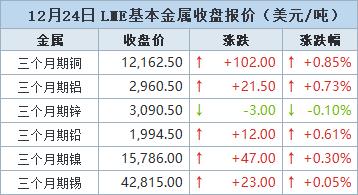
Core Viewpoint - The London Metal Exchange (LME) copper prices have reached a historic high, driven by strong U.S. economic growth and a weakening dollar, with three-month copper prices closing at $12,162.5 per ton on December 24, 2023, marking a 0.85% increase [1]. Group 1: Copper Market Performance - LME three-month copper rose by $102, or 0.85%, closing at $12,162.5 per ton, with an intraday peak of $12,282 [1][2]. - Copper prices have increased by 2.4% this week and over 8% in December, positioning for the best monthly performance since April 2024, with an annual increase of 38% [3]. - The copper premium at Yangshan Port surged to $55 per ton, the highest level since September 24 [3]. Group 2: Economic Indicators - The U.S. GDP grew at an annualized rate of 4.3% in Q3 2023, surpassing market expectations and marking the fastest quarterly growth in two years [3]. - Consumer spending in the U.S. showed strong growth, while both investment and imports declined [3]. Group 3: Other Metals Performance - LME three-month aluminum increased by $21.5, or 0.73%, closing at $2,960.5 per ton [2][4]. - LME three-month zinc decreased by $3, or 0.1%, closing at $3,090.5 per ton [2][4]. - LME three-month lead rose by $12, or 0.61%, closing at $1,994.5 per ton [2][4]. - LME three-month tin increased by $23, or 0.05%, closing at $42,815 per ton [2][4]. - LME three-month nickel rose for the sixth consecutive day, increasing by $47, or 0.3%, closing at $15,786 per ton, amid market speculation about reduced mining output in Indonesia by 2026 [4].
今日适逢美国圣诞节假期 外盘交易所休市安排一览
Wen Hua Cai Jing· 2025-12-25 00:41
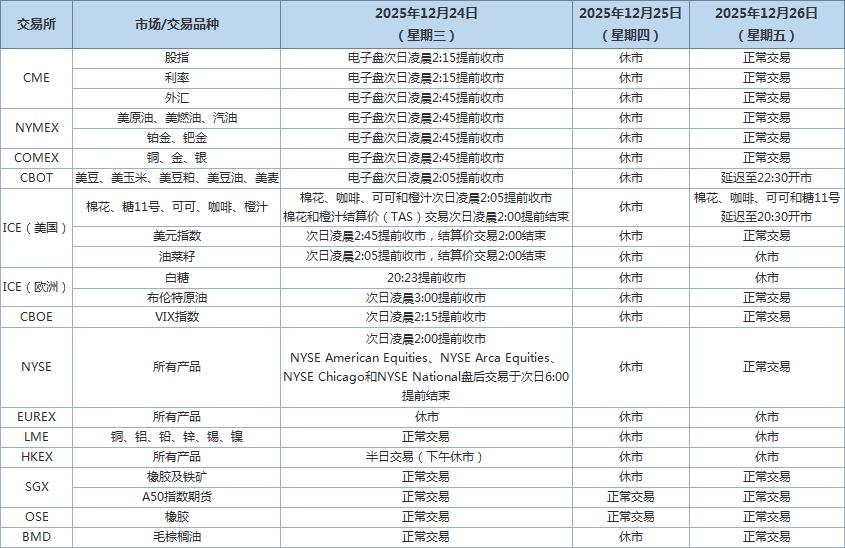
Summary of Key Points Core Viewpoint - The article provides a detailed schedule of trading hours for various exchanges during the holiday period from December 24 to December 26, 2025, highlighting early closures and market holidays for different commodities and indices [1]. Group 1: Trading Hours Overview - CME will have early closures for stock indices and interest rates on December 24, with no trading on December 25, and normal trading resuming on December 26 [1]. - NYMEX will also close early for crude oil and other energy products on December 24, with a complete market holiday on December 25, and normal trading on December 26 [1]. - CBOT will see early closures for agricultural products on December 24, a market holiday on December 25, and delayed opening on December 26 [1]. Group 2: Specific Commodities and Indices - ICE (U.S.) will have early closures for cotton, coffee, cocoa, and orange juice on December 24, with a market holiday on December 25, and normal trading on December 26 [1]. - CBOE will close early for the VIX index on December 24, with no trading on December 25, and normal trading on December 26 [1]. - HKEX will operate half-day trading on December 24, with a market holiday on December 25, and no trading on December 26 [1].
海关总署:中国11月铜矿砂进口量环比微增 矿紧局面仍在延续
Wen Hua Cai Jing· 2025-12-24 11:01
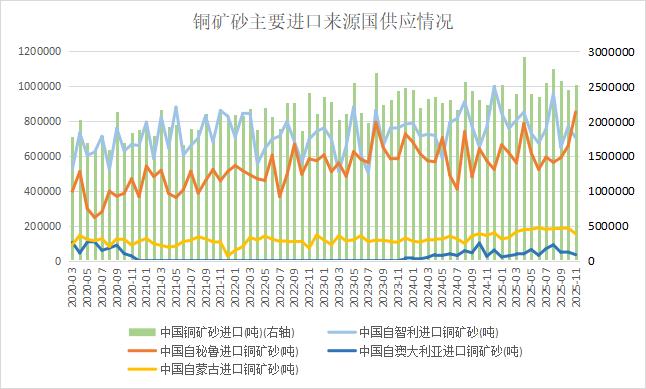
Core Insights - China's copper ore and concentrate imports in November 2025 reached 2,526,194.63 tons, reflecting a month-on-month increase of 3.05% and a year-on-year growth of 13.13% [1] Group 1: Import Sources - Peru's copper ore supply surged nearly 30% to 852,529 tons, becoming the largest supplier for the month, surpassing Chile [1] - Chile's copper ore shipments declined by approximately 8% to 704,596 tons, marking a significant drop in its supply [1] - Mongolia, the third-largest supplier, also experienced a decrease in its copper ore shipments [1]
多头情绪蔓延 沪铜午后攀高【盘中快讯】
Wen Hua Cai Jing· 2025-12-24 07:52
Group 1 - The core viewpoint of the article indicates that copper prices are experiencing a strong upward trend, with the main contract rising over 2% as of the midday close on December 24 [2] - The copper market is facing a tight supply situation, which is contributing to the price increase [2] - There are concerns in the market regarding the potential transmission of tight supply conditions to the smelting sector, which may further influence copper prices [2] - The recent strong performance of precious metals is also positively impacting the copper price trend [2]
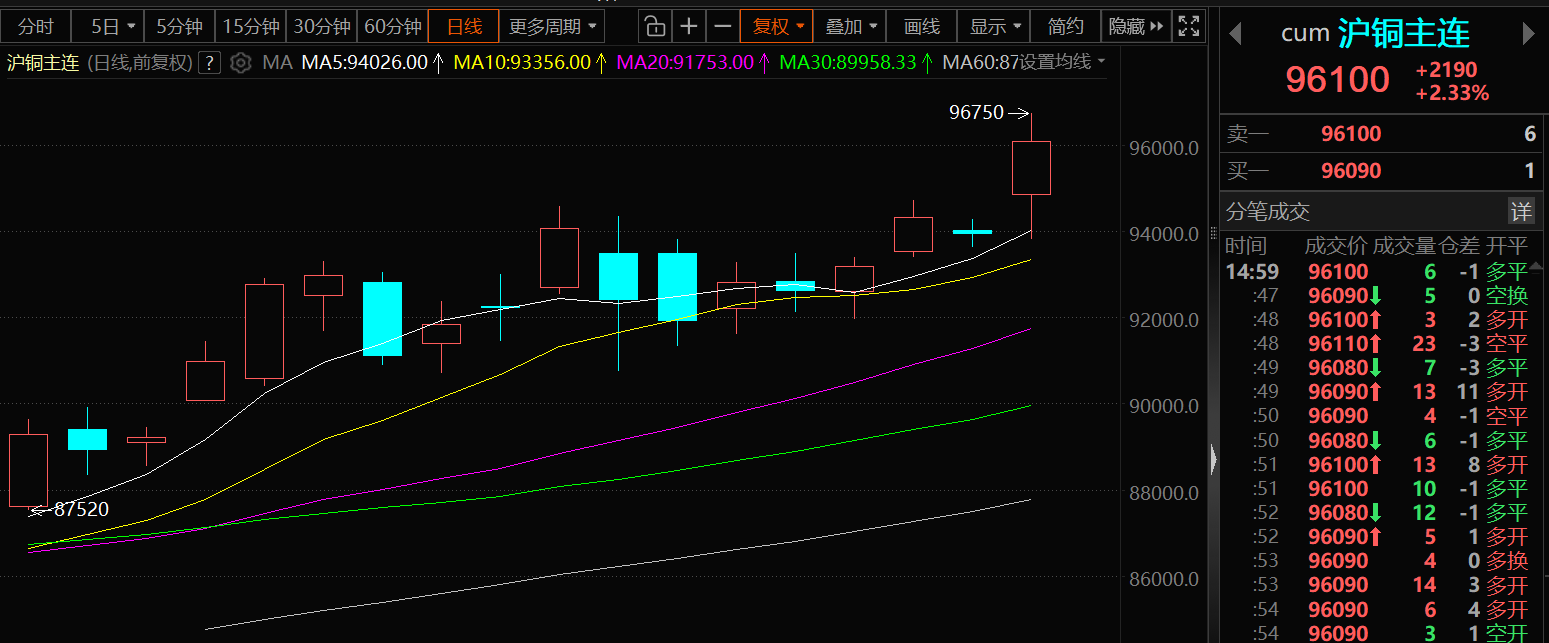
LME期铜创12282美元纪录高位 受需求前景改善及供应紧张迹象提振【盘中快讯】
Wen Hua Cai Jing· 2025-12-24 07:46
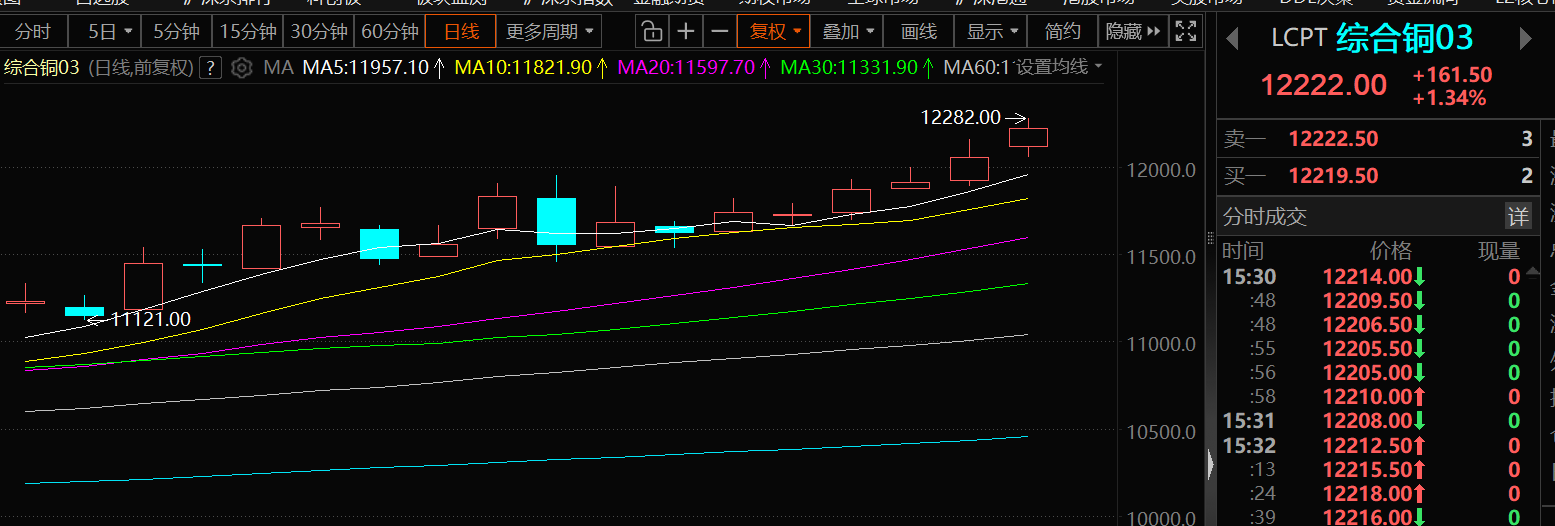
Group 1 - The core point of the article highlights that LME three-month copper prices increased by over 1%, reaching a record high of $12,282 due to strong economic growth in the United States, which boosted copper demand prospects [2] - The article indicates that signs of tight supply also provided support for copper prices, reflecting a favorable market condition for the metal [2]
海关总署:中国11月废铜进口量继续增加 为今年单月最高
Wen Hua Cai Jing· 2025-12-24 05:48
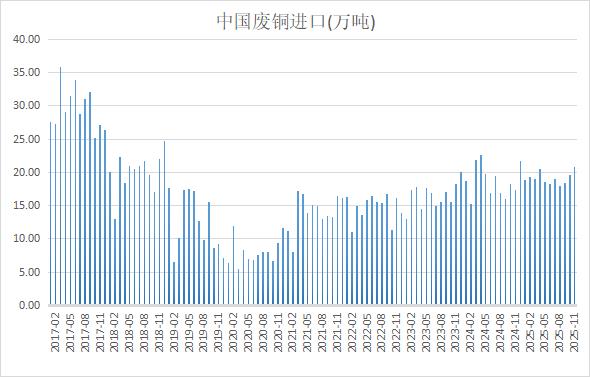
(文华综合) 海关总署在线查询数据显示,中国11月废铜进口量为20.81万吨,环比增加5.8%,同比增加19.9%,为 2025年单月新高。日本、泰国、韩国、马来西亚等主要供应国输送都有增加。 数据来源:海关总署 ...
海关总署:出口窗口继续打开 中国11月精炼铜出口量增逾一倍
Wen Hua Cai Jing· 2025-12-24 05:48
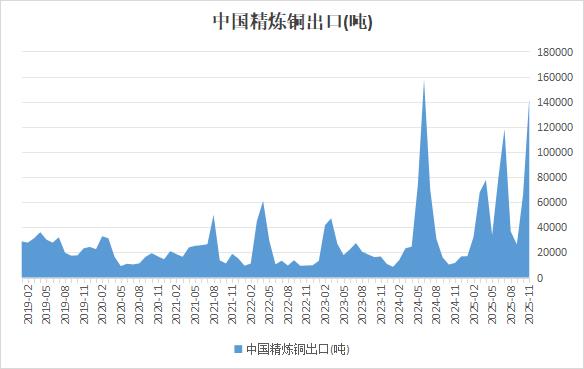
海关总署在线查询数据显示,中国11月精炼铜出口量为142991吨,同比增加逾11倍,环比大增逾1倍。 精炼铜出口窗口继续打开,国内需求受高铜价抑制较为有限,冶炼厂出口动力仍强,精炼铜出口量大 增。 数据来源:海关总署 (文华综合) ...