Wen Hua Cai Jing

Search documents
Evercore ISI:铝厂火灾将给福特带来高达10亿美元的损失
Wen Hua Cai Jing· 2025-10-09 02:01
Core Viewpoint - A fire at an aluminum plant in New York is expected to significantly impact Ford's production of the F150 truck, potentially leading to losses of up to $1 billion for the automaker [1] Group 1: Incident Details - The fire occurred on September 16 and is expected to halt most operations at the aluminum plant until the first quarter of 2026 [1] - The incident will affect the supply of metal for Ford's best-selling F150 truck, particularly as the year-end approaches [1] Group 2: Company Response - Ford has been working closely with Novelis, one of its aluminum suppliers, to address the situation and explore alternative solutions to minimize potential disruptions [1] - A dedicated team has been assigned to manage the response to the supply chain interruption caused by the fire [1] Group 3: Industry Impact - While other automakers may also be affected by the fire, Ford is expected to experience the most significant impact due to its reliance on aluminum for the F150 truck's body, which was adopted over a decade ago to reduce vehicle weight [1]

矿端担忧延续 沪铜早间高开【盘中快讯】
Wen Hua Cai Jing· 2025-10-09 02:01
(文华综合) 沪铜和国际铜节后高开,目前主力合约涨幅都在2%附近。智利8月铜产量同比减近一成,环比也有明显 下滑,主要受Codelco旗下矿山事故影响,叠加前期印尼Grasberg矿遭逾不可抗力,市场对于铜矿端脆弱 性担忧继续笼罩。宏观方面,美国非农推迟发布,ADP就业人口表现疲弱,继续推升市场对美联储年内 继续降息两次的预期,铜价和贵金属涨势联动。整体来看,矿端担忧持续叠加宏观氛围偏暖,铜价仍然 偏强运行。 ...
矿端脆弱性担忧笼罩 LME铜重心上移【十一外盘综述】
Wen Hua Cai Jing· 2025-10-09 01:54
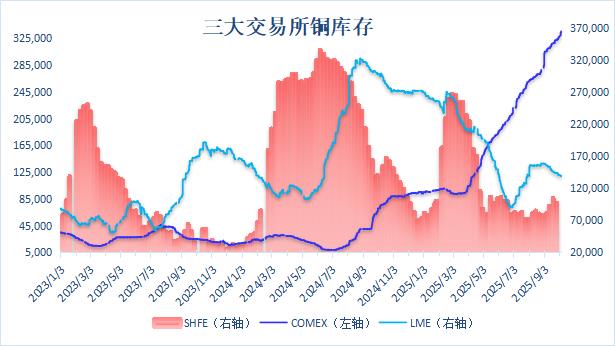
Group 1 - During the National Day holiday, overseas liquidity easing expectations boosted risk assets, with copper prices reaching around $108,000, the highest since May 2022 [1] - The U.S. government shutdown has led to a decline in ADP employment data, with a decrease of 32,000 jobs in September, raising expectations for two rate cuts by the Federal Reserve this year [1] - Chile's copper production fell by 9.9% year-on-year in August, marking the largest decline in over two years, primarily due to an accident at Codelco's El Teniente mine [1] Group 2 - Global copper mine vulnerabilities have been increasingly exposed this year, complicating negotiations between domestic smelters and overseas miners, leading to concerns about supply tightness [2] - Freeport's Grasberg mine in Indonesia faced force majeure, further escalating supply concerns and contributing to rising copper prices [2] - LME copper inventory has slightly decreased, while COMEX copper inventory has accumulated to over 330,000 tons, indicating a potential shift in market dynamics [2]

海外股市纷纷创出新高,美元触及逾两个月高位,美国期金突破4000【十一外盘综述】
Wen Hua Cai Jing· 2025-10-09 01:48
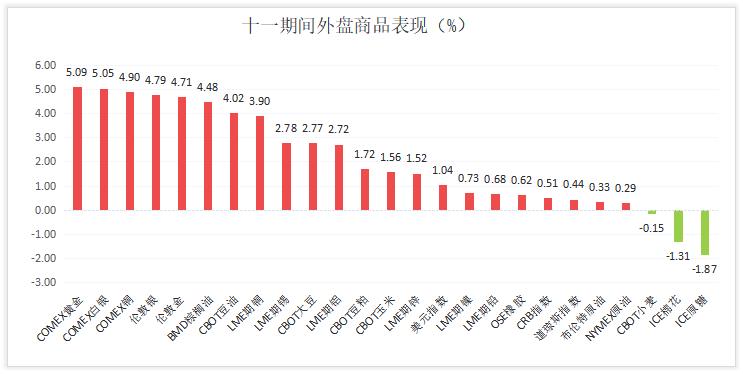
Market Overview - During the National Day holiday, global financial markets faced multiple risk events, including the U.S. government shutdown entering its eighth day and political changes in Japan and France impacting the markets [1] - U.S. stock markets continued to rise, with major indices reaching record highs, supported by expectations of interest rate cuts [1] - The dollar index reached a two-month high, while the Japanese yen fell to its lowest level since mid-February [1][2] Commodity Market - LME copper prices hit a 16-month high due to supply concerns, reaching $10,815 per ton, influenced by operational disruptions in major mines [3] - COMEX gold prices surpassed $4,000 per ounce for the first time, driven by expectations of interest rate cuts and geopolitical uncertainties [6] - Oil prices fell to a four-month low, with concerns over oversupply and OPEC's decision to maintain a modest production increase of 137,000 barrels per day [7][17] Agricultural Commodities - CBOT soybean futures rebounded after hitting a seven-week low, supported by lower yield forecasts and expectations of improved demand [9][10] Central Bank Insights - The Federal Reserve noted increased risks in the employment market while remaining vigilant about inflation, with discussions on potential interest rate adjustments ongoing [11][12] - The New Zealand central bank unexpectedly cut rates by 50 basis points, indicating concerns over economic weakness [13]
期铜回落,稍早受供应担忧推动触及16个月最高【10月8日LME收盘】
Wen Hua Cai Jing· 2025-10-09 01:04
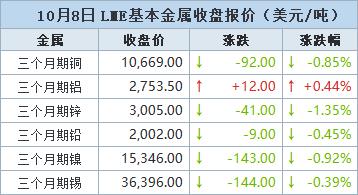
10月8日(周三),伦敦金属交易所(LME)铜价回落,受累于美元走强,稍早因交易商担心矿山生产 持续中断可能造成短缺而触及16个月最高。 铝价亦触及16个月最高水平,因可用库存下滑。 伦敦时间10月8日17:00(北京时间10月9日00:00),LME三个月期铜下跌92美元,或0.85%,收报每吨 10,669.0美元。盘中一度触及每吨10,815美元的去年5月22日以来最高。 国际铜业研究组织(ICSG)周三预计,2025年全球精炼铜市场将供应过剩约17.8万吨,2026年将短缺15万 吨。今年4月,该组织预测今年将过剩28.9万吨,2026年将过剩20.9万吨。 "所有的供应干扰都使得市场吃紧,"WisdomTree大宗商品策略师Nitesh Shah称。"矿商在新勘探方面几 乎没有什么动作,甚至开采新矿也变得更加困难,因此这种供应紧张的状况将会持续。" | | 10月8日 LIE基本金属收盘报价(美元/吨) | | | | --- | --- | --- | --- | | 金屋 | 收盘价 | 张跃 | 张跌幅 | | 三个月期铜 | 10.669.00 + | -92.00 ↓ -0.85% | | ...
印尼总统敦促当局打击非法采矿和锡矿走私
Wen Hua Cai Jing· 2025-10-08 06:55
Core Viewpoint - Indonesian President Prabowo Subianto emphasizes the need for continued efforts by various departments to combat illegal tin mining and smuggling activities [1] Group 1 - The President witnessed the asset handover ceremony related to a corruption case in tin mining, highlighting the government's serious commitment to eradicating illegal mining [1] - The call to action includes collaboration among the Attorney General's Office, military, customs, and coast guard to address these issues [1]
期铜逼近16个月高位,受助于矿山生产中断忧虑【10月7日LME收盘】
Wen Hua Cai Jing· 2025-10-08 06:44
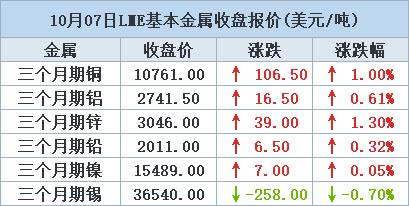
Group 1: Copper Market Overview - LME copper prices rose by 1% to $10,761.00 per ton, approaching a 16-month high due to concerns over mining production disruptions outweighing the impact of a stronger dollar [1][2] - Year-to-date, LME copper has increased by 22%, driven by production interruptions in major copper mines in Chile, the Democratic Republic of Congo, and Indonesia [2][3] - The Grasberg copper mine in Indonesia, one of the largest globally, has been suspended for nearly a month following a landslide that resulted in seven fatalities [2][3] Group 2: Price Forecasts and Market Sentiment - Citigroup raised its target price for LME three-month copper from $10,500 to $11,000 per ton, anticipating that economic growth recovery in 2026 could push prices to $12,000 per ton [3] - Dan Smith from Commodity Market Analytics noted that LME copper is nearing a critical resistance zone between $10,750 and just below $11,000, which has previously been a barrier in May 2021, March 2022, and May 2024 [3] Group 3: Chilean Copper Exports and Global Nickel Market - Chile's copper exports in September amounted to $4.39 billion, a decrease of 2.03% compared to the same month last year [4] - Sumitomo Metal Mining forecasts a continued surplus in the global nickel market for the third consecutive year, with a projected surplus of 256,000 tons in 2026, slightly down from 263,000 tons in 2025 [5] - The International Nickel Study Group (INSG) expects global nickel demand to rise to 3.82 million tons in 2026, up from 3.6 million tons in 2025, while production is anticipated to increase to 4.09 million tons [6][7]
期铜从16个月高点回落,美元走强引发获利了结【10月6日LME收盘】
Wen Hua Cai Jing· 2025-10-08 06:44
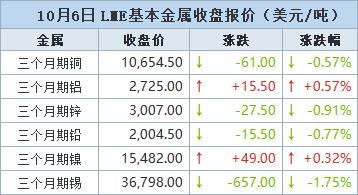
Core Viewpoint - LME copper prices experienced a decline after reaching a 16-month high, primarily due to profit-taking triggered by a stronger US dollar, overshadowing supply concerns from Chile and Indonesia [1][4]. Price Movements - LME three-month copper fell by $61, or 0.57%, closing at $10,654.50 per ton after hitting a peak of $10,800, marking a nearly 25% increase since early April [1][2]. - Other base metals showed mixed results: - Three-month aluminum rose by $15.50, or 0.57%, to $2,725.00 [2][6]. - Three-month zinc decreased by $27.50, or 0.91%, to $3,007.00 [2][7]. - Three-month lead dropped by $15.50, or 0.77%, to $2,004.50 [2][8]. - Three-month nickel increased by $49, or 0.32%, to $15,482.00 [2][9]. - Three-month tin fell by $657, or 1.75%, to $36,798.00 [2][10]. Market Influences - The recent rise in copper prices was partly attributed to the absence of the Chinese market during the Golden Week holiday, leading to increased selling by Chinese investors [4]. - A stronger US dollar, which rose by 0.4% to 98.11, made dollar-denominated metals more expensive for buyers using other currencies, prompting traders to close long positions [4]. - The ongoing US government shutdown has delayed the release of key economic data, including the September employment report, which may impact market sentiment [5]. Supply Concerns - Supply disruptions are expected to persist due to operational halts at Freeport-McMoRan's Grasberg mine in Indonesia following a landslide, along with other interruptions at mines in the Democratic Republic of Congo and Chile [5].
期铜创逾16个月新高,并录得逾一年来最佳周度表现【10月3日LME收盘】
Wen Hua Cai Jing· 2025-10-05 07:11
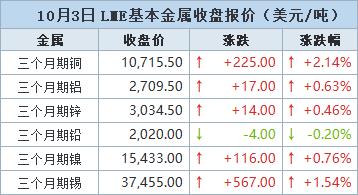
Core Insights - LME copper prices reached a 16-month high on October 3, driven by supply tightness and a weakening dollar [1][4] - The three-month copper price increased by $225, or 2.14%, closing at $10,715.5 per ton, marking a weekly gain of 5.2%, the strongest since September 2024 [1][5] Price Movements - Three-month copper: $10,715.50, up $225.00 (+2.14%) [2] - Three-month aluminum: $2,709.50, up $17.00 (+0.63%) [2] - Three-month zinc: $3,034.50, up $14.00 (+0.46%) [2] - Three-month lead: $2,020.00, down $4.00 (-0.20%) [2] - Three-month nickel: $15,433.00, up $116.00 (+0.76%) [2] - Three-month tin: $37,455.00, up $567.00 (+1.54%) [2] Supply Dynamics - LME copper inventory dropped to 140,475 tons, the lowest level since early August [5] - Supply risks and potential delays in restoring supply have been highlighted as key market drivers [4]
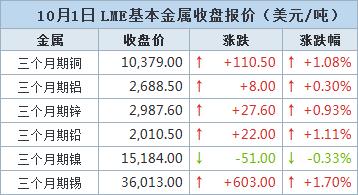
期铜攀升,因供应担忧挥之不去且美元走软【10月1日LME收盘】
Wen Hua Cai Jing· 2025-10-05 07:04
Core Insights - LME copper prices increased by over 1% due to supply disruptions and a weakening US dollar amid government shutdown concerns [1] - LME three-month copper closed at $10,268.5 per ton, down $145.5 or 1.4% from earlier highs [1] Group 1: Market Performance - On October 1, LME three-month copper closed at $10,379.00, up $110.50 or 1.08% [2] - Other base metals also saw price increases, with three-month aluminum up 0.30%, zinc up 0.93%, and lead up 1.11% [2] - Three-month tin rose by 1.70%, closing at $36,013.00 [2] Group 2: Supply Concerns - The Grasberg mine in Indonesia faced force majeure, contributing to market volatility and upward price pressure [4] - Antofagasta Minerals' Los Pelambres copper mine in Chile may face a strike after union leaders rejected a new contract proposal, raising supply concerns [4] - Chile's copper production in August fell by 9.9% year-on-year, marking the largest decline in over two years [5] Group 3: Inventory and Currency Impact - Copper inventories in LME warehouses dropped to 141,725 tons, the lowest level since early August [6] - A weakening US dollar, influenced by the government shutdown, provided additional support for base metal prices [6]