华尔街见闻

Search documents
极致贪婪时刻!美银基金经理调查:全球经济“不着陆”首次成共识,股票对冲策略几近崩溃
华尔街见闻· 2026-01-20 11:17
Group 1 - The core sentiment among global investors is one of "extreme greed," with market sentiment reaching its highest level since mid-2021 [1] - A recent Bank of America survey indicates that cash levels in investment portfolios have plummeted to historical lows as fund managers aggressively pursue risk assets [2][9] - The macroeconomic outlook has shifted decisively, with the "no landing" scenario becoming the baseline expectation for investors, surpassing both "soft landing" and "hard landing" for the first time in three years [3][7] Group 2 - The Bank of America's "Bull-Bear Indicator" has surged to a level of 9.4, indicating "extreme bullishness," which is often interpreted as a contrarian sell signal [4] - There is a significant increase in stock allocations, with a net overweight of 48% in equities, the highest since December 2024, while bond allocations have decreased to a net underweight of 35%, the lowest since September 2022 [12] - Investors are increasingly favoring cyclical sectors, with bank stocks being the most over-allocated sector at a net overweight of 34%, contrasting sharply with a net underweight of 30% in consumer staples, the lowest since February 2014 [12] Group 3 - Despite the high risk appetite, there is a notable increase in the popularity of "long gold" trades, which has become the most crowded trade, with 51% of investors favoring it, surpassing the previously dominant "long seven tech giants" [13] - Geopolitical risks are perceived as the largest tail risk by 28% of investors, followed by concerns over an "AI bubble" and rising bond yields [15] - The upcoming U.S. midterm elections are expected to result in a "divided Congress," with 60% of respondents predicting that Democrats will control the House and Republicans will control the Senate [17]


“木头姐”2026展望:“里根经济学”升级版,美股继续“黄金时代”,美元走高压制黄金
华尔街见闻· 2026-01-20 11:17
Core Viewpoint - ARK Invest founder Cathie Wood predicts a "golden age" for the U.S. stock market driven by deregulation, tax cuts, sound monetary policy, and innovative technologies, likening the next three years to "Reaganomics on steroids" [2][4] Economic Outlook - Despite continuous growth in real GDP over the past three years, the underlying U.S. economy has experienced a rolling recession and is poised for a strong rebound [3][11] - Wood emphasizes that the U.S. economy will benefit significantly from policy changes, including a reduction in effective corporate tax rates to around 10% [4][25] - Inflation is expected to be controlled and may even turn negative, driven by productivity gains [5][30] GDP Growth Projections - The nominal GDP growth rate in the U.S. is projected to remain between 6% and 8% in the coming years, primarily driven by productivity improvements rather than inflation [6][51] Market Impact - Wood anticipates that the relative advantage of U.S. investment returns will lead to a significant appreciation of the dollar, reminiscent of the 1980s when the dollar nearly doubled in value [7][68] - The strengthening dollar is expected to suppress gold prices, while Bitcoin will exhibit a different trend due to its supply mechanism and low asset correlation [8][66] Valuation Concerns - Wood does not believe an AI bubble has formed, arguing that while current price-to-earnings ratios are historically high, corporate earnings growth driven by AI and robotics will absorb these valuations [9][82] - Historical patterns suggest that significant bull markets can occur alongside P/E compression, as seen in previous market cycles [84] Consumer Confidence and Spending - Consumer confidence among low-income groups has dropped to its lowest level since the early 1980s, indicating a tightly coiled spring with potential for rebound [22][23] - Tax cuts and regulatory easing are expected to boost disposable income growth significantly, potentially increasing from approximately 2% to 8.3% annually [25][28] Technological Innovation and Productivity - The integration of AI, robotics, and other technologies is anticipated to drive a robust capital expenditure cycle, marking one of the strongest periods of investment in history [20][70] - Productivity growth is expected to accelerate to 4-6% annually, further reducing unit labor cost inflation [41][46] Gold and Bitcoin Market Dynamics - Gold prices have surged significantly, while Bitcoin has seen a decline, with supply dynamics influencing their respective markets [54][56] - The historical context suggests that gold prices are currently at a high level relative to M2 money supply, indicating potential overvaluation [60] Future of the Dollar - Predictions indicate that U.S. investment returns will improve relative to other regions, potentially leading to a stronger dollar in the coming years [68]
美联储独立性的分水岭!明天,美国最高法院审“特朗普诉库克案”
华尔街见闻· 2026-01-19 09:46
Core Viewpoint - The ongoing court case regarding the Federal Reserve Board member Lisa Cook is critical for the independence of the Federal Reserve, with potential implications for monetary policy driven by political motives rather than data-driven logic [1][4]. Group 1: Court Case and Its Implications - The Supreme Court hearing this week will determine whether Lisa Cook can continue her role on the Federal Reserve Board, following allegations of fraud made by the Trump administration [3]. - UBS highlights that the case directly challenges the "for cause" removal protection outlined in the Federal Reserve Act, which could lead to significant changes in the governance of the Federal Reserve [4]. - If the court rules against Cook, it may open the door for the President to remove Federal Reserve officials based on political motivations, undermining the institution's independence [5]. Group 2: Political Tensions and Market Reactions - The relationship between the U.S. administration and the Federal Reserve has escalated into a public confrontation, with the Justice Department issuing subpoenas related to the management of the Federal Reserve's office renovation [7]. - UBS analysts suggest that if the government pursues criminal charges against Fed Chair Jerome Powell, it could lead to a scenario where Powell remains in a board role beyond his chairmanship, potentially acting as a buffer against aggressive rate cuts [7]. - The market is bracing for a turbulent 2026, with expectations of declines in the dollar, U.S. stocks, and bonds if the court ruling is unfavorable for Cook or if Powell faces increased pressure [6][7].
“新全球秩序=新全球牛市=金银牛市!” 美银:黄金有望突破6000
华尔街见闻· 2026-01-19 09:46
Core Viewpoint - The article discusses the emergence of a "New World Order = New World Bull Market" driven by global fiscal expansion under Trump's leadership, with a bullish outlook on gold and silver, while highlighting risks associated with the rapid appreciation of East Asian currencies [2][3]. Group 1: Global Market Dynamics - Hartnett believes that the market is entering a phase of global rebalancing, moving away from American exceptionalism, with international stocks being favored [3]. - The article notes that since 2020, U.S. stock funds have seen inflows of $1.6 trillion, while global funds have only attracted $0.4 trillion, indicating a significant imbalance that is expected to correct [3]. Group 2: Investment Recommendations - Hartnett recommends going long on international stocks and assets related to economic recovery, particularly favoring small and mid-cap stocks, homebuilders, retail, and transportation sectors [12]. - The article suggests that gold is expected to break the historical high of $6,000, with a current allocation of only 0.6% among high-net-worth clients, indicating potential for significant price appreciation [8][10]. Group 3: Economic Indicators and Risks - The article highlights that the sustainability of the optimistic outlook depends on the U.S. unemployment rate remaining low and Trump's ability to lower living costs to improve his approval ratings [12][15]. - A major risk identified is the potential rapid appreciation of the Japanese yen, South Korean won, and New Taiwan dollar, which could lead to a tightening of global liquidity [16][18]. Group 4: Geopolitical Context - China is identified as a key market, with the end of deflation expected to catalyze bull markets in Japan and Europe [4]. - The stability of Middle Eastern markets, such as the Tehran Stock Exchange's 65% increase since last August, is seen as a positive signal for global oil supply and market conditions [4].

开年最惨!美国软件股崩了,因为Claude Code太火了
华尔街见闻· 2026-01-19 09:46
Core Viewpoint - The release of Claude Code has reignited concerns about the disruption of the software industry by AI, leading to the worst annual start for U.S. software stocks in years, with a 15% decline in a basket of SaaS stocks tracked by Morgan Stanley since the beginning of the year [1][4]. Group 1: Market Performance - Software stocks have experienced a significant downturn, with a 15% drop since the start of the year, following an 11% decline in 2025, marking the worst opening performance since 2022 [1]. - Current valuations for software stocks are at a record low, trading at 18 times expected earnings for the next 12 months, significantly below the average of over 55 times in the past decade [1]. Group 2: Impact of AI Developments - The panic in the market was triggered by Anthropic's release of "Claude Cowork," which showcased capabilities that alarmed investors about the future of software companies [5][6]. - Users reported completing complex projects in a week that would typically take a year, highlighting the disruptive potential of AI tools [2]. Group 3: Analyst Perspectives - Many buy-side institutions believe there is currently "no reason to hold" software stocks due to the uncertainty brought by AI, with no catalysts for valuation recovery in the short term [4][6]. - Analysts note that existing software companies have not demonstrated significant appeal in their AI products, with Salesforce and Adobe showing limited revenue impact from their AI initiatives [8]. Group 4: Comparative Sector Performance - The earnings growth forecast for software and services companies in the S&P 500 is expected to slow from approximately 19% in 2025 to 14% in 2026, contrasting with the semiconductor sector, which is projected to see profit growth of nearly 45% in 2025 and accelerate to 59% in 2026 [8][9]. - Major tech companies like Microsoft, Amazon, Alphabet, and Meta Platforms are expected to invest heavily in AI infrastructure, providing clearer visibility for revenue growth compared to software firms [8]. Group 5: Valuation Discrepancies - Despite low valuations, there is a divide in market sentiment regarding the future of software stocks, with some analysts optimistic about a rebound by 2026 due to stable customer spending and attractive valuations [10][11]. - Concerns remain about how software companies will compete against AI agents capable of completing tasks rapidly, complicating the assessment of appropriate valuation multiples [11].



“只买不卖”!“香港巴菲特”将四分之一的财富投入黄金
华尔街见闻· 2026-01-19 09:46
Core Viewpoint - The article highlights the investment strategy of Cheung Hai, known as the "Hong Kong Buffett," who allocates a significant portion of his wealth to gold, far exceeding the average allocation among peers, and adheres to a "buy and hold" strategy [1][4]. Group 1: Investment Strategy - Cheung Hai has allocated approximately 25% of his family office assets, totaling around $1.4 billion, to precious metals, while the average allocation in global family offices is only 2% [1][4]. - His investment in precious metals began with small amounts in 2008, leading to substantial investments in physical gold ETFs, resulting in cumulative gains of $251.1 million and a 167% increase over ten years [2][4]. - He recommends a portfolio composition of 60% stocks, 20% bonds, and 20% precious metals, primarily gold, citing geopolitical tensions as a driving force for gold and silver prices [3][4]. Group 2: Market Insights - Cheung Hai's investments are supported by historical highs in metals like gold, silver, copper, and tin, driven by anticipated monetary easing from the Federal Reserve and geopolitical tensions [3][8]. - He emphasizes the importance of physical gold storage, especially in light of recent geopolitical events, suggesting that it serves as a secure asset against potential sanctions or asset seizures [7][8]. - The article notes that silver has seen a significant price increase, doubling in value over the past year, which has attracted interest from various Asian family offices [8].

没有商业模式--DeepSeek最坚固的“护城河”
华尔街见闻· 2026-01-19 09:46
Core Viewpoint - DeepSeek's unique advantage lies in its lack of a commercial model, allowing it to focus solely on its AGI (Artificial General Intelligence) aspirations without external pressures or funding requirements [3][8][12]. Group 1: Market Expectations and Competition - The market's expectations for DeepSeek's upcoming model are tempered by the saturation of open-source models, making it less likely to shock the world again as it did previously [3][4]. - DeepSeek is no longer the only or the most open player in the market, as other labs have quickly followed suit with their own models [5][8]. Group 2: Funding and Control - DeepSeek's founder, Liang Wenfeng, has maintained a "zero external financing" approach, prioritizing control over financial gain, which is unique among top labs [3][9]. - The success of Liang's quantitative fund, which generated over $700 million in profit with a 53% return rate, allows DeepSeek to fund its operations without external investment [3][11]. Group 3: Advantages of No Commercial Model - The absence of external funding means DeepSeek is not burdened by commercial KPIs, allowing it to focus purely on technological advancements [3][12]. - The lack of external financial pressures fosters a flat organizational structure, reducing internal competition and bureaucracy, which can hinder innovation [14][15]. Group 4: Research and Resource Allocation - DeepSeek's limited resources do not impede its research quality, as good research does not necessarily require excessive computational power [13][14]. - The organization can prioritize innovative ideas without the distractions and conflicts that often accompany larger, well-funded labs [15][18].

谁是新主席、起诉鲍威尔、颠覆美联储?围绕美联储的各种斗争,下周分胜负?
华尔街见闻· 2026-01-18 11:59
Core Viewpoint - The ongoing political struggles surrounding the Federal Reserve, particularly the investigation into Chairman Jerome Powell, are reaching a critical juncture that could significantly impact market expectations regarding interest rate movements [1][2][3]. Group 1: Investigation into Powell - The criminal investigation into Powell is evolving into a political backlash against the Trump administration, with subpoenas issued regarding renovation costs of the Federal Reserve building [4]. - This backlash resonates within the Republican Party, signaling to the White House that failure to terminate the investigation could hinder the confirmation process for the next Federal Reserve Chair [5]. - Trump's advisors are attempting to de-escalate the situation, suggesting that once the requested information is provided, the matter could be resolved [6][7]. Group 2: Supreme Court Case - The upcoming Supreme Court hearing regarding Federal Reserve Governor Lisa Cook is crucial for the independence of the Federal Reserve [8]. - The case stems from Trump's attempt to dismiss Cook on allegations of mortgage fraud, which she denies, and her legal challenge aims to protect her position [9]. - A ruling in favor of Trump could undermine the independence of the Federal Reserve by allowing the President to dismiss any Federal Reserve official at will [10]. Group 3: Economic Context - The U.S. GDP growth reached 4.3% in the fourth quarter, raising questions about the justification for interest rate cuts, especially given Trump's previous calls for rates to be lowered to near zero [11]. - If investors perceive that the Federal Reserve is no longer independent in combating inflation, bond yields could rise sharply [12]. Group 4: Future Leadership of the Federal Reserve - The selection process for the next Federal Reserve Chair is expected to conclude soon, with candidates including Kevin Hassett and Kevin Warsh [14]. - Current indications suggest that Warsh is favored over Hassett, as he is seen as more capable of maintaining a degree of independence, which is viewed positively by Wall Street [15]. - Trump's upcoming speech in Davos may coincide with the announcement of the new Federal Reserve Chair, although there is potential for delays or unexpected candidates [16][17].
一周重磅日程:中国GDP、“美联储最爱通胀指标”、日央行决议、冬季达沃斯
华尔街见闻· 2026-01-18 11:59
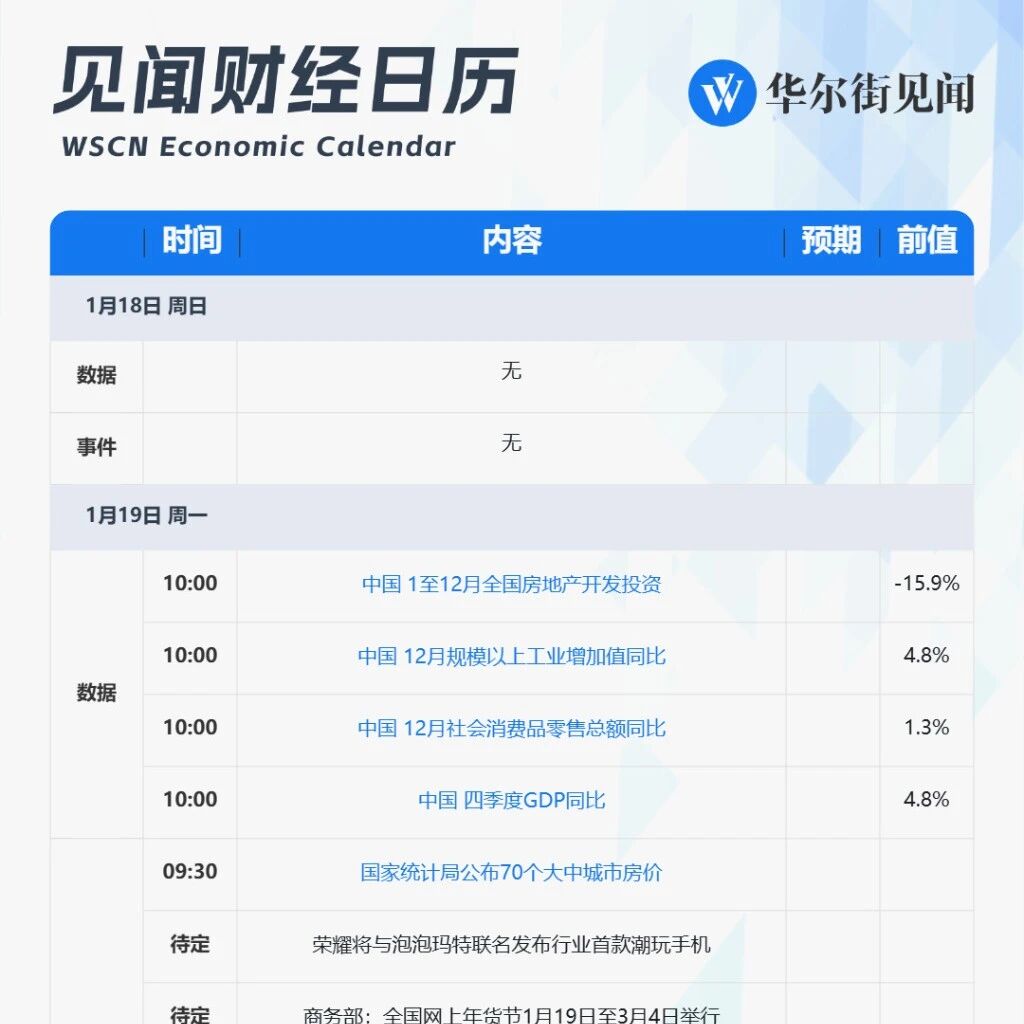
Core Viewpoint - The article discusses significant upcoming economic events and data releases that could impact global markets, focusing on U.S. inflation, geopolitical tensions, and China's economic indicators [6][7][10]. Economic Data and Events - On January 19, China will release key economic data including GDP, industrial output, and retail sales, with expectations of a 4.6% year-on-year GDP growth for Q4 [15]. - The U.S. will publish the core PCE price index on January 22, which is anticipated to show a rebound, potentially affecting market expectations for interest rate cuts by the Federal Reserve [11][12]. - Japan's central bank is expected to maintain its interest rate at 0.75% during its meeting on January 23, amid political uncertainties [16]. Geopolitical Developments - The World Economic Forum in Davos will take place from January 19-23, with U.S. President Trump expected to address economic and geopolitical issues, which may influence market sentiment [22]. - The U.S. Supreme Court will hear a case regarding Trump's dismissal of a Federal Reserve official, which could set a precedent for presidential authority over Fed officials [29]. Corporate News and Financial Reports - Major companies such as Intel and Netflix are set to release earnings reports, which will be critical in assessing the recovery in technology hardware and streaming sectors [39]. - Walmart will be added to the Nasdaq-100 index on January 20, replacing AstraZeneca, which may impact its stock performance [41]. - Dragon Flag Technology is seeking to raise up to $2.05 billion through an IPO in Hong Kong, with shares expected to start trading on January 22 [42].
“飙升的电费”成为美国中选焦点,AI数据中心站上“政治火山口”
华尔街见闻· 2026-01-18 11:59
Core Viewpoint - Rising electricity costs are becoming a central issue in the U.S. political agenda, surpassing other types of inflation, with data centers being heavily criticized for their significant energy consumption [1][2]. Group 1: Political Implications - The Trump administration is actively engaging with state governors to address rising electricity prices, pushing for emergency power auctions and requiring large tech companies to either self-supply electricity or bear the costs of new power plants [1][2]. - Electricity costs in the U.S. increased by 6.7% year-over-year as of December, with a cumulative rise of approximately 38% since 2020, while overall consumer prices rose only 2.7% during the same period [2]. - The political pressure surrounding electricity prices is evident, with various state governors expressing concerns about the impact of rising costs on consumers and the need for regulatory scrutiny of utility companies [3][4]. Group 2: Market Dynamics - The increase in electricity prices is attributed to multiple factors, including aging infrastructure, natural disasters, state renewable energy initiatives, and fluctuations in fuel costs [3][8]. - The demand for electricity is shifting due to electrification, the return of manufacturing, and the retirement of coal plants, which is tightening regional electricity markets and increasing costs passed on to consumers [8][9]. - Goldman Sachs suggests that investors should hedge against the political risks associated with AI and data centers, as policymakers are increasingly vocal about the energy consumption of data centers [2][10]. Group 3: Industry Response - Data centers are being labeled as the scapegoat for rising electricity costs, leading to debates about cost allocation between residential consumers and large commercial clients [6][12]. - Goldman Sachs has identified three primary concerns regarding data centers: the substantial cash flow investments in infrastructure, the accuracy of measuring capacity demand, and the potential regulatory controls that may arise from the upcoming midterm elections [11][12]. - The firm recommends several trading strategies to mitigate risks associated with the political landscape, including investing in non-tech companies that enhance productivity through AI and hedging against volatility in AI-related stocks [11][12].