华尔街见闻

Search documents
白银和伦铜双双创历史新高,原因详解
华尔街见闻· 2025-12-01 09:56
Core Viewpoint - The article highlights the rising prices of silver and copper driven by global supply constraints and expectations of monetary policy easing, marking a significant shift in the commodities market [1][4]. Supply and Demand Dynamics - The strong momentum in silver and copper prices reflects a general optimism in the precious metals market and specific supply-demand imbalances for these metals [2]. - On December 1, 2023, spot silver prices surpassed $57 per ounce for the first time in history, with silver futures reaching $57.81 per ounce [3]. - China's silver inventory has dropped to a seven-year low, directly linked to record export volumes in October, indicating a significant consumption of inventory due to cross-border tariff arbitrage activities [5][11]. Price Trends and Market Reactions - Copper prices also surged, with the London Metal Exchange (LME) reaching a historical high of $11,210.5 per ton, and Comex copper prices rising to $532.55 per pound [5][7]. - Since the end of August, LME copper prices have increased by approximately 13%, driven by supply tightness and traders moving inventory to the U.S. to lock in premiums [7]. Market Sentiment and Future Outlook - The current situation is characterized by a supply shortage that is becoming a core driver of prices, as indicated by the movement of large inventories to the U.S. market [9][10]. - Analysts suggest that the supply tightness is evident in commercial negotiations, with Chilean copper producer Codelco seeking to significantly increase its annual contract premiums [12]. Monetary Policy Influence - Expectations of monetary easing by the Federal Reserve are providing solid support for silver and the broader precious metals market, enhancing the appeal of non-yielding assets like silver [14]. - Recent dovish comments from Federal Reserve officials have reinforced market expectations for a potential rate cut in December, further boosting confidence in a low-interest-rate environment [14].


美联储大消息!特朗普宣传:新主席人选已决定
华尔街见闻· 2025-12-01 09:56
(图片由豆包生成) 刚刚过去的周末, 美国总统特朗普表示已决定下任美联储主席人选 ,此前他曾多次明确表示期待新主席推动降息。 这一表态引发市场积极反应,10年期美债收益率一度跌破4%。 美国财长贝森特上周表示, 特朗普可能在12月25日圣诞节假期前宣布提名人选 。现任主席鲍威尔的任期将于明年5月结束,但其作为美联储理事的任期要到 2028年才结束。 特朗普确认已作出决定 特朗普周日在空军一号返回华盛顿途中告诉记者:"我知道我要选谁,是的。我们会宣布这个决定。" 但他未透露具体人选姓名。 特朗普频繁批评现任美联储主席鲍威尔未能迅速降息,并多次释放信号希望新主席更积极推动降息。 此前在11月18日,特朗普曾表示"我真想马上把现在那个人换掉,但有人在阻止我这么做。" 白宫国家经济委员会主任Kevin Hassett(哈塞特)在接受媒体采访中强调, 市场对特朗普即将宣布新主席人选的消息"反应非常非常积极"。 作为特朗普首席 经济顾问的哈塞特被视为接替鲍威尔的热门人选,目前在polymarket预测中以66%的概率领先。 哈塞特表示: 相关消息传出后,美国国债拍卖表现强劲,利率下降,这表明"美国民众可以期待特朗普挑选一 ...

月产5000万只!当Labubu不再稀缺,泡泡玛特拿什么接棒?
华尔街见闻· 2025-12-01 09:56
Core Viewpoint - Deutsche Bank warns that Pop Mart is facing an "Availability Paradox," where the rapid expansion of production capacity is leading to Labubu transitioning from a scarce trendy IP to a mass consumer product, which will diminish its fashion appeal and secondary market prices [1][2]. Group 1: Production Capacity and Market Dynamics - Pop Mart's production capacity has surged from an average of 10 million units per month in the first half of the year to 50 million units per month by the end of the year, trading scarcity for short-term revenue growth [1][2]. - The strong growth driven by Labubu is masking significant risks of supply-demand reversal, with potential valuation pressures if Labubu's popularity peaks in 2026 without new hits [1][3]. Group 2: Market Performance and Pricing Trends - Since August 2025, the premium for Labubu and other popular IPs has halved, with the price of Labubu's "hidden" variants dropping over 50% [6]. - Specific examples show that Labubu 1.0 "Exciting Macaron" hidden variant prices have fallen by 50%, while Labubu 3.0 "Love" variant prices have dropped by 81% [7]. Group 3: Consumer Sentiment and Product Reception - The secondary market has seen immediate discounts on newly released products, indicating a slowdown in sales and a potential "fashion fatigue" among consumers [11][12][14]. - Negative feedback regarding design and quality has increased on social media, suggesting a decline in consumer interest in the Labubu IP [13][14]. Group 4: Valuation Scenarios - Deutsche Bank maintains a "Hold" rating for Pop Mart with a target price of 228 HKD, presenting two contrasting valuation scenarios based on Labubu's popularity trajectory [15]. - In a bearish scenario, if Labubu's popularity peaks in 2026, net profit could drop to 10.6 billion RMB, leading to a significant increase in implied P/E ratio to 23x [15]. - Conversely, in a bullish scenario with sustained growth and new IP launches, net profit could exceed 23.1 billion RMB, reducing the implied P/E ratio to 13x [16].

罕见大逆袭,全球牛市排行榜,欧洲霸屏
华尔街见闻· 2025-12-01 09:56
在2025年全球股市的角逐中,一场罕见的逆转正在上演。曾 一度被投资者忽视的欧洲市场,如今正以惊人的表现霸占全球股市排行榜的前列,打破了华尔街 将主导市场的普遍预期。 在距2025年交易结束仅剩一个月之际,全球表现最佳的20个股票市场中, 欧洲独占半壁江山。以美元计算,匈牙利、斯洛文尼亚和捷克共和国等市场的涨幅 均超过60%,跻身全球前十。 这一出人意料的强劲表现, 是欧洲自欧元区成立以来仅有的第四次,标志着投资者信心的显著回归。 这一转变已在资金流向上得到体现。 美国银行的最新月度调查显示,投资者目前已转为净增持欧洲股票,同时略微减持美国股票。斯托克600指数(Stoxx 600 Index)相对标准普尔500指数(S&P 500)的美元计价表现,正迈向2006年以来的最大优势。 强劲反弹的背后,是欧洲经济前景的改善、低于美国的通胀水平、德国即将开启的财政刺激,以及走强的欧元。这些因素共同作用,正在重塑全球资本的配置 版图。 意外的强劲表现 今年以来,欧洲多个股指的表现远超预期。 匈牙利、斯洛文尼亚和捷克共和国等市场以美元计算的涨幅均超过60%,稳居全球表现最佳的股指之列。西班牙、 波兰和奥地利的股市也紧随 ...

这家公司,员工分了18亿,上次分9亿
华尔街见闻· 2025-11-30 12:10
Core Viewpoint - The article highlights the wealth creation phenomenon among employees in A-share listed companies, particularly focusing on the case of United Imaging Healthcare, which has successfully implemented employee stock ownership plans leading to significant financial rewards for its staff [5][20]. Group 1: United Imaging Healthcare's Employee Stock Ownership - United Imaging Healthcare announced that its five employee stock ownership platforms collectively reduced their holdings by 13.37 million shares, valued at approximately 1.82 billion yuan [7]. - The company has established a robust employee stock ownership plan since 2013, which has now covered over 800 beneficiaries, including both current employees and those who have made significant contributions [9][8]. - Following the recent share reduction, each employee involved in the stock ownership plan could receive at least 2 million yuan, showcasing the financial benefits of the program [10]. Group 2: Founders and Company Growth - The founders of United Imaging Healthcare, Xue Min and Zhang Qiang, started the company in 2011 with the goal of breaking the foreign monopoly in high-end medical equipment, leading to a current market valuation of around 110 billion yuan [5][13]. - The company has successfully launched several innovative medical imaging products, filling gaps in both domestic and international markets, and was listed on the Sci-Tech Innovation Board in 2022 [16][17]. - Early investors, such as Daofu Yuantong, have seen substantial returns on their investments, with some reducing their holdings for a total of approximately 3.16 billion yuan [17][18]. Group 3: Broader Market Trends - The trend of wealth creation through employee stock ownership is not limited to United Imaging Healthcare; other companies like Century Huatong and Ailisi are also rewarding employees with significant stock options and bonuses [20][21]. - Over 1,300 listed companies have announced stock incentive plans this year, a significant increase compared to 381 in 2024, indicating a growing trend in employee wealth sharing [22]. - The article emphasizes that the era of wealth creation is expanding beyond founders and investors to include dedicated employees, reflecting a shift in corporate culture towards shared success [23].


“特朗普交易”遭重创
华尔街见闻· 2025-11-30 12:10
Group 1 - The "Trump trade" is facing significant losses, particularly for assets directly associated with Trump and his family, with the Trump Media & Technology Group's stock down 75% since his inauguration [1] - The meme coins named after Trump and Melania have seen declines of 86% and 99% respectively since the inauguration, while another cryptocurrency project linked to the Trump family has dropped about 40% since its launch in September [1] - The sell-off of these assets coincides with a broader decline in speculative market enthusiasm, affecting various risk assets including Bitcoin and AI-related stocks [1][2] Group 2 - The decline in speculative sentiment is not limited to Trump-related assets; a basket of unprofitable tech stocks tracked by Goldman Sachs has fallen 21% from mid-October to November 21 after an earlier surge [3] - The Trump Media & Technology Group has a staggering price-to-sales ratio of 1240, indicating a significant market correction [4] - Despite the downturn in certain sectors, healthcare stocks have risen, and major Wall Street banks like Goldman Sachs have performed well, while regional banks lag behind due to economic slowdown concerns [5][6] Group 3 - Gold has emerged as a winner amid market turmoil, with prices around $4200 per ounce, reflecting a nearly 60% increase this year as investors seek safe-haven assets [6] - Bitcoin has faced a harsh sell-off, dropping 30% in less than two months after a strong rally, impacting the Trump business ventures heavily invested in the cryptocurrency [6] - The macroeconomic outlook remains mixed, with expectations of a potential interest rate cut by the Federal Reserve in December, which could stabilize market sentiment [10]

业界大佬:全球铜都在流向美国,这是铜多头“一次大好机会”
华尔街见闻· 2025-11-30 12:10
Group 1 - Kostas Bintas, head of metals at Mercuria Energy Group, reiterated a bullish outlook on copper prices, warning of further depletion of copper inventories globally as large amounts of metal flood into the U.S. market [1] - Bintas described the current situation as a "great opportunity" for copper bulls, noting that profitable U.S. arbitrage trading is returning, leading to supply shortages outside the U.S. and driving copper prices higher [2] - He emphasized that from a mathematical perspective, the only answer to the current trends of tight supply and rising prices is that even Chinese buyers will have to pay higher premiums to secure supply [3] Group 2 - Mercuria expects a significant increase in U.S. copper imports in the coming months, predicting that the import rate in Q1 2026 will match the record level of over 500,000 tons seen in Q2 2025 [4] - The copper market has experienced volatility this year, with U.S. copper prices soaring earlier in the year due to tariff threats, leading to a massive flow of metal into the U.S. from other regions [4] - Bintas believes the current market structure, characterized by weak demand and surplus yet rising prices, is a "special dynamic" that could lead to shortages in the Chinese market as metal continues to flow to the U.S. [4] Group 3 - Bintas acknowledged that the bullish outlook is driven by U.S. policy, with the U.S. now being the largest copper consumer globally [5] - Market data shows that New York futures prices are significantly higher than London benchmark prices, leading to a bidding war among Asian buyers [5] - This market polarization has created a "dual-speed" mechanism, where LME and Shanghai copper contracts are primarily supported by Russian and Chinese metals, while metals deliverable to Comex enjoy high premiums [5] Group 4 - Traders have pushed up the premium for deliverable copper, with reports indicating some traders attempting to purchase Chilean copper at premiums exceeding $500 over LME prices [7] - Chile's Codelco has recently proposed a benchmark premium of over $300 per ton to customers in South Korea and China, shocking Asian buyers [7] - Bintas predicts that while Chinese buyers are currently hesitant about high prices, they will eventually accept them, and the market will likely settle above a $200 premium [7]

一周重磅日程:美俄会谈、中美PMI
华尔街见闻· 2025-11-30 12:10
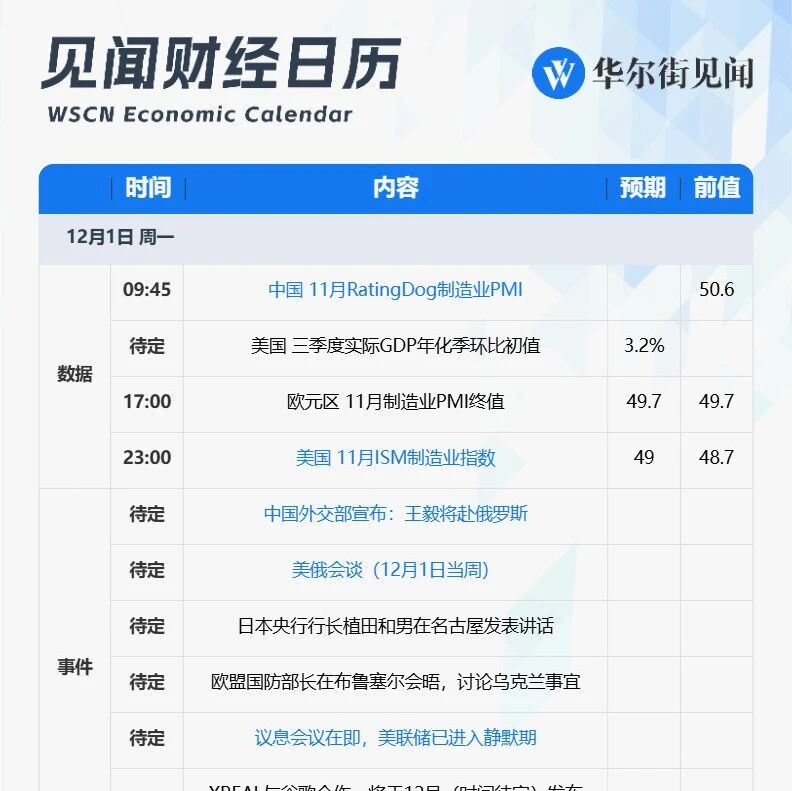
Economic Indicators - China's November RatingDog Manufacturing PMI will be released on December 1, with the previous value at 50.6, indicating continued expansion but slowing growth [6][8] - The US ISM Manufacturing Index for November is expected to rise slightly from 48.7 to 49.0, still in contraction territory, but regional Fed surveys suggest employment improvements may support the index [6][8] - The US PCE report and personal income report, key inflation indicators for the Federal Reserve, have been rescheduled to December 5 [7][8] Key Events - US-Russia talks are scheduled for the week of December 1, with President Putin confirming the US delegation's visit to Moscow [10] - Chinese Foreign Minister Wang Yi will visit Russia for strategic security consultations on December 1-2 [11] - The Bank of Japan Governor Kazuo Ueda will speak in Nagoya on December 1, with market expectations on his comments regarding inflation and wage negotiations [12] Company Announcements - Nvidia will attend the UBS Global Technology and AI Conference on December 2, with a financial call scheduled for February 25 [13] - Ideal Automotive will hold a launch event for its AI glasses, Livis, on December 3, aiming to integrate AI capabilities into daily life [14][15] - XREAL and Google are set to release AR glasses, Project Aura, in December 2025, featuring advanced AI technology [16] Financial Reports - A wave of earnings reports is expected, with Credo reporting on December 2, Marvell on December 3, and C3.ai and Salesforce on December 4 [26][27]
洪灝、李蓓、付鹏罕见同台发声:黄金已卖,投资告一段落,AI泡沫三观点,100万这么布局
华尔街见闻· 2025-11-29 13:26
Core Viewpoints - The discussion highlights concerns about the sustainability of massive capital expenditures in AI, suggesting that while there may be potential for individual successful applications, the overall financial viability remains uncertain [3][5][26] - The panelists express skepticism about the current AI investment boom, likening it to past infrastructure investments in China that ultimately did not yield sustainable returns [4][25][26] - There is a consensus that gold may not be a guaranteed investment, with recent actions by central banks, particularly Russia's selling of gold, signaling potential shifts in the market [7][60][62] Group 1: AI Investment Insights - Li Bei emphasizes that the current level of capital expenditure in AI is unsustainable, questioning whether it can generate significant cash flow returns [3][26] - The panelists agree that AI may not be the primary upward driver in the market moving forward and could instead become a downward drag [5][29] - The difficulty of timing exits in a bubble is highlighted, with references to top traders struggling to navigate market peaks [6][49] Group 2: Gold and Currency Perspectives - The recent selling of gold by the Russian central bank is noted as a significant warning sign for the gold market [7][60] - There is a belief that while dollar-denominated gold may not decline significantly, gold priced in RMB could face downward pressure [67] - The undervaluation of the RMB is discussed, with expectations that it may gradually be recognized in international reserves, potentially replacing gold and USD [61][62] Group 3: Investment Strategies - The panelists suggest avoiding chasing bubble assets and instead focusing on resilient companies that can thrive in challenging economic conditions [8][90] - Recommendations include diversifying into non-US value stocks, commodities, and companies involved in AI development that are undervalued [11][91][94] - The importance of maintaining a balanced investment portfolio that allows for peace of mind during market volatility is emphasized [91][95]

高盛点评“中国AI大厂之战”:阿里 vs 腾讯 vs 字节
华尔街见闻· 2025-11-29 13:26
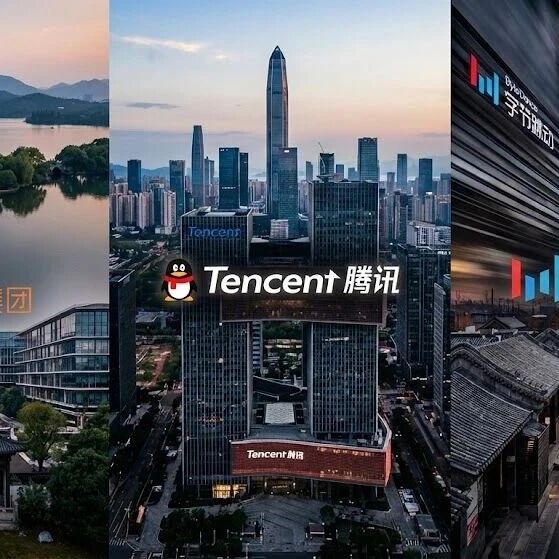
Core Viewpoint - The article discusses the competitive landscape of China's AI industry, highlighting the strategic choices of major players like Alibaba, ByteDance, and Tencent as they navigate a battle for capital efficiency, infrastructure dominance, and traffic entry points. Group 1: Alibaba's Strategy - Alibaba is adopting a "full-stack" approach similar to Google's, with a significant capital expenditure increase of 80% year-on-year, reaching 32 billion RMB in the September quarter [2] - The company's cloud revenue grew by 29% year-on-year, with AI-related revenue achieving triple-digit growth for the ninth consecutive quarter, and is expected to accelerate to 38% growth in the December quarter [3] - Alibaba aims to establish a "full-stack" barrier in the AI market, positioning itself as a dominant player through heavy asset investment [4] Group 2: ByteDance's Approach - ByteDance leverages its massive traffic advantage, with a daily token consumption of 30 trillion, approaching Google's 43 trillion, significantly outpacing competitors like Baidu and DeepSeek [7] - The company's app "Doubao" leads in domestic AI application activity, while its overseas education app Gauth saw a 394% year-on-year revenue increase [8] - ByteDance's strategy creates substantial inference demand, allowing it to encroach on traditional cloud giants in the Model as a Service (MaaS) sector, capturing 49.2% of the public cloud market share for large models [11] Group 3: Tencent's Strategy - Tencent maintains a conservative approach, reducing capital expenditures while focusing on seamlessly integrating AI capabilities into its extensive social and payment ecosystem [12][14] - The company has integrated its AI assistant "Yuanbao" into WeChat Pay, enhancing operational efficiency for small and medium-sized businesses [14] - Tencent's strategy emphasizes high implementation certainty despite lower capital expenditure figures compared to competitors [14] Group 4: Competitive Dynamics - The competition between China and the U.S. in AI has entered a "dynamic alternation" phase, with Chinese models rapidly iterating and catching up within 3-6 months after significant advancements in U.S. models [4][17] - Chinese companies exhibit resilience through unique "Chinese speed" and open-source ecosystems, with 80% of AI startups utilizing open-source models [17] - Cost control is a competitive advantage for Chinese models, as seen with Kuaishou's "Kling" video generation model, which offers significantly lower prices than global counterparts [17] Group 5: Valuation Insights - Goldman Sachs analysts assert that the Chinese AI sector is not in a bubble, with projected P/E ratios for Tencent and Alibaba at 21x and 23x for 2026, respectively, lower than those of major U.S. tech companies [18]