国泰海通证券研究

Search documents
国泰海通|宏观:全球变局下的金融:促改革、扩开放、重科创——2025年陆家嘴论坛政策解读
国泰海通证券研究· 2025-06-18 15:25
Core Viewpoint - The 2025 Lujiazui Forum focuses on "Financial Openness and Cooperation in the Global Economic Changes and High-Quality Development," emphasizing global financial governance, extensive financial openness, capital market integration with technology and industry, and a comprehensive foreign exchange innovation policy [1][2]. Financial System - The international monetary system is likely to evolve towards a scenario where a few sovereign currencies coexist, compete, and balance each other. The global cross-border payment system is developing towards greater efficiency, security, inclusiveness, and diversity. There is a need for international financial organizations to enhance the representation and voice of emerging markets and developing countries. Additionally, structural monetary policy tool innovations are being highlighted, including pilot programs for blockchain letters of credit refinancing, cross-border trade refinancing, and expansion of carbon reduction support tools [2][3]. Financial Openness - China is poised for significant financial openness, focusing on several areas: - Expansion and upgrading of consumer demand, creating vast financial service opportunities - Broad prospects in technology finance, promoting pilot programs for equity investments in financial asset investment companies and loans for technology enterprise mergers - Strong momentum in green finance, with foreign institutions introducing ESG rating systems and climate risk management tools - Opportunities in pension finance, with plans to expand pension wealth management, savings, exclusive insurance, and commercial pension pilot programs - A golden period for wealth management, supporting foreign institutions in investment, asset allocation, and insurance planning [2][3]. Capital Market - The capital market aims to enhance the integration of technology innovation and industrial creation through the introduction of the "1+6" policy measures, which include: - Establishing a growth layer for the Sci-Tech Innovation Board - Restarting the fifth set of listing standards for unprofitable companies on the Sci-Tech Innovation Board - Introducing a pre-review mechanism for IPOs of high-quality technology companies - Expanding the applicability of the fifth set of standards and strengthening the linkage between stocks and bonds to support technological innovation [3]. Foreign Exchange Management - A comprehensive innovation policy for foreign exchange management is being established, focusing on creating a system that is more convenient, open, secure, and intelligent. This includes implementing ten facilitation policies in free trade pilot zones, such as optimizing new international trade settlement methods and expanding the Qualified Foreign Limited Partner (QFLP) pilot [3].


国泰海通|固收:交易盘做多情绪已浓
国泰海通证券研究· 2025-06-18 15:25
Group 1: Core Insights - The report indicates a significant increase in net buying of 7-10 year long-term bonds and bonds over 10 years, with weekly net buying intensity reaching the second highest and highest levels of the year respectively [1] - The overall funding market has warmed up, with both net inflow and outflow amounts rising, and an increase in the leverage ratio in the interbank bond market [2] - The secondary market shows improved activity, particularly in ultra-long bonds, with a rise in turnover rates for 30-year government bonds and an increase in average duration for medium to long-term pure bond funds [3] Group 2: Market Dynamics - In the primary market, there was a noticeable "marginal" sentiment, with an increase in the issuance of government bonds and a rise in the bid-to-cover ratio for government bonds, while the ratio for policy financial bonds decreased [2] - Major institutional behaviors indicate that funds are aggressively allocating to long-term and ultra-long-term bonds, while rural commercial banks are selling off across all maturities, particularly in the 7-10 year and over 10-year segments [3] - The scale of wealth management products in June did not show the typical seasonal decline, with a slight overall decrease in the week of June 15, while fund sizes increased significantly compared to previous months [4]

国泰海通|策略:资本市场改革进入提速期——2025年陆家嘴论坛金融政策点评
国泰海通证券研究· 2025-06-18 15:25
Core Viewpoint - The 2025 Lujiazui Forum emphasizes the acceleration of RMB internationalization and capital opening, with a focus on the integration of technology and industrial innovation as a main theme [1][2]. Summary by Sections RMB Internationalization and Financial Opening - The forum announced eight financial opening measures aimed at enhancing the infrastructure of the interbank market, promoting digital RMB internationalization, and innovating offshore financial services [2]. - Key issues such as the lag in financial system reform, insufficient financial product innovation, and lack of foreign exchange risk management tools have been identified [2]. - The central bank aims to reduce reliance on the US dollar and promote the Special Drawing Rights (SDR) as a leading international currency [2]. - The measures are expected to attract more international capital into the Chinese market, enhancing the certainty of RMB assets [2]. Technology and Industry Innovation - The "1+6" policy for the Sci-Tech Innovation Board was introduced, which includes the establishment of a growth tier and the reintroduction of listing standards for unprofitable companies [3]. - The policy aims to support various cutting-edge technology sectors, including artificial intelligence and commercial aerospace, enhancing the financing ecosystem for innovative companies [3]. - Since the implementation of the "8 Articles of Sci-Tech Innovation Board," there have been 106 new merger and acquisition transactions, totaling over 140 billion [3]. - A total of 479 companies have released action plans for 2025, with 433 companies launching equity incentive plans, indicating a robust investment and financing environment [3]. Financial Opening Initiatives in Shanghai - The forum highlighted initiatives to support offshore trade in Shanghai and innovate structural monetary policy tools [4]. - These measures are designed to build a financial system that aligns with Shanghai's status as an international financial center [4]. - The comprehensive policies are expected to enhance Shanghai's ability to attract international capital and improve its global asset pricing capabilities [4]. Market Outlook - The acceleration of institutional reforms and the opening of capital markets are seen as key drivers for the revaluation of Chinese assets [4]. - The certainty of the Chinese market is viewed as a foundation for stability and gradual growth in the stock market, with emerging technology as the main investment theme [4].

国泰海通|轻工:5月浆、纸价格共振下行,供需改善有限
国泰海通证券研究· 2025-06-18 15:25
Group 1 - The core viewpoint of the article indicates that the prices of pulp and paper are experiencing a downward trend, with pulp prices expected to remain low and paper prices approaching a weak seasonal period [1][2][3][4] Group 2 - Cultural paper prices and costs are both declining, with a marginal improvement in supply and demand expected. As of May 28, the market average price for 70g high white double glue paper is 5204 yuan/ton, a decrease of 2.84% month-on-month. Factors include weak orders from paper mills, general inventory pressure, and limited support from downstream demand [1] - Whiteboard prices initially fell before slightly rebounding, with an overall downward trend in supply and demand. As of May 28, the market average price for 250-400g flat white cardboard is 4075 yuan/ton, down 3.28% month-on-month. The market faced weak orders and a supply surplus, although a slight recovery was noted mid-month due to improved macro sentiment [2] - Boxboard prices and profitability continue to decline as the off-season approaches, with the average market price for corrugated paper at 3511 yuan/ton, down 0.90% month-on-month. Initial price drops were followed by a slight increase due to tariff adjustments, but overall demand remains weak [3] - Pulp prices are declining due to limited demand improvement. External prices for needle and hardwood pulp have been adjusted downwards, with domestic hardwood pulp prices also under pressure. Downstream raw paper companies are maintaining low inventory levels, limiting upward price momentum in the pulp market [4]

国泰海通|固收:估值蓄力,坚守主线——转债市场点评
国泰海通证券研究· 2025-06-17 15:09
风险提示: 理财赎回风险;转债转股溢价率压缩风险;转债正股表现不及预期。 报告来源 以上内容节选自国泰海通证券已发布的证券研究报告。 报告名称: 估值蓄力,坚守主线——转债市场点评 报告日期:2025.06.17 报告作者: 顾一格 (分析师),登记编号: S0880522120006 报告导读: 当前转债估值较4月初略有下降,性价比有所提升。建议通过布局自主可 控、内需发力和红利三条主线降低关税影响,提前布局优质底仓替代标的。 5月12日中美日内瓦协议落地以来,权益市场并未大涨,而是维持窄幅波动。 我们认为一方面是因为关税 摩擦缓和预期已经在4月8日-5月12日的反弹中被市场充分定价,另一方面,市场担心2018年中美达成协议 后美方单方面撕毁协议的情况再次发生。事实上,自中美日内瓦经贸会谈以来,美方新增多项对华限制措 施,包括发布AI芯片出口管制指南、停止对华芯片设计软件销售、宣布撤销中国留学生签证等。在刚刚结 束的中美伦敦会谈中,就落实两国元首6月5日通话重要共识和巩固日内瓦经贸会谈成果的措施框架达成原 则一致,就解决双方彼此经贸关切取得新进展。紧张关系暂时缓和,但结构性矛盾仍未根本性解决。中美 之间的结 ...

国泰海通|稀土观点合集
国泰海通证券研究· 2025-06-17 15:09
Core Viewpoint - Since 2024, rare earth prices have gradually bottomed out, with domestic quota allocations slowing down, and overseas development expectations for rare earths fermenting, although actual progress may fall short of expectations. Demand from sectors such as electric vehicles, home appliances, and wind power remains stable, while humanoid robots present long-term upside potential. The supply-demand reversal is beginning to unfold, and with Trump's tariff policies exceeding market expectations, rare earths, as a strategic domestic commodity, are likely to experience a double boost in profitability and valuation [1][5][12]. Group 1: Supply and Demand Dynamics - The implementation of export controls on medium and heavy rare earths by China has led to a significant increase in overseas prices, creating a mismatch in supply and demand [3][4]. - As of mid-May 2025, the price of terbium oxide increased from $906/kg in early April to $1005/kg, marking an 11% rise, with the price gap between overseas and domestic markets widening significantly [4]. - Domestic rare earth quotas are expected to grow at a slower rate of 6% in 2024, down from over 20% in previous years, indicating a tightening supply environment [12][26]. Group 2: Policy and Strategic Implications - The U.S. rare earth producer MP Materials announced a halt in shipments to China, which is expected to lead to a temporary contraction in domestic supply and potentially drive up prices [7][8]. - China's export control measures cover a wide range of medium and heavy rare earth products, which may exacerbate the supply-demand mismatch and trigger downstream stockpiling [11][12]. - The introduction of stricter management regulations for rare earth mining and processing is likely to enhance the strategic positioning of the industry and may lead to the exit of smaller players, further tightening supply [15][16]. Group 3: Investment Recommendations - With the recent issuance of export licenses, the rising prices abroad are expected to gradually transmit to the domestic market, benefiting rare earth magnet material companies through improved performance and valuation [5][12]. - The demand for rare earth materials is projected to maintain growth rates of 37% for electric vehicles and 19% for air conditioning in 2025, indicating a robust demand outlook [5][21]. - The rare earth sector is anticipated to experience a significant recovery, with core companies likely to benefit from the upward price trend and improved market conditions [24][28].

国泰海通|计算机:豆包大模型1.6发布,性价比进一步提升
国泰海通证券研究· 2025-06-17 15:09
Core Viewpoint - ByteDance's recent launch of the Doubao model 1.6 represents a significant upgrade in its AI model family, enhancing both performance and cost-effectiveness, which is expected to directly benefit AI implementation across various industries [2][4]. Group 1: Product Launch and Features - The Doubao model family has been expanded with the release of Doubao model 1.6, Doubao Video Generation Model Seedance 1.0 Pro, and Doubao Real-time Voice Model, establishing itself as a leading model with full modality, full size, and high cost-performance [2][3]. - Doubao model 1.6 includes three models: 1. Doubao-seed-1.6, an all-in-one model supporting 256K context, deep thinking, multi-modal understanding, and graphical interface operations [3]. 2. Doubao-seed-1.6-thinking, a reinforced version focusing on deep thinking capabilities, with improvements in coding, mathematics, and logical reasoning [3]. 3. Doubao-seed-1.6-flash, a high-speed version with low latency and strong visual understanding capabilities [3]. Group 2: Performance Metrics - By May 2025, the daily token usage of Doubao model exceeded 16.4 trillion, marking a 137-fold increase since its initial release in May 2024 [2]. - Doubao model 1.6 has shown significant improvements in reasoning, mathematics, instruction adherence, and agent capabilities, supporting complex agent construction and enhancing AI productivity [2][3]. Group 3: Pricing Strategy - Doubao model 1.6 introduces a novel pricing model based on input length, with a uniform token price regardless of whether deep thinking mode is activated [4]. - For the most commonly used input range of 0-32K, the pricing is set at 0.8 yuan per million tokens for input and 8 yuan per million tokens for output, representing a 63% cost reduction compared to previous models [4]. - A promotional pricing tier has been established for inputs of 32K and outputs within 200 tokens, further lowering costs to 0.8 yuan per million tokens for input and 2 yuan per million tokens for output [4].

国泰海通|电子:中国台湾收紧出口管控,自主可控加速推进
国泰海通证券研究· 2025-06-17 15:09
Core Viewpoint - Taiwan's tightening of export controls on certain high-tech products is accelerating the push for self-sufficiency in the semiconductor supply chain, particularly in the area of ABF substrates [1][2]. Group 1: Export Control Measures - Taiwan's International Trade Administration has added entities such as SMIC and Huawei to a restricted export list, requiring permits for exports to these entities [1]. - A total of 601 entities, including those from Russia, Pakistan, Iran, Myanmar, and mainland China, have been added to the list due to concerns over military expansion activities [1]. Group 2: Domestic Industry Response - Domestic companies are actively working to support the supply chain, with companies like Xinsong Technology already supplying 20-layer substrates in bulk [2]. - Efforts are ongoing to validate and produce higher-layer substrates, indicating a potential breakthrough in domestic production capabilities [2]. Group 3: Technical Challenges - The ABF substrate segment remains one of the few areas in the Ascend supply chain that is not fully self-sufficient, with Taiwanese manufacturers holding a significant market share [1]. - The technical challenges in producing high-spec ABF substrates include maintaining layer alignment and thickness consistency, especially for larger and multi-layered products [1].

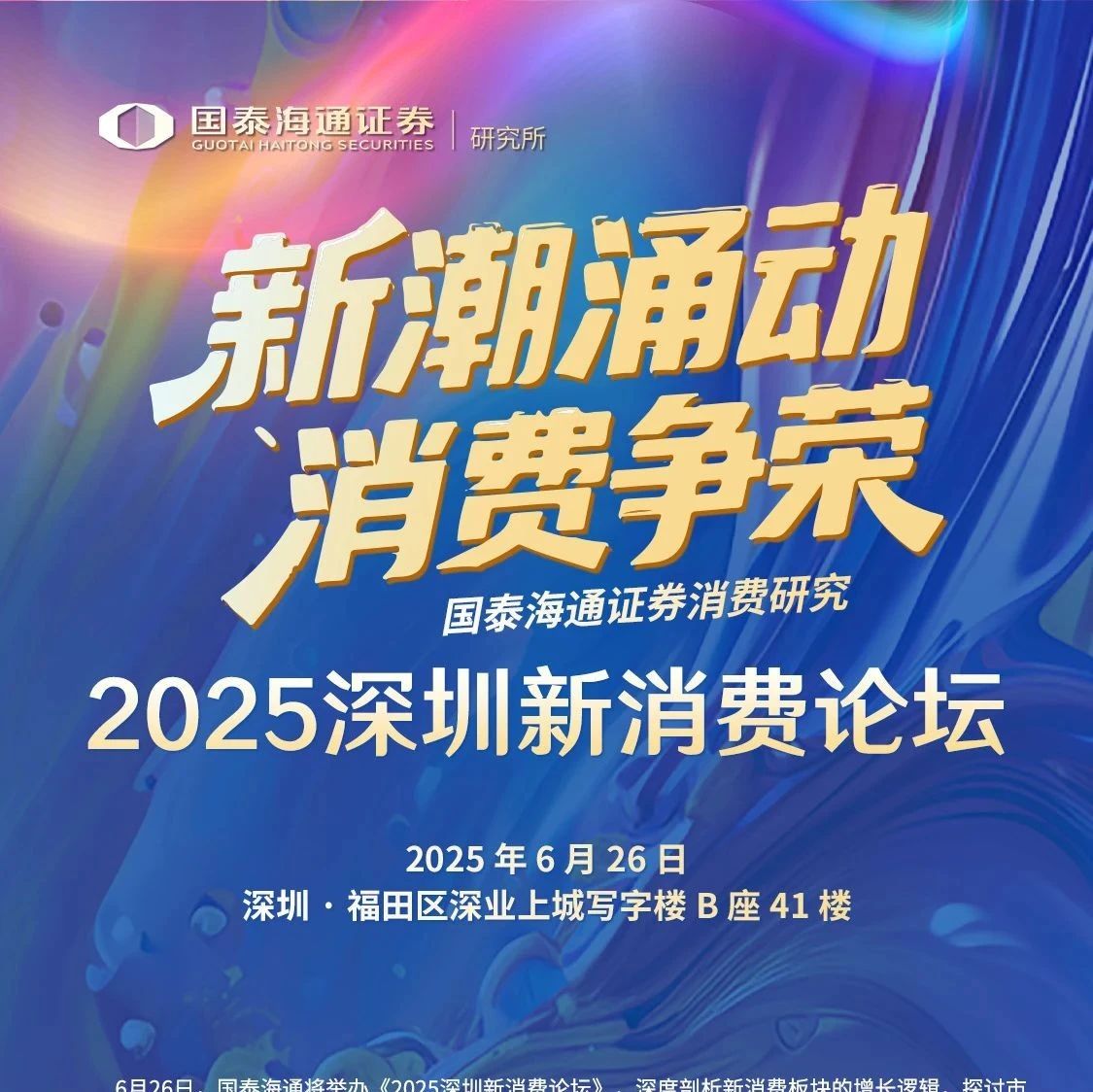
邀请函|“新潮涌动,消费争荣”国泰海通新消费论坛
国泰海通证券研究· 2025-06-17 15:09
本订阅号所载内容仅面向国泰海通证券研究服务签约客户。因本资料暂时无法设置访问限制,根据《证 券期货投资者适当性管理办法》的要求,若您并非国泰海通证券研究服务签约客户,为保证服务质量、 控制投资风险,还请取消关注,请勿订阅、接收或使用本订阅号中的任何信息。我们对由此给您造成的 不便表示诚挚歉意,非常感谢您的理解与配合!如有任何疑问,敬请按照文末联系方式与我们联系。 法律声明 更多国泰海通研究和服务 亦可联系对口销售获取 重要提醒 ...
国泰海通 · 晨报0618|策略、机械
国泰海通证券研究· 2025-06-17 15:09
Core Viewpoint - The article emphasizes the optimistic outlook for China's stock market, highlighting the emergence of new technology trends and business models, a decrease in opportunity costs for stock investments, and improved economic policies that favor investor returns. This creates a favorable environment for thematic investments, particularly in frontier technologies, advanced manufacturing, and structural improvements, with a focus on investment opportunities for the second half of 2025 [1][6][11]. Group 1: Frontier Technologies - Theme 1: AI and Embodied Intelligence - Artificial intelligence is expected to follow a path of "information infrastructure construction," "basic software deployment," "online application explosion," and "restructuring offline industries," with AI becoming a key catalyst for commercialization and increasing demand for computing power [2]. - The application of embodied intelligence is accelerating in fields such as research, education, and healthcare, with a focus on specific robotic products like quadrupedal and exoskeleton robots [2]. - Theme 2: Bioeconomy and Brain-Machine Interfaces - Biotechnology is rapidly advancing, enabling traditional industries to upgrade, with synthetic biology and information crossover technologies opening new spaces in the bioeconomy [3]. - The brain-machine interface industry is in the exploratory phase, with several tech companies attempting breakthroughs in hardware and applications [3]. - Theme 3: 6G Communication - 6G technology is set to revolutionize communication with significant improvements in speed and latency, with research expected to start in 2025 and commercial systems planned for 2030 [4]. Group 2: Advanced Manufacturing - Theme 4: Low-altitude Economy and Commercial Space - The low-altitude economy is entering a "manned era," with market size expected to exceed one trillion yuan by 2026, driven by the establishment of non-controlled airspace and operational certifications [7]. - The commercial space sector is anticipated to see significant growth due to the increasing demand for satellite launches and the development of satellite constellations [7]. - Theme 5: Deep-sea Technology - The government has prioritized deep-sea technology, with policies accelerating the industrialization process and a projected marine production value exceeding ten trillion yuan by 2024 [8]. - Theme 6: Self-sufficiency - The semiconductor sector is becoming a focal point in the technology competition, with policies promoting mergers and acquisitions to deepen domestic replacements [9]. Group 3: Structural Improvements - Theme 7: Smart Driving - The penetration of advanced smart driving technologies is accelerating, with significant cost reductions expected in related hardware due to scale effects from companies like BYD [10]. - Theme 8: New Consumption Brands - The consumption recovery is showing a "K-shaped" divergence, with traditional consumption under pressure while new consumption is thriving, driven by digital economy and infrastructure changes [12]. - Theme 9: Price Cycle Products - Some cyclical industries are beginning to reduce capacity, with expectations for improved supply-demand dynamics leading to price recoveries in related sectors [13]. - Theme 10: Regional Economy - There is an increasing urgency to address regional development imbalances, with accelerated investment in western infrastructure and supportive policies for local industries [14].