BYD(01211)

Search documents
汽车周报:小鹏比亚迪新技术发布,投资进入事件催化密集期-20260301
Shenwan Hongyuan Securities· 2026-03-01 12:15
Investment Rating - The report maintains a positive outlook on the automotive industry, particularly in AI applications and new energy vehicles, recommending companies such as Xiaopeng, Li Auto, and BYD [2][6]. Core Insights - Xiaopeng's VLA 2.0 is expected to enhance its position in intelligent driving, while BYD's upcoming technology release aims to address winter driving challenges, reinforcing its competitive edge across its product range [2]. - The report highlights the increasing penetration of new energy vehicles and the potential introduction of a "mileage tax" in response to rising fiscal deficits due to the integration of road maintenance fees into fuel taxes [2]. - The automotive market in China saw a significant increase in retail sales, with an average of 41,000 vehicles sold daily in early February, marking a 54% year-on-year growth [2][47]. Industry Updates - The report notes a rise in raw material prices for both traditional and new energy vehicles, with the traditional vehicle raw material index increasing by 1.3% week-on-week and decreasing by 1.5% month-on-month, while the new energy vehicle index rose by 5.7% week-on-week and fell by 1.9% month-on-month [2]. - The automotive industry index rose by 0.79% over the week, underperforming compared to the Shanghai Composite Index, which increased by 1.08% [14]. - A total of 168 automotive stocks rose, while 98 fell, with the largest gainers being Weifu High-Technology, Tianrun Industrial, and Lizhong Group, which saw increases of 22.4%, 21.7%, and 14.7%, respectively [19]. Market Conditions - The report indicates that the automotive industry is transitioning from price competition to value competition, with companies like BYD and Zeekr focusing on technology and brand strength [4]. - The Southeast Asian market for new energy vehicles is expected to grow, with Chinese brands maintaining a market share of 72%-78%, despite some fluctuations in individual brand performance [3]. - The report predicts significant growth for several brands in the Southeast Asian market in 2026, with Chery expected to see a 182% increase in sales, while BYD is projected to maintain its leading position with a 35% growth [5]. Important Events - The report discusses the implications of the recent safety standards for car door handles following a high-profile accident, which may lead to design adjustments across the industry [10][11]. - The introduction of the Helix 02 AI system is expected to enhance the capabilities of humanoid robots, potentially impacting the robotics sector positively [8][9]. Stock Performance - The automotive sector's price-to-earnings ratio stands at 30.13, ranking it 20th among all sectors, indicating a relatively low valuation compared to the broader market [15]. - The report highlights upcoming stock unlocks for several companies, which may influence market dynamics [23].





比亚迪股份2月新能源汽车销量约19.02万辆
Zhi Tong Cai Jing· 2026-03-01 12:08
Group 1 - The core viewpoint of the article highlights BYD's significant growth in the production and sales of new energy vehicles (NEVs) in February 2026, with production reaching approximately 175,300 units and sales around 190,200 units, marking a year-on-year increase of 15.27% [1] - In the first two months of 2026, the company produced about 407,600 NEVs and sold approximately 400,200 units, indicating strong demand and production capabilities [1] - BYD exported a total of 100,600 NEVs in February 2026, showcasing its expanding international market presence [1] Group 2 - The total installed capacity of BYD's new energy vehicle power batteries and energy storage batteries in February 2026 was approximately 18.773 GWh, contributing to a cumulative installed capacity of about 38.960 GWh for the year [1]
比亚迪股份(01211)2月新能源汽车销量约19.02万辆
智通财经网· 2026-03-01 12:07
Group 1 - The core viewpoint of the article highlights BYD's significant growth in the production and sales of new energy vehicles (NEVs) for February 2026, with production reaching approximately 175,300 units and sales around 190,200 units, marking a year-on-year increase of 15.27% [1] - In the first two months of 2026, BYD's NEV production totaled approximately 407,600 units, while sales were about 400,200 units [1] - The company exported a total of 100,600 NEVs in February 2026 [1] Group 2 - BYD's total installed capacity for power batteries and energy storage batteries in February 2026 was approximately 18.773 GWh, with a cumulative installed capacity of about 38.960 GWh for the year [1]
比亚迪:2月新能源车销量190,190辆
Ge Long Hui A P P· 2026-03-01 12:01
Group 1 - The core viewpoint of the article highlights BYD's target to achieve sales of 190,190 electric vehicles by February 2026 and the export of 100,600 electric vehicles in February [1] - In February, the total installed capacity of new energy vehicle power batteries and energy storage batteries reached approximately 18.773 GWh [1]
比亚迪股份(01211) - 自愿公告2026年2月產销快报
2026-03-01 11:42
香港交易及結算所有限公司及香港聯合交易所有限公司對本公告的內容概不負責,對其準確性或完整性亦不發表任何聲明,並明確表示概 不就因本公告全部或任何部份內容而產生或因倚賴該等內容而引致的任何損失承擔任何責任。 比 亞 迪 股 份 有 限 公 司 BYD COMPANY LIMITED (在中華人民共和國註冊成立的股份有限公司) (股份代號:01211(港幣櫃台)及:81211(人民幣櫃台)) 網站:http://www.bydglobal.com 自願公告 2026年2月產銷快報 此乃比亞迪股份有限公司(「本公司」)作出的自願公告。 本公司董事會謹此宣佈,本公司於2026年2月產、銷量詳細如下(單位:輛): | | | | 產量 | | | | | 銷量 | | | | --- | --- | --- | --- | --- | --- | --- | --- | --- | --- | --- | | 項目類別 | 本月 | 去年同期 | 本年累計 | 去年累計 | 累計同比 | 本月 | 去年同期 | 本年累計 | 去年累計 | 累計同比 | | 新能源汽車 | 175,280 | 334,124 | 407 ...
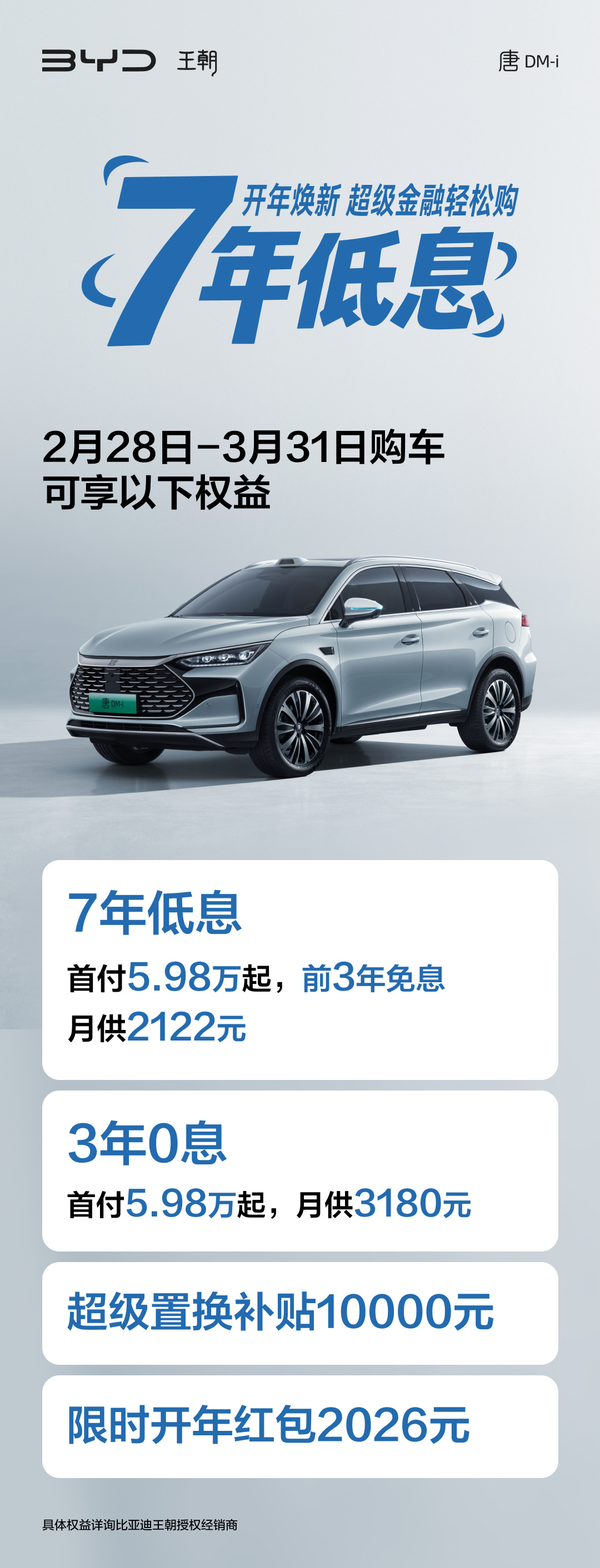
比亚迪汉唐家族开年购车权益:首付 5.98 万元起,提供 3 年 0 息、7 年低息方案
Xin Lang Cai Jing· 2026-03-01 08:26
7年低息 首付5.98万起,前3年免息 月供2122元 3年0息 首付5.98万起,月供3180元 超级置换补贴10000元 限时开年红包2026元 IT之家 3 月 1 日消息,比亚迪今日公布汉唐家族开年专属福利,首付 5.98 万元起,提供 3 年 0 息、7 年低息方案,活动时间 2 月 28 日-3 月 31 日。 2 月 28 日-3 月 31 日购车可享以下权益: 7年低息 首付5.98万起,前3年免息 具体权益详询比亚迪王朝授权经销商 BLHD 王朝 18 开年焕新 超级金融轻松购 FIFA . 2月28日-3月31日购车 可享以下权益 IT之家注意到,比亚迪昨日还公布了秦 PLUS 史上最强金融政策(3 月 31 日截止): 此外,截至 3 月 31 日(含),元 UP 享超级置换补贴 5000 元,综合补贴后 6.98 万元起。 ...

亿纬锂能落子合肥;宁德时代/宝马合作深化;比亚迪45GWh项目公示;正力新能净利暴增;湖南60GWh项目开工;LG新能源方形储能电池厂落地
起点锂电· 2026-03-01 03:16
Core Insights - The article discusses the upcoming 2026 (Second) Starting Point Lithium Battery Cylindrical Battery Technology Forum and the release of the Top 20 Cylindrical Battery Rankings, emphasizing advancements in all-tab technology and leadership in the large cylindrical battery market [1] Group 1: Industry Developments - BMW Group signed a memorandum of understanding with CATL to enhance collaboration in the battery supply chain and reduce carbon footprints in electric vehicles, highlighting the importance of cooperation and innovation in the industry [2] - Zhengli New Energy anticipates a net profit increase of up to eight times by 2025, projecting a profit of approximately RMB 6.8 billion to 8.2 billion, driven by market demand and improved operational efficiencies [3] - ATL has acquired a stake in Shanghai Carbon Yuan New Materials Technology Co., entering the next-generation silicon-carbon anode materials sector [5] Group 2: Project Announcements - Rongjie Energy announced a new 15GWh battery production project, with a total investment of RMB 148 million, expanding its production capacity to 25GWh [6] - EVE Energy established a new company in Hefei with a registered capital of RMB 500 million, focusing on manufacturing and selling new energy equipment [7] - EVE Energy and CITIC Bo signed a strategic cooperation framework agreement for a two-year plan to collaborate on 12GWh of energy storage batteries and systems [8] Group 3: Production Capacity Expansions - Ganfeng Lithium's new 10GWh battery project has commenced operations in Dongguan, with a total investment of RMB 5 billion [9] - BYD's 45GWh battery project is undergoing planning adjustments to meet production needs [10] - Hunan Ningxiang Shengyan Technology's 60GWh lithium battery project has officially started construction, expected to meet the battery needs of approximately 1 million electric vehicles [11] Group 4: Market Trends - Lithium carbonate prices have surged, with contract prices reaching RMB 160,000 per ton, reflecting a 10.56% increase [15][16] - Zimbabwe has suspended the export of lithium concentrate and raw ore to encourage local processing, aiming to enhance economic benefits from its lithium resources [17] Group 5: Corporate Actions - Jinli New Energy completed a merger with Fosun Technology, marking the end of a two-year industry consolidation process [20] - Zhenyu Technology plans to raise up to RMB 1.88 billion through convertible bonds to expand its production of precision components for lithium batteries [21] - Jiangsu Hankan Electronics is ramping up production of lithium-ion battery electrolyte additives, with a new project expected to be completed by the end of the year [22]


比亚迪:公司在电池领域技术领先、多种路线都在研发
Mei Ri Jing Ji Xin Wen· 2026-02-28 15:51
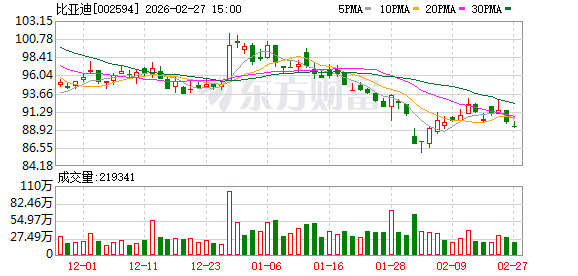
Group 1 - The company, BYD, claims to be a leader in battery technology and is developing multiple routes in this field [1] - In the energy storage sector, the company has established a comprehensive global network for sales, delivery, operation, and after-sales service [1] - As of now, the company has successfully delivered over 500 energy storage projects, with applications in more than 110 countries and regions worldwide [1] Group 2 - An investor inquired about the company's battery and vehicle sales performance, noting that despite strong sales, the stock price has been declining [3] - The investor also asked about the company's progress on solid-state battery patents and its involvement in energy storage for the power grid [3]
全球车企销量前十出炉,比亚迪、上汽、吉利控股上榜
Xin Jing Bao· 2026-02-28 13:05
Group 1 - Toyota remains the largest automotive manufacturer globally, with an estimated sales volume of approximately 11.32 million units in 2025, maintaining its position for six consecutive years since surpassing Volkswagen in 2020 [1] - Volkswagen ranks second with a projected sales volume of 8.984 million units in 2025, experiencing a decline in sales in both the Chinese and North American markets, with an 8% year-on-year decrease in China [1] - Hyundai, General Motors, and Stellantis are positioned third to fifth, with sales volumes of 7.274 million, 6.182 million, and 5.484 million units respectively [1] Group 2 - BYD ranks sixth among global automakers with a sales volume of 4.602 million units in 2025, improving its ranking by one position compared to 2024 [2] - SAIC Motor ranks seventh with a sales volume of 4.508 million units, also moving up one position year-on-year [2] - Geely Holding Group ranks ninth with a sales volume of 4.116 million units, surpassing Honda and improving its ranking by two positions compared to 2024 [2]



比亚迪夺新年首冠 安凯暴涨7倍进前五 1月新能源客车销量出炉 | 头条
第一商用车网· 2026-02-28 10:32
Core Insights - In January 2026, the sales of large and medium-sized new energy buses in China experienced a significant decline, with total sales of 2,137 units, representing a month-on-month decrease of 77.63% and a year-on-year decrease of 19.66% [1][2]. Group 1: Overall Market Performance - Despite the overall market downturn, several companies showed positive performance, with five out of the top ten companies achieving year-on-year sales growth [3][4]. - BYD led the market with 442 units sold, capturing a market share of 20.68%, and achieved a month-on-month growth of 10.22% and a year-on-year growth of 54.55% [2][3]. - Xiamen Golden Dragon returned to the top three with 260 units sold, reflecting a year-on-year increase of 6.56% [3][4]. Group 2: Competitive Landscape - Among the mid-tier companies, Zhongtong Bus sold 240 units, marking a year-on-year increase of 46.34%, while Ankai Bus saw a remarkable year-on-year increase of 725% with 198 units sold [4][6]. - Other notable performances included Suzhou Golden Dragon Haige with 183 units sold and Chery Wanda with a month-on-month growth of 5.80% and a year-on-year increase of 1.39% [4][6]. Group 3: Market Segmentation - The sales of new energy buses in January 2026 were categorized into three segments: public buses, seat buses, and other buses (including school buses), all of which experienced negative growth [6][7]. - In the public bus segment, 1,756 units were sold, with BYD leading at 442 units and a market share of 25.17% [7][8]. - The seat bus segment saw a total of 378 units sold, with Zhongtong Bus leading at 132 units and a year-on-year growth of 140% [9][10]. Group 4: Future Outlook - The overall performance in January indicates that while the market faced challenges, the potential for growth remains, supported by policies like "old-for-new" exchanges and ongoing advancements in new energy technology [12].