
GWMOTOR(02333)

Search documents
长城汽车获贝莱德增持180.8万股 每股作价约13.5港元
Xin Lang Cai Jing· 2026-02-05 23:40
香港联交所最新资料显示,1月29日,贝莱德增持长城汽车(02333)180.8万股,每股作价13.498港元, 总金额约为2440.44万港元。增持后最新持股数目约为1.86亿股,最新持股比例为8.04%。 香港联交所最新资料显示,1月29日,贝莱德增持长城汽车(02333)180.8万股,每股作价13.498港元, 总金额约为2440.44万港元。增持后最新持股数目约为1.86亿股,最新持股比例为8.04%。 热点栏目 自选股 数据中心 行情中心 资金流向 模拟交易 客户端 热点栏目 自选股 数据中心 行情中心 资金流向 模拟交易 客户端 责任编辑:卢昱君 责任编辑:卢昱君 ...


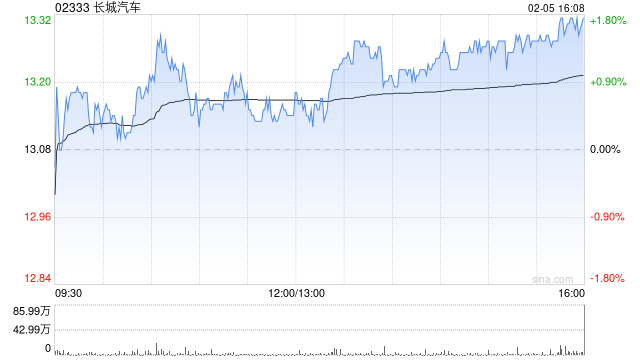
贝莱德增持长城汽车(02333)180.8万股 每股作价约13.5港元
智通财经网· 2026-02-05 11:54
智通财经APP获悉,香港联交所最新资料显示,1月29日,贝莱德增持长城汽车(02333)180.8万股,每股 作价13.498港元,总金额约为2440.44万港元。增持后最新持股数目约为1.86亿股,最新持股比例为 8.04%。 ...
贝莱德增持长城汽车180.8万股 每股作价约13.5港元
Zhi Tong Cai Jing· 2026-02-05 11:54
香港联交所最新资料显示,1月29日,贝莱德增持长城汽车(601633)(02333)180.8万股,每股作价 13.498港元,总金额约为2440.44万港元。增持后最新持股数目约为1.86亿股,最新持股比例为8.04%。 ...
长城汽车:料今年盈利弹性取决于提效,维持“买入”评级-20260206
BOCOM International· 2026-02-05 10:50
Investment Rating - The report maintains a "Buy" rating for Great Wall Motors with a target price of HKD 22.5 [1] Core Insights - Great Wall Motors reported a revenue of RMB 222.79 billion for the previous year, representing a year-on-year growth of 10.2%. However, net profit decreased by 21.7% to RMB 9.912 billion, primarily due to the costs associated with direct sales channel development and the preemptive investment in new products and branding [1] - In Q4 of the previous year, the company achieved a record revenue of RMB 69.21 billion, but net profit fell to RMB 1.277 billion, a quarter-on-quarter decline of 44%. This decline was mainly attributed to a one-time provision for year-end bonuses (RMB 4.6 billion) along with increased expenditures on direct sales and advertising, as well as the ramp-up costs of new stores [1] - Looking ahead to 2026, the report suggests that the profitability of Great Wall Motors will depend on efficiency improvements, with overseas challenges expected to reach 600,000 units, which, along with enhanced direct sales efficiency, could drive profit recovery [1]
多家车企1月销量出炉 出口成拉动销量重要因素
Zhong Guo Zhi Liang Xin Wen Wang· 2026-02-05 05:41
Core Insights - The overall sales of car manufacturers in January showed a year-on-year increase but a month-on-month decline, with exports becoming a significant factor in driving sales amid domestic market fluctuations [1][2][3] - The competition in the domestic market is intensifying, leading to a structural differentiation in the performance of new energy vehicles versus traditional fuel vehicles, as well as between new entrants and established brands [1][3] Group 1: Traditional Automakers - SAIC Motor Corporation achieved vehicle sales of 327,000 units, a year-on-year increase of 23.9% but a month-on-month decline of approximately 18.03%; overseas sales reached 105,000 units, up 51.7% year-on-year [1] - GAC Group sold 116,600 vehicles, marking an 18.47% year-on-year increase but a month-on-month drop of 37.79%; overseas sales grew by 68.59% year-on-year [1] - Geely Automobile reported sales of 270,200 units, a year-on-year increase of 1.29% and a month-on-month increase of 14.08%; overseas sales surged by 121% [2] Group 2: New Energy and Emerging Automakers - NIO delivered 27,200 vehicles, a year-on-year increase of 96.1% but a month-on-month decline of 43.53% [3] - The AITO brand under Huawei delivered 57,900 vehicles, a year-on-year increase of 65.6% but a month-on-month decline of 35.3% [3] - BYD's sales were significantly impacted by the reduction in new energy vehicle purchase tax, with January sales at 210,100 units, a year-on-year decline of 30.11% and a month-on-month decline of 50.04%; however, overseas sales exceeded 100,000 units, up 43.3% year-on-year [2][3] Group 3: Market Trends and Strategies - The January sales data indicates that the domestic automotive market, particularly in the new energy vehicle sector, is moving away from a universally high-growth model [3] - Many automakers are responding to market changes by increasing promotions, offering extended loan terms and low-interest rates, and some are directly reducing prices to maintain market share [3] - The need for automakers to develop unique competitive advantages is emphasized, especially in light of the changing subsidy policies and market dynamics [3]




自由现金流ETF中证全指(561080)跌1.55%,半日成交额840.67万元
Xin Lang Cai Jing· 2026-02-05 03:44
Group 1 - The Freedom Cash Flow ETF CSI All Index (561080) closed down 1.55% at 1.330 yuan with a trading volume of 8.4067 million yuan [1] - Major holdings in the ETF include China National Offshore Oil Corporation (CNOOC) down 1.12%, SAIC Motor up 0.14%, Gree Electric Appliances down 0.33%, COSCO Shipping Holdings up 0.07%, Muyuan Foods down 0.15%, Aluminum Corporation of China down 6.77%, TCL Technology down 0.61%, Baosteel down 1.52%, Great Wall Motors up 1.06%, and Chint Electric down 4.14% [1] - The ETF's performance benchmark is the CSI All Index Free Cash Flow Index, managed by Huaan Fund Management Co., Ltd. The fund has returned 35.06% since its inception on April 23, 2025, and 7.11% over the past month [1]



1月车市观察:第一名卖了27万辆,但真正的故事在海外
3 6 Ke· 2026-02-05 03:05
Core Viewpoint - The automotive market is currently experiencing a sales downturn, particularly in the electric vehicle (EV) segment, due to a combination of factors including a shift in vehicle purchase tax policy and seasonal demand fluctuations [1][3][4]. Market Performance - In January, nationwide retail sales of passenger vehicles reached 1.794 million units, reflecting a year-on-year decline of 12.1% and a month-on-month drop of 31.9% [3]. - The performance of major automotive brands showed a pattern of "year-on-year differentiation and month-on-month decline," with domestic brands benefiting from their EV offerings while facing pressure from the tax policy change [3][4]. Domestic Brand Performance - Geely Auto topped domestic sales in January with 270,200 units sold, achieving a year-on-year growth of 1% and a month-on-month increase of 14% [5]. - SAIC Group reported sales of 327,400 units, a year-on-year increase of 23.9%, while its domestic brand sales reached 214,000 units, up 39.6% year-on-year [6]. - GAC Group's sales were 116,600 units, marking an 18.47% year-on-year increase, with its domestic brands showing explosive growth [6]. Joint Venture Brands - Major joint venture brands like GAC Toyota and SAIC General saw a recovery in January, with GAC Toyota selling 63,600 units, a nearly 10% year-on-year increase [9][11]. - SAIC General's sales reached 51,000 units, up 8.2% year-on-year, driven by strong performance in its EV and export segments [11][12]. Export Growth - The overseas market has emerged as a significant growth driver for domestic automakers, with many companies reporting export growth rates exceeding 40% [13][14]. - Chery Group exported 119,600 units in January, a 48.1% year-on-year increase, maintaining its position as the top exporter in China [14]. - Geely's overseas sales reached 60,500 units, reflecting a staggering year-on-year growth of 121% [16]. Industry Trends - The overall trend indicates that by 2026, China's automotive export volume is expected to reach 7.4 million units, with EV exports projected to exceed 30% of total exports [17].


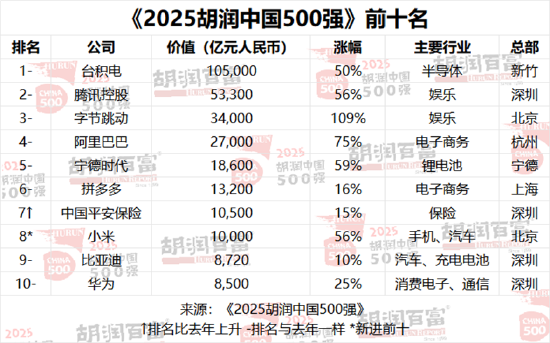
2025胡润中国500强发布:台积电、腾讯、字节跳动位列前三
Xin Lang Cai Jing· 2026-02-05 02:27
Core Insights - The 2025 Hurun China 500 list shows significant growth in company valuations, with TSMC leading as the highest valued private enterprise in China at 10.5 trillion RMB, followed by Tencent and ByteDance [1][9]. Company Performance - TSMC's value increased by 3.5 trillion RMB, driven by strong demand for artificial intelligence, advanced process technology, and a solid market position [3][11]. - Tencent's valuation rose by 1.9 trillion RMB, attributed to strong performance in gaming, advertising, and fintech [3][11]. - ByteDance's value grew by 1.8 trillion RMB, benefiting from advancements in AI [3][11]. - Alibaba's value increased by 1.2 trillion RMB, due to strategic investments in AI and cloud computing, alongside a recovery in traditional e-commerce [4][12]. - CATL's valuation rose by 690 billion RMB, supported by sustained demand in the electric vehicle market [4][12]. - Xiaomi entered the top ten with a valuation increase of 357 billion RMB, driven by growth in its automotive business and premium smartphone sales [4][12]. - Other notable companies include Cambricon, which saw a valuation increase of 370 billion RMB, and NetEase, which grew by 238 billion RMB due to strong gaming performance [4][12]. Industry Trends - The total value of the Hurun China 500 companies increased by 21 trillion RMB (38%) to reach 77 trillion RMB [2][10]. - The semiconductor industry experienced the most significant growth, surpassing the life sciences sector to become the second-largest industry in the list, while industrial products remained the largest [2][10]. - The real estate sector faced the largest decline, followed by retail [2][10]. - The average age of the top 500 companies is 29 years, indicating a relatively young corporate landscape [11]. Geographic Insights - Beijing, Shanghai, and Shenzhen are the top three cities with the most companies on the list, housing 59, 57, and 49 companies respectively [2][10]. - Suzhou emerged as the preferred manufacturing base with 68 companies, while Shanghai was the leading research and development hub with 101 companies [2][10]. New Entrants and Market Dynamics - A total of 95 companies (19%) made it to the list for the first time, with seven companies valued over 100 billion RMB [2][10]. - The threshold for entry into the 2025 Hurun China 500 increased by 7.5 billion RMB to 34 billion RMB, reflecting a 28% rise [2][10].





“永”立潮头 “川”流不息——重庆永川以产业之力筑强渝西发展高地
Shang Hai Zheng Quan Bao· 2026-02-04 18:12
Core Viewpoint - Yongchuan District in Chongqing is positioning itself as a key industrial hub within the Chengdu-Chongqing economic circle, focusing on high-quality development in manufacturing and emerging industries, particularly in smart connected vehicles, new materials, and digital economy [10][11][12]. Manufacturing and Industrial Development - Yongchuan is developing a modern manufacturing cluster system known as "3322," targeting three key industries: smart connected new energy vehicles, new materials, and big data & artificial intelligence [10][11]. - The district aims to achieve an industrial output value of 105.07 billion yuan by 2025, with 394 industrial enterprises, establishing itself as a modern manufacturing base and vocational education hub [11]. Automotive Industry - Great Wall Motors' Chongqing base has become a milestone for local industrial development, with over 1.2 million vehicles produced during the 14th Five-Year Plan, including 600,000 "Great Wall Cannon" pickups, making Yongchuan a significant player in China's pickup truck market [12][13]. - By 2025, the total output value of Yongchuan's automotive industry is expected to exceed 55.79 billion yuan, with new energy vehicles accounting for 13.4% of total production [13]. New Materials and Digital Economy - Yongchuan's new materials sector is developing rapidly, with a focus on glass, aluminum processing, and fiberglass, attracting leading companies like Xinyi Group and Dongfang Hope [13][14]. - The Chongqing Yun Valley Big Data Industrial Park hosts nearly 600 companies and 28,000 employees, contributing to a robust digital economy ecosystem [14][15]. Regional Connectivity and Trade - Yongchuan serves as a logistical hub, facilitating the efficient movement of goods and resources, with an expected import-export value of 6.98 billion yuan by 2025, marking a 1027.4% increase [16]. - The district's strategic location enhances its role in the Chengdu-Chongqing economic circle, promoting industrial collaboration and resource sharing [16][17]. Future Industry and Innovation - Yongchuan is focusing on future industries such as low-altitude economy and biotechnology, while also nurturing emerging sectors like smart robotics and new energy equipment [21][22]. - The district is recognized for its advancements in smart connected vehicles, having established a testing ground for autonomous driving, attracting major tech companies [20][21]. Business Environment and Support - Yongchuan has implemented various measures to improve the business environment, including talent support policies and dedicated services for enterprises, fostering a conducive atmosphere for industrial growth [22][23]. - The district aims to become a core node in the Chengdu-Chongqing economic circle, targeting an industrial output value of over 150 billion yuan by 2030 [23].
长城汽车(601633):长城汽车点评:单车营收持续增长,年终奖、政府补贴等因素短期扰动盈利
Changjiang Securities· 2026-02-04 10:14
Investment Rating - The investment rating for the company is "Buy" and is maintained [8] Core Views - The company is expected to achieve a net profit attributable to shareholders of 9.91 billion yuan in 2025, a year-on-year decline of 21.7% [2][5] - The company is accelerating its global expansion and is committed to the transformation towards new energy, with a continuous new car cycle expected to drive improvements in sales and performance [2] - Long-term strategies, including four major expansion strategies, are anticipated to open up long-term growth potential for sales, while the shift towards smart technology is expected to enhance profitability across the entire industry chain [2] Summary by Relevant Sections Financial Performance - In Q4 2025, the company achieved sales of 400,000 units, a year-on-year increase of 5.5% and a quarter-on-quarter increase of 13.2% [12] - The revenue for Q4 2025 was 69.21 billion yuan, representing a year-on-year increase of 15.5% and a quarter-on-quarter increase of 13.0% [12] - The net profit attributable to shareholders for Q4 2025 is projected to be 1.28 billion yuan, a year-on-year decline of 43.5% and a quarter-on-quarter decline of 44.4% [12] Strategic Initiatives - The company is focusing on three dimensions: product, channel, and supply chain adjustments to deepen its new energy transition [12] - The "ONE GWM" strategy is accelerating the company's overseas expansion, with sales channels covering over 1,400 locations in more than 170 countries and regions [12] - The company is enhancing its technological capabilities in smart driving and data algorithms, which are expected to strengthen its competitive edge in the smart vehicle market [12] Future Projections - The projected net profits for the company from 2025 to 2027 are 9.91 billion yuan, 14.20 billion yuan, and 17.40 billion yuan, respectively [12] - The corresponding price-to-earnings ratios for A-shares are expected to be 17.9X, 12.5X, and 10.2X for the same period [12]