HAIDILAO(06862)

Search documents
海底捞净利润半年下降13%!创始人张勇再出山,重任CEO
Sou Hu Cai Jing· 2026-01-14 03:40
2025年上半年海底捞营收净利双降,报告期内营业收入207.03亿元,同比下降3.7%。核心经营利润(非 国际财务报告准则计量)24.08亿元,同比下降14.0%;净利润17.55亿元,同比下降13.7%。 1月13日,海底捞国际控股有限公司发布公告称,苟轶群辞去CEO,张勇接任。这是张勇时隔四年再次 担任海底捞CEO。 在董事会成员调整的同时,海底捞亦完成新一轮执行董事委任。公告称,为支持本公司持续创新及长期 发展,积极磨砺并培养年轻一代管理团队,李娜娜、朱银花、焦德凤、朱轩宜已分别获委任为公司执行 董事,自1月13日起生效。根据公告,李娜娜、朱银花、焦德凤、朱轩宜皆为女士,年龄分别为38岁、 44岁、39岁、35岁。她们均长期在海底捞体系内成长,分别来自区域运营管理、产品与供应链管理及集 团战略支持等不同岗位。 2022年3月,张勇曾卸任海底捞CEO,由被称为"最牛服务员"的杨利娟接棒。2024年7月,杨利娟辞任公 司CEO,由苟轶群接任。 ...

餐饮股集体回升 海底捞大涨超10%领衔 九毛九涨6%
Ge Long Hui· 2026-01-14 03:27
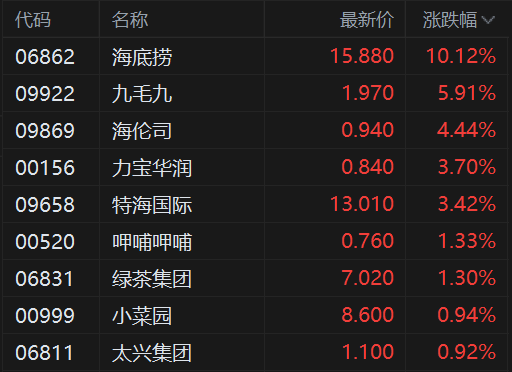
Core Viewpoint - The Hong Kong restaurant stocks experienced a collective surge, with Haidilao leading the rise by over 10%, indicating a positive market sentiment towards the restaurant sector as consumer spending rebounds during the holiday season [1] Group 1: Market Performance - Haidilao's stock price increased by 10.12% to 15.880 [2] - Other notable performers included Jiumaojiu, which rose by 5.91% to 1.970, and Hailun Si, which increased by 4.44% to 0.940 [2] - The overall trend shows a strong recovery in the restaurant sector, with multiple stocks experiencing significant gains [1][2] Group 2: Consumer Trends - The consumer market saw a "good start" during the New Year holiday, with over 4.5 million customers served across Haidilao's stores from December 31, 2025, to January 1, 2026 [1] - Dining experiences have become an essential aspect of travel, reflecting a shift in consumer behavior towards enjoying culinary delights during outings [1] Group 3: Strategic Developments - Haidilao's founder and chairman, Zhang Yong, has returned to the front line of management, taking on the role of CEO [1] - The restaurant industry is focusing on two main growth strategies: penetrating lower-tier markets and expanding internationally, as brands seek new growth opportunities beyond first and second-tier cities [1]

张勇重任海底捞CEO,能否打造第二曲线?
2 1 Shi Ji Jing Ji Bao Dao· 2026-01-14 03:26
Group 1: Company Leadership Changes - Zhang Yong has returned to the CEO position of Haidilao, effective January 13, 2026, following the resignation of Guo Yiqun as CEO [1] - Zhang Yong previously handed over the CEO role to Yang Lijuan in March 2022, and Guo Yiqun took over in June 2024 [1] - The leadership change comes as Haidilao faces performance challenges, with a 3.0% year-on-year revenue decline to 20.703 billion yuan and a 13.7% drop in net profit to 1.755 billion yuan in the first half of 2025 [1] Group 2: Industry Context - The Chinese restaurant industry is experiencing a slowdown, with revenue growth decelerating, profits declining, and competition intensifying, as reported by the China Cuisine Association [1] - Competitors like Xiaobai Xiaobai reported an 18.88% revenue decline to 1.942 billion yuan and a net loss of 84 million yuan in the same period [1] Group 3: Strategic Initiatives - Zhang Yong's return is linked to the "Pomegranate Plan," a multi-brand incubation strategy launched in August 2024, aimed at creating a second growth curve for Haidilao [2] - As of June 2025, the "Pomegranate Plan" has incubated 14 restaurant brands, generating a 227% year-on-year revenue increase to 600 million yuan from related businesses [2] - The company is at a critical transformation juncture, with Zhang Yong becoming more involved in operational details [2]





张勇重任海底捞CEO,能否打造第二曲线?丨消费参考
2 1 Shi Ji Jing Ji Bao Dao· 2026-01-14 03:10
Group 1: Company Leadership Changes - Zhang Yong has returned to the CEO position of Haidilao, effective January 13, 2026, following the resignation of Guo Yiqun as CEO [1] - Zhang Yong previously handed over the CEO role to Yang Lijuan in March 2022, and Guo Yiqun took over in June 2024 [1] - The leadership change comes as Haidilao faces performance challenges, with a 3.0% year-on-year revenue decline to 20.703 billion yuan and a 13.7% drop in net profit to 1.755 billion yuan in the first half of 2025 [1] Group 2: Industry Context - The restaurant industry in China is experiencing a slowdown, with the China Cuisine Association noting a trend of "slowing revenue growth, declining profits, and intensified competition" in the first half of 2025 [1] - Competitors like Xiaobing Xiaobing reported an 18.88% revenue decline to 1.942 billion yuan and a net loss of 84 million yuan during the same period [1] Group 3: Strategic Initiatives - Zhang Yong's return is linked to the "Pomegranate Plan," a multi-brand incubation strategy launched in August 2024, aimed at creating a second growth curve for Haidilao [2] - As of June 2025, the "Pomegranate Plan" has incubated 14 restaurant brands, with a total of 126 stores, and the related business saw a 227% year-on-year revenue increase to 600 million yuan in the first half of 2025 [2] - The company is at a critical juncture for transformation, with Zhang Yong becoming more involved in operational details [2]

港股速报|港股小幅高开 张勇回归 海底捞涨超10%
Mei Ri Jing Ji Xin Wen· 2026-01-14 03:10
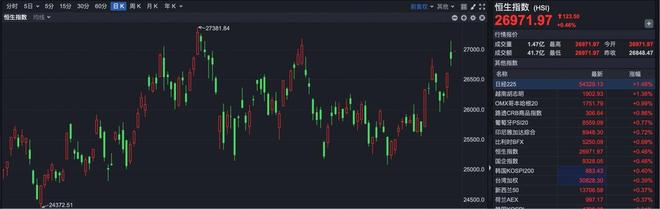
Market Overview - The Hong Kong stock market opened slightly higher on January 13, with the Hang Seng Index at 26,971.97 points, up 123.50 points, representing a 0.46% increase [2] - The Hang Seng Tech Index opened at 5,894.63 points, gaining 24.84 points, which is a 0.42% rise [4] Company Focus - Haidilao (HK06862) saw its stock rise over 10% in early trading [6] - On January 13, Haidilao announced changes in its board of directors, including the resignation of CEO and executive director Gou Yiqun, and the appointment of Zhang Yong, the company's co-founder, as the new CEO [7] - Zhang Yong previously served as CEO until March 2022, and the board adjustments are part of a strategic realignment [7] Sector Performance - Technology stocks showed mixed performance, with Alibaba rising over 3%, Kuaishou up over 4%, and Baidu and Tencent increasing by over 1%, while JD.com fell nearly 1% [7] - The innovative drug sector continued its upward trend, with BeiGene rising over 3% [7] - The metals sector was active, with Zijin Mining increasing by over 1% [7] - Lithium battery stocks opened higher, with CATL rising over 1% [7] Market Outlook - Brokerages indicate that liquidity in the Hong Kong market is gradually recovering, with net inflows from southbound funds totaling HKD 41.296 billion since the beginning of 2026 [9] - The market is expected to benefit from three converging factors: rising expectations for overseas liquidity easing, accelerated capital inflows, and upward revisions in profit expectations, suggesting a potential upward trend for the Hong Kong stock market [9]
餐饮股涨幅居前 机构料多数餐饮头部品牌将实现客流量回正 餐供竞争逐渐趋于理性
Zhi Tong Cai Jing· 2026-01-14 03:10
Core Viewpoint - The restaurant sector is experiencing a recovery since the beginning of 2023, driven by demand and supply dynamics, with leading brands expected to see positive customer traffic in the second half of 2025 [1] Group 1: Stock Performance - Notable stock increases include Haidilao (06862) up 9.64% to HKD 15.8, Jiumaojiu (09922) up 4.84% to HKD 1.95, Helen's (09869) up 3.33% to HKD 12.99, and Tehai International (09658) up 3.26% to HKD 12.99 [1] Group 2: Industry Analysis - According to Zheshang Securities, the recovery in the restaurant industry is largely determined by demand, while the pace is dictated by supply, with expectations for most leading brands to achieve positive customer traffic in the second half of 2025 [1] - The average customer spending is stabilizing or increasing for many leading brands, indicating a recovery in pricing power [1] - The report suggests that the bottom has been reached for customer spending and single-store performance among leading brands, with ongoing monitoring of same-store sales growth and sustainability [1] Group 3: Competitive Landscape - Guotai Junan notes that the overall demand in the restaurant supply industry has been under pressure in recent years, leading to intensified competition driven by market share concerns [1] - The marginal benefits from price competition have significantly decreased, prompting leading companies to adopt a more rational competitive stance [1] - The profitability of the restaurant supply sector has shown signs of recovery, indicating that the worst operational period has passed, with competition becoming more rational and leading companies innovating in new products, channels, and markets [1]
海底捞(06862):创始人重新出任CEO,2026年经营蓄势待发
Guoxin Securities· 2026-01-14 03:09
Investment Rating - The investment rating for the company is "Outperform the Market" [2][7]. Core Insights - The founder Zhang Yong has resumed the role of CEO, which is expected to enhance operational efficiency and strategic focus on the "Pomegranate Plan" aimed at diversifying the restaurant business and creating a second growth curve [4][5][10]. - The company has shown resilience in a challenging market, with an increase in store count from 1,368 at the end of 2024 to 1,381 by early 2026, while the overall hot pot industry has seen a decline in store numbers [5][13]. - The company is projected to achieve a net profit of 42.2 billion, 47.5 billion, and 54.2 billion CNY for the years 2025, 2026, and 2027 respectively, with corresponding dynamic PE ratios of 17.1, 15.2, and 13.3 [6][28]. Summary by Sections Management Changes - Zhang Yong has returned as CEO after nearly four years, following a series of management changes that reflect the company's adaptation to different strategic needs over time [4][10]. - The transition from previous CEO Guo Yiqun to Zhang Yong is expected to stabilize operations and enhance the focus on the "Pomegranate Plan" [5][10]. Market Position and Performance - The hot pot industry is experiencing a contraction, with the total number of hot pot restaurants decreasing by approximately 13.7% from January 2025 to January 2026, while the company has managed to increase its store count [5][13]. - The company’s same-store turnover rate is expected to stabilize and show year-on-year growth by Q4 2025, aided by improving consumer price index (CPI) data [5][17]. Financial Projections - The company is expected to maintain a high dividend payout ratio, with a projected dividend rate of 95% in the first half of 2025 [6][28]. - Under optimistic scenarios, the company could achieve net profits of 50.0 billion and 59.6 billion CNY in 2026 and 2027, respectively, indicating growth rates of 18.5% and 19.2% [6][28].
港股异动 | 餐饮股涨幅居前 机构料多数餐饮头部品牌将实现客流量回正 餐供竞争逐渐趋于理性
智通财经网· 2026-01-14 03:08
Group 1 - The core viewpoint of the article highlights the recovery of the restaurant industry since the beginning of 2023, driven by demand and supply dynamics [1] - Major restaurant stocks have shown significant gains, with Haidilao up 9.64% to HKD 15.8, Jiumaojiu up 4.84% to HKD 1.95, Helen's up 3.33% to HKD 12.99, and Tehai International up 3.26% to HKD 12.99 [1] - Zhejiang Securities reports that most leading restaurant brands are expected to see a positive turnaround in customer traffic in the second half of 2025, as the year-on-year basis normalizes [1] Group 2 - The average customer spending is stabilizing or recovering for more leading brands, indicating an improvement in market conditions [1] - Guotai Junan notes that the overall demand in the restaurant supply industry has been under pressure, leading to intensified competition, but the marginal benefits from price competition have significantly decreased [1] - The restaurant supply sector has reportedly passed its worst operational phase, with competition becoming more rational and leading companies innovating in new products, channels, and markets [1]
港股餐饮股集体回升 海底捞大涨超10%领衔 九毛九涨6%
Jin Rong Jie· 2026-01-14 02:57
Group 1 - The Hong Kong stock market saw a collective rise in the restaurant sector, with notable gains from several companies [1] - Haidilao led the surge with an increase of over 10%, indicating strong market performance [1] - Other companies such as Jiumaojiu, Helen's, and Tehai International also experienced significant increases of 6%, 4.4%, and 3.4% respectively [1]
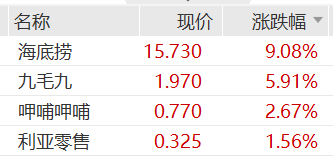
海底捞大涨超9%,创始人张勇重掌CEO
2 1 Shi Ji Jing Ji Bao Dao· 2026-01-14 02:55
| 名称 | 现价 | 涨跌幅 ▼ | | --- | --- | --- | | 海底捞 | 15.730 | 9.08% | | 九毛九 | 1.970 | 5.91% | | 甲哺甲哺 | 0.770 | 2.67% | | 利亚零售 | 0.325 | 1.56% | 海底捞(6862.HK)盘初一度飙升超10%,股价创去年5月以来新高。截至09:53,海底捞涨9.08%,报15.73港元/股,总市值为876亿港元。 消息面上,时隔近四年,海底捞创始人及董事会主席张勇回归管理一线,接任公司CEO。与此同时,公司董事会也发生调整,为培养年轻一代管理团队, 迎来四位新董事加入。 1月14日,港股早盘三大指数高开后涨幅收窄,恒生科技指数盘初曾大涨至2.35%,截至10:00,涨0.43%,恒生指数、国企指数分别上涨0.32%及0.23%。 盘面上,消费股走强,海底捞涨超9%,农夫山泉涨超5%,九毛九涨超5%,呷哺呷哺涨超2%。 公开资料显示,张勇出生于1971年,是海底捞的创办人之一,在海底捞积累了逾30年食品行业及管理经验。2018年,海底捞在港交所上市,张勇担任公司 首席执行官,后于2022年3月卸任。 ...