LEAPMOTOR(09863)

Search documents
超20款车光速调价,丰田“自杀式”反击,2026价格战再升级
3 6 Ke· 2026-01-16 12:53
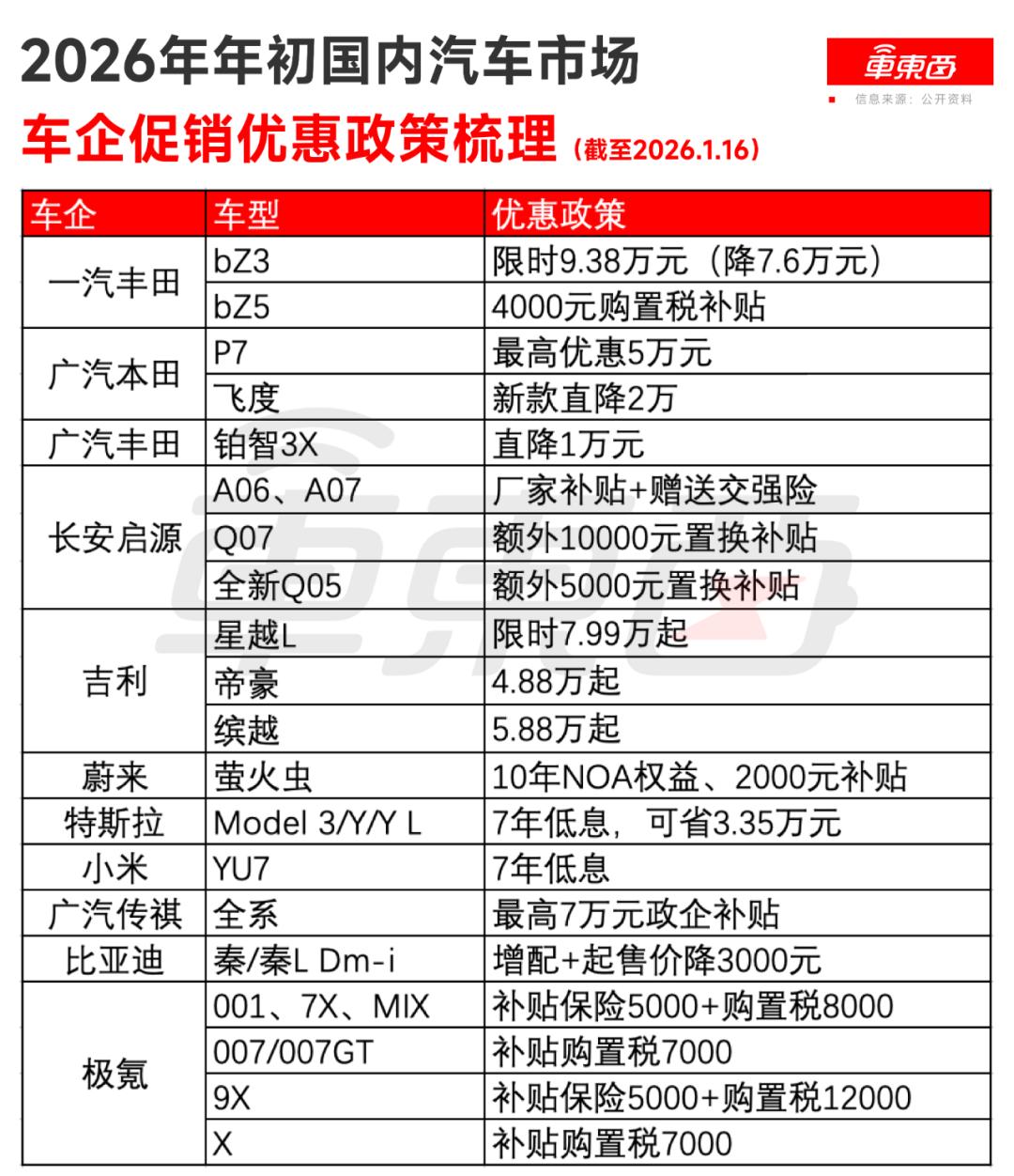
Core Viewpoint - The automotive industry is experiencing an intense price war initiated by luxury brands, leading to significant price reductions across various models from multiple manufacturers, creating a new wave of discounts in the market [1][6]. Group 1: Price Reductions and Promotions - BMW has initiated a price drop of up to 300,000 yuan, prompting over 10 automakers to follow suit with more than 20 mainstream models participating in the price reduction trend [1]. - Geely's Emgrand is now priced at 48,800 yuan, while the new Honda Fit has seen a price cut of 20,000 yuan, setting a new low at 66,800 yuan [1][13]. - Toyota's bZ3 electric sedan has been drastically reduced to 93,800 yuan, a decrease of 76,000 yuan, representing a nearly 45% drop from its previous price [9]. Group 2: Competitive Strategies - The competition has escalated with joint efforts from joint venture brands, particularly Japanese automakers, who are adopting aggressive pricing strategies to reclaim market share [7]. - Various automakers are employing a combination of subsidies, enhanced features, and financing options to attract buyers, rather than relying solely on price cuts [20][30]. - NIO's Firefly brand is offering cash subsidies along with a 10-year NOA (Navigation on Autopilot) free usage right, showcasing a strategic approach to enhance customer value [32]. Group 3: Market Dynamics and Consumer Impact - The price war has led to a significant reduction in the entry price for electric vehicles, making them more accessible to consumers [9][19]. - The automotive market is witnessing a shift where companies are not just competing on price but also on the value offered through financing and additional features, which may lead to a more sustainable competitive environment [37]. - The ongoing promotions and price adjustments are expected to drive sales ahead of the Chinese New Year, indicating a strategic push by manufacturers to maximize order volumes during this peak season [37].






盘点2025:让车企走下坡路的九大“致命伤”
3 6 Ke· 2026-01-16 12:12
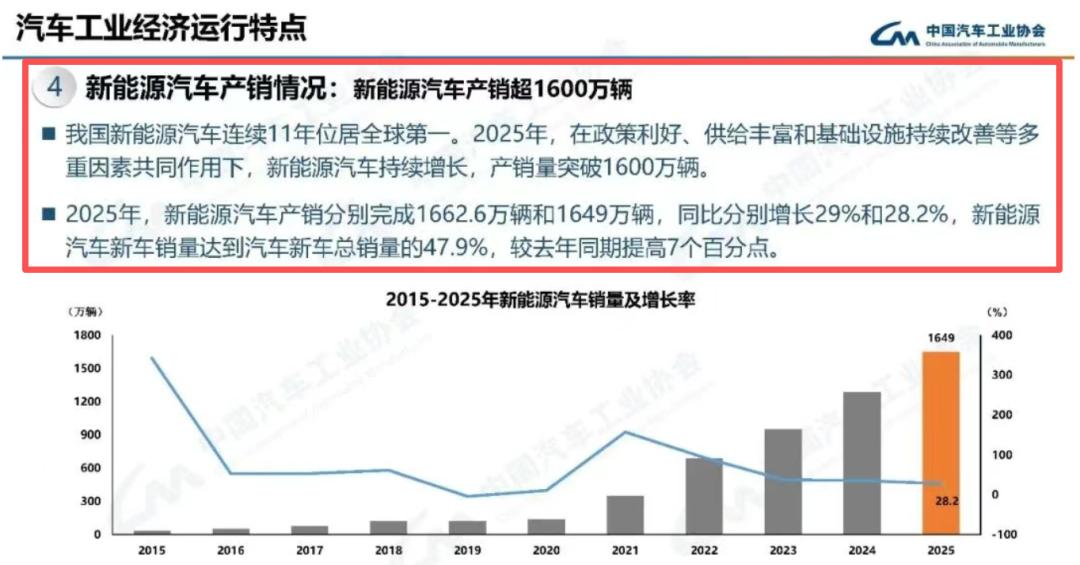
Core Insights - The Chinese electric vehicle (EV) market saw record production and sales in 2025, with 16.626 million units produced and 16.49 million units sold, marking a year-on-year growth of 29% and 28.2% respectively, maintaining its position as the global leader for 11 consecutive years [1][3] - A significant industry reshuffle is underway, with previously dominant brands experiencing declines, highlighting that success now hinges on minimizing errors rather than just speed [3][4] Group 1: Market Dynamics - The rapid evolution of the EV market has led to increased competition, with companies like Li Auto facing challenges due to slow product line updates, resulting in lost market share [4][9] - Competitors have surpassed Li Auto in key metrics such as electric range and technology, prompting Li Auto to accelerate its product upgrade cycle from four years to two [9][10] Group 2: Quality Control Issues - Manufacturing quality issues, such as the "spray powder" problem affecting BYD vehicles, have led to customer dissatisfaction and complaints, indicating potential weaknesses in quality control and supply chain management [10][11][14] - These quality concerns can erode brand loyalty and consumer trust, as they directly impact user experience [14] Group 3: Marketing and Trust - Some companies are engaging in "small print marketing," which obscures critical information and can lead to trust erosion among consumers, as seen with Xiaomi's SU7 [15][18] - The practice of reducing vehicle configurations without proper disclosure has resulted in significant backlash, particularly for XPeng's G6 model, leading to a sharp decline in brand reputation [18][22] Group 4: Design and Consumer Perception - Controversial design choices, such as those made for the Li Auto MEGA, have sparked public debate and negatively affected sales and brand image [23][25] - A disconnect between innovative design and consumer expectations can lead to adverse market reactions [25] Group 5: Supply Chain and Financial Health - The financial struggles of companies like Nezha, which reported a mere 15.45 million yuan in cash against debts exceeding 26 billion yuan, highlight the risks of aggressive expansion without solid financial foundations [30][32] - Poor supplier choices can lead to significant reputational damage, as seen with Zeekr's "zero self-ignition" claim being undermined by safety incidents [33][35] Group 6: Product Recalls and Safety - Major recalls due to safety issues, such as those affecting Xiaomi and BYD, underscore the importance of rigorous product testing and quality assurance [36][39] - Recalls not only incur financial costs but also severely damage brand reputation and consumer confidence [39] Group 7: Competitive Landscape - The EV industry is evolving into a comprehensive competition encompassing strategic stability, technological innovation, honest marketing, and robust supply chain management [39] - Companies that respect manufacturing principles and maintain a focus on user value are more likely to succeed in this challenging environment [39]




2026年销量目标现分化: 传统车企稳健推进 新势力冲刺高增长
Zhong Guo Zheng Quan Bao· 2026-01-15 21:12
Core Insights - The automotive market in 2026 is characterized by significant differentiation in sales targets among major car manufacturers, with a total target exceeding 21.55 million units, approximately 63% of the 2025 domestic sales volume [1] - Traditional automakers are focusing on stable growth rates of 10% to 30%, while new entrants and cross-industry brands are setting aggressive targets of 34% to 67.5%, indicating a strong push for market share [1] Summary by Company - **Geely**: Set a sales target of 3.45 million units for 2026, a 14% increase from 2025, with a focus on 2.22 million units of new energy vehicles (NEVs), achieving a penetration rate of 64.3% [1] - **Chery**: Aims for 3.2 million units, a 14.03% increase from 2025's 2.81 million units, with plans to launch 17 key models [2] - **Dongfeng Group**: Targets 3.25 million units, a 30% increase from 2025, with 1.7 million NEVs and 600,000 units for export [2] - **Great Wall Motors**: Sets a more conservative target of 1.8 million units, a 36% increase from 2025's 1.32 million units [2] - **Leap Motor**: Aims for 1 million units, a 67.5% increase from 2025's 596,600 units, leveraging core technology and a competitive parts system [2] - **Xiaomi**: Targets 550,000 units, a 34% increase from 2025's 410,000 units, emphasizing a stable expansion strategy [3] - **NIO**: Plans for a sales range of 456,000 to 489,000 units, maintaining a growth rate of 40% to 50% [3] - **GAC Toyota**: Sets a conservative target of 800,000 units, a 3.6% increase from 2025 [3] - **SAIC Volkswagen**: Aims for 1 million units, maintaining 2025 levels, with plans for 7 new NEV models [3] Market Dynamics - The automotive industry is shifting from incremental expansion to competition within existing market shares, with varying growth rates reflecting companies' strategies and market conditions [4] - Traditional automakers are generally targeting growth rates between 13% and 30%, with NEV sales growth rates significantly higher, indicating a consensus on NEVs as the main growth driver [4] - New energy vehicle sales targets are notably higher than overall sales targets, with Geely and Changan targeting 32% and 26.2% growth rates respectively [4] Strategic Considerations - The high growth targets set by new entrants are driven by the need for scale to improve cash flow and profitability, but achieving these targets will require strong organizational capabilities [5] - Key factors influencing the achievement of sales targets include the rollout of new energy products, success in overseas markets, and the overall capability of the companies [6] - The industry is expected to see a 4.3% growth in exports, with companies like BYD targeting 1.5 to 1.6 million units for overseas sales [6]


传统车企稳健推进 新势力冲刺高增长
Zhong Guo Zheng Quan Bao· 2026-01-15 20:48
Core Insights - The automotive market in 2026 is characterized by significant differentiation in sales targets among major car manufacturers, with a total target exceeding 21.55 million units, approximately 63% of the 2025 domestic sales volume [1] - Traditional automakers are focusing on stable growth rates of 10% to 30%, while new entrants and cross-industry brands are setting aggressive targets ranging from 34% to 67.5%, indicating a strong push for market share [1] Summary by Company - Geely aims for a sales target of 3.45 million units in 2026, a 14% increase from 2025, with a focus on 2.22 million units of new energy vehicles, achieving a penetration rate of 64.3% [1] - Chery targets 3.2 million units, a 14.03% increase from 2025, with plans to launch 17 key models focusing on electrification and intelligence [2] - Dongfeng Group sets an ambitious target of 3.25 million units, a 30% increase from 2025, with a focus on 1.7 million new energy vehicles and 600,000 exports [2] - Great Wall Motors adopts a more cautious approach with a target of 1.8 million units, reflecting a 36% increase from 2025 [2] - Leap Motor aims for 1 million units, a 67.5% increase, building on a strong 2025 performance of 596,600 units [2] - Xiaomi targets 550,000 units, a 34% increase, emphasizing a production strategy driven by orders [3] - NIO sets a sales target range of 456,000 to 489,000 units, maintaining a growth rate of 40% to 50% [3] - GAC Toyota's target is 800,000 units, a modest 3.6% increase, while SAIC Volkswagen aims for 1 million units, maintaining its 2025 target [3] Market Dynamics - The differentiation in sales targets reflects a shift from incremental expansion to competition within existing market shares, with the difficulty of achieving these targets closely tied to each company's base, product layout, and systemic capabilities [4] - Traditional automakers are generally targeting growth rates between 13% and 30%, with a notable emphasis on new energy vehicle sales growth, which is significantly higher than overall growth targets [4] - New energy vehicles are recognized as the main growth engine, with companies like Geely and Changan setting ambitious growth targets for their new energy vehicle sales [4] - The aggressive targets set by new entrants are seen as a response to the need for scale, cash flow improvement, and valuation support, although they face challenges in converting scale into systemic strength [5] Key Factors for Target Achievement - The success of sales targets hinges on three main dimensions: the rollout of new energy products, effectiveness in overseas market expansion, and the overall systemic support capabilities of the companies [5] - Companies like Geely and Changan are expected to achieve their targets due to stable completion rates and robust channel layouts, while some joint venture brands may face risks of market share erosion despite conservative targets [5]
向质而行!2025中国汽车驶出增长新动能
Zhong Guo Jin Rong Xin Xi Wang· 2026-01-15 13:33
Group 1 - The core viewpoint of the article highlights that China's automotive industry has achieved significant milestones in 2025, with production and sales both exceeding 34 million units, and new energy vehicles (NEVs) surpassing 16 million units, marking a continuous 17-year dominance in the global market [1][2] - The market share of NEVs in domestic new car sales has exceeded 50%, indicating that NEVs have become the dominant force in China's automotive market [2][3] - Major breakthroughs in the automotive sector include BYD surpassing Tesla in annual pure electric vehicle sales, and significant milestones achieved by other companies like FAW-Volkswagen and Changan Automobile [2] Group 2 - The penetration of intelligent assisted driving technology has accelerated, with over 60% of new passenger cars sold featuring advanced driving assistance systems [3] - The cost of battery cells has decreased, and improvements in battery life and charging speed have alleviated "range anxiety" for electric vehicles, with a growing charging infrastructure [3] - The automotive industry is experiencing a convergence with robotics and low-altitude economy, creating a new ecosystem that enhances technological integration and innovation [6] Group 3 - The automotive industry in China is undergoing a phase of standardization, with measures being implemented to regulate market competition and ensure safety [7][9] - A series of reforms have been introduced to combat "involution" in the market, promoting a shift from scale expansion to value enhancement among car manufacturers [9][10] - The "14th Five-Year Plan" emphasizes the importance of building a modern industrial system and enhancing the supply-demand adaptability of consumer goods, with smart connected vehicles being a key focus area [10]


2025年车市销量创新高,TOP5车企“吃掉”半数天下
2 1 Shi Ji Jing Ji Bao Dao· 2026-01-15 13:22
Core Viewpoint - In 2025, China's automotive market is expected to achieve record growth amidst structural changes, with production and sales reaching 34.53 million and 34.40 million units respectively, marking a year-on-year increase of 10.4% and 9.4% [1] Group 1: Market Growth and Structure - The growth is significantly driven by the rise of new energy vehicles (NEVs), with domestic sales projected to reach 13.875 million units, a year-on-year increase of 19.8%, resulting in a penetration rate of 54% for new energy passenger cars [1] - Chinese brands are a core engine of this growth, with sales of domestic passenger cars expected to hit 20.936 million units, a 16.5% increase, raising market share to 69.5%, the highest since 2018 [1] - The automotive industry has seen a rational return to pricing strategies, with only 156 new models reducing prices in the first ten months of 2025, indicating improved market order [1] Group 2: Profitability and Market Dynamics - Despite the growth in sales, the automotive industry's profitability remains under pressure, with revenues surpassing 10 trillion yuan and profits reaching 440.3 billion yuan, a 7.5% increase, but with a profit margin of 4.4%, below the average of 6% for downstream industrial enterprises [2] - The market is shifting towards new energy vehicles, with traditional fuel vehicle sales declining by 4.3% to 11.06 million units, while new energy vehicle sales are expected to grow by 17.7% [3] Group 3: Competitive Landscape - The competition in the 100,000 to 200,000 yuan price range is intense, with significant sales growth for NEVs in this segment, which accounted for 6.941 million units sold, a 24% increase [3] - BYD continues to dominate this price segment, with its Dynasty and Ocean series capturing nearly 90% of its total sales, while Geely's Galaxy brand has seen a 150% increase in sales [4] - New entrants like Leap Motor and Xpeng are also making significant inroads, with Leap Motor achieving a 104.7% increase in sales, focusing on cost control and technology [7] Group 4: Future Outlook and Challenges - The automotive market is expected to face a slowdown in growth, with predictions for 2026 indicating only a 1% increase in total sales to 34.75 million units, while NEVs are expected to grow by 15.2% [8] - Policy changes, such as the new recycling and consumption policies, are anticipated to support market demand, but competition is expected to intensify [9] - Major traditional automakers have set ambitious sales targets for 2026, while new entrants are also aiming for aggressive growth, indicating a highly competitive environment [10]
从两个“百万”看中国新能源汽车产业量质齐升
Zhong Guo Zhi Liang Xin Wen Wang· 2026-01-15 09:20
Group 1 - The core message highlights the significant milestones achieved by Chinese electric vehicle manufacturers, with NIO producing its one-millionth vehicle, symbolizing a dual breakthrough in scale and brand for the industry [1] - The emergence of new energy vehicle companies like NIO, Li Auto, and Xpeng has redefined the automotive industry in China, moving away from traditional fuel vehicles to electric and intelligent models, thus reshaping business models and user relationships [2] - The collaboration between Huawei and JAC Motors to create the high-end vehicle, the Zunji S800, signifies a shift in the automotive industry towards high-end pricing and advanced technology integration, marking a new phase in China's automotive evolution [2] Group 2 - Data from the China Association of Automobile Manufacturers indicates strong performance in the new energy vehicle sector, with production and sales reaching 14.907 million and 14.78 million units respectively from January to November 2025, reflecting year-on-year growth of 31.4% and 31.2% [3] - The Chinese new energy vehicle industry is transitioning from survival to value creation, indicating a maturation phase as brands aim for global competitiveness [3]

国泰海通:维持零跑汽车(09863)“增持”评级 目标价68.73港元
智通财经网· 2026-01-15 02:39
智通财经APP获悉,国泰海通发布研报称,近日一汽与零跑汽车(09863)签署投资和合作协议。该行认 为,此次合作标志着双方战略协同进一步深化,为长期发展注入持续动力。维持"增持"评级, 2025/26/27年归母净利润预测13/48/76亿元不变。该行用PS法为公司估值,参考可比公司,给予公司 2026年估值0.8倍PS,对应目标价68.73港元(按1港元=0.8991人民币汇率换算)。 根据公司公告,公司已有条件同意发行7483.22万股内资股,而一汽股权已有条件同意认购7483.22万股 内资股,认购价为内资股每股50.03元(相当于55.29港元)。相较于12月24日零跑汽车收市价49.94港元, 以及协议日期前连续5个交易日平均收市价49.23港元,这一认购价均存在溢价。7483.22万股内资股相当 于零跑汽车已发行内资股总数的约25.74%、经扩大已发行内资股的约20.47%;相当于已发行股份总数的 约5.26%,以及经扩大已发行股份的约5%。本次认购完成后,朱总及一致行动人股权22.56%, Stellantis18.99%,整体股权结构仍保持稳定。 强化战略协同,共享资源优势 早在2019年,一 ...

国泰海通:维持零跑汽车“增持”评级 目标价68.73港元
Zhi Tong Cai Jing· 2026-01-15 02:37
国泰海通发布研报称,近日一汽与零跑汽车(09863)签署投资和合作协议。该行认为,此次合作标志着 双方战略协同进一步深化,为长期发展注入持续动力。维持"增持"评级,2025/26/27年归母净利润预测 13/48/76亿元不变。该行用PS法为公司估值,参考可比公司,给予公司2026年估值0.8倍PS,对应目标 价68.73港元(按1港元=0.8991人民币汇率换算)。 国泰海通主要观点如下: 根据公司公告,公司已有条件同意发行7483.22万股内资股,而一汽股权已有条件同意认购7483.22万股 内资股,认购价为内资股每股50.03元(相当于55.29港元)。相较于12月24日零跑汽车收市价49.94港元, 以及协议日期前连续5个交易日平均收市价49.23港元,这一认购价均存在溢价。7483.22万股内资股相当 于零跑汽车已发行内资股总数的约25.74%、经扩大已发行内资股的约20.47%;相当于已发行股份总数的 约5.26%,以及经扩大已发行股份的约5%。本次认购完成后,朱总及一致行动人股权22.56%, Stellantis18.99%,整体股权结构仍保持稳定。 事件 2025年12月28日,中国一汽与零 ...
2025年我国新能源汽车出口达261.5万辆,出口规模再上新台阶
Xin Lang Cai Jing· 2026-01-14 07:19
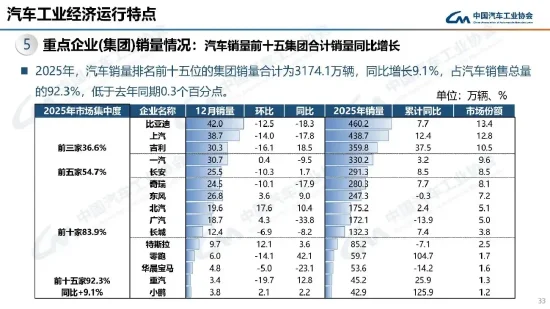
Core Insights - The Chinese automotive industry is projected to achieve record production and sales figures of 34.53 million and 34.40 million vehicles respectively in December 2025, maintaining its position as the world's largest market for 17 consecutive years [1][4]. Group 1: Market Performance - The passenger vehicle market is experiencing steady growth, significantly contributing to the overall automotive market expansion [5]. - The commercial vehicle market is recovering, with production and sales increasing by over 10%, surpassing 4 million units [5]. - New energy vehicles (NEVs) are leading the market, with production and sales exceeding 16 million units, accounting for over 50% of domestic new car sales [5]. Group 2: Export and Trade - The automotive export market shows strong resilience, with total exports exceeding 7 million vehicles, including 2.615 million NEVs, marking a new high in export scale [5]. Group 3: Market Concentration - The top fifteen automotive groups sold a total of 31.741 million vehicles, reflecting a year-on-year growth of 9.1%, which constitutes 92.3% of total vehicle sales, slightly down by 0.3 percentage points from the previous year [5][7]. - The top three groups, BYD, SAIC, and Geely, accounted for 36.6% of total vehicle sales [5][7]. - In the NEV segment, the top fifteen groups sold 15.669 million units, a year-on-year increase of 29.2%, representing 95% of total NEV sales, up by 0.7 percentage points from the previous year [5][7].