XPENG-W(09868)

Search documents
小鹏汽车:2026年1月共交付新车20011台。
Jin Rong Jie· 2026-02-01 09:23
Group 1 - The core point of the article is that Xpeng Motors delivered a total of 20,011 new vehicles in January 2026 [1] Group 2 - The delivery figure indicates a significant milestone for the company, reflecting its growth trajectory in the electric vehicle market [1] - This delivery number may influence investor sentiment and market positioning for Xpeng Motors in the competitive landscape of the automotive industry [1] - The performance in January could set the tone for the company's sales strategy and production capabilities in the upcoming months [1]
小鹏IRON机器人走路摔倒 何小鹏回应:跌倒后会站稳,下一步就是奔跑
Xin Lang Cai Jing· 2026-02-01 09:19
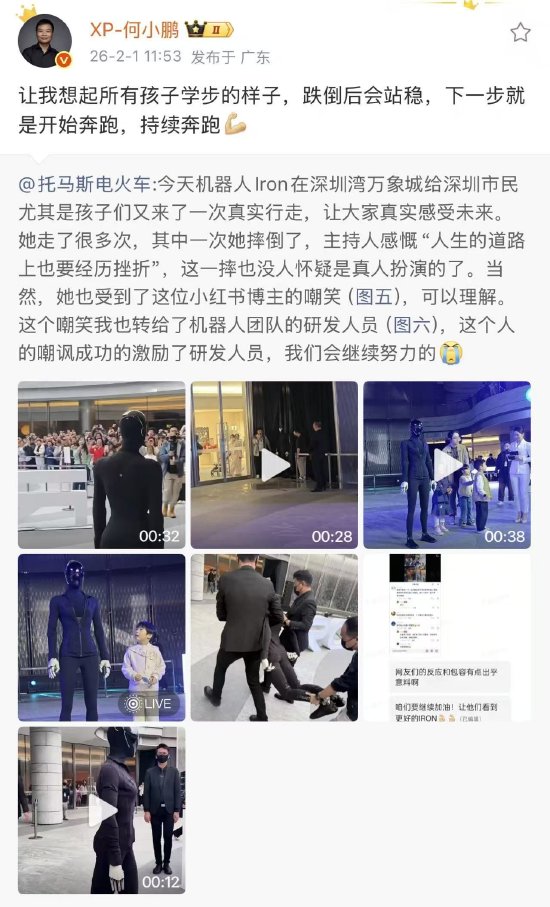
新浪科技讯 2月1日下午消息,近日,有网友在社交平台晒出小鹏IRON人形机器人摔倒照片。 小鹏汽车副总裁于涛通过微博账号"托马斯电火车"表示,机器人IRON在深圳湾万象城给深圳市民尤其 是孩子们又来了一次真实行走,让大家真实感受未来。她走了很多次,其中一次她摔倒了,主持人感 慨"人生的道路上也要经历挫折",这一摔也没人怀疑是真人扮演的了。 其后,小鹏汽车董事长、CEO何小鹏转发并表示:"让我想起所有孩子学步的样子,跌倒后会站稳,下 一步就是开始奔跑,持续奔跑"。 新浪科技讯 2月1日下午消息,近日,有网友在社交平台晒出小鹏IRON人形机器人摔倒照片。 小鹏汽车副总裁于涛通过微博账号"托马斯电火车"表示,机器人IRON在深圳湾万象城给深圳市民尤其 是孩子们又来了一次真实行走,让大家真实感受未来。她走了很多次,其中一次她摔倒了,主持人感 慨"人生的道路上也要经历挫折",这一摔也没人怀疑是真人扮演的了。 其后,小鹏汽车董事长、CEO何小鹏转发并表示:"让我想起所有孩子学步的样子,跌倒后会站稳,下 一步就是开始奔跑,持续奔跑"。 责任编辑:常福强 责任编辑:常福强 ...


XPENG Announces Vehicle Delivery Results for January 2026
Prnewswire· 2026-02-01 09:00
Group 1: Vehicle Deliveries and Environmental Impact - In January 2026, XPeng delivered a total of 20,011 vehicles, which is expected to reduce life-cycle greenhouse gas emissions by over 300,000 tons, equivalent to the carbon absorption of 4.94 million tree seedlings over 10 years [1]. Group 2: Global Expansion and Sales Network - XPeng launched the P7+ simultaneously across 36 countries, with its European launch at the 2026 Brussels Motor Show in January [2]. - As of December 31, 2025, XPeng has expanded its global presence to 60 countries and regions, with an overseas sales network of 380 physical stores, representing a year-over-year growth of over 150% [2]. - The worldwide sales and service network has grown to over 1,000 outlets [2]. Group 3: Company Overview - XPeng is a leading Chinese Smart EV company focused on designing, developing, manufacturing, and marketing Smart EVs for technology-savvy middle-class consumers [3]. - The company aims to become a trusted smart technology provider globally and develops in-house advanced driver-assistance systems and intelligent operating systems [3]. - XPeng is headquartered in Guangzhou, China, with additional offices in major cities including Beijing, Shanghai, Shenzhen, Silicon Valley, and San Diego [3].
小鹏回应机器人摔倒被嘲笑:跌倒后会站稳,下一步开始奔跑
Xin Lang Cai Jing· 2026-02-01 05:52
Core Viewpoint - The incident involving the Xpeng robot IRON falling during its first offline showcase in Shenzhen has sparked both criticism and reflection on the challenges of technological development and learning processes [1] Group 1: Incident Overview - The Xpeng robot IRON experienced a fall during its public demonstration at Shenzhen Bay MixC, leading to social media mockery and comments about it being a "large-scale social death scene" [1] - The robot was subsequently removed from the scene by staff after the fall, highlighting the challenges faced in real-world applications of robotics [1] Group 2: Company Response - Xpeng's Vice President, Thomas, addressed the incident by emphasizing the importance of experiencing setbacks, likening the robot's fall to the learning process of children learning to walk [1] - The company expressed a commitment to continue improving the robot, indicating that feedback from the incident would be taken seriously by the development team [1]
带电量提升能支撑多少国内动力装机增速?
Changjiang Securities· 2026-01-31 13:46
Investment Rating - The industry investment rating is "Positive" and maintained [7] Core Insights - The penetration rate of domestic new energy passenger vehicles has reached 55%, and future sales growth is expected to slow down. However, the increase in battery capacity is anticipated to significantly impact demand, with a projected double-digit growth in battery demand for passenger vehicles by 2026 [2][4] - The domestic new energy passenger vehicle market has entered a consumption-driven growth phase since the end of 2020, with penetration rates increasing from around 10% to an expected 55% by the end of 2025. This growth is accompanied by a slowdown in sales growth due to a higher base [4][17] - The increase in battery capacity is expected to support the growth of battery installations, with single-vehicle battery capacity projected to rise from 52.8 kWh in April 2025 to 61.2 kWh by December 2025 for EVs, and from 23.3 kWh to 33.7 kWh for PHEVs during the same period [4][18] Summary by Sections Market Trends - The market for new energy passenger vehicles is projected to see a slight decline in total vehicle numbers, while new energy vehicles are expected to achieve small single-digit growth due to increased penetration rates. Battery capacity per vehicle is expected to increase by approximately 7%-8%, supporting a battery installation growth rate of around 12% [6][34] Policy and Economic Factors - Positive factors for battery capacity enhancement include changes in the old-for-new policy, which sets a subsidy cap at 8% of the vehicle price in 2026, and changes in purchase tax standards that require PHEVs to have a pure electric range of 100 kWh to qualify for tax exemptions [5][23] - The trend towards larger batteries in range-extended and plug-in hybrid vehicles is expected to continue, addressing consumer concerns about range anxiety and enhancing the perception of electric vehicles' convenience and cost-effectiveness [24] Product Development - Major manufacturers are launching new models with increased battery capacities. For instance, BYD and Geely are introducing models with capacities ranging from 20.79 kWh to 36.62 kWh for their 2026 versions [27][30] - The introduction of large-capacity EVs and PHEVs is expected to further enrich the market, with new models like the Wanjie M9 and NIO ES9 expected to have battery capacities around 100 kWh [31][33]




【乘用车1月月报】内需静待改善,出口韧性较强
东吴汽车黄细里团队· 2026-01-30 14:43
Group 1: Electric Vehicle Market Insights - In December 2025, the retail penetration rate of new energy vehicles (NEVs) reached 58.7%, with a year-on-year increase of 10.9% but a month-on-month decrease of 2.5 percentage points [2][6][14] - The retail sales of passenger vehicles in December 2025 were 2.27 million units, showing a year-on-year decline of 16% and a month-on-month increase of 14.7% [11][14] - BYD maintained a market share of 25% in the NEV sector, while Geely's market share decreased to 11% [22][6] Group 2: Global Market Performance - In December 2025, Southeast Asia's NEV penetration rate exceeded expectations, with a significant contribution from VinFast, leading to a month-on-month increase [3][35] - Chinese automakers exported 641,000 passenger vehicles in December 2025, with 245,000 being NEVs, resulting in a NEV penetration rate of 38.2% [3][7] - The market share of Chinese brands in Southeast Asia reached 14.7%, with a month-on-month increase of 0.8 percentage points [51][62] Group 3: Policy and Market Outlook - The old-for-new vehicle replacement policy is set to be implemented in January 2026, which is expected to stimulate demand in the passenger vehicle market [2][6] - The industry anticipates a recovery in passenger vehicle demand in Q1 2026, driven by the new policy and a shift in consumer sentiment [4][6] - The focus for domestic investments is on companies less sensitive to policy fluctuations, such as JAC Motors, and those expected to see growth in the high-end electric vehicle segment, including Geely and Great Wall Motors [4][6]


乘用车1月月报:内需静待改善,出口韧性较强
Soochow Securities· 2026-01-30 08:24
Investment Rating - The report maintains a positive outlook on the passenger car sector, particularly in the context of the new vehicle replacement policy and the resilience of exports [2][3]. Core Insights - The passenger car industry experienced a significant decline in retail sales in December 2025, with a year-on-year drop of 16% and a total retail volume of 227,000 units. The wholesale volume was 279,000 units, reflecting a decrease of 9.7% year-on-year [7][10]. - The penetration rate of new energy vehicles (NEVs) reached 58.7% in December 2025, showing a year-on-year increase of 10.9% [10][12]. - The report highlights the stability of the NEV market, with BYD holding a market share of 25% and Geely at 11% in December 2025 [16]. Electric Vehicle Data Tracking - The report indicates that the old-for-new vehicle replacement policy was implemented in January 2026, which is expected to stimulate demand in the passenger car market [2][3]. - In December 2025, the NEV wholesale volume was 156,300 units, with a year-on-year increase of 3.4% [12]. - The report notes a significant inventory reduction in the passenger car sector, with a total decrease of 69,000 units in December 2025, including 43,000 units of NEVs [13]. Globalization Data Tracking - The report tracks the performance of Chinese car manufacturers in international markets, noting that in December 2025, 641,000 passenger cars were exported, with 245,000 being NEVs, resulting in a penetration rate of 38.2% for NEVs [3][43]. - The report highlights the strong performance of BYD in exports, particularly in Southeast Asia, where the NEV penetration rate exceeded expectations [3][27]. - The market share of Chinese brands in various regions, including Southeast Asia and Europe, showed positive trends, with notable increases in the UK market [38][40].


小鹏超级增程家族添新成员 2026款P7+/G7超级增程上市
Zhong Guo Zhi Liang Xin Wen Wang· 2026-01-30 07:48
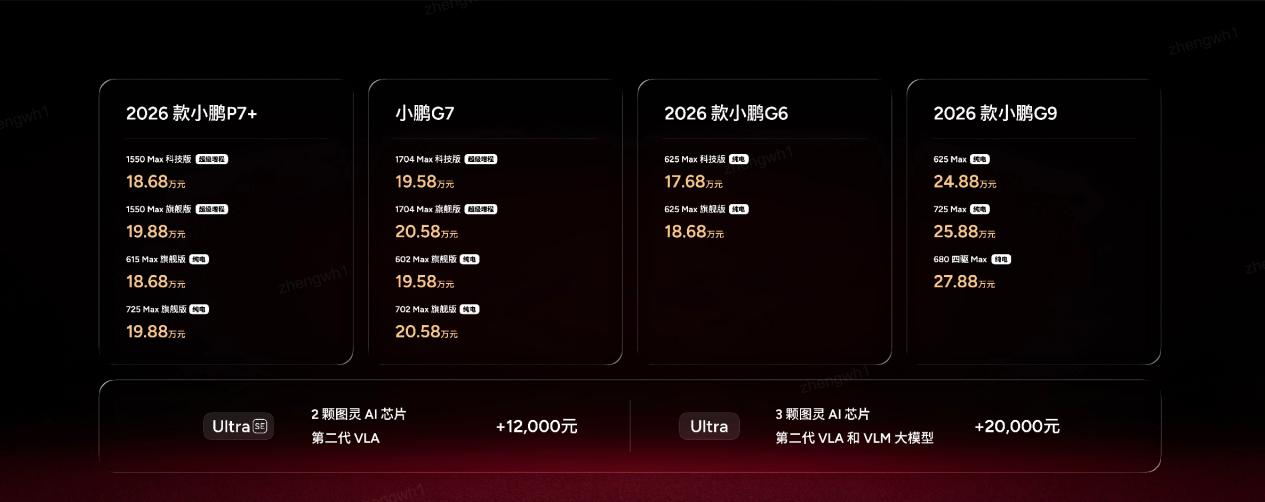
Core Viewpoint - Xiaopeng Motors has launched its 2026 models, including the P7+, G7, G6, and G9, showcasing advancements in AI technology and global expansion efforts, with the P7+ being released in 36 countries simultaneously [1][10][28]. Group 1: Product Launch Details - The 2026 Xiaopeng P7+ starts at 186,800 yuan, while the G7 starts at 195,800 yuan, the G6 at 176,800 yuan, and the G9 ranges from 248,800 to 278,800 yuan [1]. - The P7+ features both super-extended range and pure electric options, with a pure electric range of 430 km and a comprehensive range of 1550 km [12]. - The G7 super-extended range model offers a combined range of 1704 km and a pure electric range of 430 km, with a 55.8 kWh battery and 60L fuel tank [19]. Group 2: AI and Technology Innovations - The second-generation VLA (Visual Language Architecture) will be implemented in the new models, enabling direct generation of action commands from visual signals, enhancing the AI's understanding of the real world [3][5]. - The Tianji AIOS 6.0 system represents a significant upgrade in smart cabin technology, transitioning from passive responses to proactive services, and will be standard in all new models [7][26]. - The P7+ and G7 models are equipped with advanced AI capabilities, including three self-developed Turing AI chips, providing a computing power of 2250 TOPS [18][23]. Group 3: Safety and Comfort Features - The P7+ meets dual five-star safety standards for both China and Europe, featuring a robust battery design that prevents fire after thermal runaway and a high-strength body structure [16]. - The P7+ offers a spacious interior with an 88% room utilization rate, including a rear trunk capacity of 725L, expandable to 2221L [14]. - The G7 includes numerous luxury comfort features, such as a zero-gravity seat for the front passenger and extensive storage options throughout the vehicle [21]. Group 4: Global Expansion and Market Strategy - Xiaopeng Motors reported a 126% year-on-year increase in global deliveries, totaling 429,445 units in 2025, with products available in 60 countries [8]. - The launch of the P7+ and G7 signifies a strategic shift from merely entering international markets to establishing a solid global presence [8][10].
小鹏汽车年会再发黄金工牌,有员工拿到24K纯金并称“老板要求高调展示”
Xin Lang Cai Jing· 2026-01-30 06:12
近日,有多位网友晒出在小鹏汽车年会领到黄金工牌,部分员工拿到了24K黄金工牌,并表示,"老板 要求高调展示"。 2025年,小鹏汽车全球累计交付 429445 台,同比增长126%。2025年三季度,小鹏汽车营收203.8 亿元 创新高,同比增长102%。 责任编辑:王翔 近日,有多位网友晒出在小鹏汽车年会领到黄金工牌,部分员工拿到了24K黄金工牌,并表示,"老板 要求高调展示"。 H 7 re 200 Distinguished Xpenger , 4 i 1 l 2 111 L / ... .. " r . W . V ? 目 0999 Z option g u NA 小型异 据悉,这已经是小鹏汽车连续两年为表现突出的员工颁发了黄金工牌作为奖励。 据悉,这已经是小鹏汽车连续两年为表现突出的员工颁发了黄金工牌作为奖励。 2025年,小鹏汽车全球累计交付 429445 台,同比增长126%。2025年三季度,小鹏汽车营收203.8 亿元 创新高,同比增长102%。 责任编辑:王翔 ...

8点1氪:国铁回应“抢票神器诱导加价”:12306是唯一官方售票渠道;iPhone 16成去年全球最畅销智能手机;UC浏览器开发商被罚没126万元
36氪· 2026-01-30 00:10
Group 1 - The core viewpoint of the article emphasizes that the China Railway Group has declared the 12306 platform as the only official ticket sales channel, stating that it has not partnered with any third-party platforms and will enhance its system to combat ticket scalping [2][3] - The China Railway Group's passenger department director, Zhu Wenzhong, highlighted the negative impact of third-party platforms on the stability of the 12306 system and announced plans to optimize the risk control system for effective identification [3] - The railway authority is focusing on four key areas for ticket sales organization: addressing the needs of students, workers, and the elderly; introducing a limited-time free refund policy for erroneous purchases; continuously improving ticket sales strategies; and ensuring the stable operation of the 12306 system [5] Group 2 - The article mentions that the 2026 Spring Festival travel period is expected to see a record 9.5 billion person-times of cross-regional movement, with self-driving travel being the main mode of transport, accounting for about 80% [6] - The article also notes that the total passenger volume for railways and civil aviation is projected to reach 540 million and 95 million respectively during the Spring Festival travel period, with both figures expected to exceed historical peaks [6]