
BABA(09988)

Search documents
阿里巴巴连涨两日,但成交额大幅萎缩
第一财经· 2026-01-22 07:07
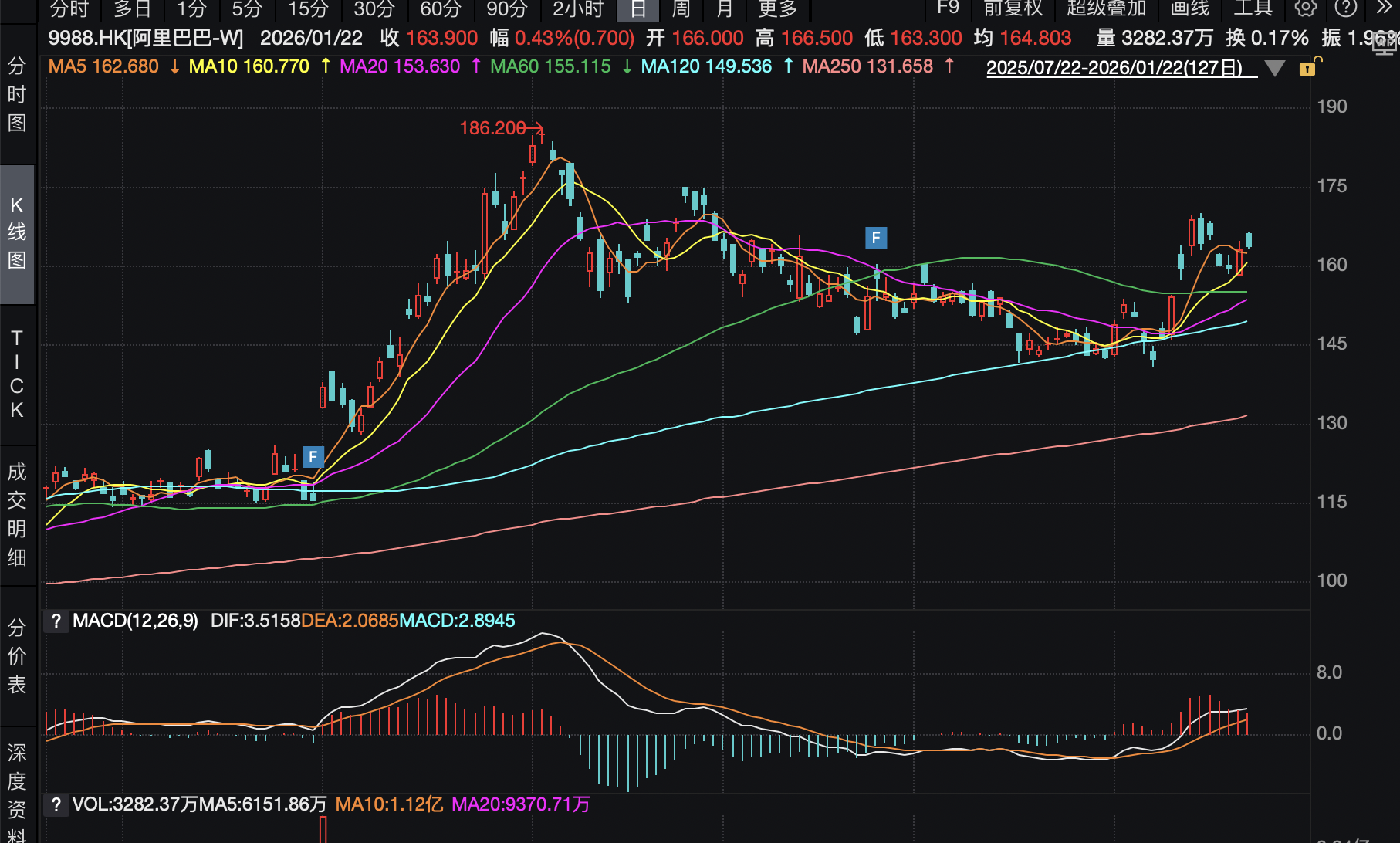
Core Viewpoint - Alibaba's stock has shown volatility with a recent rebound, but trading volume has significantly decreased, indicating a lack of follow-up investment in the short term while maintaining confidence in its fundamentals due to substantial investments in artificial intelligence [3][6]. Trading Volume Analysis - On January 22, Alibaba's stock rose by 0.43% to HKD 163.9, with a trading volume of only HKD 5.4 billion, potentially dropping below HKD 10 billion for the day, compared to over HKD 40 billion on January 14 [3][4]. - The trading volume decline is attributed to insufficient follow-up funds and a general decrease in trading activity in the Hong Kong stock market [3][6]. AI Developments - As of January 21, Alibaba's Tongyi Qianwen derivative models surpassed 200,000, making it the first open-source large model to achieve this milestone globally, with a cumulative download exceeding 1 billion times [5]. - The AI product launch on January 14 led to a significant stock price increase of 5.69% and a trading volume close to HKD 40.8 billion, but the subsequent week saw a 75% drop in trading volume [5][6]. Revenue Growth Projections - Dongwu Securities forecasts that Alibaba's revenue for Q3 of FY2026 (ending December 31, 2025) will reach CNY 292.9 billion, reflecting a year-on-year growth of 4.6%, primarily impacted by a slowdown in e-commerce growth [8]. - The adjusted EBITA for the same quarter is expected to be CNY 30.611 billion, with an EBITA margin of 10.5% [8]. E-commerce and Cloud Business Insights - The e-commerce segment is anticipated to face pressure due to weakened macro demand and high base effects, with customer management revenue growth expected to decline to 3% [9]. - Alibaba Cloud's revenue for the quarter is projected to be CNY 42.852 billion, a 35% year-on-year increase, with a stable EBITA margin around 9% [9]. Long-term Outlook - If Alibaba's AI assistant products achieve technological and user acceptance milestones, the company is positioned to capture a significant share of the new internet traffic entry points [9][10]. - The company’s ecosystem, which includes various applications without reliance on third parties, provides a natural advantage in maintaining stable traffic [10].



计算机行业周报:政策赋能算力升级,AI应用生态持续深化-20260122
BOHAI SECURITIES· 2026-01-22 06:47
Investment Rating - The report maintains a "Neutral" rating for the computer industry and an "Accumulate" rating for Hongsoft Technology (688088) [2][29] Core Insights - The Ministry of Industry and Information Technology (MIIT) is accelerating breakthroughs in key technologies such as training chips and heterogeneous computing power, which is expected to further speed up the development of the domestic computing power industry [13][28] - The AI application ecosystem is deepening, with significant developments such as the integration of Alibaba's Qianwen App into its ecosystem, enabling AI shopping functionalities [14][28] - The report highlights the growth potential of AI applications driven by rapid technological implementation and the release of market demand, suggesting a focus on leading companies with strong AI technology capabilities and scene adaptability [28][29] Industry News - MIIT has announced a special action plan for "Artificial Intelligence + Manufacturing," aiming to promote high-quality development in the AI industry [13] - The GLM Coding Plan by Zhiyuan has announced a temporary sales limit due to a surge in user numbers, indicating a tight supply of computing resources [14] - Alibaba's Qianwen App has integrated with various services, achieving over 100 million monthly active users within two months [14][15] Company Announcements - Hikvision reported a total revenue of 92.518 billion yuan for 2025, with a net profit of 14.188 billion yuan, reflecting a year-on-year growth of 18.46% [17] - Tonghuashun expects a net profit of 2.735 billion to 3.282 billion yuan for 2025, representing a growth of 50% to 80% [18] - Longxin Technology anticipates a net profit of 100 million to 150 million yuan for 2025, with a significant increase due to improvements in its energy digitalization business [20] Market Review - From January 15 to January 21, the CSI 300 index fell by 0.40%, while the Shenwan Computer Industry index dropped by 7.27%, with most sub-sectors experiencing declines [21] - The valuation of the Shenwan Computer Industry as of January 21, 2026, was 223.77 times earnings, with a premium of 1550.55% relative to the CSI 300 [22] Weekly Strategy - The report emphasizes the ongoing high demand for computing power and the expected acceleration in the domestic cloud computing capital expenditure, driven by easing supply constraints [28] - The anticipated launch of the DeepSeek V4 model during the Lunar New Year is expected to drive a new round of technological iteration in domestic large models [28] - The report suggests a focus on leading companies in the AI application sector that demonstrate strong capabilities in technology implementation and scene adaptability [29]




阿里巴巴连涨两天,单日成交一周内却缩量七成|市场观察
Di Yi Cai Jing· 2026-01-22 06:29
Core Viewpoint - Alibaba's trading volume has significantly decreased from approximately 408 billion HKD to around 100 billion HKD, indicating a shift in market dynamics and investor sentiment [2][3]. Trading Volume Analysis - On January 22, Alibaba's stock rose by 0.43% to close at 163.9 HKD, but the trading volume was only 54 billion HKD, with expectations that it might fall below 100 billion HKD [2]. - The trading volume peaked at over 400 billion HKD on January 14, driven by positive news regarding artificial intelligence products [2][3]. - A week later, on January 21, the trading volume dropped to approximately 109 billion HKD, reflecting a 75% decrease in just one week [3]. Market Sentiment and Investor Behavior - Analysts suggest that the recent decline in trading volume is due to a lack of new stimulating news and a cautious approach from investors, who are holding onto their positions despite short-term price fluctuations [4]. - The overall market environment has also contributed to this cautious sentiment, with the Hang Seng Index falling below 27,000 points [4]. Revenue Growth Projections - East China Securities analysts predict that Alibaba's revenue for the third quarter of fiscal year 2026 will reach 292.9 billion CNY, representing a 4.6% year-over-year growth, primarily impacted by a slowdown in e-commerce growth [5]. - For the third quarter of fiscal year 2025, Alibaba's revenue is expected to be 280.15 billion CNY, with an 8% year-over-year increase [5]. Cloud Services Performance - Alibaba Cloud is projected to generate 42.852 billion CNY in revenue for the current quarter, marking a 35% year-over-year increase, with a stable EBITA profit margin around 9% [6]. - The company is enhancing its AI cloud services, which are expected to maintain growth due to increasing demand for AI capabilities [6]. AI and Market Position - The launch of the AI assistant product is seen as a significant milestone, potentially positioning Alibaba to capture a larger share of the internet traffic in the future [7]. - Alibaba's open-source model, which has surpassed 200,000 derivatives and 1 billion downloads, places it at the forefront of the AI model landscape [3][7].
阿里巴巴连涨两天,单日成交一周内却缩量七成
Di Yi Cai Jing· 2026-01-22 06:24
Core Viewpoint - Alibaba's trading volume has significantly decreased from approximately 408 billion HKD to around 100 billion HKD, indicating a lack of follow-up capital and a broader market contraction despite recent rebounds in stock price [2][8]. Trading Volume Analysis - On January 22, Alibaba's stock rose by 0.43% to 163.9 HKD, but the trading volume was only 54 billion HKD, potentially falling below 100 billion HKD for the day. This contrasts sharply with January 14, when trading volume exceeded 400 billion HKD due to positive news regarding AI products [2][8]. - The trading volume dropped approximately 75% within a week, from nearly 408 billion HKD on January 14 to about 109 billion HKD on January 21, reflecting a significant decline in market activity [3][9]. - Analysts suggest that the recent decline in trading volume is linked to a lack of new stimulating news and a cautious approach from buyers, as the market enters a correction phase [4][10]. Revenue Growth Projections - Dongwu Securities forecasts that Alibaba's revenue for the third quarter of fiscal year 2026 will reach 292.9 billion CNY, representing a 4.6% year-over-year growth, primarily impacted by a slowdown in e-commerce growth [5][11]. - For the third quarter of fiscal year 2025, Alibaba's revenue is expected to be 280.15 billion CNY, with an 8% year-over-year increase, while adjusted EBITDA is projected at 62.05 billion CNY [5][11]. AI and Cloud Business Insights - Alibaba Cloud's revenue is anticipated to reach 42.852 billion CNY this quarter, marking a 35% year-over-year increase, with a stable EBITA margin of around 9% [6][12]. - The company is focusing on enhancing its AI capabilities, which could lead to sustained revenue and profit growth as AI adoption increases [6][12]. - The launch of the AI assistant product is seen as a pivotal moment for Alibaba, potentially allowing it to capture a significant share of the new internet traffic [7][13]. Market Position and Future Outlook - Alibaba's AI models have achieved significant milestones, including over 200,000 derivative models and 1 billion downloads, positioning the company as a leader in the open-source AI model space [3][9]. - The market's focus is shifting from traditional e-commerce to AI and cloud services, which are expected to contribute increasingly to Alibaba's valuation in the medium to long term [7][13].
张坤等知名基金经理罕见发声!
天天基金网· 2026-01-22 05:20
Group 1 - The core viewpoint of the article highlights the strategic adjustments made by prominent fund managers at E Fund in their investment portfolios for Q4 2025, focusing on sectors like AI, healthcare, consumer goods, and technology [2][4][6][10] Group 2 - Zhang Kun adjusted the structure of investments in the healthcare, consumer, and technology sectors while maintaining a stable position in top holdings, which include Tencent Holdings, Kweichow Moutai, and Alibaba-W [4][5] - Zhang Kun expressed confidence in the improvement of living standards and social security in China over the next decade, suggesting a narrowing gap with developed countries [4] - The AI wave is seen as a significant driver for innovation, with strong domestic demand expected to attract global resources and talent [4][5] Group 3 - Chen Hao focused heavily on AI-related sectors, increasing allocations in power equipment, new energy, non-bank financials, and chemicals, which yielded positive returns [7][8] - Chen Hao anticipates a transition of the AI industry from an acceleration phase in 2025 to a stable growth phase in 2026, emphasizing the importance of structural opportunities and the integration of AI with local applications [7][8] Group 4 - Xiao Nan reduced allocations in high-end and sub-high-end liquor sectors while increasing investments in the livestock industry, anticipating inflation-driven cost increases over the next two years [10] - The top holdings in Xiao Nan's consumer sector fund remained unchanged, including Kweichow Moutai and Midea Group [10]






阿里股价较去年同日翻倍,今年涨幅达15%
Di Yi Cai Jing· 2026-01-22 05:00
摩根大通在近期发布的一份研报中表示,对阿里巴巴-W(09988)未来6至12个月的交易前景持乐观看法,预期集团股价将克服短期获利压力,并在"云业务+生 成式AI"变现拐点更明朗后获重新评级。摩根大通预计,阿里云收入增长将在未来几季持续加速,因为生成式AI工作负载将从试点阶段扩展到更广泛的部 署,证明阿里有能力在中国捕捉并实现AI驱动需求。 不过,摩根大通同时表示,由于阿里因外卖、即时零售及生成式AI原生应用用户获取的投资增加,利润率短期内可能转弱,且阿里国内核心电商商品交易 总额(GMV)的增长挑战仍存等,将阿里美股目标价由230美元下调至215美元,港股目标价由225港元下调至210港元。 wind数据显示,2026年以来,阿里巴巴港股涨幅达14.78%,美股涨幅已超15%。 AI驱动了过去一年阿里巴巴等互联网大厂股价重回上涨通道。1月21日,开源社区 Hugging Face 最新数据显示,阿里千问衍生模型数突破 20 万个,成为全 球首个达成此目标的开源大模型,同时,千问系列模型下载量突破 10 亿次,平均每天被下载 110 万次,已完全超越 Llama。 此前,阿里推出的C端AI应用千问APP宣布全面 ...
AI进入生态对决,大厂们的明牌与暗战
3 6 Ke· 2026-01-22 04:59
Core Insights - The article discusses the competitive landscape among major tech companies in the AI sector, particularly focusing on Alibaba, ByteDance, and Tencent as they prepare for the upcoming Spring Festival and the AI application race [1][3][12] Group 1: AI Competitive Landscape - Alibaba has launched the Qianwen App, achieving over 100 million daily active users within two months, and has integrated it with its ecosystem, enhancing its AI capabilities [2][3] - ByteDance's Doubao has also surpassed 100 million daily active users and is expanding into various smart devices, indicating a strong push in AI hardware and software integration [4][8] - Tencent is taking a more cautious approach, focusing on internal restructuring and gradual development of its AI capabilities, with recent organizational changes and the introduction of new AI models [6][10] Group 2: Strategic Approaches - Alibaba's strategy involves rapid deployment and integration of AI across its business lines, aiming to enhance user experience and operational efficiency [7][12] - ByteDance leverages its existing user base and ecosystem to minimize costs and maximize the impact of its AI applications, positioning itself as a major player in the AI hardware market [8][9] - Tencent's strategy appears to be more conservative, focusing on building a robust AI infrastructure and integrating AI into its existing services, particularly within the WeChat ecosystem [11][12] Group 3: Market Dynamics and Future Outlook - The competition for AI market share is intensifying, with all players needing to ensure user engagement and retention rather than just focusing on user acquisition [12] - The article suggests that the upcoming Spring Festival may serve as a pivotal moment for these companies to showcase their AI advancements and marketing strategies [2][5]

组合中企业“护城河还在,城在不在”?张坤在2025年四季报中给出了明确回答
Xin Lang Cai Jing· 2026-01-22 03:40
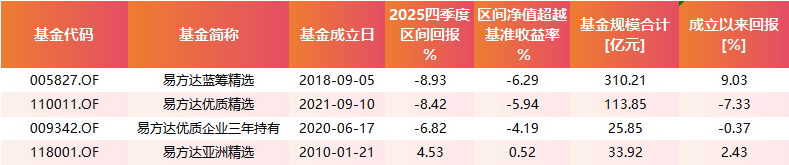
Core Viewpoint - The report highlights the investment strategies of top fund managers, particularly focusing on Zhang Kun from E Fund, who has made adjustments in his portfolio amidst market fluctuations, maintaining a long-term optimistic outlook on China's economic transformation and the growth of domestic demand [1][10]. Fund Performance - As of the end of Q4 2025, Zhang Kun managed funds totaling 48.383 billion yuan, with three A-share focused products underperforming against benchmarks, while the E Fund Asia Select, which invests in overseas Chinese stocks, achieved a positive return of 4.53% [1][2][10]. - The performance of the funds is as follows: - E Fund Blue Chip Select: -8.93% return, 31.021 billion yuan in size - E Fund Quality Select: -8.42% return, 11.385 billion yuan in size - E Fund Quality Enterprise Three-Year Holding: -6.82% return, 2.585 billion yuan in size - E Fund Asia Select: 4.53% return, 3.392 billion yuan in size [2][12]. Portfolio Adjustments - In Q4 2025, Zhang Kun reduced holdings in key stocks such as Kweichow Moutai, Wuliangye, Shanxi Fenjiu, and Luzhou Laojiao, while maintaining overall stock positions but adjusting sector allocations towards pharmaceuticals, consumer goods, and technology [3][13]. - The top holdings in the portfolio include Tencent Holdings (6.93%), Kweichow Moutai (6.87%), and Wuliangye (6.70%), with notable reductions in their respective weightings [3][13]. Economic Outlook - Zhang Kun expressed a long-term optimistic view on macroeconomic conditions, predicting significant improvements in living standards and social security in China over the next decade, narrowing the gap with developed countries [4][14]. - He emphasized the unique advantages of the Chinese market in the context of the global AI wave, suggesting that a strong domestic demand market is a crucial driver for technological innovation [4][14]. Investment Philosophy - The report indicates that despite current market pessimism regarding core assets, Zhang Kun believes that the intrinsic value of quality companies remains intact, presenting attractive investment opportunities for long-term investors [5][15]. - The central economic work conference highlighted the importance of boosting consumption and expanding domestic demand as key tasks for 2026, reinforcing the focus on consumer-driven growth [6][16]. GDP Growth Projections - According to the "14th Five-Year Plan," China aims to achieve a per capita GDP of $23,400 by 2035, requiring a compound annual growth rate of 5.27% from the current level of $13,300 [7][17]. - The report notes that the decline in housing prices over the past five years has negatively impacted consumer wealth and spending, but this trend may be reversing, potentially improving consumer sentiment and demand [8][18].




张坤2025四季报发声:强大内需不仅是“消费引擎”,更是“科技创新的燃料”
Xin Lang Cai Jing· 2026-01-22 03:34
Core Viewpoint - The report highlights the investment strategies of top fund managers, particularly focusing on Zhang Kun from E Fund, who has made adjustments in his portfolio amidst market fluctuations, maintaining a long-term optimistic outlook on China's economic transformation and the growth of the domestic market [1][10]. Fund Performance - As of the end of Q4 2025, Zhang Kun managed a total fund size of 48.383 billion yuan, which reflects adjustments from the previous quarter [1]. - Three of the funds primarily investing in A-shares reported negative quarterly returns, failing to outperform their benchmarks, while the E Fund Asia Select, which focuses on overseas Chinese stocks, achieved a positive return of 4.53%, significantly exceeding its benchmark [2][10]. Portfolio Adjustments - In Q4 2025, there was a reduction in holdings of key stocks such as Kweichow Moutai, Wuliangye, Shanxi Fenjiu, and Luzhou Laojiao, while maintaining a stable stock position overall [3][13]. - The adjustments focused on reallocating investments in sectors such as pharmaceuticals, consumer goods, and technology [3][13]. Economic Outlook - Zhang Kun expressed a long-term optimistic view on the macroeconomic environment, predicting significant improvements in living standards and social security in China over the next decade, narrowing the gap with developed countries [4][14]. - He emphasized the unique advantages of the Chinese market in the context of the global AI wave, noting that a strong domestic demand market is a crucial driver for technological innovation [4][14]. Investment Philosophy - The report addresses concerns regarding the long-term value of core assets, with Zhang Kun asserting that the underlying value remains intact and that current market pessimism has created attractive valuations for quality companies [5][15]. - He believes that the current low valuation of quality assets presents a rare opportunity for long-term investors [5][15]. Policy Context - The Central Economic Work Conference in December emphasized the importance of boosting consumption and expanding domestic demand as a key task for 2026, highlighting the government's commitment to enhancing consumer spending [6][16]. - The report notes that recent indicators show domestic consumption has been weak, particularly for companies focused on domestic demand compared to those reliant on exports [6][16]. GDP Growth Projections - According to the "14th Five-Year Plan," China aims to achieve a per capita GDP level comparable to that of middle-income developed countries by 2035, requiring a compound annual growth rate of 5.27% [7][17]. - The report suggests that the decline in housing prices over the past five years has negatively impacted consumer wealth and spending, but this trend may be reversing due to potential policy support and lower interest rates [7][17].
张坤2025四季报出炉:三只产品跑输基准 亚洲精选飘红 坚定看好中国核心资产长期价值
Xin Lang Cai Jing· 2026-01-22 03:12
Core Viewpoint - The report highlights the investment strategies of Zhang Kun, a prominent fund manager at E Fund, focusing on the performance of his funds and his optimistic outlook on China's economic growth and consumer market potential over the next decade [1][2][3]. Fund Performance Summary - As of the end of Q4 2025, Zhang Kun managed a total fund size of 48.383 billion yuan, with three A-share focused funds underperforming their benchmarks, while the E Fund Asia Select fund achieved a positive return of 4.53%, significantly exceeding its benchmark [1][2][3]. - The E Fund Blue Chip Select (005827.OF) reported a net value growth rate of -8.93%, underperforming its benchmark by over 6 percentage points, with a total size of 31.021 billion yuan and a cumulative return of 9.03% since inception [2][3][4]. - The E Fund Quality Select (110011.OF) and E Fund Quality Enterprise Three-Year Holding (009342.OF) also reported negative returns of -8.42% and -6.82%, respectively, since their inception returns are -7.33% and -0.37% [3][4]. Market Outlook and Investment Strategy - Zhang Kun maintains a long-term optimistic view on the macroeconomic environment, asserting that the living standards and social security levels in China will significantly improve over the next decade, narrowing the gap with developed countries [2][3][4]. - He emphasizes that the current pessimistic market pricing has made high-quality companies' valuations very attractive, presenting good opportunities for long-term investors [3][4][5]. - The report indicates a structural adjustment in fund allocations, focusing on sectors such as healthcare, consumer goods, and technology, while maintaining stable stock positions [10][11][12]. Consumer Market Insights - Zhang Kun argues that the current weakness in domestic consumption is a temporary phenomenon, with significant growth potential in China's domestic market, which is expected to be a key driver for future investments [11][12][13]. - He cites the goal of achieving a per capita GDP comparable to developed countries by 2035, suggesting that China has ample room for growth in consumer spending and quality of life improvements [12][13][14]. - The report also highlights the potential for recovery in consumer sentiment as housing price declines stabilize, which could enhance consumer willingness to spend [12][13][14]. Technology and Innovation - The report discusses the unique advantages of the Chinese market in the context of the global AI wave, noting that a strong domestic demand market is crucial for technological innovation [13][14][15]. - Zhang Kun expresses optimism about domestic AI application companies, anticipating that a stronger consumer environment will facilitate better interactions between subscription revenues and model capabilities, aiding in closing the gap with global leaders [13][14][15]. Conclusion - The report reflects Zhang Kun's commitment to long-term investment strategies amid market volatility, with a focus on optimizing fund structures and capitalizing on undervalued assets, positioning for potential excess returns in the next economic cycle [15][16][17].