POP MART(09992)

Search documents
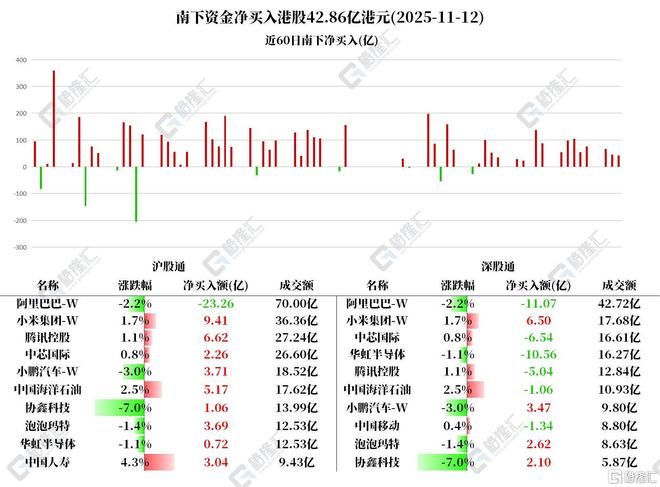
11月12日南向资金净买入42.86亿港元
Zheng Quan Shi Bao Wang· 2025-11-13 00:39
Core Viewpoint - The Hang Seng Index rose by 0.85% to close at 26,922.73 points on November 12, with a net inflow of HKD 4.286 billion through the southbound trading channel [1] Group 1: Market Activity - The total trading volume for the southbound trading on November 12 was HKD 105.405 billion, with a net buy of HKD 4.286 billion [1] - The Shanghai Stock Exchange's southbound trading accounted for HKD 66.456 billion in trading volume and a net buy of HKD 3.397 billion, while the Shenzhen Stock Exchange had HKD 38.949 billion in trading volume and a net buy of HKD 0.889 billion [1] Group 2: Active Stocks - Alibaba-W was the most actively traded stock on the Shanghai Stock Exchange with a trading volume of HKD 70.00 billion, but it experienced a net sell of HKD 23.26 billion, closing down by 2.24% [1][2] - Xiaomi Group-W followed with a trading volume of HKD 36.36 billion and a net buy of HKD 9.41 billion, closing up by 1.68% [1][2] - On the Shenzhen Stock Exchange, Alibaba-W also led with a trading volume of HKD 42.72 billion and a net sell of HKD 11.07 billion, closing down by 2.24% [2] - Other notable stocks included Tencent Holdings with a trading volume of HKD 27.24 billion and a net buy of HKD 6.18 billion, and SMIC with a trading volume of HKD 16.61 billion [2]





南向资金今日成交活跃股名单(11月12日)
Zheng Quan Shi Bao Wang· 2025-11-13 00:32
Group 1 - The Hang Seng Index rose by 0.85% on November 12, with a total southbound trading volume of HKD 105.4 billion, including HKD 54.8 billion in buy transactions and HKD 50.6 billion in sell transactions, resulting in a net inflow of HKD 4.3 billion [1] - The southbound trading through Stock Connect (Shenzhen) totaled HKD 38.9 billion, with buy transactions of HKD 19.9 billion and sell transactions of HKD 19.0 billion, leading to a net inflow of HKD 0.9 billion; while Stock Connect (Shanghai) had a total of HKD 66.5 billion, with buy transactions of HKD 34.9 billion and sell transactions of HKD 31.5 billion, resulting in a net inflow of HKD 3.4 billion [1] - Alibaba-W had the highest trading volume among southbound stocks, totaling HKD 112.72 billion, followed by Xiaomi Group-W and SMIC with HKD 54.04 billion and HKD 43.22 billion respectively [1] Group 2 - Xiaomi Group-W recorded the highest net inflow among stocks, with a net buy of HKD 15.92 billion, closing up by 1.68%; followed by XPeng Motors with a net buy of HKD 7.18 billion, and Pop Mart with a net buy of HKD 6.31 billion [1] - Conversely, Alibaba-W experienced the largest net outflow of HKD 34.34 billion, closing down by 2.24%; Huahong Semiconductor and SMIC also faced significant net outflows of HKD 9.85 billion and HKD 4.28 billion respectively [1] - Over a continuous period, Xiaomi Group-W saw a net inflow for 11 consecutive days, totaling HKD 81.36 billion, while China National Offshore Oil Corporation and Pop Mart had net inflows of HKD 28.21 billion and HKD 14.55 billion respectively [2]



智通港股沽空统计|11月13日
智通财经网· 2025-11-13 00:21
Core Insights - The article highlights the top short-selling ratios and amounts for various companies, indicating significant market sentiment against these stocks [1][2]. Short-Selling Ratios - The top three companies with the highest short-selling ratios are Hang Seng Bank-R (80011) and BYD Company-R (81211), both at 100.00%, followed by Kuaishou-WR (81024) at 90.79% [1][2]. - The short-selling ratio for Shengjing Bank (02066) is 83.46%, while Meituan-WR (83690) has a ratio of 77.62% [2]. Short-Selling Amounts - The companies with the highest short-selling amounts are Xiaomi Group-W (01810) at 2.038 billion, Tencent Holdings (00700) at 1.705 billion, and Pop Mart (09992) at 1.689 billion [1][2]. - Other notable companies include Alibaba-SW (09988) with 1.451 billion and Ping An Insurance (02318) with 1.368 billion [2]. Short-Selling Deviation Values - The top three companies with the highest deviation values are Shengjing Bank (02066) at 71.47%, Hang Seng Bank-R (80011) at 60.71%, and BYD Company-R (81211) at 49.79% [1][2]. - Kuaishou-WR (81024) has a deviation value of 40.46%, indicating a significant difference from its historical short-selling average [2].
“双十一”购物车,透出国潮消费新趋势
Xin Hua Wang· 2025-11-12 23:26
Core Insights - The "Double Eleven" shopping festival serves as a significant window to observe new consumer trends, particularly highlighting the rise of domestic brands and cultural products in the e-commerce space [1][2]. Group 1: Domestic Brand Performance - On Tmall, the beauty brand Proya ranked first in sales, with domestic brands occupying 9 out of the top 10 spots in clothing sales, showcasing strong performance from brands like Bosideng and Xuezhongfei [2]. - On JD.com, the original Chinese brand Sanjihei's sales increased by over 10 times, while the Hanfu brand Chixia saw a 300% year-on-year growth in sales during the festival [2]. Group 2: Cultural and Traditional Products - The sales of cast iron pots that incorporate intangible cultural heritage techniques grew by 127.9% on Douyin, indicating a strong consumer interest in traditional craftsmanship [2]. - Tmall reported that the traditional gold shop's sales reached 2.9 billion yuan, with products like diamond butterfly chains and Vajra pestle rings becoming bestsellers [2]. Group 3: Consumer Preferences and Trends - Consumers are increasingly valuing craftsmanship, materials, and cultural significance, with domestic products becoming a preferred choice for quality [4]. - The rise of cultural confidence and identity among consumers is driving the popularity of domestic products, which blend traditional culture with modern design [5][8]. Group 4: Industry Innovation and Cross-Industry Integration - The growth of domestic consumption is supported by industry innovation and cross-industry collaboration, with cultural industries increasingly integrating with technology and ecology [9]. - The digital strategy for cultural industries is guiding traditional cultural innovation, leading to a more mature consumer understanding of domestic products [8]. Group 5: Global Expansion and Cultural Exchange - The continuous rise of domestic consumption is also linked to the development of new cultural formats, with significant exports of holiday goods and toys exceeding 50 billion yuan to over 200 countries [9]. - Domestic cultural products are not only being exported but also serving as vehicles for cultural exchange and identity construction on a global scale [9]. Group 6: Challenges and Recommendations - Despite the growth, challenges such as product homogeneity and lack of innovation persist, necessitating a robust industry and policy ecosystem to support sustainable development [10]. - Experts suggest enhancing intellectual property protection and establishing industry standards to promote healthy and orderly growth in the domestic market [10].


胖东来与泡泡玛特案例,河南为什么出营销奇才?
Sou Hu Cai Jing· 2025-11-12 18:36
Core Insights - The article discusses the rise of marketing talents from Henan, highlighting how local entrepreneurs have transformed retail and new consumption from regional to national and global levels [1] Group 1: Key Entrepreneurs and Their Achievements - Yu Donglai opened the first store in 1995, achieving sales of 16.964 billion yuan by 2024 with a focus on customer service and return policies [2] - The Zhang brothers of Mixue Ice City rebranded in 1998 and are set to list on the Hong Kong stock exchange in 2025 with a market value exceeding 200 billion HKD, operating nearly 30,000 stores [2] - Wang Ning founded Pop Mart in 2010, reaching revenue of 13.04 billion yuan in 2024, with overseas business growing by 375.2% [2] Group 2: Business Strategies and Market Positioning - Entrepreneurs from Henan leveraged local advantages such as high agricultural output and established supply chains to build their businesses [2] - The common strategy among these entrepreneurs includes a long-term commitment to their business models, often taking 20 years to reach a breakthrough [2][4] - Each entrepreneur faced significant challenges, such as store fires for Yu Donglai and price wars for Mixue Ice City, but they adapted their supply chains and service standards to overcome these obstacles [4][5] Group 3: Capital and Growth Dynamics - Some brands opted for slow growth, while others, like Mixue Ice City, saw their valuations soar post-IPO [5] - Pop Mart has successfully commercialized its IP, creating a comprehensive brand ecosystem that includes blind boxes and international stores [5] - By 2024 and 2025, Henan's enterprises have established a strong presence in the supermarket, new consumption, and trendy toy sectors, forming a notable industry matrix [5]

资金动向 | 北水净买入港股近43亿港元,减持阿里巴巴、华虹半导体
Xin Lang Cai Jing· 2025-11-12 11:57
Group 1: Market Activity - Southbound funds net bought Hong Kong stocks worth 4.286 billion HKD on November 12, with notable purchases including Xiaomi Group (1.592 billion HKD), Xpeng Motors (717 million HKD), and China National Offshore Oil Corporation (411 million HKD) [1] - Continuous net buying trends were observed for Xiaomi (81.3635 billion HKD over 11 days), CNOOC (28.2105 billion HKD over 4 days), and Pop Mart (14.5466 billion HKD over 3 days) [3] Group 2: Company Insights - Xiaomi reported a cumulative payment amount exceeding 29 billion HKD as of November 11, with Goldman Sachs maintaining a "Buy" rating and a 12-month target price of 56.5 HKD, citing its strong balance sheet and competitive advantages in the electric vehicle sector [4] - Morgan Stanley raised the target price for Xpeng Motors to 131 HKD, reflecting growth potential from new AI products and expected market sentiment improvement starting mid-2026 [4] - CNOOC's production cost is projected to be 29.56 USD per barrel in 2024, the lowest among major Chinese oil companies, indicating strong international competitiveness [4] Group 3: Company Developments - Alibaba is set to launch its first self-developed flagship AI glasses, Quark AI Glasses, on November 27, with pre-sales performing strongly during the "Double 11" shopping festival [5] - GCL-Poly Energy responded to market rumors regarding its storage platform, asserting that such claims are unfounded, while the China Photovoltaic Industry Association emphasized the importance of policy support in the solar industry [5]

南向资金追踪|净流入约43亿港元 加仓小米和多家中字头并减持阿里
Xin Lang Cai Jing· 2025-11-12 10:33
Core Insights - Southbound funds recorded a transaction volume of approximately HKD 105.4 billion, an increase of about HKD 15.6 billion compared to the previous day, accounting for 44.59% of the total turnover of the Hang Seng Index today [1] - The Hang Seng Index continued its short-term upward trend, with net inflows from southbound funds amounting to approximately HKD 4.286 billion, marking 16 consecutive trading days of net inflows totaling HKD 101.525 billion [1] Individual Stock Performance - Xiaomi Group-W saw a significant net inflow of HKD 1.592 billion, with a short-term increase of 1.68% and an additional 7.608 million shares acquired over the past five days [2][3] - Pop Mart International fell by 1.43%, with a net outflow of HKD 631 million and a reduction of 202,000 shares in the last five days [2] - XPeng Inc. experienced a decline of 3.04%, but short-term funds accelerated inflow, acquiring 1.944 million shares in the past five days [2] - China National Offshore Oil Corporation rose by 2.50%, with a net inflow of HKD 411 million and an increase of 13.3 million shares acquired over the past five days [2] - GCL-Poly Energy Holdings saw a drop of 7.04%, with a net outflow of HKD 316 million and a reduction of 11.6 million shares in the last five days [2] - China Life Insurance gained 4.30%, with a net inflow of HKD 304 million and an increase of 1.692 million shares acquired over the past five days [2] - Alibaba Group Holding experienced a significant net outflow of HKD 3.434 billion, with a decline of 2.24% and a reduction of 402,000 shares in the last five days [2][3] - Hua Hong Semiconductor saw a decrease of 1.06%, with a net outflow of HKD 985 million but an increase of 1.536 million shares acquired over the past five days [2][3] - Semiconductor Manufacturing International Corporation rose by 0.83%, with a net outflow of HKD 428 million and a reduction of 400,000 shares in the last five days [2][3]

泡泡玛特股价承压下挫,伯恩斯坦预警Q4业绩恐不及预期
Hua Er Jie Jian Wen· 2025-11-12 06:21
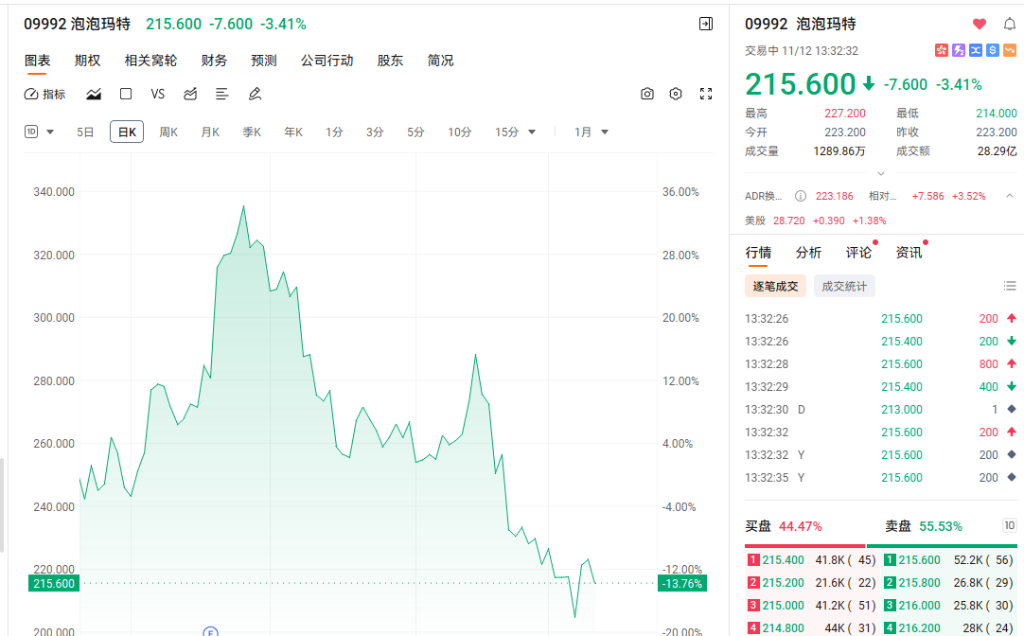
Core Viewpoint - Bubble Mart's stock price is under pressure due to a warning from Bernstein regarding potential underperformance in Q4 earnings, driven by a slowdown in demand observed since June [1][3]. Group 1: Demand and Performance Indicators - Bernstein's report indicates a general slowdown in demand for Bubble Mart's products in both domestic and international markets, with data from October showing a significant decline from peak levels in June [1]. - The report highlights that various independent data sources, including transaction data, social media trends, and search interest, collectively suggest a deceleration in fundamental demand, which cannot be dismissed as mere noise or channel shifts [1]. - The decline in indicators during October is noted to be substantial and consistent, leading to expectations that Q4 performance may disappoint market forecasts [1]. Group 2: Stock Performance and Market Sentiment - Following Bernstein's warning, Bubble Mart's stock experienced a drop of 3.7% on November 12, making it one of the worst performers in the market despite a remarkable 250% year-on-year increase in Q3 sales [1][3]. - The stock has seen a nearly 40% decline from its record high in late August, resulting in a market capitalization loss of approximately $20 billion [3]. - Despite the recent downturn, the stock has still achieved a cumulative increase of about 140% year-to-date, indicating a significant divergence in market sentiment among the 40+ brokerages covering Bubble Mart, with Bernstein being the only one to assign an "underperform" rating [3].
港股新消费概念股持续活跃,港股消费ETF(513230)现涨近1.5%
Mei Ri Jing Ji Xin Wen· 2025-11-12 03:09
Group 1 - The Hong Kong stock market's new consumption concept stocks are actively performing, with the Hong Kong Consumption ETF (513230) rising nearly 1.5% during trading [1] - Among the holdings, Mixue Group leads with a gain of over 5%, while other companies like Smoore International, Shenzhou International, Midea Group, Giant Bio, and Nongfu Spring also see increases of over 3% [1] - The Ministry of Finance's report highlights a more proactive fiscal policy since 2025, focusing on stabilizing employment, businesses, markets, and expectations, with plans for six key areas of work to boost consumption [1] Group 2 - The growth of emerging consumer goods reflects the new consumption concepts of the younger generation in the current social environment, which is crucial for identifying growth opportunities in new consumption companies [2] - In the gold jewelry sector, it is recommended to focus on head brands in the ancient gold segment that are favored by younger consumers, such as Laopu Gold [2] - For trendy toys, companies with strong IP creation and operational experience, like Pop Mart, are suggested for attention [2] - In the ready-to-drink tea segment, it is advised to focus on leading tea brands with strong brand power and wide business coverage, such as Mixue Group and Guming [2] - The Hong Kong Consumption ETF (513230) tracks the CSI Hong Kong Stock Connect Consumption Theme Index, encompassing a wide range of sectors including leading new consumption companies and major internet e-commerce players like Tencent, Kuaishou, Alibaba, and Xiaomi [2]
智通港股通持股解析|11月12日
智通财经网· 2025-11-12 00:33
Core Insights - The top three companies by Hong Kong Stock Connect holding ratios are China Telecom (71.95%), Gree Power (69.48%), and COSCO Shipping Energy (69.03%) [1] - Xiaomi Group-W, XPeng Motors-W, and CNOOC have seen the largest increases in holding amounts over the last five trading days, with increases of +2.291 billion, +2.057 billion, and +1.853 billion respectively [1] - The companies with the largest decreases in holding amounts over the last five trading days include Pop Mart, Sunny Optical Technology, and the Tracker Fund of Hong Kong, with decreases of -578 million, -495 million, and -425 million respectively [2] Group 1: Top Holding Ratios - China Telecom (00728) has a holding of 9.986 billion shares, representing 71.95% [1] - Gree Power (01330) has a holding of 281 million shares, representing 69.48% [1] - COSCO Shipping Energy (01138) has a holding of 895 million shares, representing 69.03% [1] Group 2: Recent Increases in Holdings - Xiaomi Group-W (01810) saw an increase of +2.291 billion in holding amount, with a change of +53.3045 million shares [1] - XPeng Motors-W (09868) experienced an increase of +2.057 billion in holding amount, with a change of +18.9581 million shares [1] - CNOOC (00883) had an increase of +1.853 billion in holding amount, with a change of +82.8003 million shares [1] Group 3: Recent Decreases in Holdings - Pop Mart (09992) had a decrease of -578 million in holding amount, with a change of -2.5896 million shares [2] - Sunny Optical Technology (02382) saw a decrease of -495 million in holding amount, with a change of -7.1164 million shares [2] - Tracker Fund of Hong Kong (02800) experienced a decrease of -425 million in holding amount, with a change of -15.8355 million shares [2]