Baosteel(600019)

Search documents
有色金属行业 2025 年三季度业绩前瞻:金融属性与供需共振,有色板块业绩亮眼
Shenwan Hongyuan Securities· 2025-10-14 14:45
官 2025 年 10 月 14 日 有色金属行业 2025 年三季度业绩前瞻 相关研究 证券分析师 研究支持 郭中耀 A0230124070003 guozy@swsresearch.com 联系人 郭中耀 (8621)23297818× quozy@swsresearch.com 申万宏源研究微信服务号 2025 三季度业绩前瞻: 我们对重点公司 2025 三季度业绩进行预测,2025 年前三季度业绩同比增速在 50%以上的有紫金 O 矿业、洛阳铝业、山东黄金、赤峰黄金、中金黄金、山金国际、株冶集团、湖南黄金、金诚信、 金力永磁,同比增速在 20-50%区间的有华友钻业、宝钢股份、南钢股份、华菱钢铁、久立特材, 同比增速在 0-20%区间的有盛达资源、西部矿业、华峰铝业、云铝股份、天山铝业、中信特钢, 业绩增长主要受益于相关金属价格同比上涨、产销量同比增长;2025Q3 业绩环比增速在 50%以 上的有盛达资源、铜陵有色、金力永磁,在 20-50%区间的有山东黄金、赤峰黄金、湖南黄金,在 0-20%区间的有紫金矿业、山金国际、株冶集团、金诚信、西部矿业、华峰铝业、云铝股份、天 山铝业、新疆众和、华友钻业、 ...



今年以来上市公司回购总额超1000亿元 回购增持再贷款提供低成本资金
Sou Hu Cai Jing· 2025-10-14 10:49
Core Insights - A-share listed companies are experiencing a surge in stock buybacks, with 17 companies announcing buyback progress on October 14 alone [1] - From January 1 to October 14, 2023, 1,374 A-share companies have executed buybacks, totaling over 11.25 billion yuan in repurchased shares [1] - The trend of "cancellation buybacks" is gaining attention, driven by policy guidance and market logic [2] Group 1: Buyback Trends - 1374 A-share listed companies have repurchased over 11.25 billion shares, amounting to 112.596 billion yuan [1] - 13 companies have repurchased over 1 billion yuan, with Midea Group leading at 6.769 billion yuan [1] - The number of companies disclosing buyback plans and implementing them is increasing, indicating a growing trend [1] Group 2: Policy Support - The People's Bank of China has optimized stock buyback financing policies, reducing the self-funding ratio from 30% to 10% and extending loan terms from 1 year to 3 years [2] - A total of 750 companies or major shareholders have accessed buyback financing, amounting to approximately 151.854 billion yuan [3] - The merger of financing tools aims to enhance flexibility and efficiency in utilizing policy funds [3] Group 3: Market Impact - The stock buyback financing has provided low-cost capital to companies, boosting investor confidence and market attention [3] - The ongoing support for buybacks is expected to evolve from a temporary measure to a more permanent mechanism, stabilizing the market [3]




国泰海通:钢铁节后需求仍有望逐步恢复增长 龙头竞争优势与盈利能力更加凸显
Zhi Tong Cai Jing· 2025-10-14 03:21
Core Viewpoint - The steel industry is expected to gradually bottom out in demand, with supply-side market clearing beginning to appear, leading to a potential recovery in the industry's fundamentals. If supply policies are implemented, the contraction of supply may accelerate, facilitating quicker industry recovery [1]. Demand and Supply Analysis - Steel consumption for the week of October 6-10, 2025, was 7.5143 million tons, a decrease of 1.5339 million tons week-on-week. Construction steel consumption was 2.2262 million tons, down 1.0846 million tons, while plate steel consumption was 5.2881 million tons, down 0.4493 million tons. Steel production was 8.6331 million tons, a decrease of 0.0376 million tons, and total inventory rose to 16.0072 million tons, an increase of 1.2786 million tons [2]. - The operating rate of blast furnaces at 247 steel mills was 84.27%, down 0.02 percentage points week-on-week, while electric furnace operating rates were 60.26%, down 1.28 percentage points. Despite a marginal decline in demand due to the National Day holiday, the industry remains in a traditional peak season, with expectations for gradual recovery in steel demand and inventory reduction [2]. Profitability Trends - The average gross profit per ton for rebar was 167.1 CNY, an increase of 24.3 CNY week-on-week, while hot-rolled coil gross profit was 112.1 CNY, up 29.3 CNY. The profitability rate for 247 steel companies was 56.28%, a decrease of 0.43% [3]. - The expectation is for iron ore production to accelerate while demand remains limited, leading to a gradual easing of iron ore prices and improvement in cost constraints for the steel industry, with a potential recovery in profitability levels [3]. Future Outlook - The negative impact of the real estate sector on steel demand is expected to diminish, with stable growth anticipated in demand from infrastructure and manufacturing sectors. Steel exports maintained a year-on-year increase from January to August [4]. - Over 40% of steel companies are currently experiencing losses, but market clearing is beginning to occur. Recent policies aim to reduce production and promote a balance between supply and demand, supporting the expectation of supply contraction and gradual recovery in the steel industry's fundamentals [4]. Recommended Companies - Key recommendations include Baosteel (600019) for its technological and product structure leadership, Hualing Steel (000932) for its product structure upgrades, and Fangda Special Steel (600507) for its low-cost advantages. Other recommendations include CITIC Special Steel (000708) for its competitive advantages and high dividend yield, as well as upstream resource companies like Hebei Steel Resources (000923) and Dazhong Mining (001203) due to their long-term growth potential [5].



中美博弈或升温,关注避险需求与战略小金属
East Money Securities· 2025-10-13 12:30
Investment Rating - The report maintains an "Outperform" rating for the industry [2][9]. Core Insights - The report highlights the increasing geopolitical tensions between China and the U.S., which may elevate demand for safe-haven assets like gold and strategic metals such as rare earths and tungsten [5][9]. - The copper market is experiencing supply disruptions, with prices trending upward due to tight supply conditions [5]. - Aluminum demand is expected to continue, with potential opportunities for investment following market corrections [5]. - The strategic importance of rare earths and tungsten is emphasized due to recent export controls and geopolitical developments [5][9]. Summary by Sections Copper Sector - Supply disruptions are ongoing, with LME copper prices at $10,735 per ton, reflecting a week-on-week increase of 1.9% [5]. - The processing fee for imported copper concentrate is negative, indicating tight supply [5]. - Companies with rich copper reserves are recommended for investment [9]. Aluminum Sector - LME aluminum prices reached $2,800 per ton, up 3.6% week-on-week [5]. - The operating rate for aluminum processing enterprises has slightly decreased, but demand is expected to remain stable [5]. - Investment opportunities are suggested for companies in the aluminum sector following market corrections [9]. Gold Sector - Gold prices are rising, with SHFE gold at 901.6 RMB per gram, up 3.1% week-on-week [5]. - The report suggests that geopolitical tensions may enhance gold's strategic position as a safe-haven asset [5]. - Investment in gold-related companies is recommended due to their undervalued resource potential [9]. Rare Metals Sector - Rare earth prices remain stable, with praseodymium-neodymium oxide at 683,000 RMB per ton [5]. - Recent export controls on rare earths have heightened their strategic importance amid U.S.-China tensions [5][9]. - Investment opportunities are highlighted in companies involved in rare earth production [9]. Steel Sector - Steel prices are stable, with SHFE rebar at 3,103 RMB per ton, reflecting a week-on-week increase of 1.0% [6]. - The report notes frequent disruptions in iron ore supply negotiations, which may impact future prices [6]. - Companies with high self-sufficiency in iron ore are recommended for investment [9].


2025年1-4月中国钢材产量为4.8亿吨 累计增长6%
Chan Ye Xin Xi Wang· 2025-10-13 01:26
Core Viewpoint - The report highlights the growth in China's steel production, indicating a positive trend in the industry with a year-on-year increase in output. Group 1: Industry Overview - In April 2025, China's steel production reached 130 million tons, marking a year-on-year growth of 6.6% [1] - From January to April 2025, the cumulative steel production in China totaled 480 million tons, reflecting a cumulative growth of 6% [1] Group 2: Companies Mentioned - The report lists several key companies in the steel industry, including Baosteel Co., Ltd. (600019), Ansteel Co., Ltd. (000898), and others [1]



证券研究报告行业周报:纷争的世界-20251012
GOLDEN SUN SECURITIES· 2025-10-12 09:44
Investment Rating - The industry investment rating is maintained as "Buy" for several key companies [6]. Core Insights - The steel industry is experiencing a slight decline in daily molten iron production, with an average of 241.5 thousand tons, down by 0.3 thousand tons [12]. - Total steel inventory is showing seasonal accumulation post the National Day holiday, with a week-on-week increase of 8.7% [24]. - Apparent consumption of steel products has decreased seasonally, with a notable drop in rebar demand [37]. - Iron ore prices have risen, influenced by changes in shipping volumes from Australia and Brazil [46]. - Steel prices are stable with slight improvements in immediate profit margins, indicating a potential for continued industry recovery [70]. Summary by Sections Supply - Daily molten iron production has slightly decreased to 241.5 thousand tons, with a decline in rebar and hot-rolled coil production [12][17]. Inventory - Total steel inventory has increased by 8.7% week-on-week, with steel mill inventories rising more than social inventories [24][26]. Demand - Apparent consumption of the five major steel products has decreased by 17.0% week-on-week, with rebar consumption down by 36.5% [48][37]. Raw Materials - Iron ore prices have increased, with the Platts 62% iron ore price index at $107.4 per ton, up by 3.4% week-on-week [58]. Prices and Profits - The comprehensive steel price index remains stable at 122.7, with slight improvements in immediate profit margins for long-process steel products [70][71].


钢厂利润承压,海外贸易摩擦升级
Minsheng Securities· 2025-10-12 05:11
Investment Rating - The report maintains a "Buy" recommendation for several steel companies, including Hualing Steel, Baosteel, Nanjing Steel, and others in the special steel and pipe sectors [5]. Core Viewpoints - Steel mill profits are under pressure due to rising inventory levels and escalating overseas trade frictions, with production remaining high during the National Day holiday [5]. - The EU has proposed to cut tax-free steel import quotas by 47% to 18.3 million tons per year, increasing tariffs on excess imports from 25% to 50%, which may suppress steel exports from China and the US [5]. - Long-term capacity regulation is expected to be a key theme, with potential recovery in profitability for steel companies under precise control measures [5]. Price Trends - As of October 10, steel prices have increased, with rebar prices at 3,260 CNY/ton (up 50 CNY), hot-rolled prices at 3,400 CNY/ton (up 60 CNY), and cold-rolled prices at 3,810 CNY/ton (up 10 CNY) [3][12]. - The overall steel inventory has risen, with total social inventory increasing by 691,100 tons to 11,268,900 tons [4]. Production and Inventory - Total production of major steel products decreased to 8.63 million tons, a reduction of 37,600 tons week-on-week, with rebar production down to 2.034 million tons [4]. - The apparent consumption of rebar fell to 1.4601 million tons, a decrease of 950,600 tons week-on-week [4]. Profitability - Steel margins have declined, with long-process rebar, hot-rolled, and cold-rolled margins decreasing by 11 CNY/ton, 10 CNY/ton, and 15 CNY/ton respectively [3][5]. Key Company Forecasts and Valuations - Hualing Steel (EPS: 0.29 CNY, PE: 22), Baosteel (EPS: 0.34 CNY, PE: 21), and Nanjing Steel (EPS: 0.37 CNY, PE: 15) are highlighted as recommended stocks [5].


独家 | 2025年9月A股上市公司变更审计机构分析
Sou Hu Cai Jing· 2025-10-12 03:10
Core Insights - In September 2025, a total of 47 listed companies in Shanghai, Shenzhen, and Beijing announced changes to their auditing firms, indicating a significant shift in the auditing landscape [3][6]. Group 1: Changes in Auditing Firms - Notable changes include companies like Xiaoxin Environment switching from Xinyong Zhonghe to Deloitte, and Jian Tai Technology moving from Zhonghua to PwC Zhongtian [4][5]. - The audit fees for 2024 for these companies varied, with Xiaoxin Environment paying 4.96 million yuan and Jian Tai Technology paying 4.5 million yuan [4]. Group 2: Client Changes Among Audit Firms - The firm with the largest decrease in clients was Lixin, losing 7 clients, while Rongcheng gained the most clients, increasing by 6 [6][8]. - The detailed statistics show that Lixin and Rongcheng were the most affected firms in terms of client changes, reflecting a competitive shift in the auditing market [6][9].





《国企要参》海外视点丨中国展示铁矿石购买力可能为时已晚
Xin Lang Cai Jing· 2025-10-11 12:37
Group 1 - The rise of China has been closely linked to the steel industry, starting from the establishment of Baosteel in the late 1970s, which utilized Japanese technology and Australian iron ore to produce steel products that fueled significant global economic growth [2] - By the early 21st century, China became Australia's largest customer for steelmaking raw materials, with iron ore from Pilbara supplying steel furnaces in Tangshan [2] - Despite the low iron ore prices, Australian mining giants like BHP and Rio Tinto have remained profitable, while Chinese steel mills have faced prices consistently above $80 per ton over the past decade [2] Group 2 - Beijing has long attempted to shift the pricing power balance by funding overseas mines and establishing pricing benchmarks, but these efforts have seen limited success [2] - The establishment of China Mineral Resources Group (CMRG) in 2022 aims to negotiate collectively with major global mining companies to enhance China's influence in the market [2] - Recent disputes between CMRG and BHP over iron ore pricing indicate that CMRG is testing its strength in negotiations without jeopardizing relationships with mining companies [2] Group 3 - Although CMRG maintains a dominant market position, with China purchasing about three-quarters of seaborne iron ore last year, this position is becoming increasingly precarious [3] - India is experiencing a construction boom and is developing its own steel supply chain, which poses a competitive threat to China's dominance in the iron ore market [3] - Geopolitical factors are increasingly affecting trade, leading to higher costs and risks associated with shipping routes [3] Group 4 - Domestically, China is shifting from large-scale economic stimulus projects in construction and heavy industry to advanced manufacturing and services, resulting in reduced demand for steel [4] - While CMRG may assist China in making more informed procurement decisions, it cannot fully mitigate the deeper underlying impacts of this shift [5]


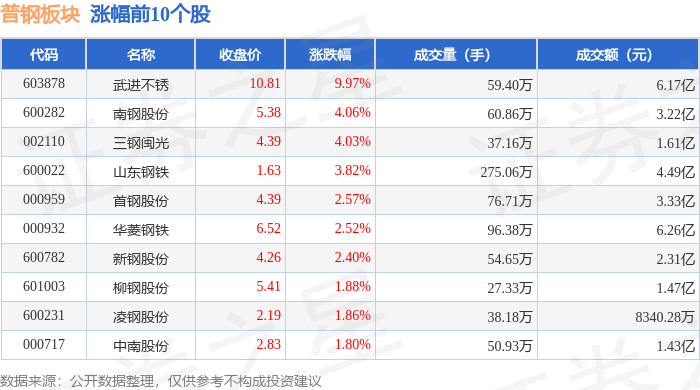
普钢板块10月10日涨1.09%,武进不锈领涨,主力资金净流出7.67亿元
Zheng Xing Xing Ye Ri Bao· 2025-10-10 08:45
Market Overview - On October 10, the general steel sector rose by 1.09%, led by Wujin Stainless Steel, while the Shanghai Composite Index closed at 3897.03, down 0.94% [1] - The Shenzhen Component Index closed at 13355.42, down 2.7% [1] Individual Stock Performance - Wujin Stainless Steel (603878) closed at 10.81, up 9.97% with a trading volume of 594,000 shares and a turnover of 617 million yuan [1] - Nanjing Steel (600282) closed at 5.38, up 4.06% with a trading volume of 608,600 shares and a turnover of 322 million yuan [1] - Other notable performers include: - Sansteel Minguang (002110) at 4.39, up 4.03% [1] - Shandong Steel (600022) at 1.63, up 3.82% [1] - Shougang Group (000959) at 4.39, up 2.57% [1] Capital Flow Analysis - The steel sector experienced a net outflow of 767 million yuan from institutional investors, while retail investors saw a net inflow of 582 million yuan [2] - Notable capital flows include: - Wujin Stainless Steel had a net outflow of 38.74 million yuan from institutional investors [3] - Liugang (601003) saw a net inflow of 20.04 million yuan from institutional investors [3] - New Steel (600782) had a net inflow of 15.20 million yuan from institutional investors [3]