CBC(600132)

Search documents
非白酒板块10月16日涨0.29%,古越龙山领涨,主力资金净流出1.29亿元
Zheng Xing Xing Ye Ri Bao· 2025-10-16 08:20
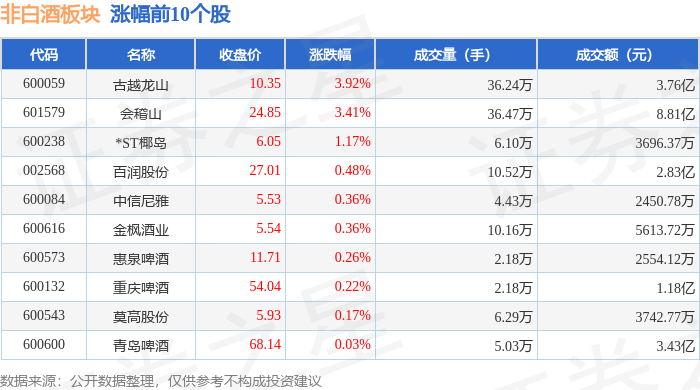
Market Overview - On October 16, the non-liquor sector rose by 0.29% compared to the previous trading day, with Guyue Longshan leading the gains [1] - The Shanghai Composite Index closed at 3916.23, up 0.1%, while the Shenzhen Component Index closed at 13086.41, down 0.25% [1] Stock Performance - Guyue Longshan (600059) closed at 10.35, up 3.92% with a trading volume of 362,400 shares and a turnover of 376 million yuan [1] - Kuaijishan (601579) closed at 24.85, up 3.41% with a trading volume of 364,700 shares and a turnover of 881 million yuan [1] - Other notable performers include *ST Yedao (600238) up 1.17%, Zhirun Co. (002568) up 0.48%, and Chongqing Beer (600132) up 0.22% [1] Capital Flow - The non-liquor sector experienced a net outflow of 129 million yuan from institutional investors, while retail investors saw a net inflow of 184 million yuan [2] - The table of capital flow indicates that *ST Yedao had a net inflow of 1.58 million yuan from institutional investors, while it faced a net outflow of 2.22 million yuan from retail investors [3] Individual Stock Analysis - *ST Yedao (600238) had a net inflow of 158,810 yuan from institutional investors, but a net outflow of 221,770 yuan from retail investors [3] - Mogaogufen (600543) saw a net inflow of 152,120 yuan from institutional investors, with a net outflow of 206,640 yuan from retail investors [3] - Chongqing Beer (600132) faced a net outflow of 652,000 yuan from institutional investors, while retail investors contributed a net inflow of 346,940 yuan [3]


重啤连续上榜重庆企业百强
Sou Hu Cai Jing· 2025-10-15 03:46
Core Insights - Chongqing Brewery Co., Ltd. (referred to as "Chongqing Beer") ranks 38th in the 2025 Chongqing Top 100 Enterprises and 21st in the Top 100 Manufacturing Enterprises, maintaining its position as the leading company in the Chongqing food and beverage industry [1] Group 1: Market Position and Brand Strategy - Chongqing Beer has a strong local presence, with local brand sales accounting for approximately 80% of its market in Chongqing, primarily driven by its well-known brands "Chongqing" and "Mountain City" [3] - The company operates a dual-brand strategy, combining international brands with local brands, which has been a key driver of its sustained growth [3] - The company aims to establish "Chongqing Beer" as a national brand, leveraging its association with local culture and cuisine, particularly through the promotion of "eating Chongqing hotpot and drinking Chongqing beer" [5] Group 2: Product Development and Community Engagement - Chongqing Beer is actively responding to market changes by optimizing its product structure and launching new products, including various craft beers [3] - The company supports local sports and cultural events, enhancing its brand visibility and community engagement through initiatives like music festivals and traditional cultural events [3][5] Group 3: ESG Initiatives and Recognition - Chongqing Beer has made significant progress in its ESG (Environmental, Social, and Governance) initiatives, achieving an "AA" rating from MSCI, the highest in the A-share food and beverage industry [6] - The company has received multiple accolades for its sustainability efforts, including recognition as a "National Green Factory" and "Chongqing Water Efficiency Leader" [6]

2025重庆企业100强、制造业企业100强榜单发布 重啤连续上榜
Zhong Guo Xin Wen Wang· 2025-10-14 07:58
Core Insights - Chongqing Brewery Co., Ltd. (referred to as "the company") ranked 38th in the 2025 Chongqing Top 100 Enterprises and 21st in the Top 100 Manufacturing Enterprises, maintaining its position as the leading company in the Chongqing food and beverage industry [1][2] - The company has experienced rapid growth and has become one of China's top five beer companies, operating a production and supply network consisting of 27 breweries and a market sales network covering all provinces and regions in China [1] - The company's brand strategy combines international and local brands, which serves as a "dual engine" driving continuous performance growth, with local brands accounting for approximately 80% of sales in the Chongqing market [1] Market Expansion - The company has successfully launched the "Chongqing Beer" V8 series in markets such as Guizhou and Hunan, and promoted "Chongqing Pure Draft" in Yibin, Sichuan, gaining high recognition from consumers in surrounding markets [2] - By the end of 2023, the company plans to establish "Chongqing Beer" as a national brand, promoting the consumption scenario of "eating Chongqing hot pot and drinking Chongqing beer" [2] ESG Initiatives - As a leading enterprise in the Chongqing food and beverage industry, the company is advancing its "Together Towards and Beyond Zero Goals" ESG (Environmental, Social, and Governance) plan and has made significant progress [2] - The company's Dazhulian Brewery in Chongqing Liangjiang New Area has received several accolades, including "National Green Factory," "Chongqing Water Efficiency Leader," and "Chongqing Water-Saving Enterprise" [2]
食品饮料行业周报:Q3业绩期临近,关注景气赛道估值切换-20251012
CMS· 2025-10-12 13:32
Investment Rating - The report maintains a recommendation for the food and beverage industry, indicating a positive outlook for the sector [4]. Core Insights - The report highlights the upcoming Q3 performance period and suggests a focus on valuation shifts in thriving sectors such as beverages, snacks, and pet products [13][14]. - It notes that the consumption sector has shown relative weakness, but low valuations may attract investment [13]. - The report emphasizes the stable growth of key companies like Shanxi Fenjiu and Wuliangye, with the latter's major shareholder completing a significant share buyback, reflecting confidence in the company [2][3]. Summary by Sections Core Company Tracking - Shanxi Fenjiu's "Glass Fen" series is experiencing steady growth, with plans to expand into markets with weaker consumption atmospheres [10]. - Wuliangye's major shareholder has completed a buyback of shares worth over 800 million yuan, increasing their stake to 55.1% [3]. - Chongqing Beer is expected to continue gaining market share in China, with a current market share of 9%, up from 6% in 2017 [11]. - Qiaqia Foods has seen improved sales in September, with expectations of a slight recovery in gross margin for Q3 [12]. Investment Recommendations - The report recommends focusing on growth stocks in the snack sector, particularly Ximai Foods and Wei Long [14]. - It continues to recommend leading companies in the Hong Kong market such as Nongfu Spring and H&H International Holdings, while suggesting attention to Haitian Flavoring [14]. - In the new consumption sector, it highlights Zhongchong Co., Guibao Pet, and Bairun Co., with additional recommendations for Yuanfei Pet and Petty Co. [14]. - Traditional consumption is entering a configuration phase, with a focus on leading liquor brands like Shanxi Fenjiu, Luzhou Laojiao, and Guizhou Moutai [14].




大众品25Q3业绩前瞻:把握新品新渠道中的结构性成长机会
ZHESHANG SECURITIES· 2025-10-12 09:21
Investment Rating - The industry investment rating is "Positive" (maintained) [2] Core Insights - The report highlights structural growth opportunities in new products and channels within the consumer goods sector, particularly in the context of the 25Q3 performance forecast [2] - The performance of various sub-sectors is expected to vary, with specific companies showing significant growth potential due to category advantages and new channel expansions [10][12][14][15][16][19][21][22] Sub-sector Summaries 1.1 Snack Foods - The performance in 25Q3 is expected to be differentiated, with companies like Wanchen Group projected to achieve a revenue growth of 39% and a net profit growth of 382% [2][25] - Emphasis is placed on companies that can leverage category trends and new channel opportunities for sustained growth [10][11] 1.2 Soft Drinks - The energy drink segment is showing improved market conditions, with companies like Dongpeng Beverage expected to see a revenue growth of 31% and a net profit growth of 33% [2][25] - The report suggests focusing on companies with strong brand power and channel capabilities for long-term growth [12][13] 1.3 Dairy Products - The dairy sector is anticipated to experience flat demand in 25Q3, with companies like Yili expected to see only a 2% revenue growth [2][25] - The report indicates that profitability may improve once raw milk prices stabilize [14] 1.4 Tea Drinks - The market is characterized by a leading player, Mixue Group, which is expected to expand its competitive edge through enhanced product offerings [2][15] - The mid-price segment is highlighted as a key growth area, with recommendations for companies like Guming [15] 1.5 Health Supplements - The report notes a trend towards increased concentration in the B-end market, with companies like Xianle Health projected to achieve a revenue growth of 15% [2][25] - The C-end market is advised to focus on high-growth single products [16][17] 1.6 Ready-to-Drink Alcohol - The performance in 25Q3 is expected to be strong, with companies like Bairun expected to see an 8% revenue growth [2][25] - New product launches are anticipated to drive sales growth [18] 1.7 Beer - The impact of the "drinking ban" is expected to be limited, with Qingdao Beer projected to achieve a 2% revenue growth and an 8% net profit growth [2][25] - The report suggests that the beer sector will see stable growth driven by structural upgrades and cost improvements [19][20] 1.8 Condiments - Leading companies like Haitian Flavoring are expected to maintain stable performance, with a revenue growth of 7% [2][25] - The report emphasizes the importance of robust market strategies during periods of flat demand [21] 1.9 Frozen Foods - The sector is facing weak demand, with companies like Anjixin expected to see a 6% revenue growth [2][25] - The report advises monitoring the recovery of the restaurant supply chain for potential investment opportunities [22][23] 1.10 Marinated Products - The focus is on improving store operations as the sector continues to recover from previous challenges [24] Key Company Tracking - The report provides a detailed forecast for various companies across different segments, highlighting expected revenue and net profit growth rates for 25Q3 [25]




非白酒板块10月10日涨0.98%,会稽山领涨,主力资金净流入3359.04万元
Zheng Xing Xing Ye Ri Bao· 2025-10-10 08:46
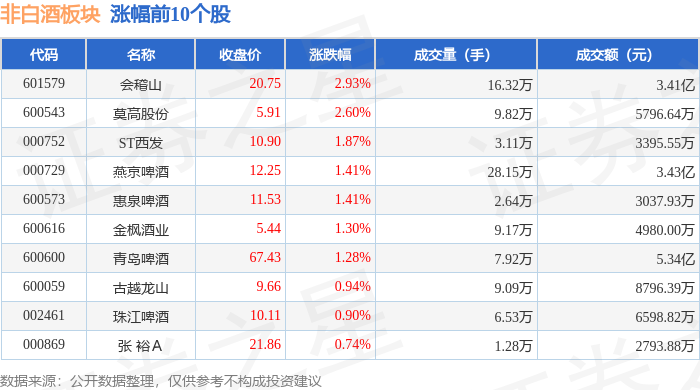
Market Overview - On October 10, the non-baijiu sector rose by 0.98% compared to the previous trading day, with Kuaijishan leading the gains [1] - The Shanghai Composite Index closed at 3897.03, down 0.94%, while the Shenzhen Component Index closed at 13355.42, down 2.7% [1] Stock Performance - Kuaijishan (601579) closed at 20.75, up 2.93% with a trading volume of 163,200 shares and a turnover of 341 million yuan [1] - Mogao Co. (600543) closed at 5.91, up 2.60% with a trading volume of 98,200 shares and a turnover of 57.97 million yuan [1] - ST Xifa (000752) closed at 10.90, up 1.87% with a trading volume of 31,100 shares and a turnover of 33.96 million yuan [1] - Other notable stocks include Nengliangzhangjiu (000729) at 12.25 (+1.41%), Huichuan Beer (600573) at 11.53 (+1.41%), and Jinfeng Wine Industry (600616) at 5.44 (+1.30%) [1] Capital Flow - The non-baijiu sector saw a net inflow of 33.59 million yuan from institutional investors, while retail investors contributed a net inflow of 21.95 million yuan [2] - However, there was a net outflow of 55.54 million yuan from speculative funds [2] Individual Stock Capital Flow - Kuaijishan (601579) had a net inflow of 26.81 million yuan from institutional investors, while it experienced a net outflow of 40.26 million yuan from retail investors [3] - ST Xifa (000752) saw a net inflow of 2.46 million yuan from institutional investors, with a slight net outflow from retail investors [3] - Mogao Co. (600543) experienced a net outflow of 1.68 million yuan from institutional investors, but a net inflow of 4.63 million yuan from retail investors [3]


2025啤酒行业趋势洞察报告
Sou Hu Cai Jing· 2025-10-08 07:42
Core Insights - The Chinese beer industry is experiencing structural transformation and high-quality development, driven by consumption upgrades and the young demographic becoming the core market engine [1][6] - The industry has moved past a period of declining production, showing a clear trend of "stable volume and improved quality" [1][6] Market Overview - In the first ten months of 2024, retail sales of tobacco and alcohol grew by 6.1%, outpacing the overall growth of consumer goods [1][15] - Beer production has rebounded since hitting a low in 2021, maintaining steady growth for four consecutive years, with 2023 seeing low inventory levels and strong confidence among distributors [1][16] - The top five brands (China Resources, Tsingtao, Yanjing, Chongqing, and Zhujiang) control over 70% of the market share, with positive growth in sales, revenue, and net profit in 2023 [1][22] Consumer Demand Trends - The beer market is evolving from a simple alcoholic beverage to a social medium for young consumers, with a significant increase in social media engagement around beer [2] - The "micro-drunk economy" is gaining traction, with beer consumption becoming more about experience rather than just drinking [2] - Flavor innovation and health consciousness are driving product diversification, with traditional yellow beer still dominant but white beer and fruit-flavored beers gaining popularity [2][3] Health and Wellness Trends - The demand for low-alcohol and non-alcoholic beers is rising, with the global market for these products valued at 94.07 billion yuan in 2023, expected to grow by 4% by 2027 [3] - Non-alcoholic beers like Qingdao's non-alcoholic white beer are catering to health-conscious consumers and those with alcohol sensitivities [3] Marketing and Distribution Innovations - Digital marketing and scenario-based innovations are prominent, with platforms like Douyin and Xiaohongshu becoming key for brand promotion [4] - Instant retail is reshaping beer consumption, with brands like Snow Beer and Tsingtao enhancing delivery services to meet consumer demand for immediate access [5] - The rise of experiential marketing through beer festivals and music events is strengthening brand engagement with younger audiences [5] Future Outlook - The Chinese beer industry is shifting from "scale-driven" to "value-driven," focusing on product innovation, channel transformation, and deepening consumer engagement [6] - The market is expected to continue evolving with a focus on personalized and diverse consumer needs, particularly among younger demographics [6]




三大质疑,拆穿嘉士伯“以重庆为家”的真相!
商业洞察· 2025-10-05 09:24
Core Viewpoint - Carlsberg's commitment to Chongqing is being questioned as the company shifts its strategic focus to Foshan, undermining its promises made to the local market [5][10][22]. Group 1: Strategic Commitment - Carlsberg's executive vice president stated that Chongqing is the company's home in China, yet the president of Carlsberg China emphasized Foshan as a key base, indicating a conflicting strategy [5][10]. - Carlsberg made five commitments to Chongqing when acquiring Chongqing Brewery, including establishing a management headquarters and an Asian R&D center in the city, which have not been fulfilled [10][11]. - The company has invested significantly in Foshan, including a new brewery with an annual capacity of 500,000 kiloliters, surpassing Chongqing's production capacity [11][13]. Group 2: Brand Management - The once-popular "Mountain City Beer" brand, which had a market share of 95% and a brand value exceeding 6 billion, is now marginalized under Carlsberg's management [16][17]. - After Carlsberg's acquisition, the focus shifted to promoting international brands, leading to a drastic decline in Mountain City Beer’s sales, which fell to less than 100,000 kiloliters, representing less than 3% of the market [18][20]. - Marketing efforts for Mountain City Beer have ceased, with the brand missing major local events and facing restrictions in sales channels [19][21]. Group 3: Future Commitments - Carlsberg's recent promises to leverage AI for the development of Chongqing's agricultural sector are met with skepticism due to the company's history of unfulfilled commitments [22][24]. - The changing market dynamics and rising national brands challenge Carlsberg to respect local brands and their emotional connections with consumers [25][27]. - The company is urged to fulfill its original commitments to Chongqing and revive the Mountain City Beer brand to regain consumer trust [28].

2025年1-8月中国啤酒产量为2683.3万千升 累计下降0.2%
Chan Ye Xin Xi Wang· 2025-10-02 02:16
Core Insights - The article discusses the performance and trends in the Chinese beer industry, particularly focusing on non-alcoholic beer and production statistics from 2025 [1][2]. Industry Overview - According to the National Bureau of Statistics, China's beer production in August 2025 was 3.58 million kiloliters, representing a year-on-year decline of 1.8% [1]. - Cumulatively, from January to August 2025, China's beer production totaled 26.833 million kiloliters, showing a slight decrease of 0.2% compared to the previous year [1]. Market Analysis - The report by Zhiyan Consulting provides an analysis of the market dynamics and competitive strategies in the non-alcoholic beer sector from 2025 to 2031 [1].

中国必选消费品9月价格报告:白酒批价多数下跌,大众品价格多数稳定
Haitong Securities International· 2025-09-30 11:25
Investment Rating - The report assigns an "Outperform" rating to multiple companies in the consumer staples sector, including Guizhou Moutai, Wuliangye, and others, indicating a positive outlook for these stocks [1]. Core Insights - The wholesale prices of Baijiu have mostly declined, with notable decreases in prices for Guizhou Moutai and Wuliangye, while prices for most consumer goods remain stable [4][10]. - The report highlights a significant drop in the discount rates for liquid milk products, indicating a shift in consumer purchasing behavior [6][18]. - Overall, the report suggests that the impact of funds is greater, advising attention to low-position stocks and heavyweight stocks in the consumer staples sector [8]. Summary by Sections Baijiu Pricing - Guizhou Moutai's wholesale prices for Feitian (case and single bottle) are 1790 and 1770 yuan, respectively, reflecting a decrease of 55 and 70 yuan from the previous month [4][37]. - Wuliangye's eighth-generation price is 895 yuan, down 25 yuan from last month [4][37]. - Luzhou Laojiao's Guojiao 1573 price increased by 10 yuan to 850 yuan [4][37]. Consumer Goods Pricing - The average discount rate for liquid milk products decreased from 74.8% to 69.4% since the end of August [6][21]. - Discount rates for soft drinks, condiments, instant foods, and beer remained stable, with slight variations in average and median values [19][35]. - The report notes that the discount rate for infant formula products also showed a minor decrease from 89.5% to 88.7% [21][35]. Investment Strategy - The report emphasizes the importance of monitoring low-position stocks and heavyweight stocks due to the greater impact of funds on the market [8].