CSEC,China Shenhua(601088)

Search documents
高股息爆发,港股通红利ETF广发(520900)放量大涨3.37%,十大重仓股全部上涨,机构称红利资产迎配置窗口期
Xin Lang Ji Jin· 2026-01-28 07:45
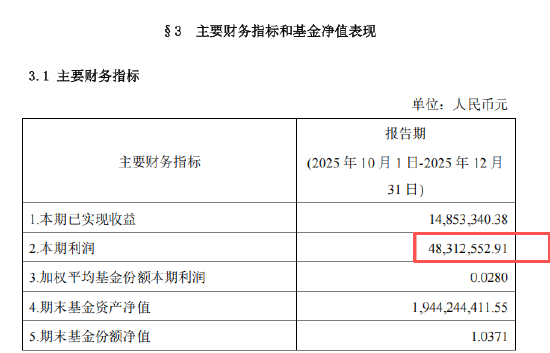
Core Viewpoint - The Hong Kong Stock Connect Dividend ETF (520900) has shown significant performance, with a notable increase in both share volume and profits, indicating strong investor interest in high-dividend assets amid a favorable economic environment [1][2][6]. Financial Performance - In Q4 2025, the Hong Kong Stock Connect Dividend ETF (520900) reported a profit of 48.31 million yuan, contributing to an annual profit of 228 million yuan for the year [2][4]. - The fund's share volume increased from 1.592 billion to 1.875 billion, marking a growth rate of 17.78% [2][4]. Market Trends - The demand for high-dividend assets is bolstered by the stable and continuous dividend policies of state-owned enterprises (SOEs), which are now key performance indicators for state-owned enterprises [6][13]. - The index tracking the ETF focuses on SOEs with stable dividend levels and high dividend yields, primarily in sectors like energy and telecommunications [7][9]. Sector Analysis - The top five sectors in the index include Oil & Petrochemicals (28.63%), Telecommunications (21.75%), Coal (11.80%), Transportation (10.47%), and Public Utilities (7.94%) [7]. - The top ten constituent stocks account for 66.88% of the index, featuring major players in the energy and telecommunications sectors [9][10]. Historical Performance - Since its inception, the index has achieved a cumulative return of 120.79%, outperforming the Hang Seng Index and the CSI Dividend Index [11][12]. - The dividend yield has increased significantly from 3%-4% in 2015 to 5%-9% in 2023-2025, reflecting the enhanced dividend capacity of SOEs [12]. Investment Outlook - Analysts suggest that the current market conditions may present a favorable window for investing in high-dividend assets, particularly through the Hong Kong Stock Connect Dividend ETF [13][14]. - The ETF provides a convenient entry point for investors looking to capitalize on stable returns and long-term value in the Hong Kong market [14].







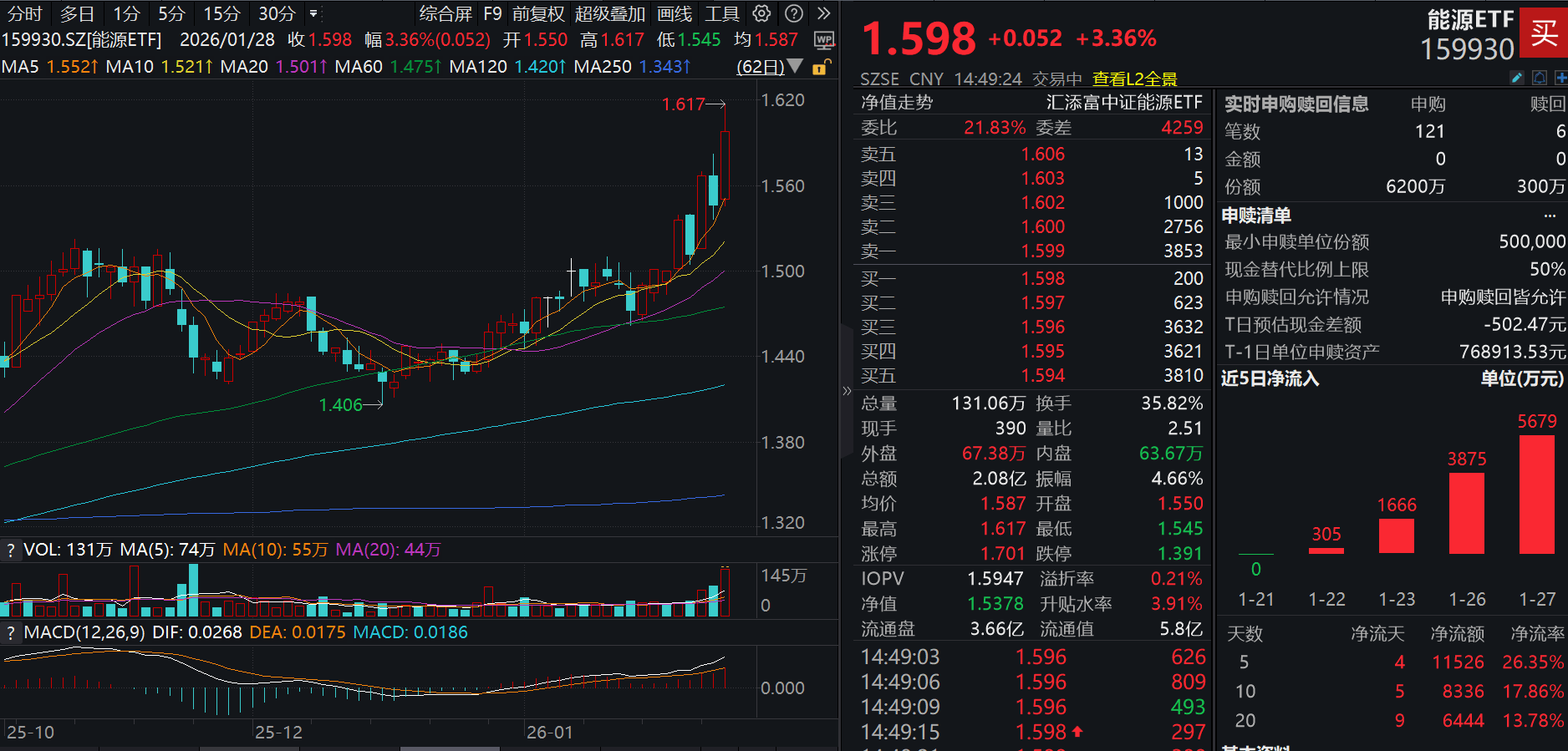
“三桶油”集体冲高,中国海油涨超7%再创新高,能源ETF(159930)飙升涨超3%,连续5日吸金超2亿元!机构:油价或已进入筑底反弹阶段!
Sou Hu Cai Jing· 2026-01-28 07:22
Core Viewpoint - The energy sector, particularly oil and coal, is experiencing significant upward momentum, with substantial capital inflows into energy ETFs, indicating strong investor interest and potential for growth [1][3]. Group 1: Market Performance - As of January 28, energy ETFs (159930) surged by 3.36%, attracting over 94 million yuan in capital, marking a total net inflow of over 200 million yuan over the past five days [1]. - Key stocks within the energy ETF saw varied performance, with China National Offshore Oil Corporation and Jereh Group both rising over 7%, while Shanxi Coking Coal and China Petroleum also posted gains [2][3]. Group 2: Component Stocks - The top ten component stocks of the energy ETF include: - China National Petroleum (3.16% increase, 15.06% weight) - China Shenhua Energy (1.43% increase, 14.26% weight) - China Petroleum & Chemical Corporation (0.16% increase, 12.09% weight) - Shaanxi Coal and Chemical Industry (2.76% increase, 10.82% weight) - Other notable stocks include Jereh Group and Shanxi Coking Coal, both showing significant gains [4]. Group 3: Oil Market Insights - According to Huatai Securities, geopolitical factors have led to a rebound in oil prices during the off-season, with Brent crude oil prices expected to average $65 per barrel by mid-2026, up from a previous estimate of $62 [5]. - The report suggests that energy companies with the ability to increase production and reduce costs may present attractive investment opportunities as oil prices stabilize [5]. Group 4: Coal Market Insights - According to Kaiyuan Securities, coal prices are at historical lows, providing room for a rebound, especially with supply-side policies constraining production and increased demand during the heating season [6]. - The report indicates that both thermal and coking coal prices have upward elasticity, with the coal sector poised for improvement as the market conditions shift [6].




煤炭股午后走强 煤价上涨叠加企业降本支撑业绩改善 板块有望走出春季行情
Zhi Tong Cai Jing· 2026-01-28 05:54
浙商证券(601878)指出,展望"十五五",全球焦煤供弱需强,供需格局逆转,产量下降,需求向上, 价格有望抬升,叠加成本下行,预计业绩显著改善;焦煤产能刚性,若价格上涨供给难增,价格弹性较 大。年初至今,焦煤价格较2025年一季度均价高269元/吨,焦煤企业成本逐步下行至低位,预计一季度 业绩显著改善。优质主焦煤公司单位产品净利润远低于动力煤公司,未体现焦煤资源的稀缺性。 煤炭股午后走强,截至发稿,中国秦发(00866)涨11.68%,报4.11港元;力量发展(01277)涨8.18%,报 1.72港元;兖矿能源(600188)(01171)涨4.25%,报11.52港元;中国神华(601088)(01088)涨3.62%, 报43.54港元;中煤能源(601898)(01898)涨3.27%,报11.38港元。 华源证券发布研报称,2023年以来,煤价呈现季度阶梯性中枢下行走势,2025Q3是除2023Q4之外,少 有的煤炭均价环比回升(基于秦港5500大卡动力煤平仓价)财报季,在煤价中枢上行背景下,预计2025Q4 板块有望实现业绩延续环比回升,2026Q1煤炭板块有望走出春季行情。供需上,2026年1 ...

华源证券:均价回升煤企业绩或环比续增 供给政策持续煤价弹性可期
智通财经网· 2026-01-27 06:25
Core Viewpoint - The coal market is expected to see a recovery in performance in Q4 2025, driven by rising coal prices and a favorable supply-demand balance, with potential for a spring rally in Q1 2026 [1][7]. Price Trends - The average price of Qinhuangdao 5500 kcal thermal coal increased from 672 CNY/ton in Q3 2025 to 765 CNY/ton in Q4 2025, marking a 13.8% increase [3]. - In Q4 2025, the price fluctuated significantly, peaking at 834 CNY/ton before dropping to a low of 670 CNY/ton, yet still achieving a notable average increase [2]. Profitability Outlook - The profitability of coal companies is expected to improve, with thermal coal prices rising and coking coal prices also showing significant increases, particularly in long-term contracts [4]. - The average price for coking coal at Jing Tang Port rose to 1726 CNY/ton in Q4 2025, a 10.5% increase from Q3 [4]. Production Dynamics - The "overproduction check" policy has led to a mixed production performance among listed coal companies, with some reporting declines while others saw increases in output [5]. - Major coal producers like China Shenhua and China Coal Energy reported production decreases of 5.0% and 2.1% respectively, while Shaanxi Coal and Yanzhou Coal Energy reported increases of 3.6% and 1.0% [5]. Cost Management - Cost control remains a priority for coal companies, with strategies shifting from volume-driven to cost-focused approaches due to previous low coal prices [6]. - Despite a slight increase in costs expected in Q4 due to rising coal prices and year-end expense settlements, companies have managed to maintain a focus on cost efficiency [6]. Future Supply and Demand - The exit of certain coal supply capacities is anticipated to significantly improve the coal supply-demand balance, with a potential reduction of around 100 million tons if implemented nationwide [8]. - This policy aligns with previous market predictions and is expected to lead to a notable reduction in coal inventories, enhancing price elasticity in 2026 [8]. Investment Recommendations - Companies to watch include stable large-cap thermal coal firms such as China Shenhua, China Coal Energy, and Shaanxi Coal, as well as high-elasticity coal firms like Yanzhou Coal Energy and Jin Coal Industry [9].


小红日报|黄金、油气股表现强势,标普A股红利ETF华宝(562060)标的指数收涨0.47%
Xin Lang Cai Jing· 2026-01-27 01:27
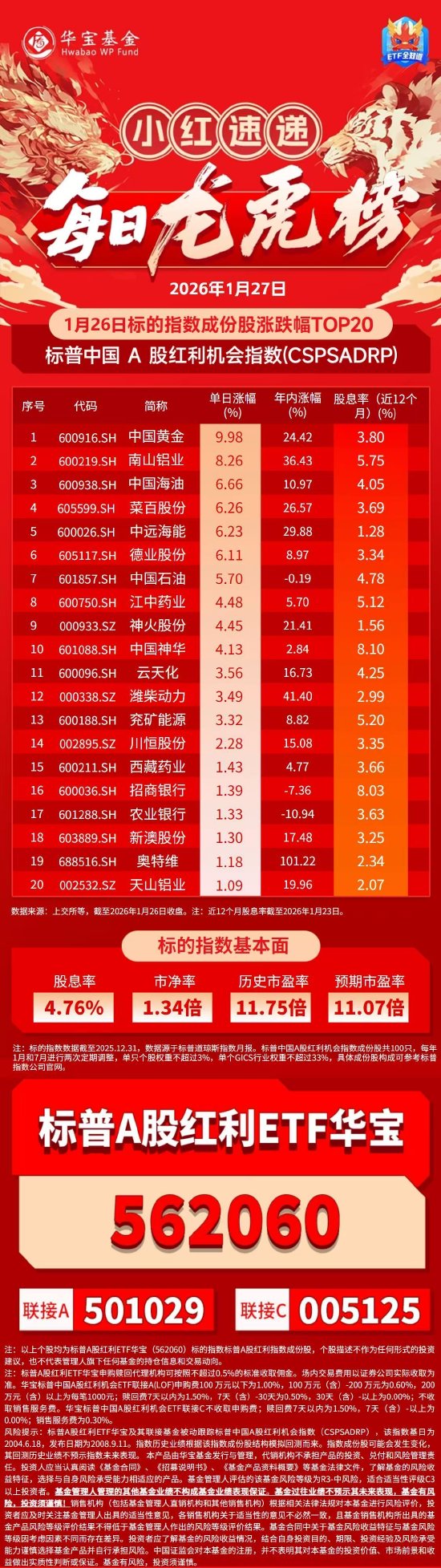
Group 1 - The article presents the top 20 stocks in the S&P China A-Share Dividend Opportunity Index (CSPSADRP) based on their daily and year-to-date performance as of January 26, 2026 [1][6] - China Gold (600916.SH) leads with a daily increase of 9.98% and a year-to-date increase of 24.42%, with a dividend yield of 3.80% [1][6] - Nanshan Aluminum (600219.SH) follows with a daily rise of 8.26% and a year-to-date rise of 36.43%, offering a dividend yield of 5.75% [1][6] Group 2 - Other notable performers include Tian Guo Hai Tan (600938.SH) with a daily increase of 6.66% and a year-to-date increase of 10.97%, and Cai Zi Co., Ltd. (605599.SH) with a daily rise of 6.26% and a year-to-date rise of 26.57% [1][6] - The index also features China Petroleum (601857.SH) with a slight daily increase of 5.70% but a year-to-date decline of 0.19%, and China Shenhua (601088.SH) with a daily rise of 4.13% and a year-to-date increase of 2.84% [1][6] - The data indicates a mix of performance among the top 20 stocks, with some showing significant year-to-date gains while others are experiencing declines [1][6]



25Q4煤炭行业基金持仓分析:基金持仓环比小幅提升,但仍处于较低水平
Guolian Minsheng Securities· 2026-01-26 15:03
Investment Rating - The report maintains a "Recommended" rating for the coal industry, indicating a positive outlook for the sector [2][3]. Core Insights - The report highlights a slight increase in fund holdings in the coal sector, with total market value rising to 6.874 billion yuan in Q4 2025, up 12.13% from Q3 2025, but still at a low level compared to historical data [9]. - The report notes that the coal sector's fund holding ratio is at its lowest in three years, suggesting low investment crowding in the sector [9]. - Key companies such as China Shenhua and Zhongmei Energy are favored by funds, with significant increases in holdings for Yancoal Energy and Shanxi Coal International [9]. - Short-term supply tightening and ongoing replenishment demand are expected to stabilize and potentially rebound coal prices, projected to fluctuate between 750-1000 yuan per ton [9]. - The report recommends focusing on companies with high spot market elasticity, such as Jinko Coal Industry and Shanxi Coal International, as well as industry leaders like China Shenhua and Shaanxi Coal Industry [9]. Summary by Sections Fund Holdings Analysis - Fund holdings in coal stocks increased to 6.874 billion yuan in Q4 2025, a 12.13% rise from Q3 2025, with a holding ratio of approximately 0.36% of total fund holdings [9]. - The report identifies the top five companies by fund holdings, including China Shenhua and Shaanxi Coal Industry, with notable increases in holdings for Yancoal Energy and Shanxi Coal International [9]. Price Outlook - The report anticipates that coal prices will stabilize and rebound due to supply constraints and replenishment needs, with a seasonal fluctuation expected between 750-1000 yuan per ton [9]. - The analysis indicates that the coal industry is likely to return to a state of basic supply-demand balance in 2023-2024, driven by production cuts and regulatory normalization [9].


——煤炭2025年四季度业绩前瞻:均价回升业绩或环比续增供给政策持续煤价弹性可期
Hua Yuan Zheng Quan· 2026-01-26 10:56
Investment Rating - The investment rating for the coal mining industry is "Positive" (maintained) [4] Core Insights - The "overproduction check" effect continues to push up the coal price center, with demand fluctuations causing rapid price changes. From July to December 2025, domestic raw coal production fell for six consecutive months year-on-year, significantly improving the coal supply-demand balance. The price of Qinhuangdao 5500 kcal thermal coal rose from 621 RMB/ton on June 30, 2025, to 689 RMB/ton on January 20, 2026. In Q4 2025, despite significant monthly fluctuations in coal demand, the average price of Qinhuangdao 5500 kcal thermal coal increased from 672 RMB/ton in Q3 to 765 RMB/ton in Q4, a rise of 13.8% [4][5] - The profitability of the sector is expected to rebound, with coking coal enterprises likely to see significant improvements. The average price of Qinhuangdao 5500 kcal thermal coal in Q4 2025 is reported at 765 RMB/ton, up 13.8% quarter-on-quarter. The long-term contract price for thermal coal also increased, with the average price for Q4 reported at 685 RMB/ton, up 2.3% [4][5] - Production levels are stable, with fluctuations among listed coal companies. The "overproduction check" policy strictly requires that annual production does not exceed announced capacity, impacting production levels in the second half of 2025. Major listed coal companies showed mixed production results in Q4, with China Shenhua and China Coal Energy reporting decreases of 5.0% and 2.1%, respectively, while Shaanxi Coal and Yanzhou Coal reported increases of 3.6% and 1.0% [4][5] - Cost control remains a key focus, although rising coal prices and year-end cost settlements may increase costs. In H1 2025, coal prices declined, prompting companies to shift from volume-based strategies to cost control. As coal prices rebound, costs are expected to rise slightly in Q4 compared to Q3 [4][5] - The sector's performance is expected to continue its positive trend into Q4 2025, with anticipated earnings growth. The coal price has shown a quarterly step-down trend, but Q4 2025 is expected to see a rebound in performance due to rising coal prices [4][5] Summary by Sections - **Performance of the Sector**: The average price of Qinhuangdao 5500 kcal thermal coal increased significantly in Q4 2025, indicating a recovery in the sector's profitability [4][5] - **Production and Supply**: The "overproduction check" policy has led to a decrease in production, stabilizing the supply-demand balance [4][5] - **Cost Management**: Companies are focusing on cost control, with expectations of slight increases in costs due to rising coal prices [4][5] - **Future Outlook**: The coal sector is expected to see continued performance improvement into 2026, driven by supply-side policy changes and price rebounds [4][5]
煤炭开采板块1月26日涨2.87%,中国神华领涨,主力资金净流入6.17亿元
Zheng Xing Xing Ye Ri Bao· 2026-01-26 09:41
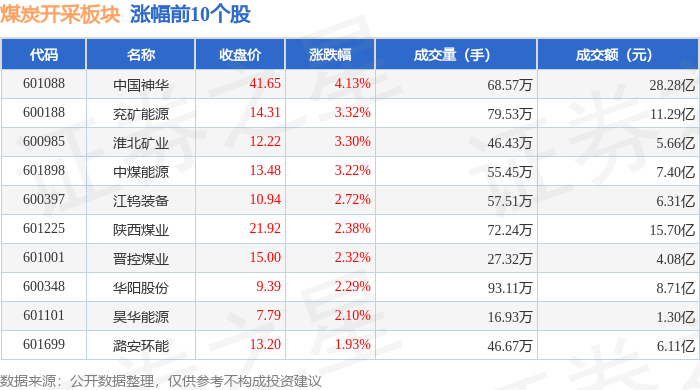
证券之星消息,1月26日煤炭开采板块较上一交易日上涨2.87%,中国神华领涨。当日上证指数报收于 4132.61,下跌0.09%。深证成指报收于14316.64,下跌0.85%。煤炭开采板块个股涨跌见下表: 以上内容为证券之星据公开信息整理,由AI算法生成(网信算备310104345710301240019号),不构成投资建议。 从资金流向上来看,当日煤炭开采板块主力资金净流入6.17亿元,游资资金净流入3813.51万元,散户资 金净流出6.56亿元。煤炭开采板块个股资金流向见下表: | 代码 | 名称 | 主力净流入 (元) | 主力净占比 游资净流入 (元) | | 游资净占比 散户净流入 (元) | | 散户净占比 | | --- | --- | --- | --- | --- | --- | --- | --- | | 601088 | 中国神华 | 2.39 Z | 8.45% | -3544.18万 | -1.25% | -2.03 Z | -7.19% | | 601225 陕西煤业 | | 1.52亿 | 9.70% | -1039.40万 | -0.66% | -1.42 Z | -9.0 ...
煤炭行业今日涨2.07%,主力资金净流入4.50亿元
Zheng Quan Shi Bao Wang· 2026-01-26 09:25
Market Overview - The Shanghai Composite Index fell by 0.09% on January 26, with 10 industries experiencing gains, led by non-ferrous metals and petroleum & petrochemicals, which rose by 4.57% and 3.18% respectively. The coal industry ranked third in terms of gains [1] - The defense and military industry and the automotive sector saw the largest declines, with drops of 4.47% and 2.31% respectively [1] Capital Flow Analysis - The main capital outflow from the two markets totaled 114.32 billion yuan, with six industries seeing net inflows. The non-bank financial sector led with a net inflow of 3.493 billion yuan and a daily increase of 0.79%, followed by the pharmaceutical and biological industry, which had a net inflow of 2.839 billion yuan and a daily increase of 0.29% [1] - A total of 25 industries experienced net capital outflows, with the electronics sector leading at a net outflow of 27.721 billion yuan, followed by the power equipment sector with a net outflow of 20.306 billion yuan. Other sectors with significant outflows included defense and military, machinery, and automotive [1] Coal Industry Performance - The coal industry rose by 2.07% with a net capital inflow of 450 million yuan, comprising 37 stocks, of which 28 increased and 9 decreased. Among the stocks with net inflows, 20 saw capital inflows exceeding 30 million yuan, with China Shenhua leading at 169 million yuan, followed by Shaanxi Coal and Huayang Co., which had inflows of 157 million yuan and 77.425 million yuan respectively [2] - The stocks with the largest capital outflows included Zhengzhou Coal Power, Electric Power Energy, and Yongtai Energy, with outflows of 45.022 million yuan, 42.177 million yuan, and 29.549 million yuan respectively [2][3]
连续3日“吸金”,港股通央企红利ETF天弘(159281)盘中获净申购2200万份,标的指数股息率近6%
2 1 Shi Ji Jing Ji Bao Dao· 2026-01-26 06:52
Group 1 - The Hong Kong stock market experienced a decline, with the Hang Seng Index down by 0.2%, while the Central Enterprises Dividend Index rose by 1.08% [1] - Among the constituents of the Central Enterprises Dividend Index, China Merchants Energy surged over 6%, China Railway increased by over 5%, and China National Offshore Oil, China National Building Material, and China Shenhua all rose by over 4% [1] - The Tianhong Central Enterprises Dividend ETF (159281) recorded a trading volume exceeding 63 million yuan, with a net subscription of 22 million shares during the session [1] Group 2 - CICC indicated that the dividend sector presents phase-specific and structural opportunities amid increasing external uncertainties or a pullback in growth styles, highlighting a "seesaw" effect between dividend and technology growth styles [2] - Demand for capital allocation is expected to support the dividend sector, including the shift of long-term funds from insurance and bank wealth management towards equity assets, as well as the transition of household deposits to dividend assets [2] - The overall dividend payout ratio in the A-share market has increased to 45%, providing fundamental support for the dividend style, alongside continuous encouragement from capital market policies for dividend-oriented strategies [2]