
PING AN OF CHINA(601318)

Search documents
非银金融行业周报:偏股基金新发同比明显增长,公募强化基准约束-20260125
KAIYUAN SECURITIES· 2026-01-25 12:45
Investment Rating - The industry investment rating is "Overweight" (maintained) [1] Core Insights - The report indicates a significant improvement in market trading volume and new fund issuance at the beginning of 2026, which is favorable for the fundamentals of financial IT and brokerage sectors. Brokerage firms are expected to continue rapid growth in their brokerage business, while investment banking, asset management, and overseas expansion are likely to enhance the return on equity (ROE) of leading brokerage firms. The insurance sector has also seen a strong start in both individual and bank-insurance channels, with a continued trend of deposit migration, suggesting a positive outlook for the insurance sector in the spring market [4][6]. Summary by Sections Brokerage Sector - Daily average trading volume for stock funds reached 3.44 trillion, down 16% week-on-week; however, the average trading volume since the beginning of 2026 is 3.64 trillion, a 105% increase compared to Q1 2025 [4] - New stock and mixed fund issuance in January 2026 totaled 44.3 billion, a 56% year-on-year increase [4] - The "Public Fund Performance Benchmark Guidelines" was officially released on January 23, 2026, establishing stricter standards for benchmark selection and changes, enhancing performance evaluation and compensation management systems [4] Insurance Sector - The fourth quarter of 2025 saw a stable research value for ordinary life insurance products at 1.89%, slightly down from 1.90% in the previous quarter, indicating a trend towards stability [6] - The individual insurance channel is under pressure due to various factors, but the strong start in 2026 is expected to improve new policy growth, aided by favorable market conditions [6] - The stabilization of long-term interest rates and a favorable equity market are expected to enhance net assets and profitability for insurance companies, with a potential valuation recovery towards 1x PEV for leading firms [6] Recommended Stocks - Recommended stocks include Guangfa Securities, Guotai Junan, Huatai Securities, and China International Capital Corporation H, as well as China Life, China Pacific Insurance, and Ping An Insurance [7]





金融行业周报(2026、01、25):业绩比较基准新规正式落地,坚定保险中长期向好逻辑-20260125
Western Securities· 2026-01-25 10:30
Investment Rating - The report maintains a positive long-term outlook for the insurance sector, indicating a strong continuity in market performance despite recent fluctuations [2][12][16]. Core Insights - The financial sector experienced a mixed performance this week, with the non-bank financial index down by 1.45%, underperforming the CSI 300 index by 0.83 percentage points. The insurance sector saw a decline of 4.02%, while the brokerage sector decreased by 0.61% [1][10]. - The insurance sector's performance is driven by two main factors: policy support leading to economic recovery and liquidity easing combined with a strong stock market. The report suggests a shift from liquidity-driven growth to a focus on macro policy support and economic recovery expectations [2][13][16]. - The brokerage sector is expected to benefit from new regulations that enhance investment management quality, with a recommendation to focus on larger, undervalued firms and those involved in mergers and acquisitions [3][18]. - The banking sector is facing a slight decline, but there are signs of recovery in profitability for leading banks, with recommendations to focus on banks with high dividend yields and those expected to benefit from market conditions [19][21]. Summary by Sections Insurance Sector - The insurance sector's recent decline is attributed to short-term market sentiment and liquidity changes, but the long-term outlook remains positive due to strong support from both the liability and asset sides [2][12][16]. - Key recommendations include focusing on companies like China Pacific Insurance, China Ping An, China Life (H), and China Taiping, with a specific recommendation for New China Life [4][16]. Brokerage Sector - The brokerage sector's performance is slightly better than the overall market, with a focus on the new guidelines from the regulatory body that aim to improve fund management quality [3][17]. - Recommended firms include Guotai Junan, Huatai Securities, and others, particularly those with strong merger and acquisition prospects [4][18]. Banking Sector - The banking sector has shown a decline but is expected to stabilize, with recommendations to focus on banks with high earnings elasticity and strong dividend yields [19][21]. - Specific banks to watch include Hangzhou Bank, Ningbo Bank, and others, with a focus on those that have previously been undervalued [4][21].


2025Q4公募基金持仓分析:保险持仓环比显著上行
GF SECURITIES· 2026-01-25 10:28
Investment Rating - The industry investment rating is "Buy" [3] Core Insights - The report highlights a significant increase in insurance holdings, with public fund holdings in the non-bank financial sector rising from 1.49% in Q3 2025 to 2.48% in Q4 2025, driven by market style rebalancing and marginal support from the sector's fundamentals [24][34] - The report notes that despite the ongoing pursuit of high-elasticity technology sectors, the non-bank financial sector is at a historical low valuation, with strong performance in the insurance sector and increased trading volumes in brokerage firms, indicating fundamental resilience [24][34] - The report suggests that the public fund holdings in the securities sector increased slightly from 0.63% in Q3 2025 to 0.71% in Q4 2025, reflecting improved performance trends and the appeal of low valuations [33] Summary by Sections New Public Fund Issuance - In Q4 2025, the number of newly issued funds remained stable at approximately 477, with a year-on-year increase of 81% compared to 264 in Q4 2024, while the issuance volume decreased by 15.19% year-on-year [12][19] - The share of newly issued equity funds decreased from 41% in the previous quarter to 32%, while mixed fund shares increased from 15% to 19% [12] Non-Bank Financial Fund Holdings - Public fund holdings in the non-bank financial sector increased, with the total market capitalization share rising to 2.48% in Q4 2025 [24] - The report attributes this increase to a shift in funds from crowded technology sectors to undervalued defensive sectors, alongside a recovery in northbound capital allocations [24] Major Non-Bank Companies' Holdings - The report indicates that major non-bank companies saw slight increases in public fund holdings, with China Ping An leading at 1.11% and China Pacific Insurance at 0.35% [41] - The report recommends focusing on key companies such as CITIC Securities, Huatai Securities, and China Ping An for potential investment opportunities [24][41]

晓数点|一周个股动向:贵金属概念活跃,五大行业获主力青睐
第一财经网· 2026-01-25 09:21
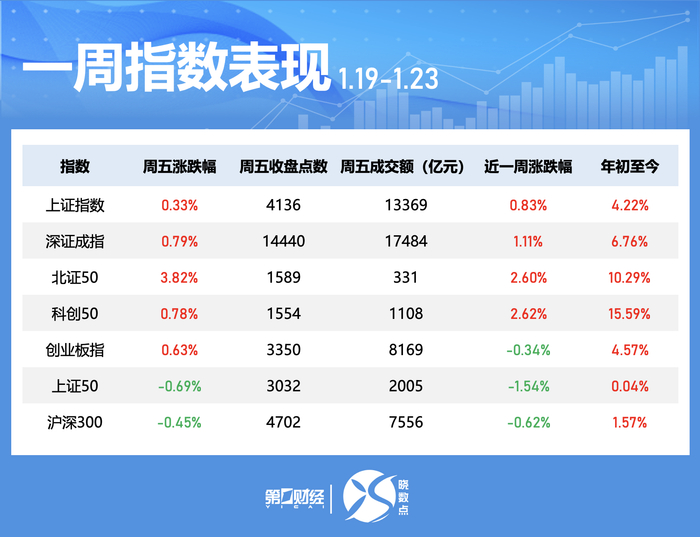
Market Performance - The three major indices showed mixed performance from January 19 to 23, with the Shanghai Composite Index rising by 0.83%, the Shenzhen Component Index increasing by 1.11%, and the ChiNext Index declining by 0.34% [1][2]. Sector Highlights - The commercial aerospace sector experienced a significant surge, while precious metals and photovoltaic equipment sectors also showed active movements [1]. - Notably, precious metals stocks were particularly vibrant, with Hunan Silver rising by 47.44% and Sichuan Gold increasing by 46.74% during the week [3]. Top Gainers and Losers - A total of 35 stocks saw a weekly increase of over 30%, with *ST Lifan leading at a remarkable 95.52% increase. Other notable gainers included *ST Changyao and Fenglong Co., both exceeding 50% [2][4]. - On the downside, 46 stocks recorded declines of over 10%, with Kema Materials leading the drop at 30.03% [3][4]. Trading Activity - There were 68 stocks with a turnover rate exceeding 100% during the week, with Sanbian Technology topping the list at 210.66% [5][8]. - The majority of stocks with high turnover rates belonged to the power equipment and electronics sectors [5]. Fund Flows - Major sectors attracting capital included banking, non-bank financials, non-ferrous metals, coal, and oil & petrochemicals, with the banking sector seeing a net inflow of 4.752 billion yuan [10]. - Conversely, sectors such as electronics, communications, computers, power equipment, and machinery faced significant net outflows exceeding 10 billion yuan [10]. Institutional Interest - Institutions showed strong interest in 167 listed companies, with Dajin Heavy Industry receiving the most attention from 209 institutions [14][16]. - A total of 47 stocks were newly favored by institutions, with 11 stocks receiving target prices [17]. Financing Activities - China Ping An topped the list for net financing purchases, amounting to 1.742 billion yuan, while Aerospace Electronics and Zijin Mining also saw significant net purchases [12][13].

非银金融行业周报(2026/1/19-2026/1/23):4Q25非银板块边际迎来显著增配,业绩快报释放高增长信号-20260125
Shenwan Hongyuan Securities· 2026-01-25 09:13
Investment Rating - The report maintains a positive outlook on the brokerage sector, indicating it is currently undervalued compared to the market, with a recommendation to focus on the sector's beta attributes and potential catalysts such as upcoming earnings reports [2][3]. Core Insights - The brokerage sector has seen a significant increase in allocation from active equity funds, with the proportion of non-bank sector holdings rising to 2.96%, up 102 basis points quarter-over-quarter, surpassing the three-year average of 1.63% [2]. - The report highlights that the earnings forecasts for 2025 are showing strong growth, with companies like Everbright Securities expecting a net profit of 3.73 billion yuan, a year-on-year increase of 22% [2]. - The insurance sector is experiencing a decline, with the insurance index dropping 4.62%, underperforming the market [2]. Summary by Sections Market Review - The Shanghai Composite Index closed at 4,702.50, with a decline of 0.62% over the week, while the non-bank index fell by 1.45% [5]. Non-Bank Sector Insights - The report notes that the brokerage sector is currently experiencing a mismatch between fundamentals and valuations, suggesting a potential for recovery as market conditions improve [2]. - Key brokerage firms such as Huatai Securities and CITIC Securities are highlighted for their strong performance and growth potential [2]. Individual Company Announcements - China Pacific Insurance reported a cumulative premium income growth of 8.1% for 2025, indicating resilience in its business model [10]. - Guotai Junan Securities anticipates a significant increase in net profit for 2025, projecting a growth of approximately 406% [13]. - Northeast Securities expects a net profit increase of 69.06% for 2025, driven by enhanced market conditions [14]. Investment Recommendations - The report recommends focusing on leading brokerage firms with strong competitive positions, such as Guotai Junan, GF Securities, and CITIC Securities, as well as firms with high earnings elasticity like Huatai Securities and Dongfang Securities [2]. - In the insurance sector, companies like China Life, New China Life, and Ping An are recommended for their potential value re-evaluation opportunities [2].
非银金融行业周报:4Q25非银板块边际迎来显著增配,业绩快报释放高增长信号-20260125
Shenwan Hongyuan Securities· 2026-01-25 08:11
Investment Rating - The report indicates a positive outlook for the brokerage sector, suggesting that it is currently in a phase of fundamental and valuation mismatch, with expectations for improvement in the first half of the year [2][6]. Core Insights - The brokerage sector has seen a significant increase in allocation by active equity funds, with a quarter-over-quarter increase of 102 basis points, surpassing the three-year average [2]. - The report highlights strong earnings forecasts for 2025, with notable increases in net profits for several brokerages, including a projected 405.3% increase for Guolian Minsheng [2][16]. - The insurance sector is expected to stabilize, with a forecasted recovery in the predetermined interest rate for life insurance products, anticipated to rise to 1.96% in Q1 2026 [2][28]. Summary by Sections Market Review - The Shanghai Composite Index closed at 4,702.50 with a decline of 0.62%, while the non-bank index fell by 1.45% [6]. - The brokerage, insurance, and diversified financial indices reported changes of -0.61%, -4.02%, and +3.10%, respectively [6]. Non-Banking Sector Insights - The report notes that the China Securities Regulatory Commission has introduced new guidelines for performance benchmarks for publicly offered securities investment funds, aiming to enhance transparency and accountability [8][10]. - Key announcements from individual companies include China Pacific Insurance reporting an 8.1% increase in premium income for 2025, and Guolian Minsheng forecasting a significant profit increase due to business integration [12][16]. Investment Analysis Recommendations - For brokerages, the report recommends focusing on firms with strong competitive positions, such as Guotai Junan and Citic Securities, as well as those with high earnings elasticity like Huatai Securities [2]. - In the insurance sector, the report maintains a positive medium-term outlook, recommending companies like China Life and Ping An Insurance [2]. Key Data Tracking - As of January 23, 2026, the average daily trading volume was reported at 30,388.36 billion [32]. - The margin trading balance stood at 27,249.13 billion [38].




非银金融行业:短期宽基份额变化影响权重股,长期基准新规约束偏移
GF SECURITIES· 2026-01-25 06:08
Core Insights - The report highlights that the short-term changes in broad-based ETF shares are impacting weighted stocks, while long-term regulatory changes are constraining deviations in benchmarks [1][5]. Group 1: Market Performance - As of January 24, 2026, the Shanghai Composite Index rose by 0.84%, while the Shenzhen Component Index increased by 1.11%. The CSI 300 Index fell by 0.62%, and the ChiNext Index decreased by 0.34% [10]. - The average daily trading volume in the Shanghai and Shenzhen markets was 2.80 trillion yuan, reflecting a 19% decrease compared to the previous period [5]. Group 2: Industry Dynamics and Weekly Commentary Insurance Sector - The performance of listed insurance companies is expected to continue high growth, with marginal improvements in long-term interest spreads. The 10-year government bond yield was 1.83%, down 1 basis point from the previous week, indicating a stable economic outlook [11][14]. - The insurance sector is benefiting from regulatory changes that enhance asset-liability management capabilities, which are expected to support high growth in 2026. Key stocks to watch include China Ping An, China Life, and New China Life [14][15]. Securities Sector - The report notes a significant decline in broad-based ETF shares, with the CSI 1000 dropping by 42%, the SSE 50 by 25%, and the CSI 300 by 23%. This decline is expected to have a direct impact on the trading volumes of associated leading stocks [15][19]. - The China Securities Regulatory Commission has introduced new guidelines for public fund performance benchmarks, effective March 1, 2026, aimed at enhancing stability and protecting investor interests [24][28]. Group 3: Key Company Valuations and Financial Analysis - China Ping An (601318.SH) has a current price of 68.40 CNY, with a target value of 85.17 CNY, indicating a buy rating. The expected EPS for 2025 is 8.91 CNY, with a PE ratio of 7.68x [6]. - New China Life (601336.SH) is rated as a buy with a target value of 94.21 CNY, and an expected EPS of 14.04 CNY for 2025, reflecting a PE ratio of 4.96x [6]. - China Pacific Insurance (601601.SH) is also rated as a buy, with a target value of 52.44 CNY and an expected EPS of 6.09 CNY for 2025, resulting in a PE ratio of 6.88x [6].

非银金融行业周报:公募基金业绩基准新规落地,险企理赔高效且获赔率高-20260125
East Money Securities· 2026-01-25 04:28
Investment Rating - The report maintains an "Outperform" rating for the non-bank financial sector, indicating a positive outlook compared to the market [2]. Core Insights - The implementation of new regulations for public fund performance benchmarks aims to reshape the industry towards long-term value creation, moving from a "scale-oriented" to a "capability-oriented" approach [14][16]. - The insurance sector shows high efficiency in claims processing, with claim acceptance rates generally above 99%, driven by technology such as AI and big data [43][44]. Summary by Sections 1. Securities Business Overview and Weekly Review - The new public fund performance benchmark regulations will take effect on March 1, 2026, addressing issues like benchmark ambiguity and style drift, thereby enhancing the accountability of fund managers [14][15]. - The report highlights a mixed performance among major indices, with the Shanghai Composite Index at 4,136.16 points, up 0.84% week-on-week, while the non-bank financial index fell by 1.70% [16][19]. 2. Insurance Business Overview and Weekly Review - Recent claims reports from various insurance companies indicate a high claim acceptance rate, with companies like Ping An Life achieving 99.2% [43]. - Despite high acceptance rates, consumer perceptions of "claim difficulties" persist, primarily due to misunderstandings regarding policy terms and inadequate preparation of claim materials [44]. - The average payout for critical illness insurance is around 100,000 CNY, while the average treatment cost for severe illnesses can reach 400,000 CNY, highlighting a significant coverage gap [44]. 3. Market Liquidity Tracking - The central bank's net injection in the open market was 9,795 billion CNY for the week of January 19-23, 2026, indicating ongoing liquidity management efforts [49].
2025Q4基金持仓分析:Q4基金动向:增配AI基建与价值股
GUOTAI HAITONG SECURITIES· 2026-01-24 15:20
Group 1 - In Q4 2025, active equity funds significantly reduced their holdings in A-shares and Hong Kong stocks, while increasing allocations in cyclical and financial value stocks, with consensus on increasing positions in non-ferrous metals and non-bank financials [5][8] - The allocation to technology showed internal differentiation, with AI hardware infrastructure being favored, while TMT, pharmaceuticals, and military industries were reduced [5][8] - The overall market capitalization of active equity funds decreased by 195.65 billion to 3.38 trillion, with stock positions dropping to 84.2%, indicating a shift towards lower valuation and improving cyclical and financial sectors [5][8] Group 2 - The industry allocation saw a comprehensive increase in cyclical financials, with significant increases in non-ferrous metals, communications, non-bank financials, machinery, and basic chemicals, while media, electronics, new energy, pharmaceuticals, and military industries were reduced [5][28] - The allocation to communication equipment was notably increased, driven by AI infrastructure investments, while most technology sectors experienced significant reductions [5][28] - In the consumer sector, essential consumption was reduced, particularly in liquor and feed, while leisure food saw a notable increase [5][28] Group 3 - In the Hong Kong market, active funds significantly reduced their allocations, with a market capitalization decrease of 86 billion to 295.2 billion, and the allocation ratio dropping to 15.6% [5][28] - The funds increased their positions in cyclical and financial sectors, such as insurance, oil, airlines, and non-ferrous metals, while reducing positions in internet and semiconductor leaders [5][28] - The issuance of funds is expected to reach an inflection point, supporting further market growth, with a high percentage of funds achieving positive returns over various time frames [5][28]





2025年四季报公募基金十大重仓股持仓分析
Huachuang Securities· 2026-01-24 12:42
Market Performance - Since October 2025, major indices have shown upward volatility, with the CSI 2000, CSI 500, and National CSI 2000 all achieving over 10% gains, while the Shanghai Composite Index has repeatedly surpassed 4000 points, reaching recent highs[1] - The top five performing sectors in Q4 2025 were non-ferrous metals (33.48%), national defense and military industry (28.59%), oil and petrochemicals (25.94%), basic chemicals (18.59%), and building materials (18.01%)[1] Fund Establishment and Positioning - A total of 100 new actively managed equity funds were established in Q4 2025, with a total share of 604.71 billion[2] - The average stock positions of various types of actively managed equity funds decreased compared to Q3 2025, with mixed equity funds averaging 88.69% (down 1.05%) and ordinary stock funds at 90.52% (down 0.52%)[3][31] Industry Distribution - The sectors with increased holdings of over 10 billion included non-ferrous metals, communication, basic chemicals, and non-bank financials, while sectors with decreased holdings included pharmaceuticals, computers, electronics, power equipment and new energy, and media[4] - The top five heavy-weight sectors for actively managed equity funds in Q4 were electronics (22.89%), communication (11.14%), power equipment and new energy (9.29%), pharmaceuticals (8.1%), and non-ferrous metals (8.09%) with notable increases in non-ferrous metals (up 2.08%) and communication[4][47] Individual Stock Analysis - The top five stocks with the largest increases in holdings were Zhongji Xuchuang, Dongshan Precision, China Ping An, Xinyi Technology, and Shengyi Technology[5] - The largest reductions in holdings were seen in Industrial Fulian, Yiwei Lithium Energy, Ningde Times, Luxshare Precision, and Focus Media[5] Billion Fund Holdings - As of January 22, 2026, there were 31 funds with over 10 billion in assets, a decrease of 3 from the previous quarter, with significant changes in holdings for companies like Shengyi Technology and Zhongji Xuchuang[6] Hong Kong Stock Holdings - The top three Hong Kong stocks held by funds in Q4 2025 were Tencent Holdings, Alibaba-W, and SMIC, each with a market value exceeding 18 billion, but all saw reductions of over 10 billion compared to the previous quarter[7]