
CICC(601995)

Search documents
中金:多重利好促成强劲“开门红”,但需防范短期波动
Jin Shi Shu Ju· 2026-01-13 11:59
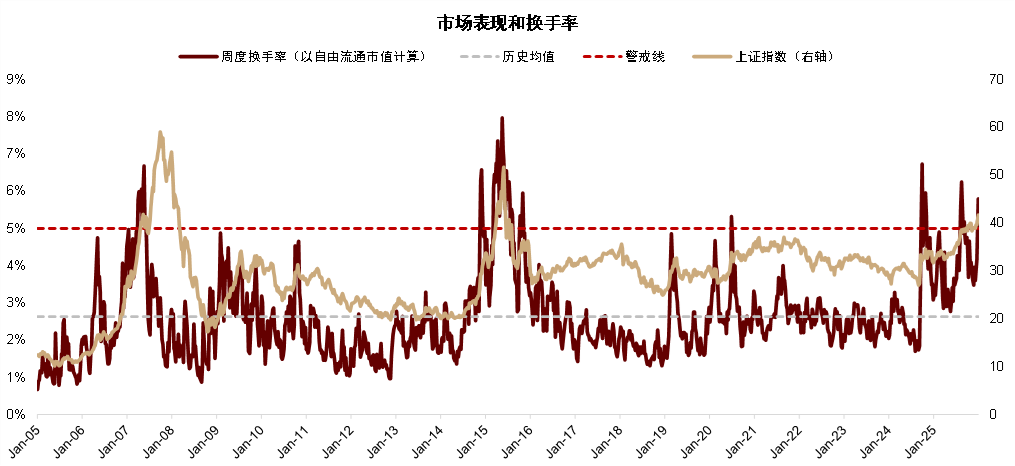
Core Viewpoint - The A-share market has shown strong performance at the beginning of 2026, with a historical high in trading volume and a significant increase in major indices, driven by multiple favorable factors [1][2][4]. Market Performance - As of January 12, 2026, the Shanghai Composite Index has risen by 4.9% since the end of 2025, marking 17 consecutive days of gains, positioning it among the top global markets [1]. - The total trading volume on January 12 reached 3.64 trillion yuan, setting a new historical record [1]. Supporting Factors - Investor optimism for 2026, particularly in the first half, has led to increased capital allocation [2]. - Recent technological advancements in sectors like AI and commercial aerospace have catalyzed market interest, with significant satellite applications submitted to the International Telecommunication Union [2]. - Anticipation of positive earnings reports from A-share companies at the end of January, especially for small and mid-cap stocks, has contributed to market optimism [2]. - The ongoing trend of capital movement from savings to investments has created a positive feedback loop with market performance [2]. - The appreciation of the Chinese yuan, recently reaching 6.96, has also supported market sentiment [2]. Short-term Considerations - The rapid increase in market performance and trading volume necessitates caution regarding potential short-term volatility, as high turnover rates may indicate overheated investor sentiment [3]. - A focus on maintaining market stability and a gradual pace of growth is recommended to attract incremental capital and support long-term market health [3]. Mid-term Outlook - The A-share market is expected to continue its upward trend, driven by the interplay of international order restructuring and domestic industrial innovation [4]. - Recent geopolitical changes and the evolving U.S.-China trade relationship are seen as stabilizing factors for the Chinese market [4]. - The ongoing advancements in AI technology and related sectors are anticipated to sustain high growth and contribute to the revaluation of Chinese assets [4]. Investment Recommendations - Focus on sectors experiencing growth, such as AI technology, innovative pharmaceuticals, and energy storage, which are entering a favorable cycle [5]. - Consider opportunities in export-oriented industries, including home appliances and machinery, which are expected to benefit from global demand [5]. - Monitor cyclical sectors like chemicals and renewable energy for potential recovery as supply-demand dynamics improve [5]. - Emphasize high-dividend stocks for long-term investment strategies, leveraging stable cash flows and lower volatility [5]. - Identify sectors likely to report strong annual performance, such as gold and technology, which are benefiting from high demand in AI [5].

海大集团分拆海大国际,递交IPO招股书,拟赴香港上市,摩根大通、中金公司、广发证券联席保荐
Xin Lang Cai Jing· 2026-01-13 11:33
Core Viewpoint - Haid International Holdings Limited, a spin-off from Haid Group, has submitted its IPO application to the Hong Kong Stock Exchange, aiming for a listing on the main board [2][14]. Business Overview - Haid International is a technology-driven global agricultural enterprise that commenced operations in 2012 after acquiring a factory in Vietnam. The company focuses on providing comprehensive solutions across the entire value chain of the livestock industry, with a core market in Asia (excluding East Asia), Africa, and Latin America [15][17]. - According to Frost & Sullivan, Haid International is the second-largest supplier of aquaculture feed in Asia, with a production capacity of 1 million tons, and the third-largest feed supplier in Vietnam, producing 1.7 million tons of feed products [15][17]. Revenue Sources - The company's revenue is derived from the sale of: 1. Feed products, including aquaculture feed, poultry feed, and pig feed 2. Seed products, including shrimp and fish seeds 3. Animal health products, including environmental modifiers and various animal health products [5][17]. Financial Performance - For the fiscal years ending December 31, 2023, 2024, and the first nine months of 2025, Haid International reported revenues of RMB 9.025 billion, RMB 11.417 billion, and RMB 11.177 billion, respectively. Corresponding net profits were RMB 360 million, RMB 735 million, and RMB 869 million [9][21]. - The gross profit margins for these periods were 12.9%, 15.2%, and 16.8%, indicating a positive trend in profitability [10][22]. Market Presence - The company’s revenue distribution by region shows that Vietnam accounted for 70.6% of total revenue in 2023, followed by Indonesia (11.4%), Ecuador (9.4%), and Egypt (1.4%) [18][22]. Management Team - The board of directors consists of 9 members, including 3 executive directors, 3 non-executive directors, and 3 independent non-executive directors, with key figures such as Zhang Guijun (General Manager) and Xue Hua (Chairman) [9][21]. IPO Underwriters - The IPO is being managed by a team including J.P. Morgan, CICC, and GF Securities as joint sponsors, with Ernst & Young as the auditor [10][22].


美银证券:中资券商股今年迎来五大核心主题 偏好国泰海通等
Zhi Tong Cai Jing· 2026-01-13 07:57
美银证券发布研报称,中资券商股今年迎来五大核心主题,包括再杠杆启动推动净资产收益率(ROE) 扩张;财富管理业务受益于家庭资产重新配置;投行业务增长受在岸市场复苏及离岸市场强劲势头带 动;离岸扩张提振经营杠杆及ROE上行;以及行业持续整合。 该行预计主要上市中资券商去年及今年盈利分别上升46%及15%。受行业利好及再杠杆支撑,海通证券 (02611)、中金公司(601995)(03908)及广发证券(000776)(01776)的盈利增长预计跑赢行业。以A股 今年预测日均成交1.8万亿元人民币(意味同比上升5%)计算,预计经纪业务收入同比上升5%。承销费 收入预计上升16%,受在岸及离岸IPO支持。财富管理收入预计上升9%,受益于证券资产管理规模扩 张。净利息收入预计上升27%,受融资余额增加及融资成本下降支持。交易收入在高基数下预计上升 8%。成本节省空间预计有限。 美银证券提到,成本效率在牛市时较为重要,但监管机构对券商股权融资仍保持审慎态度。该行偏好具 备强劲资本状况的券商,看好海通证券、中金公司及广发证券H股,因其增长前景良好且ROE具备上行 空间。 该行提到,所覆盖H股券商去年平均上涨33%,跑赢中 ...


“天量存款”即将到期 利率持续低位资金会否搬入股市?
Xin Jing Bao· 2026-01-13 07:08
Core Viewpoint - The article highlights a trend of declining deposit interest rates among banks in China, particularly as the new year begins, with many banks entering a "1 era" for their rates, indicating a significant drop in returns for savers [1][2][3]. Group 1: Deposit Rate Changes - Anhui Xin'an Bank has lowered its 2-year fixed deposit rate by 10 basis points to 2.25% starting January 16 [1]. - Several local banks, including Suzhou Commercial Bank and Puyang Zhongyuan Village Bank, have also reduced their deposit rates, with some products now offering rates as low as 1.9% for 3-year deposits [2]. - Major state-owned banks like ICBC and CCB are offering 1-year fixed deposit rates at 1.1%, while some joint-stock banks have slightly higher rates, with CITIC Bank and GF Bank offering 1.3% for 1-year deposits [3]. Group 2: Impact on Large Certificates of Deposit - The attractiveness of large certificates of deposit (CDs) has diminished, with 3-year CDs nearly extinct and 1-year CDs offering rates only marginally higher than regular fixed deposits [4][5]. - Many banks are now issuing new large CDs with rates in the "1 era," and some short-term large CDs have even dropped below 1% [5]. Group 3: Upcoming Expiration of Deposits - A significant volume of fixed deposits is set to mature in 2026, with estimates suggesting around 75 trillion yuan will be due, marking a 12% increase from 2025 [6]. - The first quarter of this year is critical as approximately 29 trillion yuan of 1-year and longer deposits will mature, representing a 4 trillion yuan increase compared to the same period in 2025 [6]. Group 4: "Deposit Migration" Trends - The trend of "deposit migration" is expected to continue, with funds potentially moving from large banks to smaller ones and then into various asset management products [7]. - Analysts suggest that while the current low-interest environment is prompting asset reallocation, the overall risk appetite among residents remains cautious, with consumption and debt repayment being primary uses for maturing deposits [7].


IPO承销保荐费格局生变
Jing Ji Wang· 2026-01-13 06:36
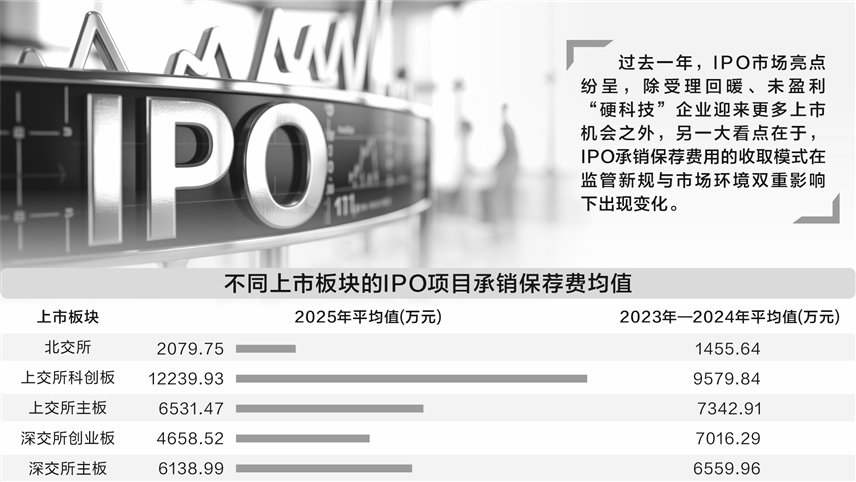
Core Insights - The IPO market is experiencing significant changes in underwriting and advisory fee structures due to new regulations and market conditions, with a notable shift from the previously dominant tiered fee model to a mixed fee model that includes fixed rates and minimum or maximum fee clauses [4][5] Fee Structures - The tiered fee model, which was prevalent in 2023 with 38% of cases, has drastically decreased to 6% by 2025, with most remaining cases adopting a decreasing fee percentage [3][4] - The traditional model of "actual fundraising amount × fixed rate" is now used by 33% of IPOs in 2025, with underwriting fees typically ranging from 5% to 9% [4] - A new model combining fixed rates with limit conditions has gained traction, with 49% of IPOs in 2025 utilizing this approach, up from 25% in 2023, primarily due to changing fundraising expectations [5] - The "one-price" fee model has been adopted by 12% of IPOs in 2025, focusing on direct pricing for online offerings [5] Market Trends - The average underwriting fee for the Sci-Tech Innovation Board reached 1.22 billion yuan in 2025, a significant increase from the previous average of 957.98 million yuan [7] - Conversely, the average underwriting fees for the main board and the ChiNext board have decreased, with the main board averaging 65.31 million yuan and the ChiNext board at 46.58 million yuan, reflecting a decline of over 30% for the ChiNext board compared to previous years [7][8] - The Beijing Stock Exchange has seen a notable increase in IPO fees, with an average of 20.80 million yuan in 2025, up 43% from the previous average of 14.56 million yuan [8] Market Concentration - The IPO underwriting market continues to exhibit a "head effect," with a small number of securities firms capturing the majority of market share, as only 13 firms generated over 100 million yuan in IPO revenue in the past year [9] - CITIC Securities leads the market with nearly 1.1 billion yuan in underwriting fees, followed by CITIC Construction Investment and Guotai Junan, indicating a concentration of high-quality projects among top firms [9]



五年IPO变局 券商投行谁在潮头?
2 1 Shi Ji Jing Ji Bao Dao· 2026-01-13 05:55
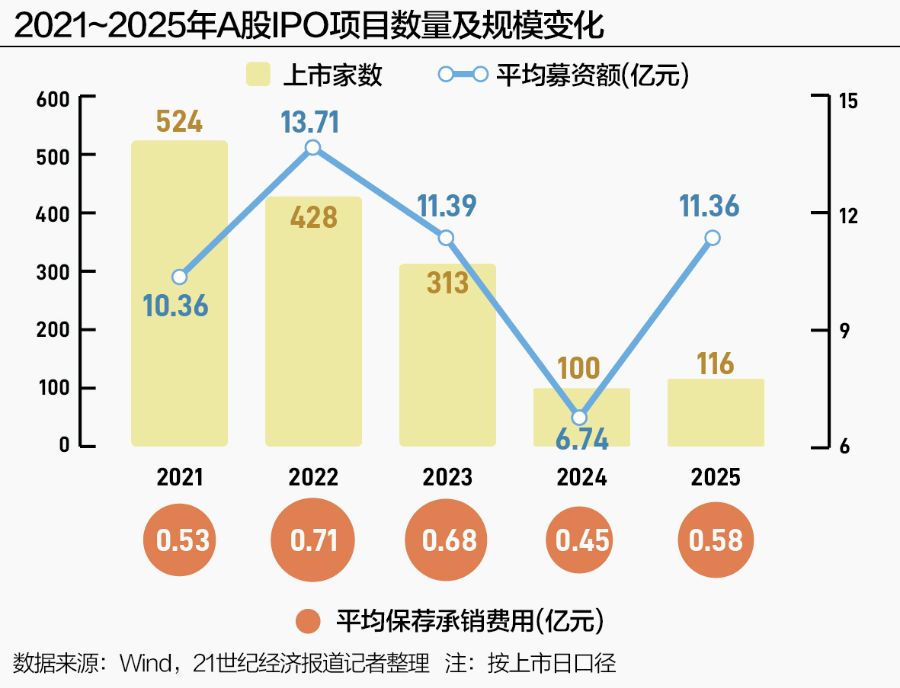
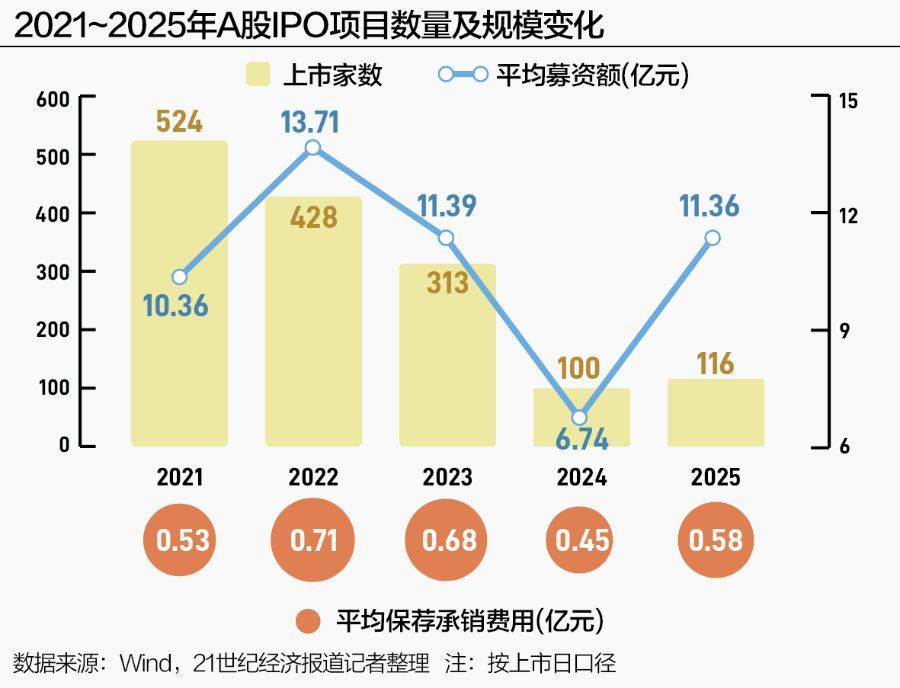
Core Insights - The A-share and Hong Kong IPO markets have shown signs of recovery in 2025, leading to discussions about a potential "IPO boom" [1] - The last significant IPO year for both markets was in 2021, marking a peak in IPO numbers and fundraising [2] A-share Market Summary - In 2025, the number of new A-share listings increased to 116, with total fundraising reaching 131.8 billion yuan, nearly doubling year-on-year [3] - The average fundraising amount per IPO rose significantly to 11.36 million yuan, with average underwriting fees for brokers increasing to 0.58 million yuan [7] - The focus has shifted from quantity to quality, with a notable increase in the "value" of individual projects [7] - The largest IPOs in recent years have transitioned from traditional sectors to technology-driven companies, particularly in semiconductors and renewable energy [11] - Leading brokers like CICC and CITIC Securities have maintained their competitive edge, with CICC involved in three of the largest IPOs in the past five years [12][13] Broker Competition in A-share Market - The competition among brokers has evolved, with CITIC Securities and CICC dominating the top spots in underwriting [13][14] - In 2025, the merger of Haitong Securities and Guotai Junan created a new leader in underwriting volume, while the competition in the lower tiers has intensified [14] - CITIC Securities has consistently led in underwriting revenue, with significant contributions from high-quality projects [15][16] Hong Kong Market Summary - The Hong Kong IPO market has experienced a "V-shaped" recovery, with total fundraising in 2025 exceeding 285.8 billion HKD, reclaiming the top position globally [20] - The average fundraising amount per IPO surged to 24.43 million HKD in 2025, driven by large projects from leading companies [20][22] - The narrative of the Hong Kong IPO market has shifted from internet-driven stories to technology and manufacturing innovations [22] Broker Competition in Hong Kong Market - Foreign investment banks like Morgan Stanley and Goldman Sachs continue to hold key positions in large IPO projects, while Chinese brokers are increasing their participation [23][24] - The rise of Chinese brokers, particularly in joint underwriting roles, reflects their growing influence in the Hong Kong market [24][25] - Futu Securities has consistently led in the number of IPOs underwritten, while traditional bank-affiliated brokers are also making significant contributions [25][28] Future Outlook - The consensus indicates a more active IPO market in 2026, but challenges related to supply and market absorption capacity are anticipated [29] - The ability of brokers to price assets and manage project depth will be crucial for success in the upcoming years [29]
五年IPO变局,券商投行谁在潮头?
Sou Hu Cai Jing· 2026-01-13 05:44
Group 1 - The A-share and Hong Kong IPO markets have shown signs of recovery in 2025, with A-shares seeing 116 new listings and total fundraising reaching 131.8 billion yuan, nearly doubling year-on-year [1][3] - The Hong Kong market raised over 285.8 billion HKD in IPO funds, reclaiming the top position globally after several years [1][16] - The average fundraising amount per IPO in A-shares increased significantly to 11.36 million yuan, while the average underwriting fee for brokers rose to 0.58 million yuan [3][12] Group 2 - The quality of IPO projects has improved, with a shift from quantity to quality and value in market pricing [4][6] - The leading IPOs in 2025 were dominated by semiconductor and new energy companies, indicating a shift in industry focus from traditional sectors to high-tech fields [6][18] - Major brokers like CICC and CITIC Securities maintained their competitive edge, with CICC involved in three of the largest IPOs in the past five years [7][12] Group 3 - The underwriting landscape has changed, with the merger of Haitong Securities and Guotai Junan creating Guotai Haitong, which took the lead in underwriting numbers in 2025 [10][21] - The competition among brokers has intensified, especially in the lower ranks of the underwriting list, with several firms showing fluctuating positions [10][12] - CITIC Securities has consistently ranked first in underwriting revenue for five consecutive years, highlighting its strong market position [11][12] Group 4 - The Hong Kong IPO market has experienced a "V-shaped" recovery, with significant fundraising in 2025 driven by large projects from leading companies [16][18] - The average fundraising amount in Hong Kong IPOs rebounded to 24.43 million HKD in 2025, reflecting a shift in market dynamics [16][18] - The narrative of the Hong Kong IPO market has transitioned from internet-driven stories to technology innovation and manufacturing upgrades [18][20] Group 5 - Chinese brokers are increasingly participating in Hong Kong IPOs, often in collaboration with foreign firms, indicating a growing influence in the market [19][20] - Futu Securities has emerged as a leader in the number of IPOs underwritten in Hong Kong, leveraging its extensive retail client network [22][24] - Despite leading in the number of projects, internet brokers and bank-affiliated investment banks face challenges in large project competitiveness [24][25]
专访中金公司彭虎:前沿科技积极落地,看好国产AI加速创新
Nan Fang Du Shi Bao· 2026-01-13 05:25
Group 1: Low Altitude Economy - The low altitude economy is driven by the increasing public safety governance needs and expectations for efficient social management, highlighted by recent low altitude safety incidents [3] - The number of registered drones in China reached 2.213 million by the end of 2024, a year-on-year increase of 74.7%, with 2.726 million registered by June 2025, amplifying potential risks to critical infrastructure [3] Group 2: Automotive Intelligence - The penetration rate of passenger cars equipped with L2 (including L2+) level ADAS reached 57.94% from January to September 2025, an increase of 28.54 percentage points compared to the entire year of 2022, with a peak monthly penetration rate of 62.05% in September 2025 [4] - The demand for higher-level autonomous driving increases the need for onboard perception and data processing capabilities, with the shipment of laser radars exceeding 1.84 million units in the first nine months of 2025, a year-on-year increase of 86%, achieving a penetration rate of 11.47% [5] Group 3: AI and Robotics - The AI sector is transitioning from a technology race to widespread implementation, becoming a core force in reshaping production and life, with a focus on building a modern infrastructure system [6] - The robot industry saw significant breakthroughs in 2025, with new products being tested across various sectors, leading to a surge in investment [7] - The demand for various sensors, main control processors, and high-end microcontrollers in robotics is expected to grow, driven by the need for high-precision environmental modeling and real-time intelligent decision-making [8]

中金:多重利好促成A股强劲“开门红” 但需防范短期波动
智通财经网· 2026-01-13 01:01
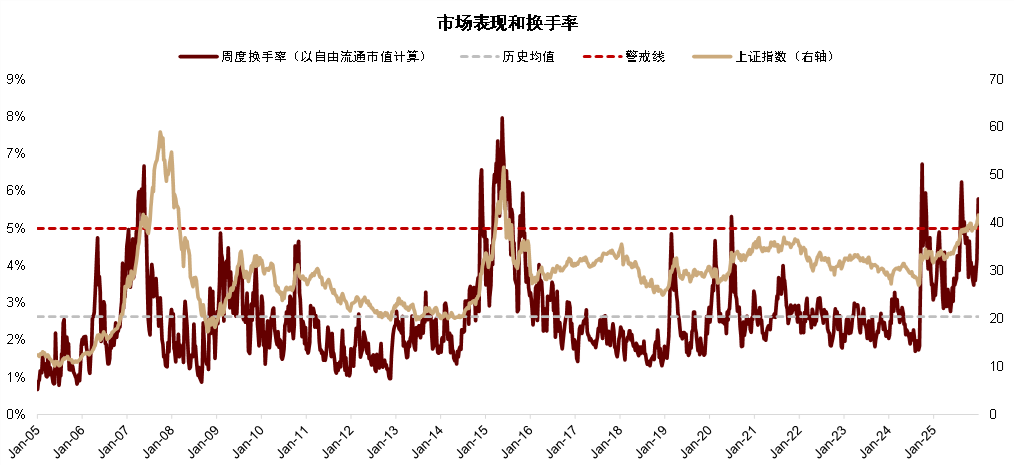
Core Viewpoint - The A-share market has shown strong performance at the beginning of 2026, with the Shanghai Composite Index rising 4.9% since the start of the year and achieving 17 consecutive days of gains since the end of 2025, ranking among the top global markets [1][2] Market Performance - The A-share market's total trading volume reached a historical high of 3.64 trillion yuan on January 12, 2026, with a turnover rate of 6.7%, the highest since August of the previous year [2][4] - The growth style is predominant, with the ChiNext Index and STAR Market Index rising 5.8% and 12.5% respectively since the beginning of the year; sectors such as media, defense, computer, and non-ferrous metals have seen increases of 21.9%, 20.1%, 16.4%, and 10.0% respectively [2] Factors Supporting Market Strength - Multiple favorable factors have contributed to the strong performance of the A-share market, including optimistic investor expectations for 2026, significant events in the technology sector, and a generally positive outlook for corporate earnings [3] - The recent rise in the renminbi exchange rate, reaching 6.96, has also played a role in supporting market sentiment [3] Short-term Market Considerations - The rapid increase in the market and high trading volume necessitate caution regarding potential short-term volatility, as a turnover rate exceeding 5% often indicates overheated investor sentiment [4] Mid-term Outlook - The company maintains a positive outlook for the A-share market's upward trend, driven by the restructuring of international order and domestic industrial innovation, which are expected to continue supporting the performance of Chinese assets in 2026 [5] Investment Recommendations - Suggested areas for investment include: 1. Growth sectors such as AI technology, which is expected to enter an application phase in 2026, with opportunities in computing power, optical modules, and cloud infrastructure [6] 2. Export-oriented sectors, particularly in home appliances, engineering machinery, commercial vehicles, and non-ferrous metals [6] 3. Cyclical sectors that may benefit from improving supply-demand dynamics, such as chemicals and renewable energy [6] 4. High-dividend stocks, focusing on companies with strong cash flow and dividend certainty [6] 5. Sectors expected to show strong performance in annual reports, including gold and TMT sectors benefiting from AI [6]
中金:如果美国通胀与流动性冲击导致中美股票、黄金、美债等资产回调,建议逢低增配
Sou Hu Cai Jing· 2026-01-13 00:55
Core Viewpoint - The article discusses the potential for a compensatory rise in U.S. inflation as predicted by CICC, which may impact the Federal Reserve's interest rate decisions and global liquidity [1] Group 1: Inflation Predictions - CICC calculates statistical errors in U.S. inflation and forecasts a rise in CPI data for December 2025, January 2026, and April 2026 [1] - Recent strong U.S. inflation could lead the Federal Reserve to slow down its rate cuts, resulting in tighter global liquidity [1] Group 2: Investment Recommendations - There is an increase in uncertainty for major asset classes in both China and the U.S. due to inflation and liquidity shocks [1] - It is recommended to increase allocation in commodities to hedge against risks [1] - In the event of a pullback in U.S. stocks, gold, and U.S. Treasuries due to inflation and liquidity impacts, it is advised to buy on dips [1]