
King's Luck(603369)

Search documents
促消费政策催化,持续看好顺周期方向
CAITONG SECURITIES· 2025-09-03 11:00
Investment Rating - The industry investment rating is "Positive" (maintained) [2][9] Core Viewpoints - Recent policies aimed at boosting consumption, such as the "2025 Shaoxing City Consumption Promotion Policy," are expected to benefit cyclical sectors, particularly in the liquor and restaurant chains [5] - The policy includes subsidies for banquet consumption, which will directly stimulate demand for liquor and benefit suppliers in the banquet consumption chain [5] - The report anticipates that similar policies may be adopted in other regions, which could enhance overall consumer demand and support the recovery of liquor demand and banquet supply chain enterprises [5] - The restaurant industry is currently at the bottom of its cycle but is expected to gradually recover due to ongoing policy support, with specific recommendations for various segments including liquor, restaurant chains, beer, and yellow wine [5] Summary by Sections Recent Market Performance - The food and beverage sector has shown a performance of -7% over the last 12 months, compared to 2% for the CSI 300 and 11% for the Shanghai Composite Index [4] Policy Impact - The Shaoxing policy provides tiered subsidies for banquet consumption, with a maximum of 5,000 yuan for events with five tables or more and total spending exceeding 10,000 yuan [5] - The policy is expected to stimulate banquet consumption during the upcoming Mid-Autumn Festival and National Day holidays, benefiting liquor demand [5] Investment Recommendations - The report recommends focusing on the following companies: - Liquor: Guizhou Moutai, Wuliangye, Luzhou Laojiao, Shanxi Fenjiu, Shede Liquor, Gujing Gongjiu, Yingjia Gongjiu, and Jinshiyuan [5] - Restaurant Chains: Hai Tian Wei Ye, Anji Food, Angel Yeast, and Qianwei Central Kitchen [5] - Beer: Qingdao Beer, China Resources Beer, and Yanjing Beer [5] - Yellow Wine: Kuaijishan and Guyue Longshan [5]





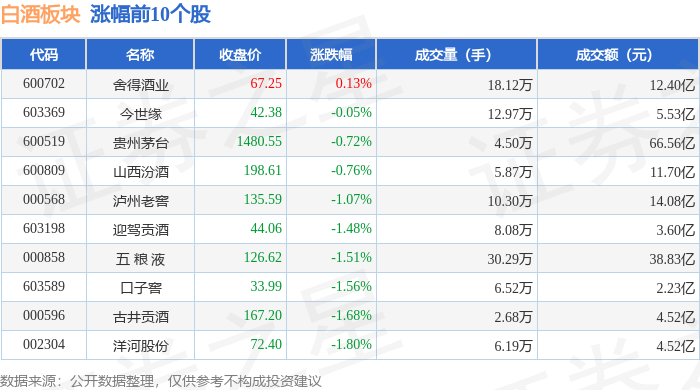
白酒板块9月3日跌0.98%,伊力特领跌,主力资金净流出7.26亿元
Zheng Xing Xing Ye Ri Bao· 2025-09-03 08:40
Market Overview - The liquor sector experienced a decline of 0.98% on September 3, with Yili Te leading the drop [1] - The Shanghai Composite Index closed at 3813.56, down 1.16%, while the Shenzhen Component Index closed at 12472.0, down 0.65% [1] Individual Stock Performance - Key stocks in the liquor sector showed varied performance, with the following notable changes: - Shede Liquor: Closed at 67.25, up 0.13% [1] - Kweichow Moutai: Closed at 1480.55, down 0.72% with a trading volume of 45,000 shares and a transaction value of 6.656 billion [1] - Wuliangye: Closed at 126.62, down 1.51% with a trading volume of 302,900 shares and a transaction value of 3.883 billion [1] - Yili Te: Closed at 15.56, down 3.35% with a trading volume of 78,800 shares and a transaction value of 1.25 billion [2] Capital Flow Analysis - The liquor sector saw a net outflow of 726 million from institutional investors, while retail investors contributed a net inflow of 479 million [2] - The following stocks had significant capital flow: - Shede Liquor: Net inflow from institutional investors was 59.79 million, while retail investors had a net outflow of 17.44 million [3] - Kweichow Moutai: Experienced a net outflow of 14 million from institutional investors [3] - Yili Te: Had a net outflow of 2.68 million from institutional investors [3]


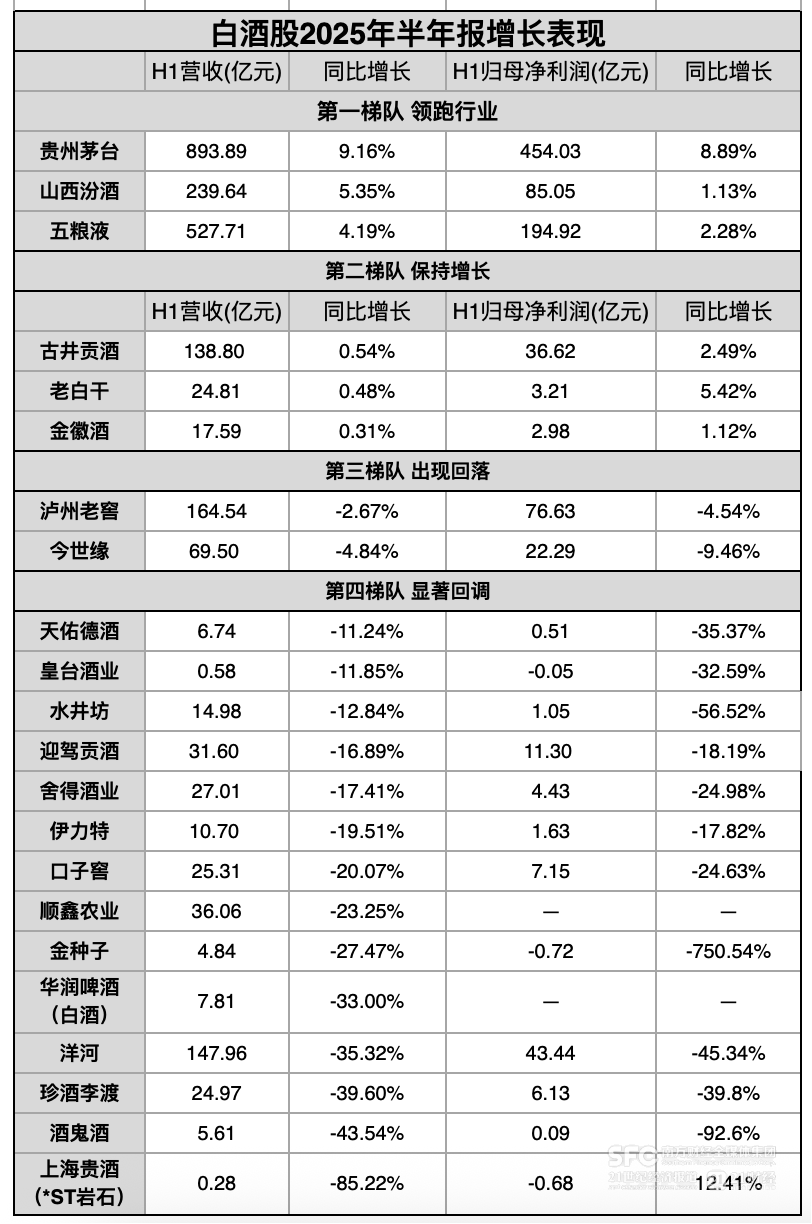
二季度迎驾贡酒、今世缘、珍酒李渡等17家白酒企业营收下滑
2 1 Shi Ji Jing Ji Bao Dao· 2025-09-03 08:22
Core Viewpoint - The Chinese liquor industry is currently in a downward trend, with many companies experiencing significant declines in performance, indicating a challenging market environment [1][5][8]. Financial Performance Summary - Among 21 listed liquor companies, 15 reported a decline in performance in the first half of the year, while only 6 maintained positive growth, including leading brands like Kweichow Moutai, Wuliangye, and Shanxi Fenjiu [1][2]. - Kweichow Moutai reported a revenue of 89.39 billion yuan, with a year-on-year growth of 9.16%, and a net profit of 45.40 billion yuan, growing by 8.89% [2]. - Shanxi Fenjiu and Wuliangye also showed growth, but many other companies, especially in the lower tiers, faced significant declines, with some experiencing drops over 20% [2][4]. Market Dynamics - The second quarter saw 17 out of 21 liquor companies report revenue declines, with half of them experiencing drops exceeding 20% [4][5]. - The overall market is undergoing a reshuffling, with leading brands maintaining their positions while others struggle to keep up [8][10]. - The industry is witnessing a trend where competitive advantages are increasingly concentrated among top brands, leading to a significant market reshuffle [12][19]. Future Outlook - Analysts suggest that unless there is a rapid market recovery in the third quarter, most liquor companies are unlikely to see unexpected growth in the latter half of the year [7][15]. - There is speculation that the upcoming Mid-Autumn and National Day festivals could provide a window for price stabilization and potential recovery for leading brands [14][18]. - The current market conditions may lead to a prolonged adjustment period, with some experts predicting a U-shaped recovery by late 2026 [16][20].


方正证券:白酒行业筑底深化 龙头企业优势凸显
智通财经网· 2025-09-03 08:15
Core Viewpoint - The current outlook for the liquor industry indicates that a bottom has formed due to multiple policy catalysts, with the liquor sector showing signs of recovery but still at historical lows. The industry is expected to benefit from improved economic expectations, with a focus on the upcoming Mid-Autumn Festival and National Day for demand recovery [1][2]. Group 1: Industry Performance - In Q2 2025, the liquor industry entered a deep adjustment phase under macroeconomic and policy pressures, with total revenue for the first half of 2025 reaching 239.8 billion yuan, a year-on-year decrease of 0.9%, and net profit attributable to shareholders at 94.6 billion yuan, down 1.2% [2]. - Excluding Moutai, other listed companies in the sector reported a total revenue of 150.4 billion yuan in H1 2025, a decline of 6.1%, with net profit at 49.2 billion yuan, down 8.9% [2]. - The overall price of mainstream liquor products has declined, but with improving industry sentiment and easing constraints in H2, a recovery is anticipated, particularly during the peak sales periods of the Mid-Autumn Festival and National Day [2]. Group 2: Brand and Price Segmentation - High-end liquor brands are outperforming mid-range and regional brands, with high-end brands maintaining resilience through strong brand power and channel control. Moutai and other leading brands are stabilizing their market positions through inventory control and channel optimization [3]. - Mid-range liquor brands are experiencing more direct impacts from policy changes, with some brands like Fenjiu showing continued growth despite pressures [3]. - Regional leaders are focusing on maintaining market share and stabilizing core product prices, while brands like Jiangsu Yanghe and Jiuzi have seen significant adjustments [3]. Group 3: Investment Recommendations - The company suggests focusing on leading brands with strong market positions such as Moutai, Wuliangye, Luzhou Laojiao, and Shanxi Fenjiu during the economic transition [3]. - Regional leaders that maintain their core markets, such as Gujing Gongjiu and Jiuzi, are expected to sustain momentum as demand recovers [3]. - Brands that have actively managed their financials during this adjustment period, like Shede and Yanghe, are also recommended for attention [3].


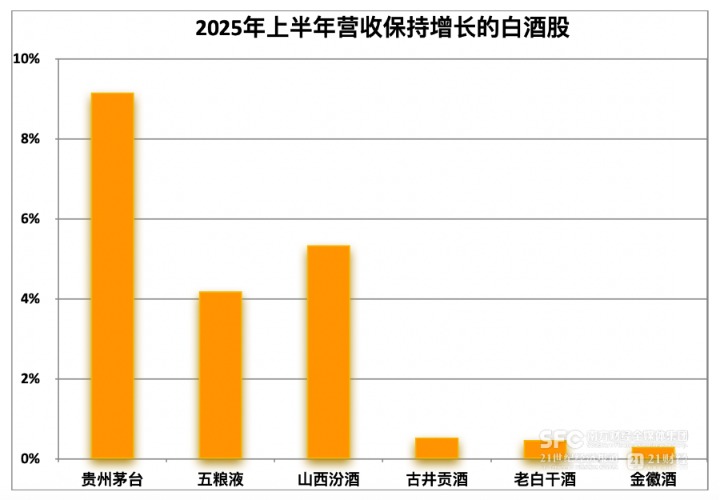
名酒保住增长,白酒业即将穿越周期?
2 1 Shi Ji Jing Ji Bao Dao· 2025-09-03 08:05
Core Viewpoint - The Chinese liquor industry, particularly the baijiu sector, is currently experiencing a downturn, with many companies reporting declining performance. However, some analysts believe this could signal a bottoming out and potential recovery in the future [1][12]. Industry Performance - In the first half of the year, 15 out of 21 listed baijiu companies reported declining performance, with only 6 companies, including Kweichow Moutai and Wuliangye, showing positive growth [1][4]. - The overall industry is facing significant challenges, with many companies returning to average performance levels after years of high growth [4][11]. Company-Specific Insights - Leading companies like Kweichow Moutai and Wuliangye continue to show resilience, maintaining their positions despite a slowdown in growth [5][9]. - Companies such as Yingjia Gongjiu and Jiuzi Jiu have reported significant declines, with Yingjia Gongjiu's revenue dropping by 24% and net profit by 35% in Q2 [2][8]. - The performance of Shanxi Fenjiu has slowed, with growth rates returning to single digits after years of double-digit increases [2][6]. Market Dynamics - The competitive landscape is shifting, with a clear trend of market share concentrating among top brands, while smaller and regional brands struggle to maintain their positions [10][11]. - The number of regulated baijiu companies has decreased, indicating a consolidation trend within the industry [11]. Future Outlook - Analysts suggest that the second half of the year may see a potential rebound, particularly during the Mid-Autumn Festival and National Day, which could provide a window for price stabilization and recovery [12][13]. - Despite recent stock price increases, the overall sentiment remains cautious, with many expecting that a full recovery may take until late 2025 or beyond [13][14].

食品饮料2025年白酒板块中报总结:出清开启,加速寻底
CMS· 2025-09-02 03:05
Investment Rating - The report maintains a strong buy recommendation for leading companies in the liquor sector, including Guizhou Moutai, Wuliangye, and Luzhou Laojiao, while suggesting a hold for Yingjia Gongjiu and Jinhuijiu [10][9]. Core Insights - The liquor industry is undergoing a significant clearing phase due to the impact of the "ban on alcohol" policy, with second and third-tier companies facing substantial challenges, while leading firms show resilience [1][9]. - The report anticipates that the financial statements of leading liquor companies will signal an industry turning point, potentially reshaping market expectations and indicating a gradual emergence of the industry bottom [9][1]. - The demand for liquor is expected to continue recovering, driven by a positive price index in 2026, which may lead to inflation and increased corporate profitability [1][9]. Revenue and Net Profit - In Q2 2025, the liquor industry reported revenues of 881 billion yuan, a year-on-year decrease of 5.0%, and a net profit of 312 billion yuan, down 7.5% [2][13]. - For the first half of 2025, the industry generated revenues of 2,415 billion yuan, with a slight year-on-year decline of 0.9% in revenue and 1.2% in net profit [2][13]. - Excluding Moutai, the industry's revenue in Q2 2025 was 484 billion yuan, reflecting a more significant decline of 13.1% [2][13]. Profitability - The overall gross margin of the liquor sector is under pressure due to declining prices and structural changes, with high-end liquor experiencing a slight decrease in gross margin [4][28]. - Many companies have increased their expense ratios to cope with price declines and intensified competition, although some have managed to reduce costs through digitalization and refined channel management [4][28]. Investment Recommendations - The report suggests focusing on strong leading companies and those that have cleared their market burdens first, such as Shanxi Fenjiu and Luzhou Laojiao, while also monitoring companies like Yingjia Gongjiu and Jinhuijiu for potential growth contributions in the second half of 2025 [9][10]. - The anticipated recovery in liquor demand and the potential for improved profitability in 2026 present a favorable investment landscape for the sector [9][1].


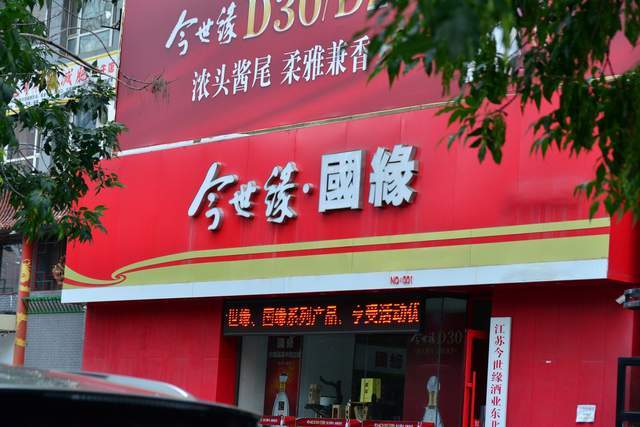
今世缘“后百亿时代”遇挑战,上半年业绩下滑,150亿目标难度升级
Sou Hu Cai Jing· 2025-09-01 18:48
Core Viewpoint - The competitive landscape of the liquor industry is intensifying, with companies facing significant challenges in achieving growth and market dominance. Despite entering the "100 billion revenue club," the company Jinshiyuan's path to growth diverges from its peers, facing declining revenues and profits amid ambitious expansion goals [1][2]. Group 1: Financial Performance - In 2023, Jinshiyuan achieved over 10 billion in revenue but reported a mere 7.24% contribution from out-of-province markets [1]. - The company's half-year report for 2025 indicated a revenue decline of 4.84% and a net profit drop of 9.46%, marking the third instance of simultaneous revenue and profit decline since its listing in 2014 [1]. - Securities firms have revised down their revenue forecasts for Jinshiyuan, with predictions indicating a potential year-on-year revenue decline for 2025, making the ambitious target of 15 billion seem increasingly unattainable [1]. Group 2: Market Challenges - The primary market for Jinshiyuan, Jiangsu province, is experiencing a downturn, significantly impacting the company's overall performance [2]. - The anticipated growth in out-of-province markets has slowed to less than 5%, complicating the company's national expansion efforts [2]. Group 3: High-End Market Strategy - Jinshiyuan's high-end brand, Guoyuan, is facing challenges, with a notable decline in the sales of high-end products, particularly in the 400-600 yuan and above price segments [4]. - The company's core products, especially the V series, are experiencing significant sales drops, casting doubt on its high-end market strategy [4]. Group 4: Expansion Efforts - Jinshiyuan is focusing its national expansion on core markets surrounding Jiangsu, such as Anhui, Shandong, Shanghai, and Zhejiang, while building a large network of distributors [5]. - Despite efforts to increase the number of out-of-province distributors, there remains a substantial performance gap compared to in-province distributors [5]. - The company is attempting to replicate its successful strategies from Jiangsu in out-of-province markets, although the effectiveness of this approach remains to be seen [7].
25H1白酒综述:逆势调整,报表纾压
HTSC· 2025-09-01 11:06
证券研究报告 必选消费 25H1 白酒综述:逆势调整,报表纾压 华泰研究 2025 年 9 月 01 日│中国内地 专题研究 25H1 CS 白酒板块营收/扣非归母净利同比-1%/-1%;25Q2 营收/扣非归母 净利同比-5%/-8%,环比降速。二季度板块受"518 新政"影响,部分政商 务消费场景缺失,压制板块表现;当前基本面环比企稳,预计 8 月以来白酒 动销端表现环比降幅收窄,部分大众宴席场景修复较快,300 元以下大众价 位白酒产品有所修复;当前政商务消费仍然有所承压,预计未来随政策限制 收窄需求也将稳步恢复。中秋旺季将近,期待需求稳步修复带动行业动销改 善。当前头部酒企均以企业长期健康发展为核心,整体经营更加务实,报表 端稳步释放压力。优选高端酒贵州茅台/五粮液/泸州老窖,关注需求恢复节 奏,推荐山西汾酒/古井贡酒/今世缘等。维持板块"增持"评级。 高端酒:经营凸显稳健,经营理性务实 25H1 高端白酒营收/扣非净利同比+6%/+6%,25Q2 营收/扣非净利同比 +3%/+1%。整体业绩凸显稳健,强品牌力龙头需求坚挺,酒企主动调整发 货节奏,在行业调整期中仍实现稳健表现。具体看,贵州茅台 25Q ...

和君王明夫:世界酒业王者是怎样炼成的?
Sou Hu Cai Jing· 2025-09-01 10:19
Core Insights - The article emphasizes the potential for individual wine enterprises to rise above current industry challenges through self-initiated efforts and strategic innovation, suggesting that the time has come for China to produce a global wine leader [2][3]. Industry Overview - The global wine industry is characterized by significant competition and evolving market dynamics, with a focus on strategic growth paths for companies transitioning from local to global players [2][3]. - The top ten global wine companies are dominated by beer giants, with Anheuser-Busch InBev leading at $593.8 billion in revenue, followed by Heineken at $402.1 billion and Diageo at $247.4 billion [7][14]. - In contrast, the Chinese wine industry shows a strong dominance of baijiu companies, with seven out of the top ten companies being baijiu producers, highlighting a stark difference from the global trend [14][17]. Company Performance - The top Chinese wine company, Kweichow Moutai, reported revenues of $212.1 billion, making it the second-largest wine company globally by market capitalization [11][17]. - The combined revenue of the top ten Chinese wine companies is approximately $620 billion, which is about 30% of the total revenue of the top ten global wine companies [17]. - The market capitalization of Kweichow Moutai and Wuliangye significantly exceeds that of their global counterparts, indicating a higher valuation in the capital markets [17][18]. Strategic Insights - The article discusses the importance of management consulting, goal decomposition, and process management as critical components for success in the wine industry [2][18]. - The narrative of Anheuser-Busch InBev's rise illustrates the effectiveness of strategic acquisitions and operational efficiencies in building a global brand [19][27]. - Diageo's growth is attributed to a series of strategic acquisitions and a focus on high-end products, showcasing the importance of brand management and market responsiveness [39][50]. Market Trends - The article notes a lack of significant presence for wine companies in the global top rankings, suggesting challenges in scaling production and market share within the wine sector [18]. - The Chinese wine market is characterized by a lack of internationalization, with Moutai's overseas revenue accounting for only 4% of its total, indicating potential growth opportunities in global markets [14][17].



食品饮料行业周报:半年报季如期收官,新老消费可圈可点-20250901
Huaxin Securities· 2025-09-01 08:56
Investment Rating - The report maintains a "Recommended" investment rating for the food and beverage industry [9]. Core Insights - The food and beverage industry shows resilience with a notable performance in the liquor sector, particularly for leading brands like Kweichow Moutai and Wuliangye, which are expected to achieve stable growth [6][9]. - The new consumption sector is experiencing high demand, with individual company performances expected to steadily improve, driven by strong fundamentals [7][9]. - The report highlights the ongoing recovery in the mass consumer goods sector, with a focus on companies like Ximai Food and Youyou Food, which are expected to benefit from market dynamics [9]. Industry Performance - The food and beverage sector has shown a 1-month performance of 6.6%, a 3-month performance of 0.6%, and a 12-month performance of 13.1% [3]. - The liquor industry reported sales revenue of 330.42 billion yuan for the first half of the year [20]. - The report notes a 5.3% year-on-year increase in liquor industry revenue, totaling 796.4 billion yuan for 2024 [34]. Company Feedback - Kweichow Moutai is launching a high-end product, Moutai 1935, and continues to expand its cultural experience venues [20]. - Ximai Food reported a gross margin increase of 3 percentage points to 43.5% due to product structure optimization and lower raw material costs [58]. - Shede Liquor's net profit margin improved by 5 percentage points to 8.56% in Q2 2025, reflecting effective cost control measures [61]. Key Data Trends - The liquor industry's cumulative production for 2024 was 4.145 million tons, a decrease of 7.72% year-on-year [34]. - The seasoning industry is projected to grow from 259.5 billion yuan in 2014 to 687.1 billion yuan by 2024, with a CAGR of 10.23% [36]. - The snack food market is expected to grow from 0.82 trillion yuan in 2016 to 1.2 trillion yuan in 2022, with a CAGR of 6% [52].