
King's Luck(603369)

Search documents
江苏和河南调研反馈、周观点:白酒旺季渐进,速冻变化积极-20260118
GOLDEN SUN SECURITIES· 2026-01-18 06:32
Investment Rating - The report suggests a positive investment outlook for the liquor and frozen food sectors, particularly highlighting the upcoming Spring Festival as a catalyst for sales growth in the liquor industry [1][2]. Core Insights - The liquor market is expected to see improved sales performance as the Spring Festival approaches, with Moutai leading the way. The report indicates that Moutai's pricing strategy and sales performance are likely to drive industry-wide improvements [1][2]. - The frozen food sector is experiencing a recovery, with demand rebounding and price competition easing. Leading companies in this sector are expected to benefit significantly from this trend [2]. - The snack food segment is also showing signs of recovery, with companies that faced challenges in 2025 beginning to emerge from their operational lows. The upcoming Spring Festival is anticipated to boost inventory levels and sales [2]. Summary by Sections Liquor Sector - The report indicates that as the Spring Festival approaches, channel collections are progressing normally, and sales are expected to improve slightly despite year-on-year pressure. Moutai is expected to perform strongly, with its pricing strategy showing a stabilizing effect [2]. - The report emphasizes that liquor companies are prioritizing volume over price and focusing on quality to gain market share [2]. Frozen Food Sector - The frozen food market is currently in its peak sales season, with demand showing a month-on-month recovery. The report notes that leading companies are likely to see revenue growth due to a low base effect and improved profit margins [2]. Snack Food Sector - Companies in the snack food sector that faced challenges in 2025 are now gradually recovering. The report highlights that the upcoming Spring Festival will significantly enhance inventory levels and sales opportunities for these companies [2]. Specific Companies - Moutai, Guizhou Moutai, and other leading liquor brands are recommended for short-term investment due to their strong performance during the Spring Festival [1]. - Companies like Sanquan Foods and others are noted for their innovative product launches and channel strategies, which are expected to drive revenue growth [4].




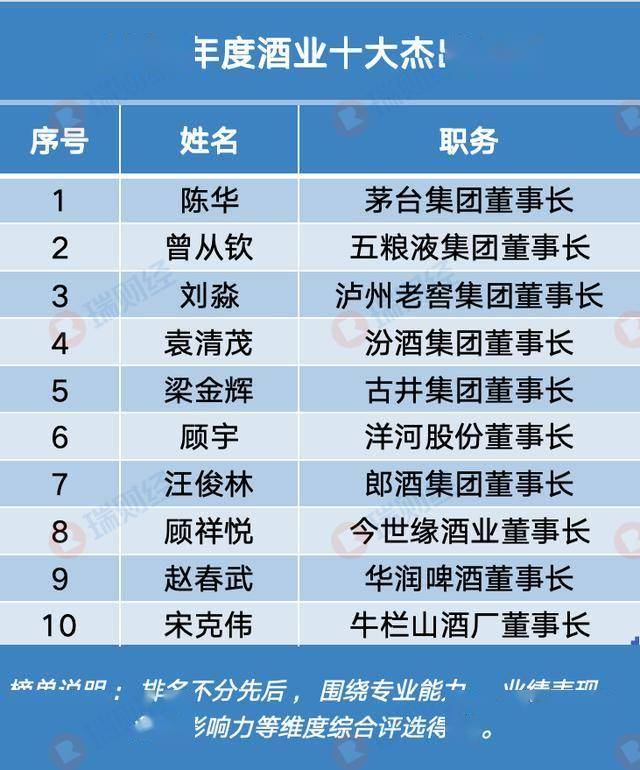
今世缘酒业董事长顾祥悦入选“2025年度酒业十大杰出人物”
Sou Hu Cai Jing· 2026-01-16 02:10
Core Insights - The "Top Ten Outstanding Figures in the Liquor Industry for 2025" list was announced by Rui Finance, highlighting Gu Xiangyue, the chairman of Jinshiyuan Liquor, as a notable figure [2] - The selection criteria for the list included professional ability, performance, and industry influence [2] Group 1 - Gu Xiangyue, born in June 1968, serves as the chairman and general manager of Jinshiyuan [3] - Gu has a master's degree in agricultural promotion from Nanjing Agricultural University and has held various political positions before joining Jinshiyuan [3] - Under Gu's leadership, Jinshiyuan aims to enhance its product matrix, expand brand marketing, and accelerate national distribution in 2025 [3]

今世缘1月15日获融资买入1532.85万元,融资余额3.65亿元
Xin Lang Cai Jing· 2026-01-16 01:33
Core Viewpoint - The company, Jiangsu Jinshiyuan Liquor Co., Ltd., has experienced a decline in both revenue and net profit for the first nine months of 2025, indicating potential challenges in its financial performance [2]. Group 1: Financial Performance - For the period from January to September 2025, the company achieved operating revenue of 8.881 billion yuan, a year-on-year decrease of 10.66% [2]. - The net profit attributable to shareholders for the same period was 2.549 billion yuan, reflecting a year-on-year decline of 17.39% [2]. - Cumulative cash dividends since the company's A-share listing amount to 6.835 billion yuan, with 3.653 billion yuan distributed over the past three years [2]. Group 2: Shareholder and Market Activity - As of September 30, 2025, the number of shareholders increased to 66,300, up by 5.09% from the previous period [2]. - The average number of circulating shares per shareholder decreased by 4.84% to 18,798 shares [2]. - The top circulating shareholder, China Merchants Zhongzheng Liquor Index A, holds 61.7143 million shares, unchanged from the previous period, while a new shareholder, the Wine ETF, holds 23.7899 million shares [2]. Group 3: Financing and Trading Activity - On January 15, the company's stock price fell by 1.19%, with a trading volume of 226 million yuan [1]. - The financing buy-in amount for the company on that day was 15.3285 million yuan, while the financing repayment was 15.5658 million yuan, resulting in a net financing buy-in of -237,300 yuan [1]. - The total balance of margin trading as of January 15 was 369 million yuan, with the financing balance accounting for 0.84% of the circulating market value, indicating a high level compared to the past year [1].
白酒板块1月15日跌0.77%,*ST岩石领跌,主力资金净流出11.52亿元
Zheng Xing Xing Ye Ri Bao· 2026-01-15 08:59
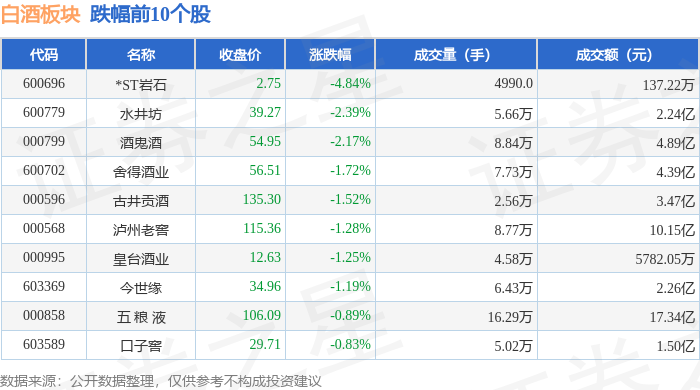
Group 1 - The liquor sector experienced a decline of 0.77% on January 15, with *ST Rock leading the drop [1] - The Shanghai Composite Index closed at 4112.6, down 0.33%, while the Shenzhen Component Index rose by 0.41% to 14306.73 [1] - Major liquor stocks showed varied performance, with *ST Rock down 4.84% to 2.75, and other notable declines including Shui Jing Fang down 2.39% and Moutai down 7.31% in net outflow [1][2] Group 2 - The liquor sector saw a net outflow of 1.152 billion yuan from main funds, while retail investors contributed a net inflow of 528 million yuan [1] - Specific stocks like Moutai and Wuliangye faced significant net outflows of 416 million yuan and 201 million yuan respectively, indicating a shift in investor sentiment [2] - The data indicates that retail investors are increasingly active, with a notable net inflow into stocks like Wuliangye, which saw 157 million yuan from retail investors [2]


A股白酒股普跌
Ge Long Hui· 2026-01-13 06:12
Group 1 - The core viewpoint of the article highlights a decline in A-share market for liquor stocks, particularly with major brands like Moutai planning to lower the prices of several products [1] - Major liquor stocks such as Shui Jing Fang, Gu Jing Gong Jiu, and others fell over 1%, while Moutai experienced a slight decline of 0.7% [1] - Moutai has reportedly confirmed a price reduction for certain products, including premium Moutai and Moutai 1935, affecting the contract prices for distributors [1]


酱酒品牌剩者为王,大众品重视春节催化:食品饮料行业周报(20260105-20260111)-20260112
Huachuang Securities· 2026-01-12 11:12
Investment Rating - The report maintains a "Recommendation" rating for the food and beverage industry, indicating an expected increase in the industry index exceeding the benchmark index by more than 5% in the next 3-6 months [26]. Core Insights - The report emphasizes that the remaining brands in the sauce liquor sector will thrive, while mass-market products are expected to benefit from the upcoming Spring Festival [2][8]. - The dairy sector is showing signs of improvement, with a potential rebound in raw milk prices and a narrowing supply-demand gap, which could lead to increased demand for processed dairy products [6]. - The beverage and snack categories are experiencing sustained growth, with specific segments like energy drinks and konjac snacks showing remarkable sales increases despite overall declines in the snack market [6]. - The report highlights a significant shift in the sauce liquor industry, where pricing strategies are becoming more pragmatic, with a new growth level emerging around the 200 yuan price point as lower-tier brands face market exit pressures [6][8]. - The report suggests that leading liquor companies should maintain operational stability during this industry downturn, focusing on balanced investments in base liquor to prepare for future market recovery [8]. Summary by Sections Industry Overview - The food and beverage sector consists of 126 listed companies with a total market capitalization of 44,935.30 billion yuan, representing 3.54% of the market [3]. - The circulating market value stands at 43,859.19 billion yuan, accounting for 4.28% of the total market [3]. Performance Metrics - The absolute performance of the industry over the past month is 1.3%, with a relative performance decline of 2.2% compared to the benchmark [4]. - Over the past 12 months, the industry has seen a relative performance decline of 25.2% [4]. Sector-Specific Insights - Dairy products are expected to benefit from a favorable pricing environment and improved supply dynamics, with major companies actively preparing for the Spring Festival [6]. - The beverage sector is witnessing growth in specific categories, with leading brands launching targeted marketing campaigns for the holiday season [6]. - The sauce liquor market is undergoing a consolidation phase, with a focus on brand strength and market share recovery among leading companies [6][8].


今世缘等成立文化传媒公司,注册资本1000万
Xin Lang Cai Jing· 2026-01-12 10:04
Group 1 - Jiangsu Jinshi Cultural Media Co., Ltd. was established on January 12, with a registered capital of 10 million RMB [1] - The legal representative of the company is Yang Dong [1] - The company's business scope includes general aviation services, performance brokerage, advertising publishing, information technology consulting services, network technology services, enterprise management, marketing planning, project planning, and public relations services [1] Group 2 - The shareholders of the company are Nanjing Times Media Co., Ltd. holding 51% and Jiangsu Jinshiyuan Liquor Sales Co., Ltd. holding 49% [1]
白酒板块1月12日涨0.79%,*ST岩石领涨,主力资金净流入4.03亿元
Zheng Xing Xing Ye Ri Bao· 2026-01-12 09:04
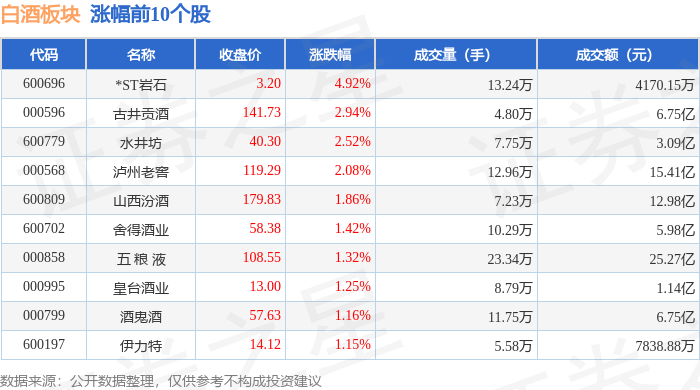
Core Viewpoint - The liquor sector experienced a rise of 0.79% on January 12, with *ST Rock leading the gains, while the Shanghai Composite Index rose by 1.09% and the Shenzhen Component Index increased by 1.75% [1] Group 1: Market Performance - The closing price of *ST Rock was 3.20, with a gain of 4.92% and a trading volume of 132,400 shares, amounting to 41.70 million yuan [1] - Gujing Gongjiu closed at 141.73, up 2.94%, with a trading volume of 48,000 shares and a transaction value of 675 million yuan [1] - Luzhou Laojiao closed at 119.29, increasing by 2.08%, with a trading volume of 129,600 shares and a transaction value of 1.54 billion yuan [1] Group 2: Capital Flow - The liquor sector saw a net inflow of 403 million yuan from main funds, while retail investors experienced a net outflow of 29.32 million yuan [1] - Wuliangye had a main fund net inflow of 267 million yuan, but retail funds saw a net outflow of 87.06 million yuan [2] - Luzhou Laojiao recorded a main fund net inflow of 85.62 million yuan, with retail funds experiencing a net outflow of 34.07 million yuan [2]



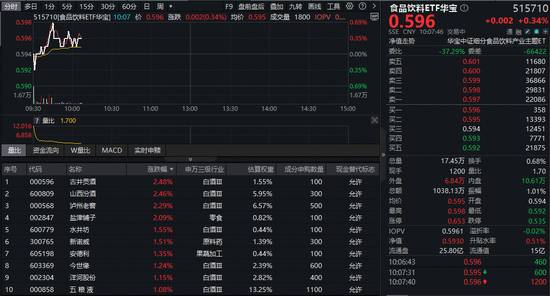
“i茅台”成交用户超40万!“茅五泸汾洋”集体上攻,机构喊话白酒配置机会!
Xin Lang Ji Jin· 2026-01-12 02:30
Group 1 - The food and beverage sector is experiencing an upward trend, with the Huabao Food and Beverage ETF (515710) showing a price increase of 0.34% as of the latest update [1] - Major liquor stocks such as Shanxi Fenjiu, Luzhou Laojiao, and Gujing Gongjiu have surged over 2%, while Wuliangye and Yanghe have increased by more than 1% [1] - The recent communication from Kweichow Moutai to its distributors emphasizes a strategy to stabilize the market by ensuring product availability directly to consumers, with over 2.7 million new users on the iMoutai platform [2][4] Group 2 - Guojin Securities notes that the market's expectations for the liquor industry are at an absolute low, and the clear volume and price planning from leading companies will alleviate concerns about price competition [3] - The valuation of the food and beverage sector is at a historical low, making it a favorable time for investment, with the food and beverage ETF's price-to-earnings ratio at 20.16, which is in the bottom 5.88% of the last decade [3] - CITIC Securities suggests that the current adjustments in the liquor industry may signal a turning point, with the upcoming Spring Festival being a critical observation period for market recovery [4] Group 3 - The Huabao Food and Beverage ETF (515710) primarily invests in leading high-end and mid-range liquor stocks, with about 60% of its portfolio allocated to these sectors [5] - The top ten weighted stocks in the ETF include major brands like Moutai, Wuliangye, and Luzhou Laojiao, indicating a strong focus on established players in the market [5]

品牌江苏挑大梁
Xin Hua Ri Bao· 2026-01-11 20:38
Group 1 - The conference titled "Guo Yuan V3.2025 Jiangsu Brand Innovation Development Conference" was held in Nanjing, focusing on the theme "Brand Jiangsu Takes the Lead, Innovation Development Sets an Example" [1] - The event gathered over 500 representatives from the brand sector, emphasizing the importance of brand empowerment in enhancing new productivity and consumer confidence [1] - The conference aligns with the goals of the "14th Five-Year Plan" and sets the stage for the "15th Five-Year Plan," highlighting Jiangsu's role in technological and industrial innovation [1] Group 2 - Dr. Xu Haoran delivered a keynote speech on the global rise of Chinese brands, emphasizing the shift from "scale expansion" to "value leadership" as a core mission [2] - The five core paths for brand development in the "15th Five-Year Plan" include technological innovation, cultural confidence, green transformation, digital integration, and institutional innovation [2] - The conference announced the first batch of brands selected for the "Strong Country Brand Plan," including companies like Jinshiyuan and Jiangsu Transportation Group [3] Group 3 - The conference featured a roundtable discussion on the "Su Chao" phenomenon, which has become one of the hottest brand events in 2025, attracting 2.343 million spectators and generating significant consumer engagement [5] - Experts analyzed the reasons behind the popularity of "Su Chao" and its implications for brand image enhancement [5] - The event concluded with a networking gala titled "Guo Yuan V3. Brand Night," fostering connections among brand experts and entrepreneurs [5]
