VANKE(000002)

Search documents
预警“活下去”的郁亮谢幕,万科仍困“深渊”
凤凰网财经· 2026-01-08 15:09
Core Viewpoint - The retirement of Yu Liang marks the end of an era for the Chinese real estate industry, symbolizing the transition from a period of rapid growth to an uncertain future for the sector [4][19]. Group 1: Yu Liang's Career and Impact - Yu Liang, known as a key figure in the Chinese real estate industry, has been referred to as the "whistleblower" of the sector due to his insightful predictions about industry turning points [5]. - He joined Vanke in 1990 and rose through the ranks, becoming the general manager in 2001 and later the chairman, leading the company to significant milestones, including surpassing 100 billion yuan in sales in 2010 [6][9]. - Under his leadership, Vanke transitioned from a focus on scale to emphasizing quality, coining terms like "white silver era" and "black iron era" to describe the industry's evolution [9][19]. Group 2: Transition of Leadership - In January 2025, Vanke announced a significant management reshuffle, with Yu Liang stepping down as chairman, marking the end of a 30-year era of professional management at the company [11]. - The new leadership structure, characterized by a combination of state-owned and professional managers, indicates a shift in Vanke's operational strategy [11][13]. Group 3: Financial Challenges and Debt Crisis - Vanke is facing severe financial difficulties, with total interest-bearing liabilities reaching 362.93 billion yuan and a cash short-term debt ratio of only 0.43, indicating a precarious liquidity position [16]. - The company reported a revenue decline of 26.61% year-on-year for the first three quarters of 2025, alongside a net loss of 28.02 billion yuan, exacerbating concerns about its financial health [16]. - To address these challenges, Vanke has received nearly 30 billion yuan in funding support from its major shareholder, Shenzhen Metro Group, and is exploring various financial strategies, including REITs and debt restructuring [16][19]. Group 4: Industry Context and Future Outlook - The departure of Yu Liang signifies not only a personal transition but also reflects the broader challenges facing the real estate sector in China, which is undergoing a significant downturn [4][19]. - The ongoing management changes and financial struggles at Vanke highlight the need for a new strategy to navigate the post-real estate boom landscape, raising questions about who will lead the company's recovery efforts [20].

万科郁亮时代,正式落幕
财联社· 2026-01-08 14:56
Core Viewpoint - The retirement of Yu Liang marks a significant transition for Vanke, a leading player in China's real estate industry, as it faces challenges related to debt and management changes [3][4][16]. Group 1: Yu Liang's Career and Impact - Yu Liang served at Vanke for 36 years, becoming a pivotal figure in the company's evolution from a diversified business to a leading real estate enterprise [4][5]. - Under Yu's leadership, Vanke became the first real estate company in China to achieve over 100 billion yuan in sales, reaching 108.16 billion yuan in 2010 [9][11]. - Yu introduced innovative strategies such as the "5986 model" during the 2008 financial crisis, which helped Vanke maintain strong sales and market share [9][12]. Group 2: Challenges Faced by Vanke - Vanke is currently grappling with significant debt issues, with a total of 217.98 billion yuan in outstanding bonds, including 157.53 billion yuan due within a year [18][20]. - The company has initiated debt extension processes, but proposals have faced substantial opposition, indicating a lack of confidence among investors [17][20]. - Yu's departure signifies a shift from a market-driven management model to one influenced by major shareholders, raising concerns about Vanke's future direction and crisis management capabilities [20].
万科郁亮时代,正式落幕
Xin Lang Cai Jing· 2026-01-08 14:20
Core Viewpoint - The retirement of Yu Liang marks a significant transition for Vanke, a leading player in China's real estate industry, as he steps down after 36 years of service, leaving behind a company facing substantial debt challenges and a need for strategic direction [1][9]. Group 1: Yu Liang's Career and Contributions - Yu Liang joined Vanke in 1990 and quickly rose through the ranks due to his financial expertise, becoming a key figure in the company's transformation and growth [2][5]. - Under his leadership, Vanke became the first real estate company in China to achieve over 100 billion yuan in sales, reaching 108.16 billion yuan in 2010, and maintained its position as an industry leader for several years [3][6]. - Yu Liang's strategic foresight was evident when he introduced the "Ten-Year 1000 Billion Plan" and the "5986 Model," which helped Vanke navigate market fluctuations and achieve significant sales growth [3][4]. Group 2: Challenges Faced by Vanke - Despite past successes, Vanke has faced increasing financial pressures, particularly highlighted by a net loss of 49.478 billion yuan in 2024, raising concerns about its debt management and overall financial health [8][12]. - The company is currently dealing with urgent debt extension issues, with multiple bonds approaching maturity and a need for investor consensus on extension proposals [10][11]. - Analysts suggest that Vanke's future direction is uncertain, especially as it transitions from a market-driven enterprise to one influenced by major shareholders, indicating a shift in corporate governance and strategy [12].
重磅 | 2025中国房地产企业产品力TOP100榜单发布!
克而瑞地产研究· 2026-01-08 13:57
Core Viewpoint - In 2025, the real estate industry is transitioning from quantity expansion to quality enhancement, with the concept of "good housing" becoming a national strategy, marking a new development stage focused on product strength as the core competitive advantage [2]. Group 1: Rankings Release - The "Top 100 Real Estate Companies by Product Strength" list has been published, highlighting leading companies in the industry [4][5]. - The list includes prominent companies such as Greentown China, Poly Developments, and China Overseas Land & Investment, among others [5][6]. Group 2: Product Series and Works - The "Top 10 Product Series" and "Top 10 Works" lists have been introduced, showcasing the best residential product series and projects in the industry [8][12]. - The top luxury product series include offerings from companies like New Hope Real Estate and China Overseas Land & Investment [8]. - The top high-end works feature projects such as Beijing Run Garden and Chengdu China Merchants Xi [13][15]. Group 3: Good Housing Strategy Characteristics - Major real estate companies like Poly, China Resources, and Yuexiu have launched "good housing" strategies focusing on safety, comfort, green living, and smart technology [29]. - These strategies extend to refined values such as craftsmanship, service, low carbon, and health, implemented through quantifiable technical standards [29][33]. - Companies are establishing comprehensive technical standard systems that cover physical space and service ecology, reflecting a meticulous management approach [33]. Group 4: Trends in Residential Projects - There is a trend towards high aesthetic appeal and high performance in residential projects, with a focus on features like full-house water purification, noise reduction, and safety [37][50]. - The use of environmentally friendly materials is emphasized, with projects achieving near-zero pollution standards [51]. - Different project tiers exhibit unique characteristics, with high-end projects focusing on cultural integration and personalized services [52][63].



1月8日重要资讯一览
Zheng Quan Shi Bao Wang· 2026-01-08 13:36
Group 1 - China Petroleum & Chemical Corporation and China Aviation Oil Group have received approval from the State Council for a restructuring [2] - The Guangzhou Municipal Government has issued a plan to accelerate the construction of an advanced manufacturing city from 2024 to 2035, focusing on reusable rocket technology and establishing testing bases for large liquid rockets [2] - On January 8, polysilicon futures hit the limit down with a decline of 9%, following a meeting where the State Administration for Market Regulation discussed monopoly risks with major solar companies [2] Group 2 - Nestlé has initiated a precautionary recall of specific batches of infant formula in several European countries, with the Chinese subsidiary complying with the recall to protect consumer rights [3] - Fenglong Co. may apply for a trading suspension if its stock price continues to rise abnormally [5] - Pritchard Co. does not expect large-scale orders for its LCP film products in the brain-computer interface sector in the short term [6] - Vanke A has announced the resignation of its retiring executive vice president, Yu Liang [7] - Jiangshun Technology is planning to jointly invest in the establishment of an investment fund [8] - Kuanse Co. clarified that it is not involved in commercial aerospace or satellite navigation businesses, countering media reports [9]



突发!郁亮谢幕:三十五年万科路
Guo Ji Jin Rong Bao· 2026-01-08 13:35
Core Viewpoint - Yu Liang has officially resigned from his positions as a director and executive vice president of Vanke due to retirement, marking the end of his 35-year career with the company [2][15]. Group 1: Resignation Details - Yu Liang submitted his resignation letter to the board, effective immediately, and will no longer hold any position within the company [2]. - As of the resignation date, Yu Liang held 7,394,945 shares of Vanke, valued at over 36 million yuan based on the closing price [3]. Group 2: Career Overview - Yu Liang joined Vanke in 1990, shortly after its establishment, and played a crucial role in its early expansion and capital market entry [4]. - He was instrumental in Vanke's first B-share issuance in 1993, raising 450 million Hong Kong dollars, which solidified the company's financial foundation [4]. - His involvement in the "Junwan Battle" in 1994 helped secure management control for Vanke, leading to his entry into the board of directors [4][5]. Group 3: Leadership and Achievements - After becoming the general manager in 2001, Yu Liang led Vanke to significant sales growth, with revenue increasing from 6.3 billion yuan in 2001 to over 529.9 billion yuan in 2017, making it the industry leader [5]. - Under his leadership, Vanke transitioned from a single residential developer to a diversified "urban service provider," focusing on logistics, commercial, and long-term rental apartments [7]. Group 4: Challenges and Strategic Shifts - The real estate industry faced downturns post-2020, putting pressure on Vanke's operations [9]. - In 2025, Vanke encountered liquidity issues, prompting major changes in leadership and strategy, including a focus on risk mitigation and operational efficiency [10][11]. - Yu Liang's final public statements emphasized the need for the company to adapt and survive in challenging market conditions, marking a critical juncture for Vanke [13][14].
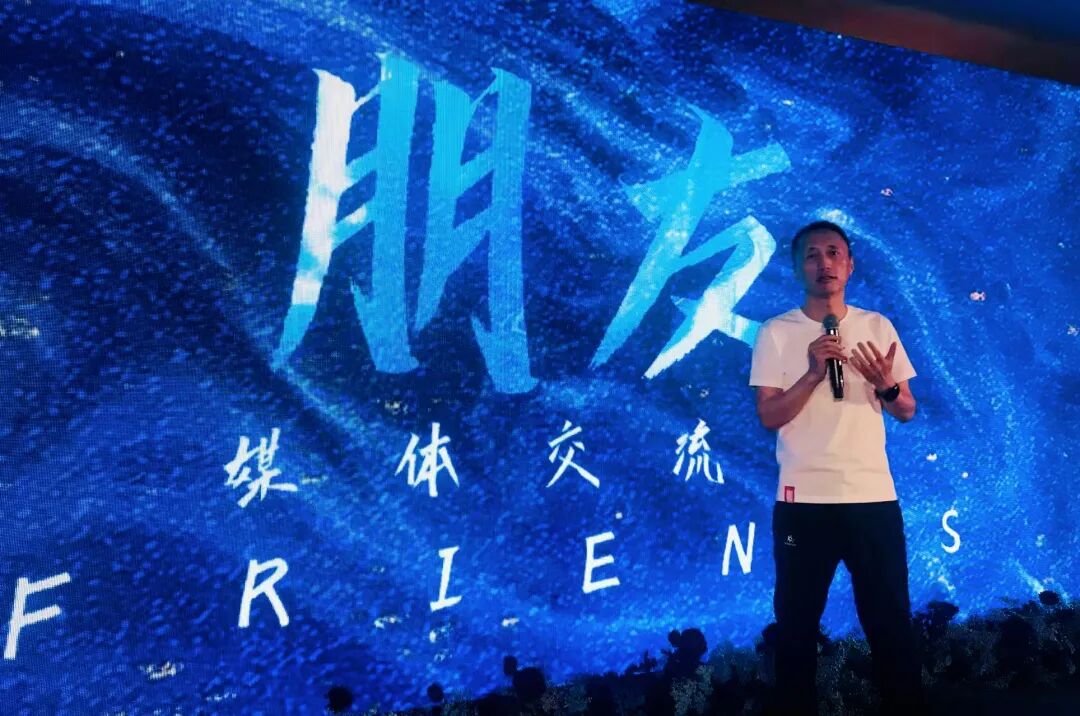
郁亮,离开万科
Bei Jing Ri Bao Ke Hu Duan· 2026-01-08 13:34
他于1990年加入万科,1992年任公司董秘,1994年起任公司董事,1996年任万科企业股份有限公司副总 经理,1999年任公司常务副总经理兼财务负责人,2001年任公司总经理(总裁),2017年任万科董事会 主席、总裁兼首席执行官。 2025年1月,万科A连发多条公告。其中,因工作调整原因,郁亮申请辞去万科董事会主席职务。此 后,郁亮担任公司董事,并担任执行副总裁职务。直至此番辞职。 来源:长安街知事微信公众号 图 万科企业股份有限公司成立于1984年,自2016年首次跻身《财富》"世界500强"以来连续9年上榜,2024 年位列第206位。2017年,深圳地铁集团成为该集团第一大股东。 官网介绍,郁亮出生于1965年,1988年毕业于北京大学国际经济学系,获学士学位;后于1997年获北京 大学经济学硕士学位。曾供职于深圳外贸集团。 转自:北京日报客户端 1月8日,万科A发布公告称,因到龄退休,郁亮向董事会提交了书面辞职报告,申请辞去公司董事、执 行副总裁职务。辞去上述职务后,郁亮将不再担任公司任何职务。截至公告披露日,郁亮持有公司股票 7,394,945股。 郁亮 资料 ...
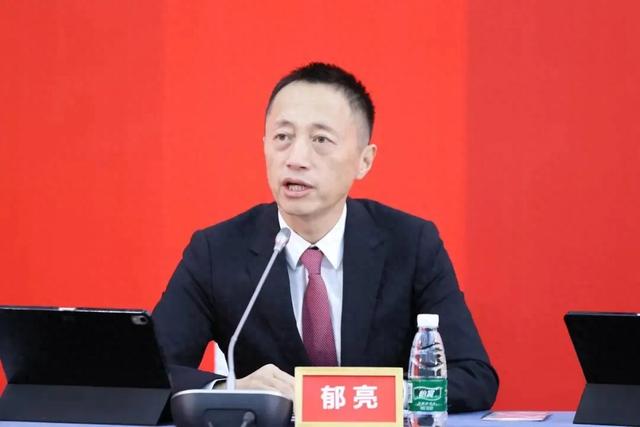
万科公告:郁亮因到龄退休辞任董事、执行副总裁 | 快讯
Hua Xia Shi Bao· 2026-01-08 13:32
公告明确,郁亮的辞职报告自送达董事会之日起生效,辞职后其将不再担任万科任何职务。作为公司核 心管理层成员,郁亮在任期间深度参与企业战略规划与经营管理,此次变动不会导致公司董事会成员低 于法定人数,亦不会对日常经营及董事会正常运作产生影响。万科方面表示,将按法定程序尽快完成董 事补选,保障公司治理连续性。 截至公告披露日,郁亮持有万科739.49万股股份,辞职后仍需严格遵守中国证监会及深圳证券交易所关 于上市公司股东股份管理的相关规定。据公开履历,郁亮深耕万科多年,任职期间见证并推动企业多项 重大战略落地,其退休辞任属于正常人事更替。 编辑:张蓓 文/黄指南 1月8日,万科企业股份有限公司发布人事公告,万科董事、执行副总裁郁亮因到龄退休,正式提交书面 辞职报告,申请辞去相关职务。 ...

郁亮退休,万科进入全深铁周期
Bei Jing Shang Bao· 2026-01-08 13:12
Core Viewpoint - The retirement of Yu Liang marks the end of a significant era for Vanke, coinciding with the company's struggle for survival amid ongoing debt negotiations and industry challenges [1][5]. Group 1: Leadership Transition - Yu Liang submitted his resignation due to reaching retirement age, officially stepping down from all positions within Vanke [1]. - His leadership began in 2017 when he took over as chairman, during a time when Vanke was already a major player in the real estate sector with annual sales in the hundreds of billions [3]. - Yu Liang's tenure was characterized by a strategic shift from being a residential developer to a broader "urban construction and life service provider" [3][4]. Group 2: Financial Challenges - Vanke is currently engaged in negotiations to extend the maturity of two domestic medium-term notes totaling 5.7 billion yuan [5]. - The company has faced significant financial pressure, with a forecast of substantial losses and unprecedented debt levels [4][5]. - Vanke's proactive approach to debt extension reflects its commitment to risk management and responsibility towards creditors, aiming to create conditions for orderly risk clearance in the industry [5]. Group 3: Support from State-Owned Enterprises - The future of Vanke increasingly relies on support from its major shareholder, Shenzhen Metro Group, which has provided substantial financial assistance totaling approximately 30.8 billion yuan [6]. - Vanke has also been active in asset disposal and equity transfer to improve liquidity, achieving sales of 100.46 billion yuan and optimizing new capacity worth 17.84 billion yuan by the end of Q3 2025 [6]. - The transition of leadership to Huang Liping from Shenzhen Metro Group signals a stronger control by the state-owned entity to navigate the ongoing crisis [6].
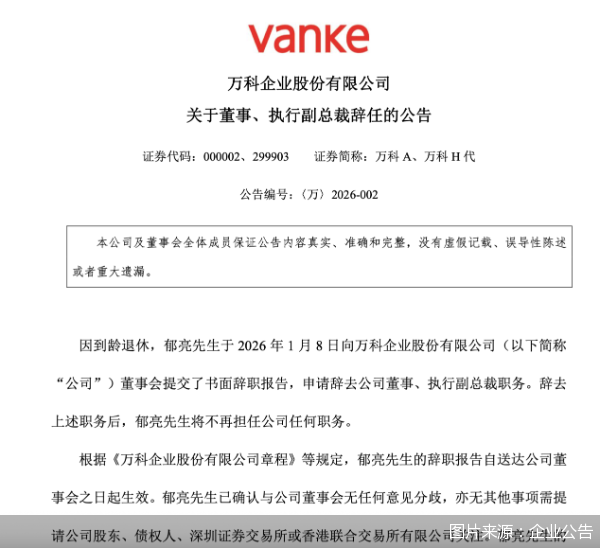
万科宣布:郁亮辞职,不再担任公司任何职务
新华网财经· 2026-01-08 12:55
1月8日晚,万科A(000002.SZ)公告称, 郁亮因到龄退休,于2026年1月8日向公司董事会提交书面辞职报告,申请辞去公司董事、执行副 总裁职务。 公告显示,辞去上述职务后,郁亮将不再担任公司任何职务。郁亮的辞职不会导致公司董事会成员低于法定人数,不会影响公司董事会的 正常运作和公司的日常经营。公司将尽快完成董事的补选工作。 根据《万科企业股份有限公司章程》等规定,郁亮的辞职报告自送达公司董事会之日起生效。郁亮已确认与公司董事会无任何意见分歧, 亦无其他事项需提请公司股东、债权人、深圳证券交易所或香港联合交易所有限公司关注。 郁亮1990年加入公司,1994年起任公司董事,1996年任公司副总经理,1999年任公司常务副总经理兼财务负责人,2001年-2018年1月 任公司总裁,2017年7月至2025年1月任公司董事会主席,2025年1月起,任公司执行副总裁。加入公司之前,郁亮曾供职于深圳外贸集 团。 来源:每日经济新闻 关注" 新华网财经 "视频号 更多财经资讯等你来看 往期推荐 雷军回应"丢轮保车" 豆包否认AI眼镜将出货 截至公告披露日,郁亮持有公司股票739.49万股。 资料显示,郁亮于196 ...