Midea Group(000333)

Search documents
家电行业周报:11月家电社零偏弱,26年1月错期影响下空调排产反弹-20251221
SINOLINK SECURITIES· 2025-12-21 08:58
Investment Rating - The report suggests a cautious outlook on the home appliance industry, indicating a potential for stable growth among leading brands due to their integrated advantages and strong pricing power [5]. Core Insights - The retail sales of consumer goods in November 2025 showed a total value of 43,898 billion yuan, with a year-on-year growth of 1.3%, reflecting a slowdown compared to October's 2.9% growth [11]. - The home appliance retail sales in November 2025 were approximately 100 billion yuan, down 19.4% year-on-year, marking a further decline from October's 14.6% drop [14]. - The air conditioning production for January 2026 is expected to rebound due to the holiday scheduling impact, with domestic production planned at 8.84 million units, up 32.0% year-on-year, while exports are projected at 11.13 million units, up 14.0% year-on-year [2][18]. Summary by Sections 1. Market Performance - The overall retail sales growth has been declining month by month since June 2025, with November showing a significant drop in home appliance sales due to high base effects from previous government subsidies and a decrease in subsidy intensity [11][14]. 2. Key Data Tracking - The Shanghai Composite Index decreased by 0.28%, while the home appliance index increased by 0.16% during the week [21]. - Raw material prices showed a mixed trend, with copper prices up 2.04% and aluminum prices down 0.29% [3]. - The exchange rate for USD to RMB was reported at 7.06, with a slight decrease of 0.01% for the week [33]. 3. Real Estate Data - In October 2025, new residential construction area decreased by 19.3% year-on-year, indicating ongoing adjustments in real estate investment and sales, which may suppress long-term demand for home appliances [40]. 4. Investment Recommendations - Leading brands are expected to achieve stable growth in domestic sales, while external sales may benefit from the US entering a rate-cutting cycle and a gradual recovery in European consumption [5][51].



家用电器:iRobot被收购利好国内头部品牌,白电内销高基数承压
Huafu Securities· 2025-12-20 13:46
Investment Rating - The report maintains a rating of "Outperform" for the industry [6] Core Insights - The acquisition of iRobot is beneficial for leading domestic brands, while the white goods domestic sales are under pressure due to high base effects [3][4] - Major home appliance categories have seen a decline in domestic sales due to the high base from last year's national subsidies and previous consumption pull-forward [3][11] - In November, the sales revenue for air conditioners, refrigerators, and washing machines decreased by -34.5%, -34.4%, and -19.2% year-on-year, respectively [3][11] - The sales volume for these categories also dropped significantly, with air conditioners and refrigerators down by -30.65% and -30.79% year-on-year [3][11] - The acquisition of iRobot, which has filed for bankruptcy, may allow brands like Roborock and Ecovacs to capture more market share in North America [4][18] Summary by Sections Domestic Sales Performance - Domestic sales of major home appliance categories are declining due to high base effects from last year's national subsidies [3][11] - November data shows significant year-on-year declines in sales revenue and volume across key categories [3][11] Brand Performance - In November, the market shares for Gree, Midea, and Haier in domestic sales were 32.1%, 29.6%, and 19.7%, respectively, with Haier showing significant growth [4][16] - Midea's export share increased to 40.4%, while Gree's share slightly decreased [4][16] Market Trends - The overall home appliance sector saw a slight increase of +0.2% this week, with white goods and small appliances showing mixed performance [5][19] - The report highlights the impact of raw material prices, with LME copper and aluminum showing fluctuations [5][19] Industry News - The report discusses the implications of iRobot's bankruptcy and acquisition on the competitive landscape in North America [4][18] - It also notes the ongoing trends in ESG ratings among leading home appliance companies, emphasizing their focus on green transformation [39]

「数据看盘」平潭发展龙虎榜现外资与量化博弈 多家实力游资集体出逃华人健康
Sou Hu Cai Jing· 2025-12-19 10:08
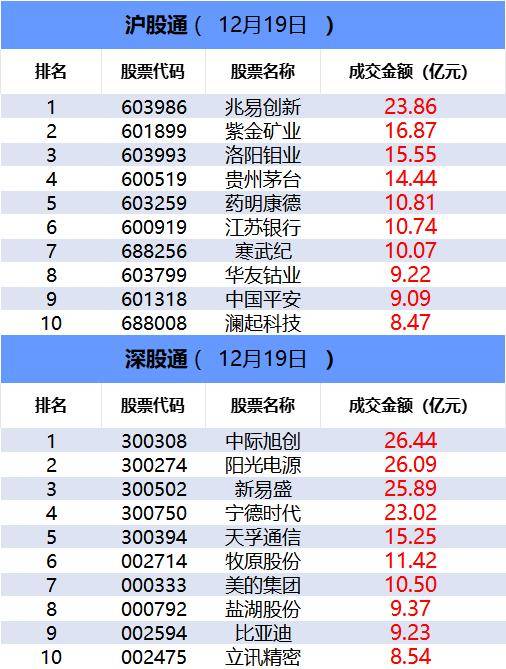
Group 1: Market Overview - The total trading amount for the Shanghai Stock Connect was 940.49 billion, while the Shenzhen Stock Connect reached 1,048.92 billion [2] - The top traded stocks on the Shanghai Stock Connect included Zhaoyi Innovation with 23.86 billion, followed by Sanfang Qianhe and Luoyang Copper with 16.87 billion and 15.55 billion respectively [3] - On the Shenzhen Stock Connect, the leading stock was Zhongji Xuchuang with 26.44 billion, followed by Sunshine Power and New Yisheng with 26.09 billion and 25.89 billion respectively [3] Group 2: Sector Performance - Sectors such as Hainan, dairy, and retail showed significant gains, while precious metals and semiconductors experienced declines [4] - The mechanical equipment sector led in net inflow of funds with 38.67 billion, followed by non-ferrous metals and transportation equipment with 35.32 billion and 31.28 billion respectively [5] - The electronic sector had the highest net outflow of funds at -57.70 billion, followed by semiconductors and pharmaceuticals with -30.20 billion and -17.73 billion respectively [6] Group 3: Individual Stock Activity - The top stocks with net inflow included Xue Ren Group with 13.84 billion, followed by N Youxun and Shanzi Gaoke with 13.69 billion and 10.55 billion respectively [7] - The stocks with the highest net outflow were Meinian Health at -9.05 billion, followed by Shenwei Electronics and C Muxi-U with -6.98 billion and -6.81 billion respectively [8] Group 4: ETF Trading - The top ETFs by trading amount included A500 ETF Huatai Baichuan with 133.655 billion, and Hong Kong Securities ETF with 104.353 billion, showing increases of 7.50% and 18.61% respectively [9] - The ETFs with the highest growth in trading amount compared to the previous trading day included Hengsheng Dividend Low Volatility ETF with 183.92% increase and Industrial Nonferrous ETF with 140.82% increase [10] Group 5: Futures Market - In the futures market, all four major index contracts (IH, IF, IC, IM) saw both long and short positions increase, with IF and IM contracts showing a higher number of short position increases [11] Group 6: Institutional and Retail Activity - Institutional activity showed a decrease compared to the previous day, with notable purchases in Aerospace Intelligence and Shanzi Gaoke, while significant sales were observed in Meinian Health and Xue Ren Group [12][13] - Retail investors were active, with significant buying in Xue Ren Group and Shanzi Gaoke, while selling was noted in Huaren Health and other stocks [14][15]




家电行业 2026 年投资策略:逆风莫摧残,挖掘定价权
Hua Yuan Zheng Quan· 2025-12-19 09:29
Investment Rating - The report rates the home appliance industry as "Positive" for investment, marking it as the first recommendation for 2026 [3]. Core Insights - The report emphasizes that leading companies with strong product capabilities, channel efficiency, cost control, and brand premium are positioned to gain market share during a challenging domestic demand environment. The industry is shifting from "incremental competition" to "stock integration" [4]. - It highlights that while short-term revenue growth may be difficult to expect, leading companies are likely to maintain profit growth due to improved efficiency and cost reduction. A stabilization in demand could lead to a new golden era for these companies [4]. - The report suggests focusing on three main investment themes: companies benefiting from domestic market consolidation, those redefining products for overseas markets, and quality dividend stocks with low valuations [4]. Summary by Sections 1. Market Performance and Fundamentals - The home appliance sector underperformed the CSI 300 index in 2025, with a growth rate of 9.7%, lagging behind the index by 7.8 percentage points, primarily due to external tariffs and domestic policy fluctuations [9]. - The report notes that the home appliance sector's valuation remains low compared to other consumer sectors, with a PE ratio of 14.7X as of November 30, 2025, reflecting the industry's mature phase and pressures from declining domestic real estate demand [19][20]. 2. Main Line One: Opportunities in Market Consolidation - The report identifies opportunities in the smart projection market, where domestic consolidation is occurring, and leading companies are gaining market share. The market is expected to improve as consumer demand recovers [61]. - In the kitchen appliance sector, leading companies are showing resilience in performance despite weak demand, with market shares increasing as smaller competitors exit the market [76]. 3. Main Line Two: Redefining Products for Export Markets - The report discusses the growth potential in the robotic vacuum cleaner market, which is expected to see double-digit growth in the overseas market from 2024 to 2029, driven by product innovation [86]. - It also highlights the potential for growth in the lawn mower robot market, particularly in Europe, where the penetration rate is expected to rise significantly [104]. 4. Main Line Three: Quality Dividend Stocks - The report suggests that companies like Midea Group and Haier Smart Home are positioned well due to their stable cash flows and increasing dividend payouts, making them attractive for long-term investment [85].


美的集团正式成立“新能源事业部”
中国能源报· 2025-12-19 09:29
Core Viewpoint - Midea Group has announced the establishment of a "New Energy Division" as part of its organizational restructuring, indicating a strategic upgrade in its new energy business layout [1]. Group 1: Organizational Changes - The New Energy Division will integrate the original New Energy Product Company and Energy Technology Company under the Industrial Technology Division, with Wang Jianguo, the Executive President of Midea Group, appointed as the President of the New Energy Division [1]. - This restructuring reflects Midea Group's long-term commitment to the new energy sector, particularly in photovoltaic and energy storage fields [1]. Group 2: Business Development - Midea Group has been actively involved in the new energy industry, acquiring Beijing Hekang New Energy Technology Co., Ltd. for 740 million yuan in March 2020, focusing on components for new energy vehicles, including charging piles and grid operations [1]. - In May 2022, Midea Group announced plans to acquire a 29.96% stake in the listed energy storage company Kelu Electronics for 837 million yuan, successfully completing the share transfer in June 2023, thus becoming the controlling shareholder [1]. - The company aims to develop Kelu Electronics into a key platform for energy management business [1]. Group 3: Industrial Technology Division - Midea Group's Industrial Technology Division focuses on new energy, HVAC, new energy vehicles, and core components for robotics, with brands such as GMCC, Welling, MR, HICONICS, CLOU, and Servotronix under its umbrella [2]. - The division operates 29 smart factories globally and has established 33 R&D testing centers in countries including China, Japan, Turkey, and the United States, covering products like compressors, motors, chips, valves/pumps, new energy vehicle components, and energy storage [2]. Group 4: Energy Operations - Midea Energy, a subsidiary of Midea Group, serves as an operational platform for the development, application, and trading of various renewable energy sources, including photovoltaic and wind energy [2]. - The company is involved in household solar storage, commercial energy solutions, and is constructing a virtual power plant operation platform [2]. - Midea's Building Technology Company, previously focused on HVAC, has expanded into solar storage and energy management services for users in recent years [2].

白色家电板块12月19日跌0.05%,美的集团领跌,主力资金净流出7821.56万元
Zheng Xing Xing Ye Ri Bao· 2025-12-19 09:02
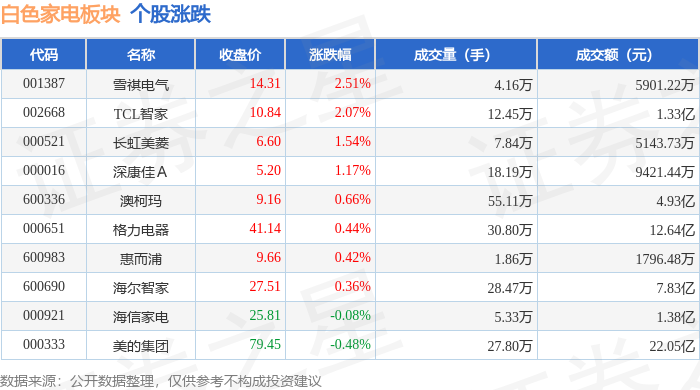
Market Overview - The white goods sector experienced a slight decline of 0.05% on December 19, with Midea Group leading the drop [1] - The Shanghai Composite Index closed at 3890.45, up 0.36%, while the Shenzhen Component Index closed at 13140.22, up 0.66% [1] Stock Performance - Notable gainers in the white goods sector included: - Xueqi Electric (14.31, +2.51%, 41,600 shares, 59.01 million CNY) - TCL Smart Home (10.84, +2.07%, 124,500 shares, 133 million CNY) - Changhong Meiling (6.60, +1.54%, 78,400 shares, 51.44 million CNY) [1] - Midea Group's stock closed at 79.45, down 0.48%, with a trading volume of 278,000 shares and a transaction value of 2.205 billion CNY [1] Capital Flow - The white goods sector saw a net outflow of 78.22 million CNY from institutional investors and 78.94 million CNY from retail investors, while retail investors had a net inflow of 157 million CNY [1] - Specific stock capital flows included: - Gree Electric: -24.78 million CNY from institutional investors, -21.92 million CNY from retail investors, and -2.87 million CNY from individual investors [2] - TCL Smart Home: +15.61 million CNY from institutional investors, -12.50 million CNY from retail investors, and -3.10 million CNY from individual investors [2] - Midea Group: -69.72 million CNY from institutional investors, -53.02 million CNY from retail investors, and +123 million CNY from individual investors [2]


2025年1-10月中国家用洗衣机产量为10107.8万台 累计增长6.4%
Chan Ye Xin Xi Wang· 2025-12-19 03:18
Core Viewpoint - The report by Zhiyan Consulting highlights the trends and investment outlook for the Chinese washing machine industry from 2025 to 2031, indicating a slight decline in production in October 2025 while showing overall growth in the first ten months of the year [1] Industry Overview - According to the National Bureau of Statistics, the production of household washing machines in China in October 2025 was 11.04 million units, representing a year-on-year decrease of 2% [1] - Cumulatively, from January to October 2025, the total production of household washing machines reached 101.078 million units, reflecting a growth of 6.4% compared to the same period in the previous year [1] Companies Involved - The report mentions several key players in the industry, including Midea Group (000333), Haier Smart Home (600690), Gree Electric Appliances (000651), Whirlpool (600983), TCL Technology (000100), and Skyworth Digital (000810) [1]


十大外资对2026年A股的建议
Sou Hu Cai Jing· 2025-12-18 15:36
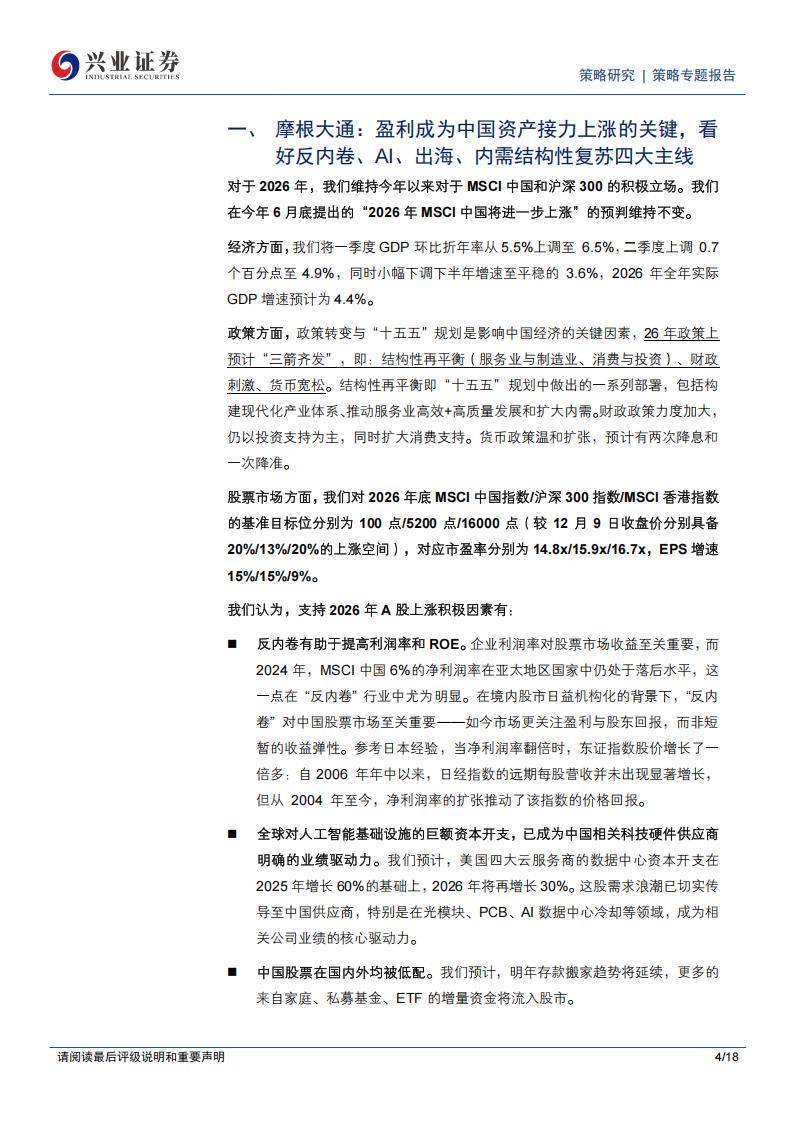
Group 1: Core Insights - The core viewpoint is that the ability of listed companies to achieve real profits will be the key driver for the rise of Chinese assets in 2026, shifting focus from valuation recovery to earnings realization [2][23]. - The predicted target for the CSI 300 index in 2026 is 5200 points, indicating a potential increase of approximately 13% from the closing price in December 2025, with an average market valuation of about 15.9 times earnings [2][24]. Group 2: Investment Themes - Morgan Stanley identifies four clear investment themes: curbing excessive competition, artificial intelligence (AI), global expansion, and a structural recovery in domestic demand [3][4]. - Goldman Sachs emphasizes five major investment themes: leading industry players, beneficiaries of the "14th Five-Year Plan," AI, global expansion, and curbing excessive competition [6][7]. - UBS highlights three main investment lines: self-sufficiency, curbing excessive competition, and global expansion, suggesting a focus on consumer sectors in the second half of the year [9][11]. Group 3: Earnings Growth Projections - Morgan Stanley forecasts a 6% earnings growth for listed companies in 2026, with an acceleration to 10% in 2027, driven by supportive policies and a narrowing decline in producer prices [13][41]. - Goldman Sachs expects the MSCI China index's earnings per share (EPS) growth to rise to 12% in 2026, significantly higher than previous cycles [5][29]. - UBS anticipates an increase in overall A-share earnings growth from 6% in 2025 to 8% in 2026, supported by nominal GDP growth and ongoing policy support [9][36]. Group 4: Sector-Specific Insights - The renewable energy sector is expected to benefit from policies aimed at restoring pricing power and healthy profit margins, particularly in the context of curbing excessive competition [3][8]. - The AI sector is projected to see a 30% increase in global capital expenditure for data centers in 2026, positively impacting related industries such as optical modules and power equipment [3][28]. - Consumer sectors, particularly essential goods and high-end luxury items, are expected to perform well, with the restaurant industry growing faster than overall retail [4][6]. Group 5: Policy and Economic Environment - The Chinese government is expected to implement a series of supportive fiscal and monetary policies, including increased fiscal deficits and continued monetary easing, to stimulate domestic demand and promote industrial upgrades [23][33]. - The anticipated fiscal policy for 2026 includes a budget deficit of around 4% and a significant increase in special government bonds, aimed at supporting consumption and infrastructure [33][34]. - The overall economic growth forecast for 2026 is set at 4.4%, with a gradual recovery in the real estate market expected to reduce its drag on the economy [23][41].




东南亚制造:泰国如何走出困境
GUOTAI HAITONG SECURITIES· 2025-12-18 12:49
Economic Overview - Thailand's GDP growth has been highly volatile, with an average annual growth rate of 8.2% from 1960-1970, but slowing to 2.5% by 2024, below the global average of 2.9%[6][7]. - Thailand's GDP was approximately $526.4 billion in 2024, down from a peak of around $540 billion in 2019, and its global GDP share has decreased to about 0.47%[7][12]. Economic Drivers - The economy is primarily driven by manufacturing and tourism, with the service sector contributing nearly 60% to GDP and tourism accounting for about 20%[14][29]. - Manufacturing, particularly in automotive and electronics, remains a key sector, with Thailand being the largest automotive producer and exporter in Southeast Asia[24][18]. Challenges and Opportunities - Thailand's economy is facing stagnation, with a reliance on low-value manufacturing and tourism, leading to a need for industrial upgrades[35][38]. - The tourism sector has not fully recovered post-pandemic, with visitor numbers at 290 million in 2025, down 17.8% from 2019 levels[38][39]. Policy Responses - The Thai government has introduced various policies to stimulate tourism and manufacturing, including tax incentives and promotional campaigns aimed at attracting international visitors[48][51]. - Efforts are being made to enhance the electric vehicle sector and promote high-tech investments, particularly from China, which has become a significant source of foreign direct investment (FDI) in Thailand[60][63]. Trade Relations - Thailand's trade with China has significantly increased, with total trade volume rising from around $10 billion to approximately $13 billion in 2025[56][61]. - The U.S.-Thailand trade framework has been updated, with Thailand eliminating tariffs on 99% of U.S. goods, while the U.S. maintains a 19% tariff on Thai products[55][56].


白色家电板块12月18日跌0.62%,澳柯玛领跌,主力资金净流入1155.01万元
Zheng Xing Xing Ye Ri Bao· 2025-12-18 09:02
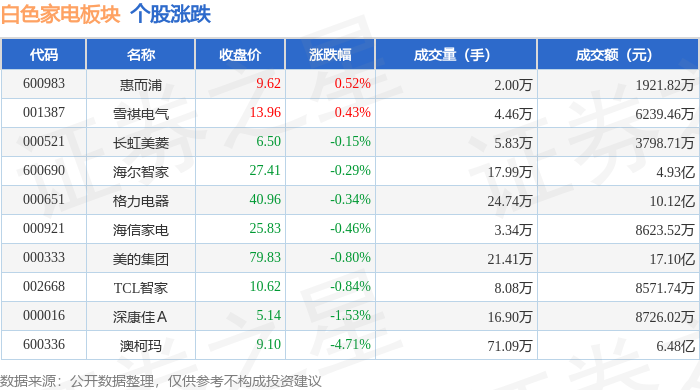
Market Overview - The white goods sector experienced a decline of 0.62% on December 18, with Aucma leading the drop [1] - The Shanghai Composite Index closed at 3876.37, up 0.16%, while the Shenzhen Component Index closed at 13053.98, down 1.29% [1] Individual Stock Performance - Whirlpool (600983) closed at 9.62, up 0.52% with a trading volume of 20,000 shares and a turnover of 19.2182 million yuan [1] - Snowball Electric (001387) closed at 13.96, up 0.43% with a trading volume of 44,600 shares and a turnover of 62.3946 million yuan [1] - Changhong Meiling (000521) closed at 6.50, down 0.15% with a trading volume of 58,300 shares and a turnover of 37.9871 million yuan [1] - Haier Smart Home (600690) closed at 27.41, down 0.29% with a trading volume of 179,900 shares and a turnover of 493 million yuan [1] - Gree Electric (000651) closed at 40.96, down 0.34% with a trading volume of 247,400 shares and a turnover of 1.012 billion yuan [1] - Hisense Home Appliances (000921) closed at 25.83, down 0.46% with a trading volume of 33,400 shares and a turnover of 86.2352 million yuan [1] - Midea Group (000333) closed at 79.83, down 0.80% with a trading volume of 214,100 shares and a turnover of 1.710 billion yuan [1] - TCL Smart Home (002668) closed at 10.62, down 0.84% with a trading volume of 80,800 shares and a turnover of 85.7174 million yuan [1] - Deep Blue Konka A (000016) closed at 5.14, down 1.53% with a trading volume of 169,000 shares and a turnover of 87.2602 million yuan [1] - Aucma (600336) closed at 9.10, down 4.71% with a trading volume of 710,900 shares and a turnover of 648 million yuan [1] Capital Flow Analysis - The white goods sector saw a net inflow of 11.5501 million yuan from institutional investors, while retail investors contributed a net inflow of 56.1258 million yuan [1] - However, there was a net outflow of 67.6759 million yuan from speculative funds [1] Detailed Capital Flow by Company - Midea Group (000333) had a net inflow of 10.2 million yuan from institutional investors, but a net outflow of 11.9 million yuan from speculative funds [2] - Gree Electric (000651) saw a net inflow of 13.5475 million yuan from institutional investors, with a net outflow of 30.2722 million yuan from retail investors [2] - Hisense Home Appliances (000921) had a net inflow of 5.6853 million yuan from institutional investors, but a net outflow of 6.9064 million yuan from retail investors [2] - Changhong Meiling (000521) experienced a net outflow of 26.61 million yuan from institutional investors [2] - Whirlpool (600983) had a net outflow of 35,100 yuan from institutional investors [2] - Snowball Electric (001387) saw a net outflow of 1.3889 million yuan from institutional investors [2] - TCL Smart Home (002668) had a net outflow of 6.753 million yuan from institutional investors [2] - Deep Blue Konka A (000016) experienced a significant net outflow of 15.4027 million yuan from institutional investors [2] - Haier Smart Home (600690) had a net outflow of 21.8413 million yuan from institutional investors [2] - Aucma (600336) faced a substantial net outflow of 63.8104 million yuan from institutional investors [2]