
LZLJ(000568)

Search documents
白酒板块11月7日跌0.14%,口子窖领跌,主力资金净流出3.76亿元
Zheng Xing Xing Ye Ri Bao· 2025-11-07 08:41
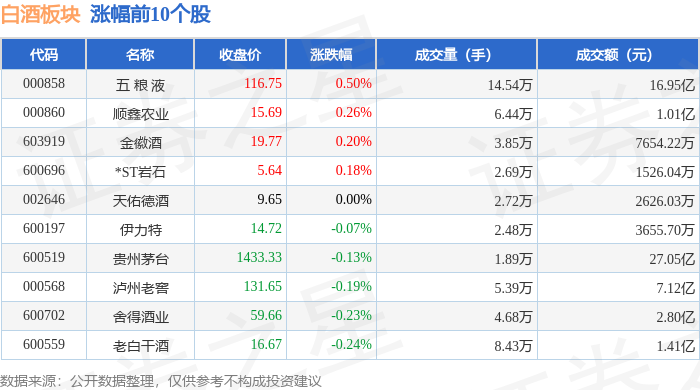
Market Overview - The liquor sector experienced a slight decline of 0.14% on November 7, with Kuaizi Jiao leading the drop [1] - The Shanghai Composite Index closed at 3997.56, down 0.25%, while the Shenzhen Component Index closed at 13404.06, down 0.36% [1] Individual Stock Performance - Wuliangye (000858) closed at 116.75, up 0.50% with a trading volume of 145,400 shares [1] - Shunxin Agriculture (000860) closed at 15.69, up 0.26% with a trading volume of 64,400 shares [1] - Kweichow Moutai (600519) closed at 1433.33, down 0.13% with a trading volume of 18,900 shares, generating a transaction value of 2.705 billion [1] - Luzhou Laojiao (000568) closed at 131.65, down 0.19% with a transaction value of 712 million [1] Capital Flow Analysis - The liquor sector saw a net outflow of 376 million from institutional investors, while retail investors contributed a net inflow of 197 million [2] - The main capital flow data indicates that Wuliangye had a net inflow of 32.596 million from institutional investors, but a net outflow from retail investors [3] Summary of Capital Flows by Company - Wuliangye (000858) had a net inflow of 32.596 million from main capital, but a net outflow of 30.204 million from retail investors [3] - Kweichow Moutai (600519) experienced a net outflow of 6.5481 million from main capital, while retail investors contributed a net inflow of 9.5224 million [3] - Other companies like Gujing Gongjiu (000596) and Tianyoude Jiu (002646) also showed significant net outflows from main capital [3]




泸州老窖:2024-2026年现金分红比例分别不低于65%、70%、75%,且均不低于85亿元
Ge Long Hui· 2025-11-07 08:28
Core Viewpoint - Luzhou Laojiao has announced its shareholder dividend return plan for the years 2024-2026, committing to a significant cash dividend distribution based on net profit [1] Summary by Categories Dividend Policy - For the years 2024-2026, the company plans to distribute cash dividends amounting to at least 65%, 70%, and 75% of the net profit attributable to shareholders, respectively [1] - The total annual cash dividend will not be less than RMB 8.5 billion (including tax) for each year [1] - The company intends to conduct cash dividends twice a year [1]

手握4700亿家底,白酒抗跌能力变强
21世纪经济报道· 2025-11-07 04:00
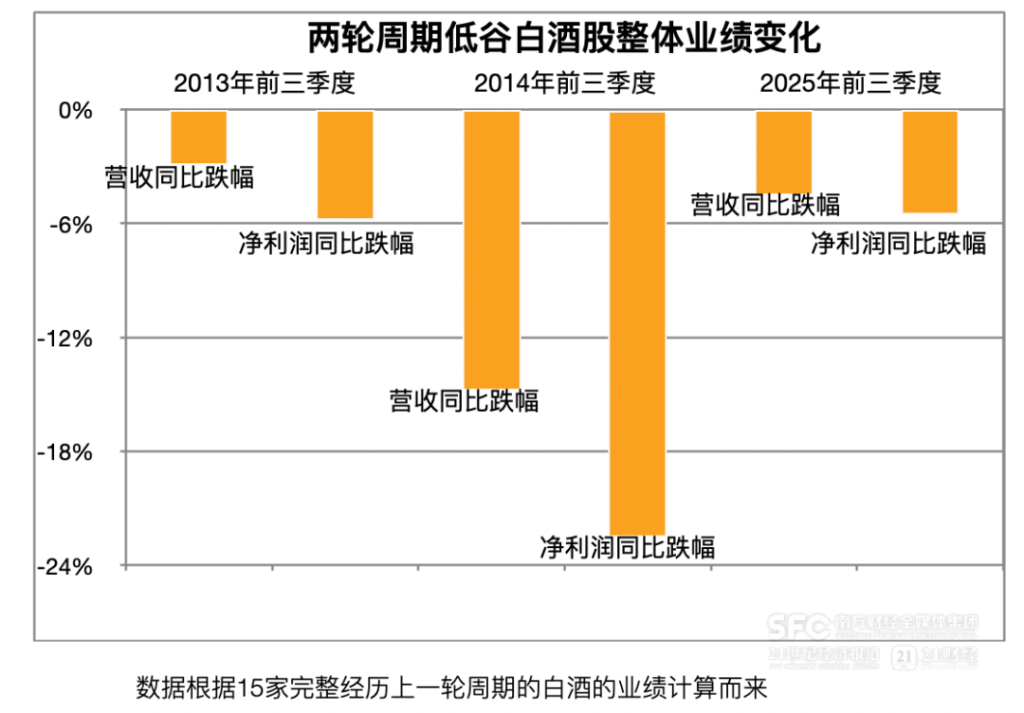
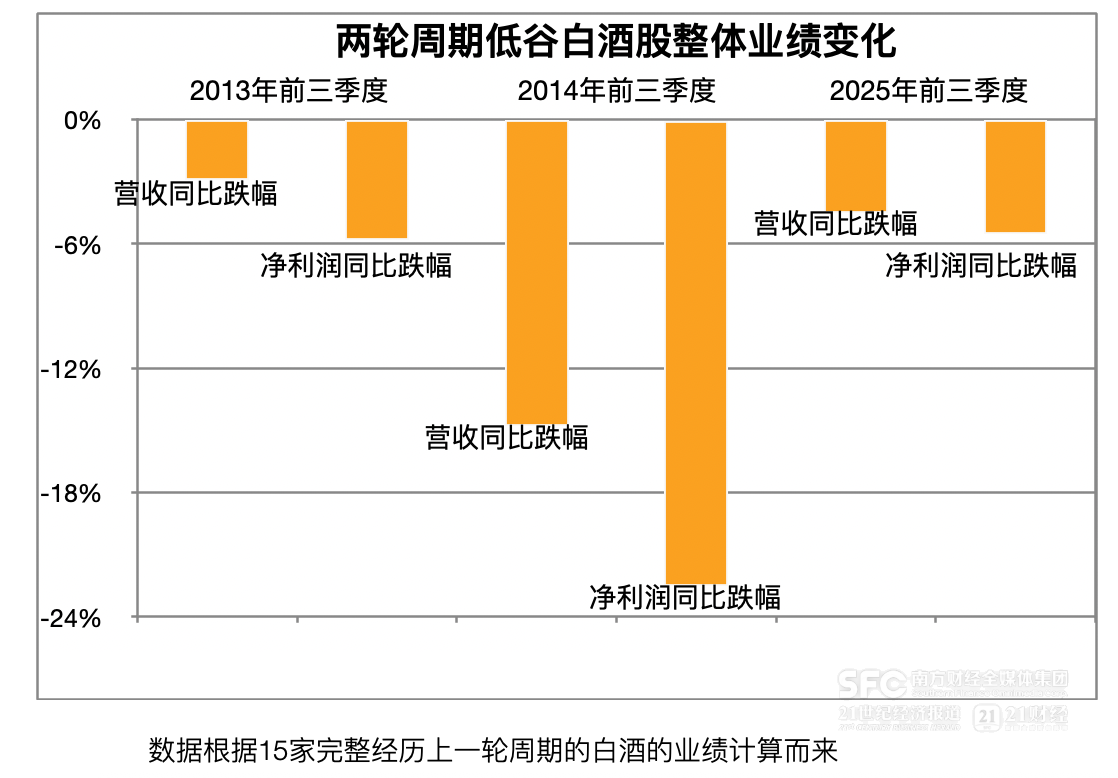
Core Viewpoint - The 2025 Q3 report for the liquor industry indicates it is the worst quarter in the past decade, with most companies experiencing significant declines in performance, while only a few, like Guizhou Moutai and Shanxi Fenjiu, managed to maintain positive growth [1][4]. Group 1: Performance Comparison - Among the 21 A-share liquor companies, only 15 have fully experienced the previous adjustment period, showing improved resilience against downturns [2]. - In 2025 Q3, the revenue and net profit of these 15 companies fell by 4.5% and 5.5%, respectively, compared to more severe declines in 2013 and 2014 [4]. - The number of leading liquor companies maintaining positive growth has increased, with Guizhou Moutai and Shanxi Fenjiu being the only ones to achieve this in 2025 Q3 [5]. Group 2: Profitability and Financial Resilience - The total net profit of the 15 liquor companies in 2025 Q3 exceeded 110 billion, significantly higher than the less than 28 billion in 2013 [10]. - The accumulated undistributed profits of these companies reached 468.8 billion, five times that of 2013, indicating a stronger financial cushion [10][12]. - The profitability of leading companies has improved, with Moutai maintaining a gross margin above 90% and Wuliangye's gross margin rising to over 80% [13][14]. Group 3: Sales and Marketing Strategies - Unlike the previous cycle, companies have been more restrained in their sales expenditures, with many reducing their sales expense ratios compared to 2013 and 2014 [17][19]. - Guizhou Moutai's sales expense ratio remains low at around 3-4%, reflecting strong brand recognition and market confidence [20]. Group 4: Channel Confidence and Cash Flow - The confidence of distributors has improved, with contract liabilities for the 15 companies increasing by 3.6% in 2025 Q3, contrasting sharply with the declines seen in the previous cycle [22][24]. - However, some non-leading companies have reported negative cash flow from operating activities, indicating potential financial strain [28].




拆解白酒十年来“最惨三季报”!
Xin Lang Cai Jing· 2025-11-07 03:46
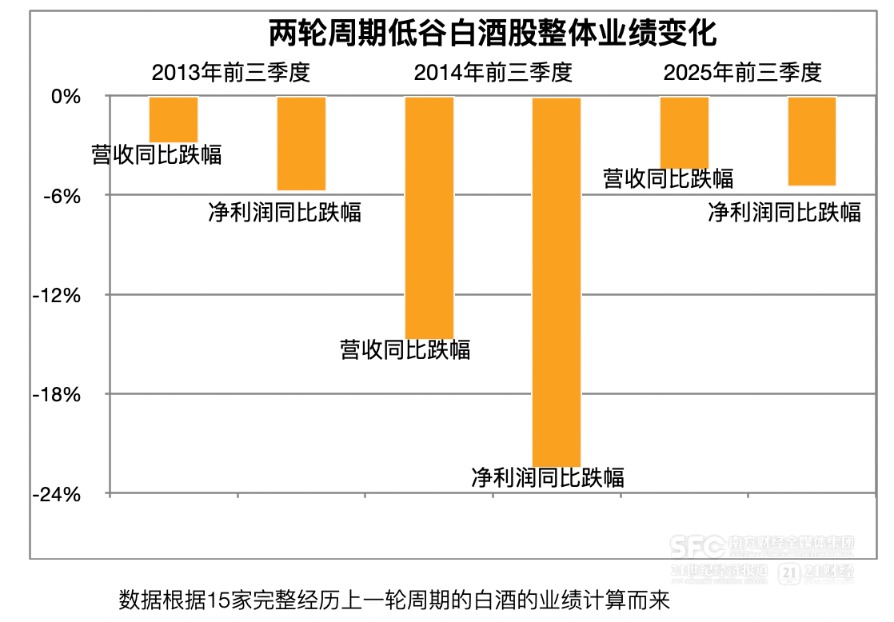
Core Viewpoint - The 2025 Q3 report for the liquor industry indicates a significant downturn, with most companies experiencing substantial profit declines, reminiscent of the previous low cycle in 2013-2014. Only a few companies like Kweichow Moutai and Shanxi Fenjiu managed to maintain positive growth [1][2]. Group 1: Performance Comparison - Among the 21 A-share liquor companies, only 15 have fully experienced the previous adjustment period, including Kweichow Moutai, Shanxi Fenjiu, and Wuliangye [2][4]. - The overall decline in revenue and net profit for these 15 companies in 2025 Q3 was 4.5% and 5.5%, respectively, compared to larger declines in the previous cycle [4][6]. - The number of leading companies maintaining positive growth has increased, with Kweichow Moutai and Shanxi Fenjiu achieving both revenue and profit growth in 2025 Q3 [6][7]. Group 2: Profitability and Financial Resilience - The total net profit for the 15 companies exceeded 110 billion yuan in 2025 Q3, significantly higher than the previous cycle's figures [11][13]. - The accumulated undistributed profits for these companies reached 468.8 billion yuan, five times that of 2013, indicating a stronger financial cushion [13][15]. - Kweichow Moutai's undistributed profits are seven times higher than in 2013, showcasing its robust financial health [15]. Group 3: Cost Management and Sales Strategy - Companies have learned from past experiences and are controlling sales expenses more effectively, with many reducing their sales expense ratios compared to the previous cycle [28][30]. - Kweichow Moutai maintains a remarkably low sales expense ratio, reflecting strong brand recognition and market confidence [32][33]. - The confidence of distributors has improved, with contract liabilities for the 15 companies increasing by 3.6% in 2025 Q3, contrasting sharply with the previous cycle's declines [35][38]. Group 4: Cash Flow and Operational Challenges - The net cash flow from operating activities for these companies declined by 19% in 2025 Q3, indicating challenges in cash collection from distributors [40][42]. - Some non-leading companies have reported negative cash flow, with specific firms like Shunxin Agriculture facing severe cash flow issues [42][43]. - The overall inventory of finished liquor has increased by nearly 4%, suggesting heightened selling difficulties in the current market [43].
解读白酒“最差三季报”:至暗时刻的破与立(二)| 逆势增长4.54%,20家上市白酒企业合同负债达390亿元!渠道信心从何而来?
Mei Ri Jing Ji Xin Wen· 2025-11-07 02:35
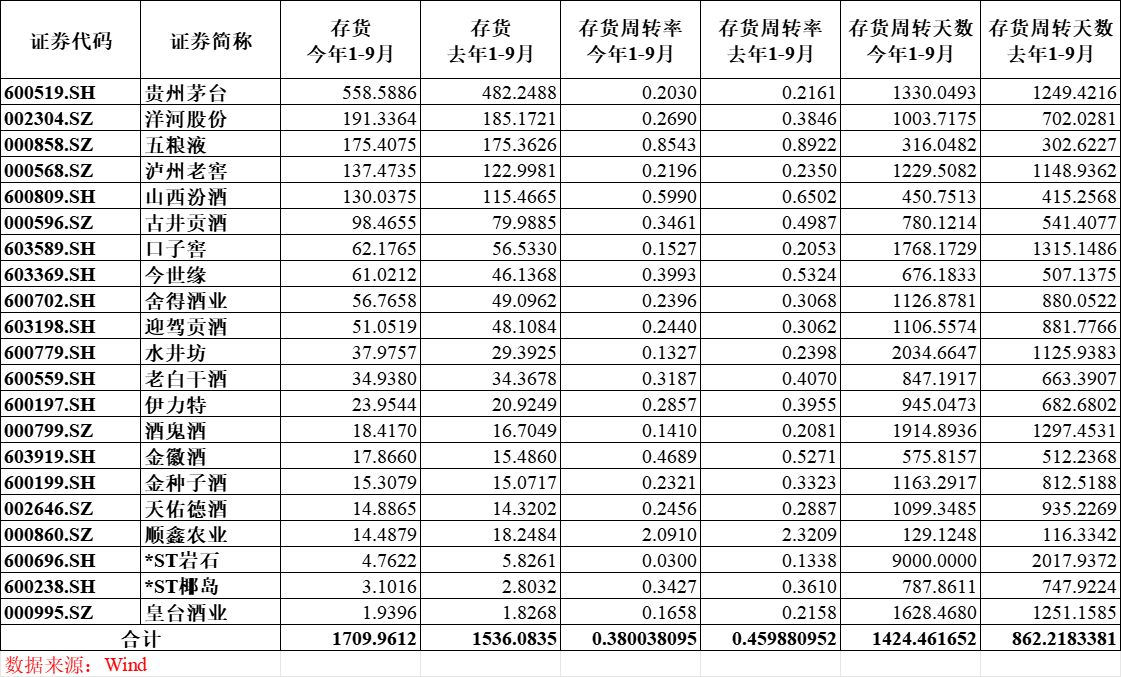
Core Viewpoint - The A-share liquor industry reported its worst performance in a decade for Q3 2025, with 20 listed companies (excluding Shunxin Agriculture) achieving a total revenue of 312.09 billion yuan and a net profit of 122.49 billion yuan, both down approximately 7% year-on-year [1][2] Financial Performance - The total revenue and net profit of the liquor industry have significantly declined, indicating a pronounced pressure on the industry [1] - Only Kweichow Moutai and Shanxi Fenjiu managed to maintain growth in both revenue and net profit amidst the overall decline [1] - The total contract liabilities for 20 liquor companies reached 39 billion yuan, reflecting a year-on-year increase of 4.54%, despite the overall performance downturn [1][6] Inventory and Turnover - The total inventory of 21 listed liquor companies rose to 170.99 billion yuan, a year-on-year increase of 11.32%, with an average inventory turnover period extending to 1424 days, up 65.21% from the previous year [2][4] - The increase in inventory turnover days signals significant pressure on channel inventory [4] Market Response - The market reacted calmly to the poor performance reports, with the China Securities Liquor Index rising by 1.72% on October 31, indicating that investors have already digested the performance pressures [1] - The stability in contract liabilities suggests that confidence in the industry and companies remains intact, despite the challenges [2][7] Channel Dynamics - The increase in contract liabilities is primarily driven by leading liquor companies, with four out of six major firms reporting year-on-year growth [7] - Companies are shifting from a simple sales model to a service-oriented approach, focusing on channel health and profitability for distributors [8][9] Innovative Sales Models - New sales models are emerging, such as the "Wan Shang Alliance" by Zhenjiu Li Du, which emphasizes no stockpiling and allows for returns, thereby reducing inventory risks [10][11] - The introduction of commission-based systems and unified pricing strategies aims to alleviate financial pressure on distributors and ensure transparent profit distribution [12] Conclusion - The growth in contract liabilities and the evolving relationships between manufacturers and distributors highlight the industry's resilience and potential for recovery, as companies prioritize channel health and collaborative strategies [12][13]
解读白酒“最差三季报”:至暗时刻的破与立(一)丨“老登”白酒迎最难拷问:业绩失速之下,股息率破纪录+低估值,最佳布局期来了?
Mei Ri Jing Ji Xin Wen· 2025-11-07 02:32
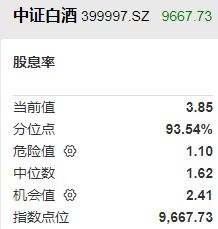
Core Viewpoint - The Chinese liquor industry is experiencing a significant downturn, with a 18% year-on-year decline in quarterly revenue, marking the worst performance since the 2012-2015 adjustment period, leading to a "de-inventory" phase across the sector [1][2]. Industry Performance - In Q3 2025, the liquor industry's revenue, net profit attributable to shareholders, and cash collection were 78.7 billion yuan, 28 billion yuan, and 83.9 billion yuan, respectively, reflecting declines of 18.4%, 22.2%, and 26.7% year-on-year [2][3]. - The high dividend yield of the liquor sector, which has reached 3.85% as of November 4, 2025, is seen as a stabilizing factor during this challenging period [3][5]. Market Sentiment - Market sentiment is fluctuating between "worry" and "expectation," with both corporate valuations and institutional holdings at historical lows [2][7]. - The current market environment is characterized by a significant withdrawal of capital, with public funds reducing their holdings in the liquor sector [1][11]. Dividend Insights - Over the past decade, the total cash dividends in the liquor industry have increased from 15.81 billion yuan in 2015 to 119.03 billion yuan in 2024 [4]. - Eleven liquor companies have a dividend yield exceeding 3%, with Yanghe Co. leading at 6.59% [5][6]. Valuation and Investment Outlook - The current price-to-earnings (P/E) ratio of the liquor index is 19.52, significantly lower than the 10-year average of 31.1, indicating a high safety margin for valuations [8][10]. - Analysts suggest that the liquor sector may no longer be viewed as a cyclical growth stock, with future price appreciation expected to come from stable earnings growth and dividends [7][10]. Fund Holdings and Strategy - As of Q3 2025, active equity funds have shown a trend of "overall reduction and structural differentiation" in their liquor stock holdings, with high-end liquor companies facing sell-offs while mid-tier brands gain traction [11][14]. - Notably, funds have increased their positions in companies like Luzhou Laojiao and Shanxi Fenjiu, while reducing holdings in leading brands like Kweichow Moutai and Wuliangye [14][17].
白酒两轮周期全扫描:行业家底更厚 头部抗跌能力更强
2 1 Shi Ji Jing Ji Bao Dao· 2025-11-07 01:56
Core Viewpoint - The 2025 Q3 report for the liquor industry indicates a significant downturn, marking the worst quarter in the past decade, with most companies experiencing substantial profit declines, while only a few, like Kweichow Moutai and Shanxi Fenjiu, managed to maintain positive growth [1] Group 1: Performance Comparison - Among the 21 A-share liquor companies, only 15 have fully experienced the previous downturn, including Kweichow Moutai, Shanxi Fenjiu, and Wuliangye [2] - The overall resilience of these 15 companies has improved, with revenue and net profit declines of 4.5% and 5.5% respectively in 2025, compared to larger declines in the previous cycle [3] Group 2: Company-Specific Insights - In 2025, Kweichow Moutai and Shanxi Fenjiu are the only companies showing both revenue and profit growth, contrasting with the previous cycle where only one company managed to do so [6] - Wuliangye's net profit decline is limited to under 14%, while Shanxi Fenjiu has returned to positive growth [7] - Luzhou Laojiao has significantly improved its performance, with revenue and profit declines controlled to single digits in 2025, compared to much larger declines in the previous cycle [7][8] Group 3: Profitability and Financial Health - The total net profit of the 15 companies exceeded 1100 billion in 2025, significantly higher than the previous cycle's total of under 280 billion [10] - The accumulated undistributed profits of these companies reached 4688 billion, five times that of 2013, providing a strong financial cushion [13][15] - Kweichow Moutai's undistributed profits are seven times higher than in 2013, indicating robust financial health [15] Group 4: Cost Management - Many companies have reduced their sales expense ratios compared to the previous cycle, indicating a more restrained approach to spending [29] - Kweichow Moutai maintains a very low sales expense ratio, consistently around 3-4%, reflecting strong brand recognition and market confidence [33] Group 5: Channel Confidence and Cash Flow - The confidence of distributors in head companies has improved, with many reporting increases in contract liabilities, indicating better cash flow management [38] - However, some non-head companies are experiencing negative cash flow, with five companies reporting negative net cash flow from operating activities for two consecutive years [42]
21特写|白酒两轮周期全扫描:行业家底更厚 头部抗跌能力更强
2 1 Shi Ji Jing Ji Bao Dao· 2025-11-07 01:51
Core Viewpoint - The 2025 Q3 report for the liquor industry is the worst in the past decade, with most companies experiencing significant declines in performance, while only a few, like Kweichow Moutai and Shanxi Fenjiu, managed to maintain positive growth [1] Group 1: Performance Comparison - Among the 21 A-share liquor companies, only 15 have fully experienced the previous adjustment period, including Kweichow Moutai, Shanxi Fenjiu, and Wuliangye [2][3] - The overall decline in revenue and net profit for these 15 companies in 2025 Q3 was 4.5% and 5.5%, respectively, compared to larger declines during the previous cycle [4] - The number of leading liquor companies showing positive growth has increased, with Kweichow Moutai and Shanxi Fenjiu both achieving revenue and profit growth in 2025 Q3 [7] Group 2: Profitability and Financial Resilience - The total net profit for the 15 companies exceeded 110 billion yuan in 2025 Q3, significantly higher than the previous cycle's figures [12] - The accumulated undistributed profits for these companies reached 468.8 billion yuan, five times that of 2013, indicating a stronger financial cushion [13][15] - Kweichow Moutai's undistributed profits are seven times higher than in 2013, showcasing its robust financial health [15] Group 3: Cost Management and Sales Strategy - Liquor companies have learned from past experiences and are controlling sales expenses more effectively, with many reducing their sales expense ratios compared to the previous cycle [26][28] - Kweichow Moutai maintains a low sales expense ratio of around 3-4%, reflecting strong brand recognition and market confidence [31] Group 4: Channel Confidence and Cash Flow - The confidence of distributors has improved, with contract liabilities for the 15 companies increasing by 3.6% in 2025 Q3, contrasting sharply with the previous cycle's declines [33] - However, some non-leading companies are experiencing negative cash flow, with five companies reporting negative net cash flow from operating activities for two consecutive years [39]
白酒2025年三季报总结:加速纾压,底部渐明
Soochow Securities· 2025-11-06 11:05
Investment Rating - The report maintains an "Accumulate" rating for the liquor industry [1] Core Viewpoints - The liquor industry is currently in a phase of pressure relief and clearing, with expectations for performance recovery in the future. The focus should be on companies that show early signs of a turning point and have leading growth elasticity [3] - The overall revenue of the liquor sector has declined, with a 5.5% year-on-year drop in total revenue for the first three quarters of 2025, and an 18.3% decline in Q3 alone. Net profit also saw a significant decrease of 21.9% in Q3 [12][24] - The high-end liquor segment is under pressure, with a need for macroeconomic recovery to achieve a balance in volume and price. Companies with strong brand positioning and national expansion potential are recommended for investment [3][12] Summary by Sections 1. Q3 Performance and Market Conditions - The Q3 performance of the liquor sector shows a slow recovery in consumption scenarios, with overall sales continuing to face pressure. The high-end and next-high-end liquor demand remains under pressure, particularly in business and personal dining scenarios [12][13] - The overall revenue for the liquor sector in Q3 dropped by 18.3% year-on-year, with net profit down by 21.9%, indicating a significant acceleration in the decline compared to previous quarters [12][24] 2. Revenue Trends - The liquor sector's revenue has been on a downward trend, with a 5.5% year-on-year decline in the first three quarters of 2025. The Q3 revenue decline is particularly sharp at 18.3% [12][24] - High-end liquor companies are experiencing a shift in their financial reports, with revenue declines driven by pressure on major brands like Moutai and Wuliangye [30][41] 3. Profitability Analysis - The gross profit margin for the liquor sector has decreased, with Q3 margins at 81.7%, down 0.7 percentage points year-on-year. The decline in profitability is attributed to structural issues and increased costs [2][3] - The report highlights that the majority of liquor companies have seen an increase in sales expenses, while management expenses have also risen slightly due to weaker revenue realization [2][3] 4. Investment Recommendations - The report suggests prioritizing investments in companies that are likely to recover first, such as Luzhou Laojiao and Shanxi Fenjiu, which have strong governance and dividend yields. Other companies to watch include Zhenjiu Lidu and Shede Liquor [3][12] - The focus should be on companies that can maintain channel stability and show early signs of marginal recovery, as the market is expected to support valuations for these firms [12][13]


食品饮料2025年三季报总结:白酒主动释放压力,速冻迎来行业拐点,软饮、零食量贩高景气维持
China Post Securities· 2025-11-06 05:06
Industry Investment Rating - The investment rating for the food and beverage industry is "Outperform" [1] Core Insights - The report highlights that the liquor sector is actively releasing pressure on financial statements, with the industry gradually bottoming out. The frozen food sector is witnessing a turning point, while the soft drink and snack sectors maintain high levels of prosperity [3][4][30] Summary by Sections 1. Liquor - The liquor sector's total revenue for the first three quarters of 2025 was CNY 319.23 billion, a year-on-year decrease of 5.76%, with net profit down 6.85% to CNY 122.67 billion. In Q3 alone, revenue fell 18.38% to CNY 78.48 billion, and net profit dropped 22.00% to CNY 28.09 billion [14][28] - High-end liquor brands like Moutai showed stable growth, while others like Wuliangye and Luzhou Laojiao faced significant declines. Moutai's revenue grew by 9.28% year-on-year, while Wuliangye's fell by 10.26% [17][19] - The second-tier liquor brands, such as Fenjiu, showed resilience with a revenue increase of 5.00%, while others like Shui Jing Fang and Shede experienced declines [26][22] 2. Soft Drinks - The soft drink sector saw significant growth, with companies like Dongpeng Beverage reporting a 34.13% increase in revenue year-on-year. The energy drink segment, particularly, showed robust growth [30][31] - The introduction of new flavors and products, such as Dongpeng's summer limited edition, contributed to the sustained high growth rates in this sector [30] 3. Dairy Products - The dairy sector, led by Yili, maintained stable performance despite high base effects, with significant growth in milk powder and cold drink products. New Dairy's low-temperature products continued to show double-digit growth [4][31] 4. Frozen Foods - The frozen food industry is experiencing a turning point, with companies noting that the price war has peaked. The focus is shifting towards rational competition and value [7][30] 5. Snacks - The snack sector is undergoing strategic adjustments, with member stores and instant retail becoming key growth channels. The overall consumption environment remains weak, but the snack sector is adapting with targeted strategies [7][30]
