GUJING(000596)

Search documents
酒价内参2月4日价格发布 青花汾20上涨5元
Xin Lang Cai Jing· 2026-02-04 01:23
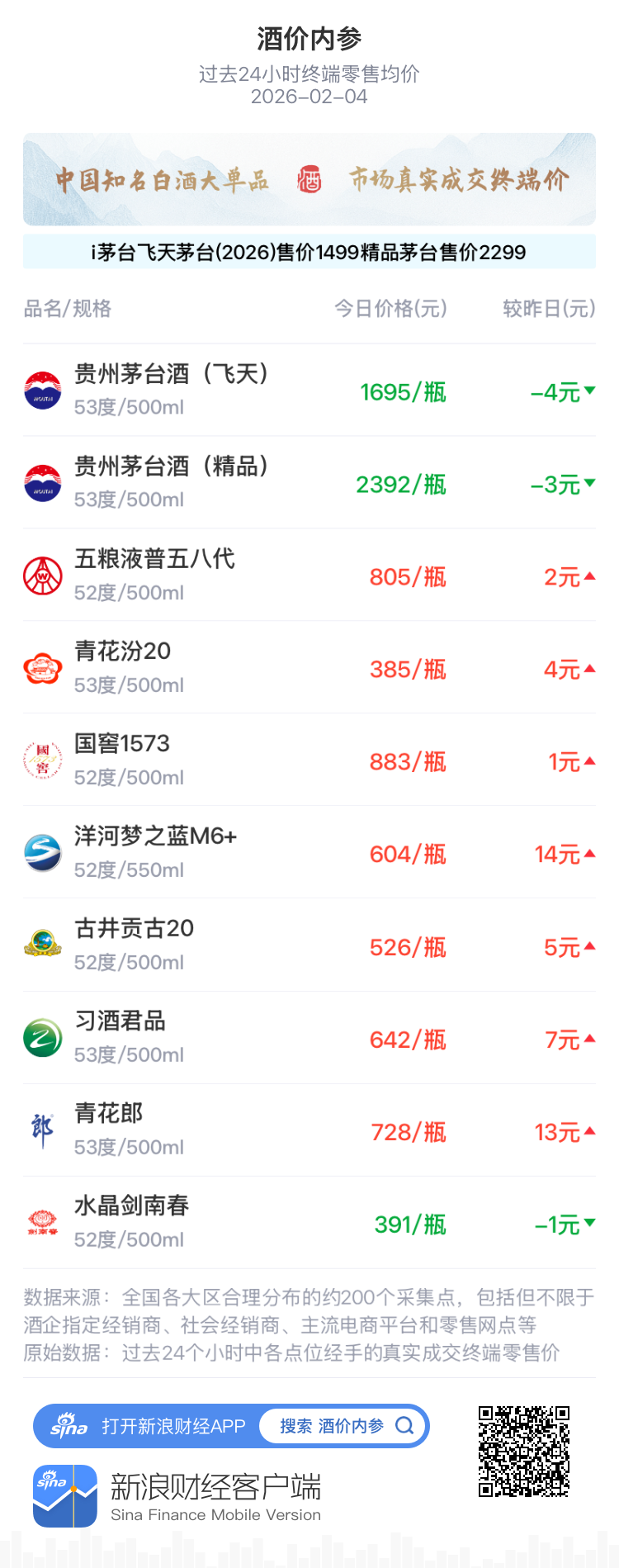
Core Insights - The article highlights the structural upward trend in the retail prices of China's top ten liquor products, with a total price of 9,051 yuan for a bundled sale, marking an increase of 38 yuan from the previous day, reaching a new high in nearly a month [1][6][7] Price Trends - The market shows a general upward trend, with seven products increasing in price and three decreasing. Mid-range products have seen concentrated price increases, while high-end liquor has slightly adjusted from high levels [1][7] - Notable price increases include: - Yanghe Dream Blue M6+ up by 14 yuan per bottle - Qinghua Lang up by 13 yuan per bottle - Xijiu Junpin up by 7 yuan per bottle - Gujing Gonggu 20 and Qinghua Fen 20 up by 5 yuan and 4 yuan respectively - Wuliangye Pu 58 and Guojiao 1573 up by 2 yuan and 1 yuan respectively [1][7][10] Price Decreases - The following products experienced price reductions: - Feitian Moutai down by 4 yuan per bottle - Boutique Moutai down by 3 yuan per bottle - Crystal Jian Nan Chun down by 1 yuan per bottle [1][7][10] Data Collection Methodology - The "Liquor Price Reference" collects data from approximately 200 sampling points across various regions, including designated distributors, social distributors, e-commerce platforms, and retail outlets, aiming to provide objective and traceable market price data [2][8] Brand Value Insights - According to the 2025 Hurun China Brand List released on February 3, Guizhou Moutai maintains its position as the top brand in China with a brand value of 795 billion yuan for the eighth consecutive year. The list has expanded from 300 to 500 brands, including non-Chinese brands, reflecting the evolving brand landscape in China [2][8]





酒价内参2月4日价格发布 总价创近一个月新高分化走势并存
Xin Lang Cai Jing· 2026-02-04 01:12
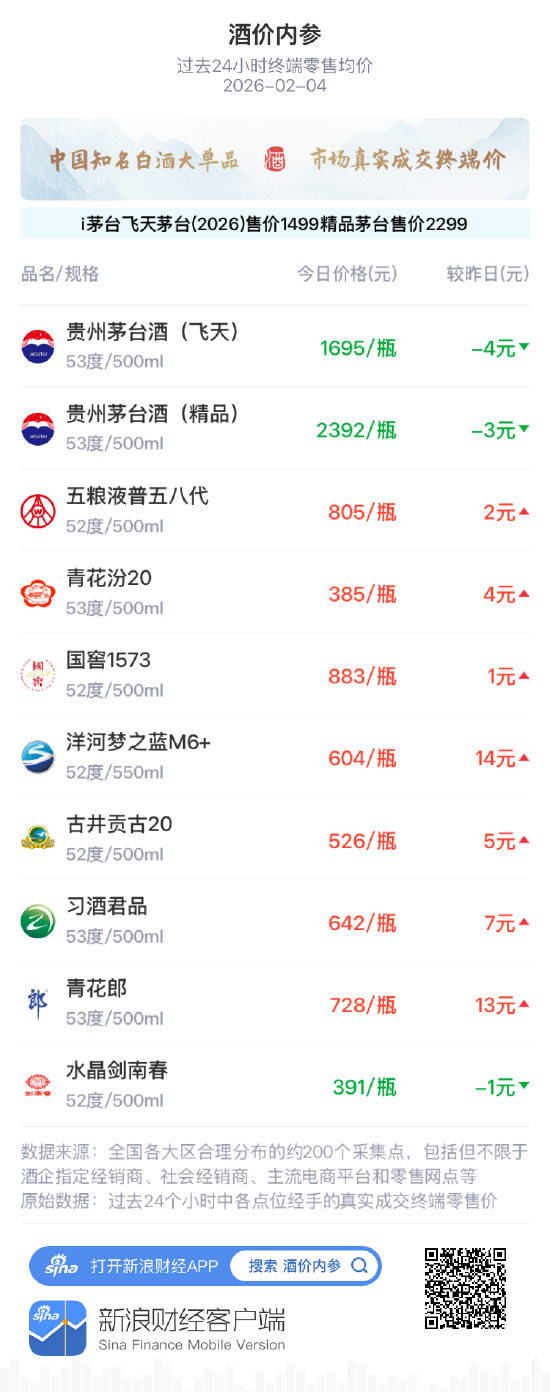
Core Insights - The Chinese white liquor market has shown a structural upward trend in retail prices for the top ten products as of February 4, with an overall price increase of 38 yuan, reaching a total of 9051 yuan, marking a new high in nearly a month [1] Price Movements - Among the top ten products, seven experienced price increases while three saw declines, indicating a general upward trend in the market [1] - Mid-range products showed concentrated price increases, while high-end liquor experienced slight adjustments from previous high levels [1] - The most significant price increase was observed in Yanghe Dream Blue M6+, which rose by 14 yuan per bottle, achieving three consecutive days of price increases [1] - Other notable increases included Qinghua Lang (up 13 yuan), Xijiu Junpin (up 7 yuan), and Gujing Gonggu 20 (up 5 yuan) [1] - Conversely, Feitian Moutai and Boutique Moutai saw decreases of 4 yuan and 3 yuan per bottle, respectively, indicating a short-term price consolidation phase after previous significant increases [1] Specific Product Pricing - The current retail prices for key products are as follows: - Feitian Moutai: 1695 yuan (down 4 yuan) - Boutique Moutai: 2392 yuan (down 3 yuan) - Wuliangye Pu 58: 805 yuan (up 2 yuan) - Yanghe Dream Blue M6+: 604 yuan (up 14 yuan) - Gujing Gonggu 20: 526 yuan (up 5 yuan) - Xijiu Junpin: 642 yuan (up 7 yuan) - Qinghua Lang: 728 yuan (up 13 yuan) - Shuijing Jian Nan Chun: 391 yuan (down 1 yuan) [3][4]
超400亿元“红包雨”:白酒巨头们稳信心
Sou Hu Cai Jing· 2026-02-03 17:40
岁末年初,白酒上市公司的分红大戏接连上演。2月3日,北京商报记者整理发现,截至目前,包括贵州 茅台、五粮液在内的四家头部白酒上市公司陆续实施2025年中期分红,分红派息总额超过420亿元。伴 随着分红方案相继披露,资本市场以一波涨停潮回应。尽管众多酒企通过分红释放利好信号,但终端市 场却仍面临着动销活力尚待激活的现状。如今,面对库存高企、动销乏力的市场环境,头部酒企已开始 多维度布局,寻找穿越行业周期的路径。 酒企"撒钱" 白酒巨头们在资本市场撒出真金白银。经粗略计算,截至目前,4家白酒企业2025年中期分红累计达到 425.36亿元,这次集中分红也被市场视为酒企"红包雨"。 2025年12月10日,贵州茅台发布公告称,公司将以总股本12.52亿股为基数,每股派发23.957元现金红利 (含税),共计派发300.01亿元(含税);同日,五粮液发布公告称,公司将以公司现有总股本38.82亿 股为基数,向全体股东每10股派现金25.78元(含税),合计分配100.07亿元(含税),不送红股,不以 公积金转增股本;随后,2026年1月24日,泸州老窖发布2025年中期分红派息实施公告,计划以14.72亿 股总股本为 ...

今世缘谈培育新消费群体:古井贡酒推出轻度古20,这种创新是有意义的
Xin Lang Cai Jing· 2026-02-03 08:03
Core Viewpoint - The company emphasizes the need to cultivate new consumer groups and demands, particularly focusing on younger and lower-alcohol preferences, which have become increasingly evident in recent years. The interplay of short-term policy factors and long-term demographic changes poses challenges to traditional government and business consumption scenarios [1]. Group 1 - The company acknowledges that changes in consumer behavior are ongoing and have become particularly pronounced in recent years [1]. - The company notes that some competitors, such as Gujinggong Liquor, are attempting innovations like the launch of lighter alcohol products, which are seen as meaningful [1]. - The company believes that transitioning existing consumer groups and attracting new ones will require time and will not happen overnight [1].

刘涛走进古井贡酒直播间,引爆春节白酒热销!
Chang Jiang Shang Bao· 2026-02-03 03:24
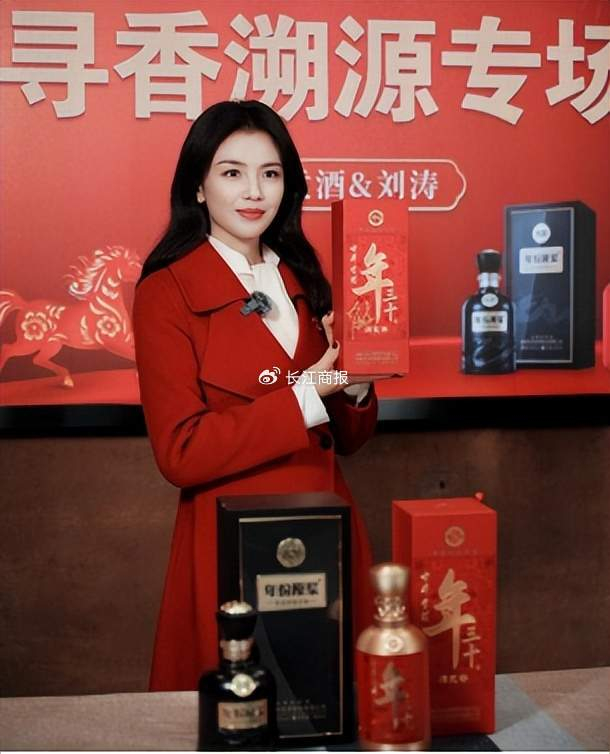
Core Insights - The article highlights the successful integration of traditional culture and modern digital marketing by Gujinggongjiu through a live-streaming event featuring actress Liu Tao, aimed at boosting the consumption of liquor during the Chinese New Year [1][10] Group 1: Live Streaming Event - The live-streaming event titled "Celebrate the New Year with Gujing, Liu Tao Brings Good Fortune" was held on January 28, attracting significant consumer interest and engagement [1] - The event lasted nearly 4 hours, achieving impressive metrics such as over 30 million total exposures and more than 5 million cumulative viewers, with a peak online audience of 156,000 [3][4] Group 2: Sales Performance - During the live stream, the total exposure of products reached over 13 million, leading to stock shortages for several gift boxes, including the Year of the Horse limited edition and other premium offerings [4] - The live stream maintained an online audience of over 100,000 throughout, securing the top position in Douyin's real-time liquor category rankings, establishing a benchmark in the white liquor live-streaming sector [4] Group 3: Brand and Cultural Engagement - The success of the live stream is attributed to Gujinggongjiu's commitment to brand culture, precise understanding of consumer scenarios, and deep insights into regional consumer needs [6] - Liu Tao's popularity and relatability aligned perfectly with Gujinggongjiu's branding as a "national liquor," enhancing the connection with viewers through interactive elements and cultural messaging [8] Group 4: Marketing Innovation - The collaboration of "celebrity + culture + live streaming" represents an innovative marketing approach for Gujinggongjiu, effectively converting sales while promoting traditional brewing techniques and cultural heritage [10] - By leveraging a national-level live streaming platform, Gujinggongjiu successfully reached a broader audience, particularly younger consumers, facilitating a transformation towards a more youthful brand image [8][10]
酒价内参2月3日价格发布 洋河梦之蓝M6+上涨5元
Xin Lang Cai Jing· 2026-02-03 01:37
Core Insights - The article discusses the launch of "Wine Price Reference" by Sina Finance, which provides real-time data on the retail prices of major Chinese liquor brands, highlighting a structural price differentiation in the market as of February 3rd [1][7]. Price Trends - The average retail price of the top ten liquor products in China was reported at 9013 yuan, a slight decrease of 7 yuan from the previous day, primarily driven by price corrections in high-end products [1][7]. - Among the ten products, seven saw price increases while three experienced declines, indicating a continued structural differentiation in pricing [1][7]. Notable Price Changes - The price of Xijiu Junpin increased by 10 yuan, while Qinghua Lang rose by 8 yuan, reflecting a stronger pricing strategy in the market [1][7]. - Other products like Yanghe Dream Blue M6+ and Guojiao 1573 each saw a price increase of 5 yuan, indicating a positive market sentiment [1][7]. - Conversely, the price of premium Moutai dropped by 22 yuan, marking the largest decline, following a previous strong price increase [1][7]. Data Collection Methodology - The "Wine Price Reference" collects data from approximately 200 sampling points across various regions, including designated distributors, social distributors, e-commerce platforms, and retail outlets, ensuring a comprehensive and objective price tracking system [2][8]. - The data aims to provide a scientifically accurate and traceable representation of the market prices for well-known liquor brands [2][8]. iMoutai Platform Insights - The iMoutai platform reported an increase of 6.28 million new users in the past month, with active users exceeding 15.31 million [2][8]. - The platform successfully processed over 2.12 million orders, with more than 1.43 million orders for the 500ml Moutai product, indicating strong consumer demand [2][8]. - iMoutai has enhanced its risk management capabilities, successfully intercepting 540 million instances of abnormal behavior in January, aiming to create a fair and orderly consumption environment [2][8].
酒价内参2月3日价格发布 十大单品七涨三跌结构分化延续
Xin Lang Cai Jing· 2026-02-03 01:24
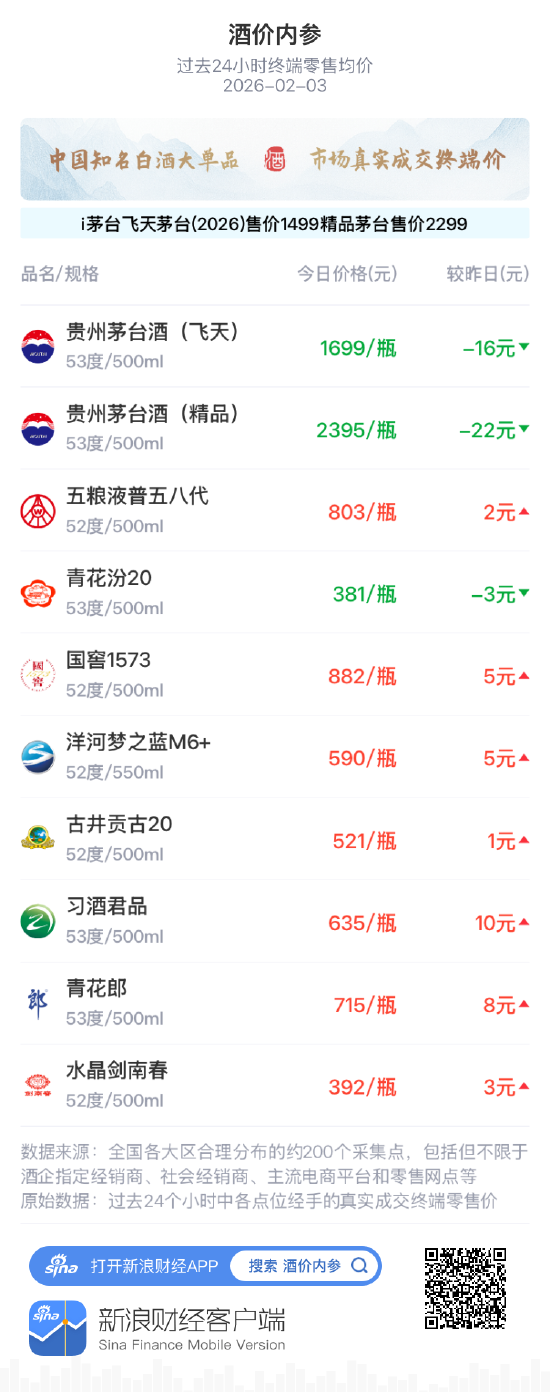
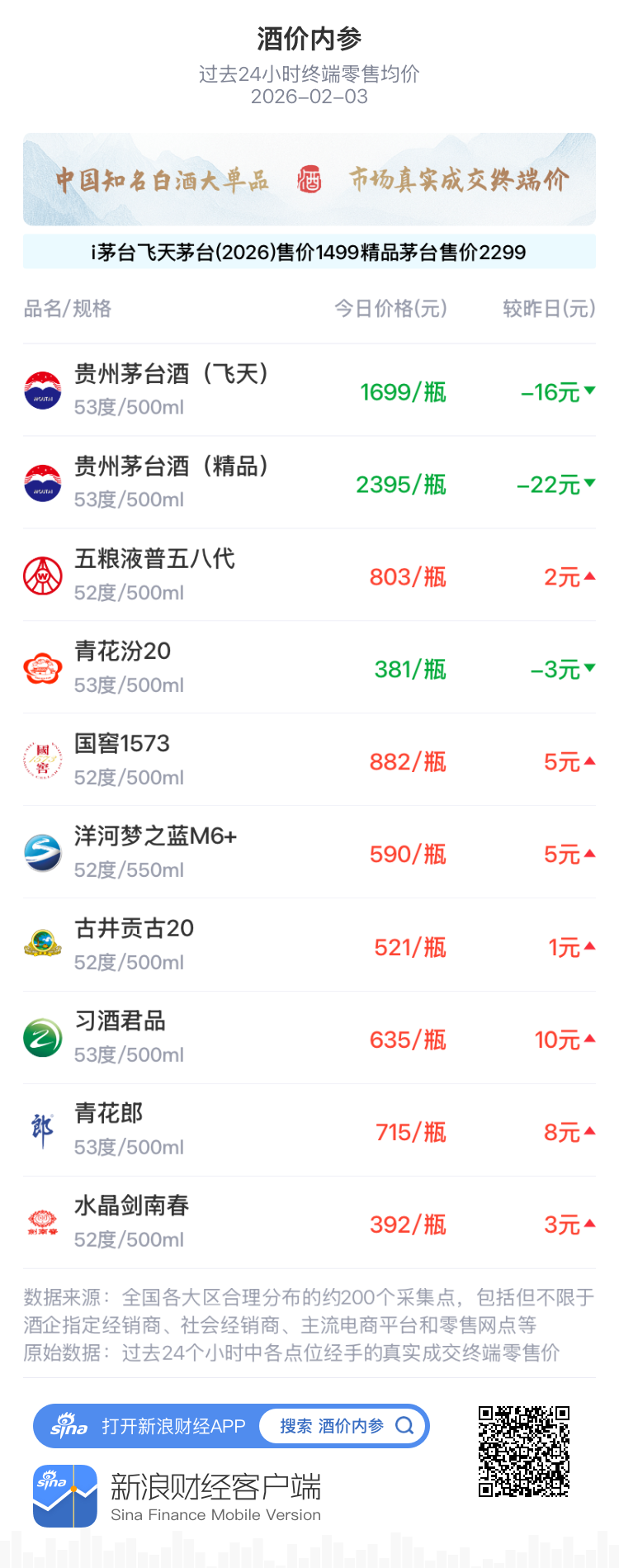
Core Insights - The Chinese white liquor market is experiencing structural price differentiation among its top ten products, with a slight overall price decline observed on February 3, where the total retail price for a bundled sale of these products was 9013 yuan, down by 7 yuan from the previous day [1] Price Movements - Among the top ten products, seven saw price increases while three experienced declines, indicating a continuation of structural differentiation in terminal prices [1] - The most significant price increases were noted for: - Xijiu Junpin, which rose by 10 yuan - Qinghua Lang, which increased by 8 yuan - Yanghe Dream Blue M6+ and Guojiao 1573, both up by 5 yuan, reflecting stronger channel pricing intentions [1] - Conversely, the largest declines were recorded for: - Boutique Moutai, which fell by 22 yuan after a previous strong increase - Feitian Moutai, down by 16 yuan following a substantial rise at the end of January - Qinghua Fen, which decreased by 3 yuan, indicating slight market price easing [1] Specific Product Pricing - The current prices for notable products are as follows: - Feitian Moutai: 1699 yuan, down by 16 yuan - Boutique Moutai: 2395 yuan, down by 22 yuan - Wuliangye Pu 58: 803 yuan, up by 2 yuan - Yanghe Dream Blue M6+: 590 yuan, up by 5 yuan - Xijiu Junpin: 635 yuan, up by 10 yuan - Qinghua Lang: 715 yuan, up by 8 yuan - Gujing Gong: 521 yuan, up by 1 yuan - Shujian Jian Nan Chun: 392 yuan, up by 3 yuan [3][4]
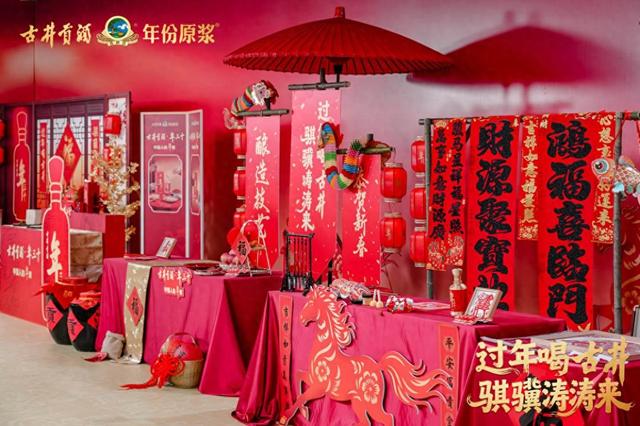
过年喝古井,骐骥涛涛来 | 国民女神刘涛携中国人的年酒,创白酒直播新高度
Guan Cha Zhe Wang· 2026-02-02 10:03
Core Insights - The article highlights a successful online Spring Festival gala hosted by Gujing Gongjiu, featuring actress Liu Tao, which attracted 4.7 million viewers and set a record for the liquor industry [1][3] - The event combined traditional cultural elements with modern interactive experiences, enhancing the festive atmosphere and promoting the brand [11][13] Group 1: Event Highlights - The live stream began at 8 PM, with Liu Tao's appearance significantly boosting viewer engagement, surpassing 100,000 viewers within the first five minutes [3][5] - The event included multiple giveaways, with 666 sets of tasting mini bottles selling out quickly, showcasing high audience participation [5][7] - The total exposure for the live stream exceeded 30 million, with over 13 million product exposures and an increase of 25,000 new followers [7] Group 2: Cultural and Brand Connection - Liu Tao's connection to the brand is emphasized through her long-standing association with the CCTV Spring Festival Gala, aligning with Gujing Gongjiu's 11-year partnership with the event [5][11] - The collaboration reflects a deep understanding of consumer trends, where modern consumers value both cultural heritage and emotional connections in their purchases [11][13] - The event successfully blended traditional craftsmanship with contemporary consumer engagement, reinforcing the brand's commitment to quality and cultural significance [9][13]
白酒板块2月2日涨1.86%,金徽酒领涨,主力资金净流入14.64亿元
Zheng Xing Xing Ye Ri Bao· 2026-02-02 09:15
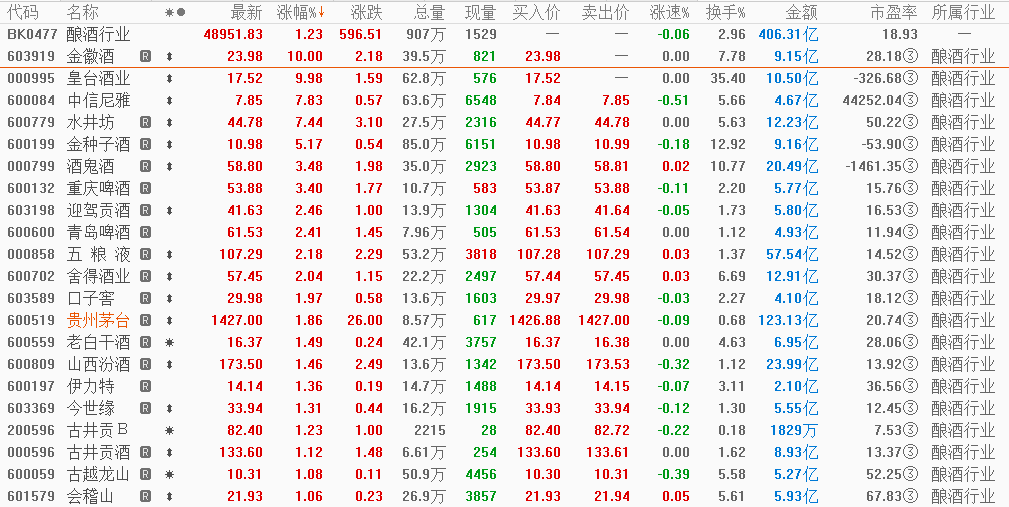
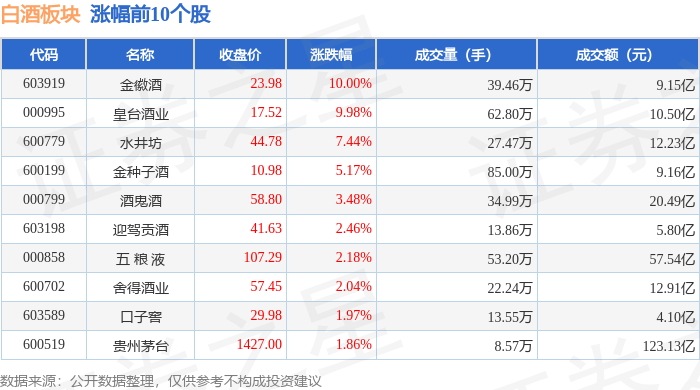
Group 1 - The liquor sector experienced a rise of 1.86% on February 2, with Jinhuijiu leading the gains [1] - The Shanghai Composite Index closed at 4015.75, down 2.48%, while the Shenzhen Component Index closed at 13824.35, down 2.69% [1] - Key stocks in the liquor sector showed significant price increases, with Jinhuijiu up 10.00% to 23.98, and Huangtaijiu up 9.98% to 17.52 [1] Group 2 - The liquor sector saw a net inflow of 1.464 billion yuan from main funds, while retail investors experienced a net outflow of 448 million yuan [2] - The trading volume for major liquor stocks included Luzhou Laojiao at 33.07 billion yuan and Wuliangye at 57.54 billion yuan [2] - The stock performance of major companies included Moutai with a closing price of 1427.00, up 1.86%, and Wuliangye at 107.29, up 2.18% [1][2] Group 3 - Moutai had a main fund net inflow of 5.46 billion yuan, while retail investors had a net outflow of 861,700 yuan [3] - Luzhou Laojiao saw a main fund net inflow of 1.56 billion yuan, with a retail net outflow of 1.1 billion yuan [3] - Water Well Square had a main fund net inflow of 1.46 billion yuan, with retail investors experiencing a net outflow of 58.5 million yuan [3]


白酒板块全线飘红,机构喊投资机遇
Huan Qiu Wang· 2026-02-02 07:54
Core Viewpoint - The A-share market's liquor sector is experiencing a strong performance, with individual stocks showing a general upward trend as the traditional sales peak season approaches due to the upcoming Spring Festival [1] Group 1: Market Performance - The liquor sector index (BK0477) closed at 48,951.83, with a 1.23% increase, indicating a positive market sentiment [2] - Notable stocks such as Jinhuijiu and Huangtaijiu reached their daily limit, while others like Wuliangye and Moutai also saw significant gains [1][2] Group 2: Seasonal Factors - The upcoming Spring Festival is expected to boost sales in the liquor industry, with Moutai's price showing signs of recovery, providing strong price support for liquor stocks [1][3] - The 2026 Spring Festival is anticipated to have one additional day compared to previous years, which may enhance actual sales performance [1][3] Group 3: Macro Environment - The improvement in macroeconomic policies is seen as a positive factor for the liquor sector, with a focus on boosting domestic demand and real estate [3] - The government plans to implement a strategy for expanding domestic demand from 2026 to 2030, which could benefit the liquor industry [3] Group 4: Investment Sentiment - The allocation of public funds to the liquor sector has decreased to 3.93%, indicating a low historical level that may provide room for recovery [3] - Notable investor Duan Yongping expressed confidence in Moutai's stock price, suggesting it is undervalued from a long-term perspective [3] Group 5: Industry Outlook - Despite some companies facing earnings pressure, the valuation of the liquor sector is at historical lows, which may lead to a recovery ahead of earnings improvement [4] - Analysts believe that the liquor industry, as a barometer of the macro economy, is likely to benefit from government support for real estate and domestic demand [4]