
WLY(000858)

Search documents
国投证券:食品饮料行业迎来基本面与估值双重复苏机遇
智通财经网· 2025-11-26 09:13
Core Viewpoint - The report from Guotou Securities emphasizes the importance of consumption in economic growth, predicting a stabilization in the consumption fundamentals in 2026, which presents a significant opportunity for investment in the food and beverage industry [1] Group 1: Alcohol Industry - The liquor sector is at a cyclical bottom, with low expectations, low holdings, and low valuations, suggesting potential for left-side layout opportunities [2] - The rapid clearing of financial reports in the past two quarters indicates a resolution of supply-demand conflicts, with a gradual recovery in household consumption expected [2] - The white liquor business model remains strong, and with a potential economic recovery, valuations are likely to rebound quickly [2] Group 2: Beer Industry - The beer sector is expected to maintain a structural market in 2026, with investment opportunities in companies with strong single-product growth logic and those benefiting from competitor adjustments [3] - Overall profitability in the beer sector is on an upward trend, driven by the expansion of products priced between 8-10 yuan and improved efficiency from lean management [3] Group 3: Dairy Industry - The dairy sector is positioned for a turnaround in the raw milk cycle in 2026, with a focus on the profitability elasticity of the dairy supply chain [4] - Demand for dairy products has shown differentiation, with low-temperature fresh milk and cheese experiencing healthy growth, while room temperature liquid milk has been a drag [4] - The average milk price in major production areas is expected to recover above the average cost of production in 2026, making it an opportune time to invest in the dairy supply chain [4] Group 4: Soft Drink Industry - The soft drink sector has seen significant performance differentiation, with companies in strong growth categories leading the industry [5] - In 2026, there is a focus on functional beverages and the competitive landscape of packaged water, with an emphasis on companies introducing new products [5] - The demand for low-sugar functional beverages is anticipated to grow, particularly among white-collar workers seeking fatigue-relief options [5] Group 5: Snack Industry - The snack sector is benefiting from strong new channel drivers, with expectations of improved gross and net profit margins due to scale effects [6] - The konjac product category is maintaining high market interest, with significant growth potential in China [6] - Investment recommendations include focusing on companies with strong performance during the adjustment period and those with leading products in the snack sector [6]




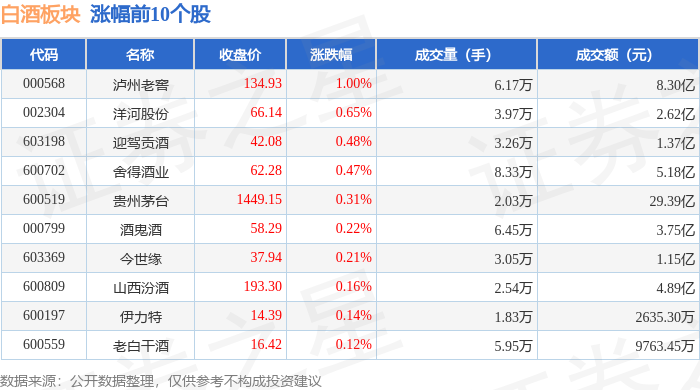
白酒板块11月26日涨0.21%,泸州老窖领涨,主力资金净流出9509.41万元
Zheng Xing Xing Ye Ri Bao· 2025-11-26 09:05
Market Overview - The liquor sector experienced a slight increase of 0.21% on November 26, with Luzhou Laojiao leading the gains [1] - The Shanghai Composite Index closed at 3864.18, down 0.15%, while the Shenzhen Component Index closed at 12907.83, up 1.02% [1] Individual Stock Performance - Luzhou Laojiao (000568) closed at 134.93, up 1.00% with a trading volume of 61,700 hands and a transaction value of 830 million [1] - Yanghe Brewery (002304) closed at 66.14, up 0.65%, with a transaction value of 262 million [1] - Guizhou Moutai (600519) closed at 1449.15, up 0.31%, with a transaction value of 2.939 billion [1] - Other notable stocks include Shanxi Fenjiu (600809) at 193.30, up 0.16%, and Jiu Gui Jiu (000799) at 58.29, up 0.22% [1] Fund Flow Analysis - The liquor sector saw a net outflow of 95.0941 million from main funds, while retail funds had a net inflow of 6.4507 million [2] - Luzhou Laojiao attracted a net inflow of 69.6728 million from main funds, while Guizhou Moutai experienced a net outflow of 64.6471 million from retail funds [3] - The overall fund flow indicates a mixed sentiment among institutional and retail investors within the liquor sector [2][3]





宁德时代与五粮液达成战略合作!
鑫椤锂电· 2025-11-26 06:42
Core Viewpoint - CATL has formed a strategic partnership with Wuliangye Group to integrate traditional liquor production with new energy technologies, aiming to create a model for zero-carbon transformation in the industry [2][4]. Group 1: Strategic Collaboration - The collaboration focuses on three main areas: project co-construction, capital cooperation, and supply chain integration [2]. - The partnership aims to establish a zero-carbon park, utilizing Wuliangye's industrial parks and CATL's expertise in photovoltaic power stations and energy storage systems [2]. Group 2: Green Logistics and Electrification - The two companies will promote the electrification of Wuliangye's own vehicles and those of its suppliers, prioritizing the use of CATL's battery products [3]. - They will explore the establishment of battery swap demonstration routes to enhance logistics efficiency [3]. Group 3: Battery Business Synergy - The partnership will advance the research and development of battery pack materials and structural components, leveraging Wuliangye's technology in high-end packaging and anti-counterfeiting [4]. - This collaboration marks a significant milestone for CATL as it expands its energy solutions from the transportation sector to industrial production scenarios [4].

五粮液旗下基金入股国创先进半导体
Xin Lang Cai Jing· 2025-11-26 03:52
【五粮液旗下基金入股国创先进半导体】智通财经11月26日电,天眼查App显示,近日,国创先进半导 体材料(无锡)有限公司发生工商变更,新增五粮液旗下四川普什产业发展基金合伙企业(有限合伙) 为股东,注册资本由3800万人民币增至4800万人民币。国创先进半导体材料(无锡)有限公司成立于 2024年3月,法定代表人为郑际杰,经营范围含工程和技术研究和试验发展、技术玻璃制品制造、技术 玻璃制品销售、新材料技术推广服务、新材料技术研发、技术进出口等。股东信息显示,该公司现由江 苏远航时代控股集团有限公司、玻璃新材料创新中心(安徽)有限公司、江苏振球投资有限公司及上述 新增股东等共同持股。 新浪财经"酒价内参"重磅上线 知名白酒真实市场价尽在掌握 转自:智通财经 ...
五粮液旗下基金入股国创先进半导体,后者增资至4800万
Xin Lang Cai Jing· 2025-11-26 03:39
Group 1 - The article highlights the launch of a new feature on Sina Finance called "Wine Price Insider," which aims to provide real-time market prices for well-known liquor brands [1] - On November 25, a business change occurred for Guochuang Advanced Semiconductor Materials (Wuxi) Co., Ltd., with the addition of Sichuan Push Industry Development Fund Partnership (Limited Partnership), a subsidiary of Wuliangye, as a shareholder [1] - The registered capital of Guochuang Advanced Semiconductor Materials increased from 38 million RMB to 48 million RMB [1] Group 2 - Guochuang Advanced Semiconductor Materials was established in March 2024, with Zheng Jijie as the legal representative [1] - The company's business scope includes engineering and technical research and experimental development, manufacturing and sales of technical glass products, promotion services for new material technologies, and technology import and export [1] - The current shareholders of the company include Jiangsu Yuanhang Times Holding Group Co., Ltd., Glass New Material Innovation Center (Anhui) Co., Ltd., Jiangsu Zhenqiu Investment Co., Ltd., and the newly added shareholder [1]
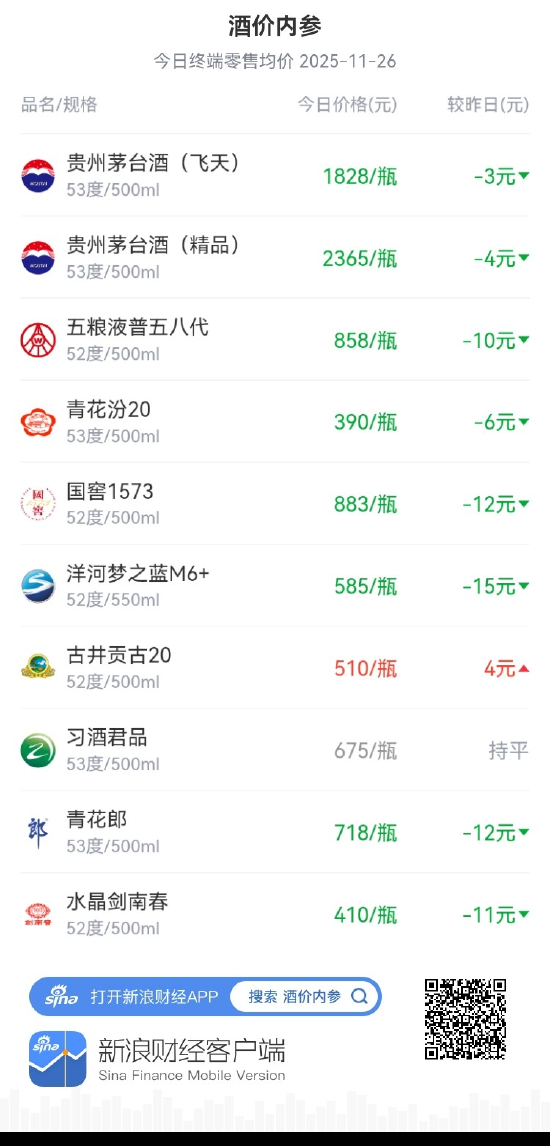
酒价内参11月26日价格发布:洋河梦之蓝M6+价格下跌15元/瓶,跌幅居前
Xin Lang Cai Jing· 2025-11-26 01:44
Group 1 - The core viewpoint of the article highlights a significant price adjustment in the Chinese liquor market, particularly among the top ten products, with an overall retail price drop of 69 yuan, totaling 9222 yuan, ending a four-day upward trend [1] - Among the products, Gujinggong Gu20 saw a price increase of 4 yuan per bottle, while the majority experienced price declines, with Yanghe Dream Blue M6+ dropping by 15 yuan per bottle, marking the largest decrease [1][4] - The article notes that prior to this price adjustment, there was a period of price stabilization and increase in the white liquor market, indicating accumulated pressure for a correction [1] Group 2 - Liu Feng, Chief Economist at the International Research Institute of Green Finance, emphasized the resilience of the liquor industry in China, despite challenges such as declining production and market segmentation, due to its essential role in social and emotional contexts [2] - Looking ahead to the 14th Five-Year Plan, Liu pointed out trends driven by consumer rationality and health consciousness, with a focus on quality and cultural value as key purchasing motivations [2] - Liu suggested that liquor companies should adopt a "1+N" product strategy, maintaining core flagship products while introducing a variety of lower-alcohol and fruit wines to meet changing consumer demands [2]

食品饮料周报(25年第43周):白酒板块红利属性凸显,关注大众品消费场景恢复-20251125
Guoxin Securities· 2025-11-25 13:55
Investment Rating - The report maintains an "Outperform the Market" rating for the food and beverage sector [4][5][15]. Core Views - The food and beverage sector is expected to benefit from a recovery in consumer spending, particularly in the context of the upcoming 2026 fiscal year, with a focus on health innovation and digital supply chains [3][10]. - The report highlights the differentiation in performance across categories, with beverages outperforming food and alcoholic beverages [2][10]. - Key investment opportunities are identified in premium liquor brands, dairy products, and innovative snack foods, with specific recommendations for companies like Guizhou Moutai, Yili, and Eastroc Beverage [2][3][15]. Summary by Relevant Sections Market Overview - The food and beverage sector saw a cumulative decline of 1.52% this week, with A-shares down 1.36% and H-shares down 3.69% [1]. - Notable performers included Nanchao Food (+11.91%) and Yili (+2.65%) [1]. Alcoholic Beverages - The liquor sector is entering a left-side layout phase, with premium brands expected to gain market share [2][10]. - Recommendations include Luzhou Laojiao, Shanxi Fenjiu, and Guizhou Moutai, with a focus on companies that can leverage pricing power and regional advantages [2][10]. Beer - The beer industry is experiencing healthy inventory levels, with expectations for demand recovery [2][11]. - Yanjing Beer is recommended for its strong growth potential and ongoing internal reforms [2][11]. Dairy Products - The dairy sector is seeing a steady recovery in demand, with Yili recommended for its valuation safety margin [2][13]. - The report anticipates improvements in supply-demand dynamics by 2026 [2][13]. Snacks - The report emphasizes the growth potential of konjac snacks, with leading companies like Weilong and Yanjinpuzi showing strong competitive advantages [2][12]. - The snack industry is shifting towards a category-driven growth model, necessitating strong product differentiation [2][12]. Investment Recommendations - The recommended investment portfolio includes Guizhou Moutai, Babi Food, Eastroc Beverage, Weilong, and Luzhou Laojiao, with an average decline of 4.94% this week [3][15]. - The report suggests that the current pricing environment for Moutai presents a favorable investment opportunity, with expectations for revenue growth in the coming years [15][16].


五粮液:截至11月20日,公司股东户数为60余万户
Zheng Quan Ri Bao· 2025-11-25 13:09
Core Insights - Wuliangye reported that as of November 20, the number of its shareholders exceeded 600,000 [2] Company Summary - Wuliangye has a significant shareholder base, indicating strong investor interest and potential market confidence [2]
11月25日深证国企股东回报(970064)指数涨0.73%,成份股中材科技(002080)领涨
Sou Hu Cai Jing· 2025-11-25 11:01
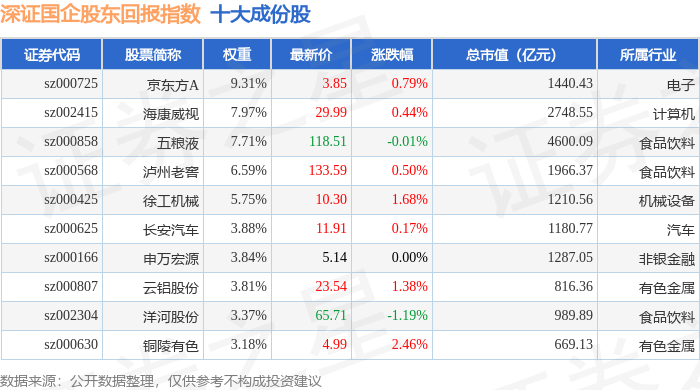
Core Points - The Shenzhen State-Owned Enterprises Shareholder Return Index (970064) closed at 1612.77 points, up 0.73%, with a trading volume of 20.124 billion yuan and a turnover rate of 0.78% [1] - Among the index constituents, 33 stocks rose, with China National Materials Technology leading at a 10.01% increase, while 12 stocks fell, with CITIC Special Steel leading the decline at 2.97% [1] Index Constituents Summary - The top ten constituents of the Shenzhen State-Owned Enterprises Shareholder Return Index include: - BOE Technology Group (sz000725) with a weight of 9.31%, latest price at 3.85, and a market cap of 144.043 billion yuan [1] - Hikvision (sz002415) with a weight of 7.97%, latest price at 29.99, and a market cap of 274.855 billion yuan [1] - Wuliangye Yibin (sz000858) with a weight of 7.71%, latest price at 118.51, and a market cap of 460.009 billion yuan [1] - Luzhou Laojiao (sz000568) with a weight of 6.59%, latest price at 133.59, and a market cap of 196.637 billion yuan [1] - XCMG Machinery (sz000425) with a weight of 5.75%, latest price at 10.30, and a market cap of 121.056 billion yuan [1] - Changan Automobile (sz000625) with a weight of 3.88%, latest price at 11.91, and a market cap of 118.077 billion yuan [1] - Shenwan Hongyuan (sz000166) with a weight of 3.84%, latest price at 5.14, and a market cap of 128.705 billion yuan [1] - Yunnan Aluminum (sz000807) with a weight of 3.81%, latest price at 23.54, and a market cap of 81.636 billion yuan [1] - Yanghe Brewery (sz002304) with a weight of 3.37%, latest price at 65.71, and a market cap of 68.686 billion yuan [1] - Tongling Nonferrous Metals (sz000630) with a weight of 3.18%, latest price at 6.67, and a market cap of 66.913 billion yuan [1] Capital Flow Summary - The net inflow of main funds into the index constituents totaled 425 million yuan, while retail funds saw a net outflow of 319 million yuan [3] - Key stocks with significant capital flow include: - China National Materials Technology with a net inflow of 210 million yuan from main funds [3] - Luzhou Laojiao with a net inflow of 91.542 million yuan from main funds [3] - Tongling Nonferrous Metals with a net inflow of 60.685 million yuan from main funds [3]



投资者提问:董秘您好: 近日看到知名酒评博主“一波说酒”在其抖音账号发布了...
Xin Lang Cai Jing· 2025-11-25 09:49
Core Viewpoint - The company has addressed inquiries regarding the authenticity and purchasing channels of its product, Wuliangye 501 Mingchi, emphasizing the importance of official sales channels for consumers [1] Group 1 - The company confirmed that the two bottles showcased by the wine reviewer are legitimate products [1] - The company referred to its March announcement regarding official e-commerce sales channels, providing consumers with guidance on where to purchase [1] - The company expressed gratitude for investor interest and encouraged checking the official channels for further information [1]