WLY(000858)

Search documents
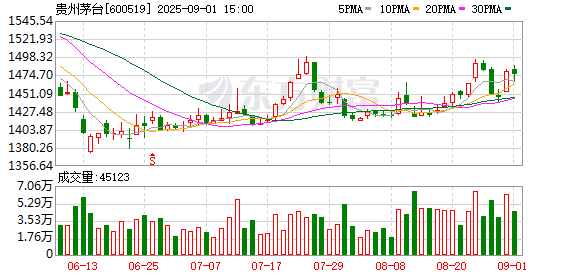
白酒板块午盘微涨贵州茅台1467.39元/股收盘
Xin Lang Cai Jing· 2025-09-01 07:35
Group 1 - The core point of the article indicates that the liquor sector, particularly the baijiu segment, is experiencing a mixed performance with some stocks declining despite a slight overall market increase [1] - The Shanghai Composite Index rose by 0.12% to 3862.65 points, while the baijiu sector saw a 0.39% increase, although 13 baijiu stocks reported declines [1] - Specific stock performances include Kweichow Moutai closing at 1467.39 CNY per share, down 0.85%; Wuliangye at 127.71 CNY, down 1.41%; Shanxi Fenjiu at 198.50 CNY, down 1.74%; and Luzhou Laojiao at 134.90 CNY [1] Group 2 - Huatai Securities' report suggests that the current fundamentals are stabilizing, with expectations that the decline in baijiu sales since August has narrowed, particularly in the context of social gatherings like graduation banquets and family reunions [1] - The report highlights a recovery in the sales of baijiu products priced below 300 CNY, indicating a positive trend in the mass market segment [1]




茅台完成回购启动增持;五粮液舍得低度酒上市热销|观酒周报
2 1 Shi Ji Jing Ji Bao Dao· 2025-09-01 07:24
Core Insights - The overall performance of the liquor industry has declined in the first half of the year, with over two-thirds of listed liquor companies experiencing a year-on-year decrease in performance, while only a few managed to maintain single-digit growth [2][10] Company Dynamics - Guizhou Moutai announced a share repurchase of 60 billion yuan and a new plan for the controlling shareholder to increase its stake by 30 to 33 billion yuan within six months, signaling confidence in the company's long-term value [3][4] - Li Du Liquor Company has suspended the supply of certain high-quality products due to resource scarcity, ensuring product quality and customer rights [5] - Shede Liquor launched a new low-alcohol product "Shede·Zizai" priced at 329 yuan, with a strategic partnership with JD.com for marketing and distribution [6] - Wuliangye's new product "Wuliangye·Yijianqingxin" was launched and sold out quickly during a live broadcast event, indicating strong market interest [7][8] - Moutai's new "Moutai 1935" product was launched with a controlled pricing model, aiming to solidify its position in the premium market segment [9] Industry Performance - Among 21 listed liquor companies, only six reported positive growth, with Moutai showing the highest increase of approximately 9% in revenue and net profit [10] - The beer industry showed mixed results, with Budweiser experiencing the largest decline, while Yanjing and Zhujiang breweries reported significant profit increases [12][13] - The yellow wine sector saw only one company, Kuaijishan, achieve double-digit revenue growth, while others like Guyue Longshan and Jinfeng reported declines [14] Industry Trends - The first half of 2025 saw a slight decrease in the production of liquor, with a total output of 191.59 million hectoliters, down 5.8%, while sales revenue increased marginally by 0.19% [16] - In Jiangsu Province, liquor production fell by 17% and beer production decreased by 3.9% in the first seven months of the year [17] Industry Events - The 114th National Sugar and Wine Fair is scheduled for March 26-28, 2026, in Chengdu, continuing to be a significant event for the industry [15] Personnel Changes - Zhu Xianghong has been appointed as the chairman of Huanghelou Liquor Company, while still serving as the general manager [18]

白酒板块午盘微涨 贵州茅台1467.39元/股收盘
Bei Jing Shang Bao· 2025-09-01 06:19
Core Viewpoint - The liquor sector is experiencing a mixed performance, with some stocks declining despite a stable overall market environment, indicating potential recovery in demand as the Mid-Autumn Festival approaches [1] Industry Summary - The Shanghai Composite Index rose by 0.12% to 3862.65 points, while the liquor sector increased by 0.39%, although 13 liquor stocks saw declines [1] - Major liquor stocks such as Kweichow Moutai, Wuliangye, Shanxi Fenjiu, Luzhou Laojiao, and Yanghe all reported price drops, with Kweichow Moutai closing at 1467.39 yuan per share, down 0.85% [1] - The current industry fundamentals are stabilizing, with a narrowing decline in sales since August, particularly in mass banquet scenarios like graduation and family gatherings [1] - Liquor products priced below 300 yuan are showing signs of recovery, while business consumption remains under pressure but is expected to gradually improve as policy restrictions ease [1] - Due to previous rapid demand declines, some distributors are being more cautious with collections and shipments, but overall, the industry is expected to see a steady recovery in demand leading up to the Mid-Autumn Festival [1]

深市两融余额创纪录!这些股票,被融资客加仓
Zhong Guo Zheng Quan Bao· 2025-09-01 05:20
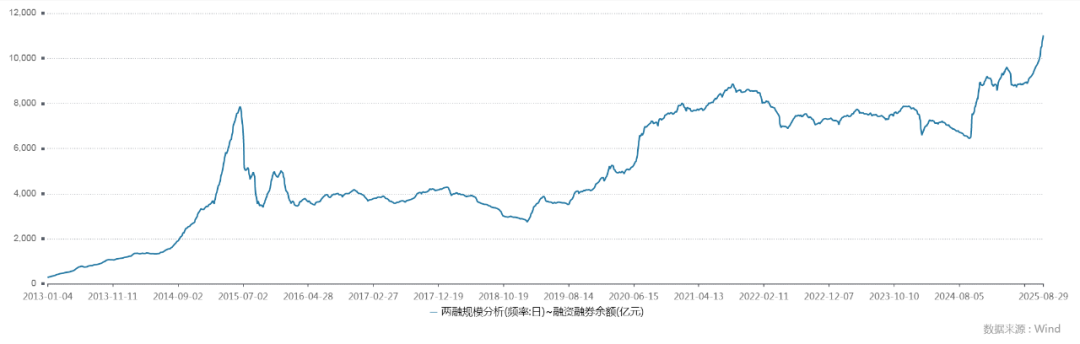
Core Insights - As of August 29, the A-share market's financing balance reached 22,454.72 billion yuan, with a margin trading balance of 158.77 billion yuan, marking an increase of 2,744.45 billion yuan in August [1][2] - The financing balance in the electronics sector increased by over 78 billion yuan, with the highest net buying stock being Cambrian-U and the largest net selling stock being Lu'an Environmental Energy [1][2][10] Financing and Margin Trading Overview - The total margin trading balance in the A-share market reached 22,613.49 billion yuan, with the financing balance at 22,454.72 billion yuan, both hitting over a 10-year high [2][7] - The Shenzhen market's margin trading balance reached a historical high of 11,020.41 billion yuan [2] Trading Activity - In August, there were 21 trading days, with the financing balance increasing on 18 of those days, and 11 days saw increases exceeding 11 billion yuan [5] - From August 13 to August 29, A-shares experienced 13 consecutive trading days where both trading volume and margin trading balance exceeded 20 billion yuan [5][6] Sector Performance - Among the 31 sectors, 30 saw an increase in financing balance, with the electronics, computer, and communication sectors leading in net buying amounts of 784.24 million yuan, 248.12 million yuan, and 235.51 million yuan respectively [7][9] Individual Stock Activity - In August, financing clients increased their positions in 687 stocks by over 100 million yuan, with Cambrian-U leading at a net buying amount of 60.48 billion yuan [10] - The top ten stocks with the highest net buying amounts included Cambrian-U, Shenghong Technology, and SMIC, with net buying amounts of 60.48 billion yuan, 57.48 billion yuan, and 53.19 billion yuan respectively [10] Margin Selling Activity - The margin selling balance in the A-share market was 158.77 billion yuan, with an increase of 20.78 billion yuan in August [11] - The top stocks for margin selling included Kweichow Moutai, New Yisheng, and Shenghong Technology, with margin selling balances of 0.87 billion yuan, 0.84 billion yuan, and 0.83 billion yuan respectively [11]





一场七夕宴,酒业新棋局
Sou Hu Cai Jing· 2025-09-01 04:27
Core Insights - The article highlights the transformation of the liquor industry through innovative marketing strategies during the Qixi Festival, focusing on low-alcohol products and immersive experiences to attract younger consumers [2][18] Product Trends - The liquor industry is shifting towards "low-alcohol" products, with brands like Wuliangye launching a 29-degree product and Gujinggong introducing a 26-degree variant, both targeting younger consumers who prefer lower alcohol content [3][12] Marketing Strategies - Companies are implementing online and offline marketing strategies that emphasize experiential and scenario-based consumption, such as interactive online campaigns and immersive offline events [5][9] - Online initiatives include social media interactions and themed content, while offline events focus on creating unique experiences that resonate with consumers [11][12] Targeting Young Consumers - The combination of low-alcohol products and scenario-based marketing aims to break traditional stereotypes associated with liquor, appealing to the younger generation's drinking habits and lifestyle [12][14] - Brands are redefining their image from "traditional liquor" to "social currency" by integrating elements relevant to young consumers, such as romance and social interactions [12][14] New Consumption Scenarios - The industry is witnessing a shift from traditional consumption scenarios like business dinners to new contexts such as family gatherings and emotional consumption, with brands adapting their offerings accordingly [13][14] - Marketing efforts are increasingly focused on emotional connections, with campaigns linking drinking to significant life moments and personal experiences [13][14] Embracing Female Consumers - The rise of the "she economy" is being recognized as a significant market opportunity, with products designed to appeal to female consumers through aesthetics and lower alcohol content [14][15] - Marketing strategies are tailored to resonate with women's self-care and emotional needs, further expanding the consumer base [15] Industry Challenges - Despite the innovative marketing approaches, the industry faces challenges such as homogenized competition and the risk of consumer fatigue due to similar marketing tactics [17] - The need for brands to convert short-term festival excitement into long-term consumer loyalty remains a critical challenge [17][18] Future Directions - The liquor industry is expected to further segment its marketing strategies, targeting emerging consumer scenarios like solo drinking and self-rewarding experiences [17][18] - Long-term success will depend on continuous product innovation and the ability to integrate drinking into everyday life rather than limiting it to festive occasions [17][18]

中国白酒 -25 年总结 - 超高端产品保持韧性;通过控制运营费用实现利润率稳定-China Spirits_ 2Q25 Wrap_ Super premium maintained resilience; Margin stability on opex control
2025-09-01 03:21
Summary of China Spirits Industry Conference Call Industry Overview - The conference call focused on the China spirits industry, particularly the performance of various spirits companies in the second quarter of 2025 (2Q25) [1][2]. Key Points and Arguments 1. Performance of Super-Premium Brands - Super-premium brands like Kweichow Moutai and Wuliangye showed resilience, with Moutai achieving a 9% year-over-year (yoy) sales growth in 2Q25 [8][16]. - Laojiao's sales declined by 8% yoy, which was better than the expected decline of 17% [16]. 2. Upper-Mid-End Brands Struggled - Upper-mid-end brands faced significant sales declines, with companies like Yanghe and King's Luck reporting sales drops of 44% and 30% yoy, respectively [16]. - Fen Wine managed to maintain flattish sales, aided by its low-end segment [1]. 3. Margin Resilience - Despite a decline in average selling prices (ASP), many companies maintained stable gross profit margins (GPM), with most experiencing a contraction of about 1 percentage point yoy [9][10]. - The GPM for Moutai and Wuliangye's high-end segments outperformed their lower-end products [8]. 4. Operating Cash Flow Concerns - There was a notable deterioration in operating cash flow for upper-mid-end brands, while super-premium brands continued to maintain positive cash inflows [11]. 5. Customer Advances and Shipment Suspensions - Customer advances showed mixed results, with significant declines for Gujing and Jiugui, down 36% and 47% yoy, respectively [12][14]. - Shipment suspensions were noted across various brands, impacting customer advance balances and overall sales performance [12]. 6. Expense Control - Companies demonstrated disciplined expense management, with selling expense ratios rising by no more than 2 percentage points [10]. - Laojiao and Gujing reported declines in their expense ratios, indicating effective cost control measures [10]. 7. Market Sentiment and Future Outlook - There are signs of normalizing policy impacts on private consumption, with market sentiment shifting towards lagging stocks as investors adopt a "worst is over" perspective [2]. - The upcoming Mid-Autumn Festival and National Day are critical periods to monitor for consumption recovery and wholesale price trends [2]. Additional Important Insights - The spirits industry is facing challenges from anti-extravagance policies, which have affected consumer spending patterns [1]. - The overall retail spirits market is expected to see a decline of approximately 30% in August and a 15-20% decline during the peak season [7]. - The diversified product portfolios of certain brands have been crucial in supporting resilience amid market challenges [8]. Conclusion - The China spirits industry is currently navigating a complex landscape characterized by varying performance across different market segments. Super-premium brands are faring better than their upper-mid-end counterparts, and careful expense management is helping to mitigate some of the financial pressures. Future performance will heavily depend on consumer sentiment and the effectiveness of policy measures in stimulating demand.
酒企“寒冬”:总量承压,分化加剧,龙头集中度提升
Zhong Guo Ji Jin Bao· 2025-09-01 02:54
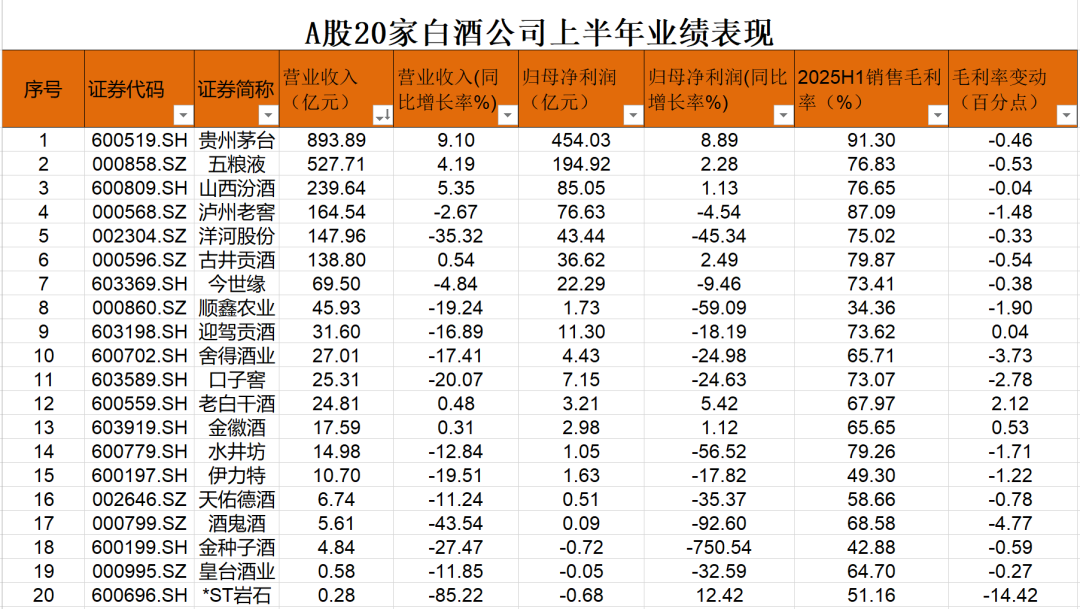
【导读】上半年白酒行业降速明显,但龙头集中度提升 6家个位数增长、11家下滑、3家亏损……2025年上半年,20家A股上市酒企的业绩表现,让广大投资者直观地感受到了白酒市场的"寒意"。 "整体降速明显,但市场对此亦有预期。"针对酒企的半年度"答卷",多位受访人士表示。 记者注意到,在行业深度调整期,一些积极因素也正在孕育,如多家酒企通过产品创新、渠道转型努力挖掘新增量,推动白酒价值由"面子"向"里子"回 归。 | | | | | | A股20家白酒公司上半年业绩表现 | | | | | --- | --- | --- | --- | --- | --- | --- | --- | --- | | 序号 | 证券代码 | 让券简称 | 营业收入 | 营业收入(同 | 归母净利润 | 归母净利润(同比 2025H1销售毛利 | | 毛利率变动 | | | ♪ | | (亿元) | 比增长率%) | (亿元) | 增长率%) | 率(%) | (自分点) | | 1 | 600519.SH 贵州茅台 | | 893.89 | 9.10 | 454.03 | 8.89 | 91.30 | -0.46 | | 2 | ...
机构:切入低估值消费与周期板块,食品饮料ETF天弘(159736)上周累计“吸金”近1亿元,中秋&国庆旺销窗口期成重要观察拐点
2 1 Shi Ji Jing Ji Bao Dao· 2025-09-01 02:53
Group 1 - A-shares opened higher on the first trading day of September, with active sectors including catering, tourism, and pharmaceuticals [1] - The Tianhong Food and Beverage ETF (159736) showed a gain of 0.66% and a premium trading rate of 0.16%, with significant price increases in constituent stocks such as COFCO Sugar Industry rising over 8% and others like Qiaqia Food, Kweichow Moutai, and others increasing by over 4% [1] - The Tianhong Food and Beverage ETF has seen a net inflow of funds totaling 98.3 million yuan over the last five trading days, with 9 out of the last 10 trading days experiencing net inflows [1] Group 2 - The white liquor sector's semi-annual reports indicate that companies are expected to accelerate performance recovery by Q2 2025, with market sentiment improving due to reduced uncertainty in the industry [2] - Analysts suggest that upcoming consumption policies may catalyze a fundamental turnaround in traditional consumer goods, particularly in the catering supply chain and dairy sectors [2] - The TMT sector is nearing a warning line in terms of market crowding, while consumer and cyclical sectors may offer better value in the next market phase, with a shift in market funds towards stable and growth-oriented assets [2]





酒企“寒冬”:总量承压,分化加剧,龙头集中度提升
中国基金报· 2025-09-01 02:51
Core Viewpoint - The white liquor industry is experiencing a significant slowdown in growth, with major companies showing resilience and increasing market concentration despite overall declines in revenue and profit [2][6][8]. Industry Performance - In the first half of 2025, 20 A-share listed liquor companies reported a noticeable decline, with 6 companies showing single-digit growth, 11 experiencing declines, and 3 reporting losses [2]. - Overall revenue and net profit for listed liquor companies decreased by approximately 1%, with a more pronounced drop in the second quarter, where revenue fell by 5% and net profit by 7.5% [7]. - The top two companies, Guizhou Moutai and Wuliangye, managed to achieve revenue growth of 9.1% and 4.19% respectively, indicating a divergence in performance within the industry [8][9]. Market Dynamics - The concentration of the top companies in the industry is increasing, with the revenue share of the top two companies (CR2) reaching 62.6%, up 6 percentage points year-on-year [9]. - The industry is characterized by "volume shrinkage, price decline, and high inventory pressure," with regional companies facing significant challenges [9]. Product and Channel Innovations - Companies are focusing on product innovation and channel transformation to explore new growth opportunities, shifting from high-end products to more affordable options [10][15]. - There is a growing demand for mid-to-low priced liquor products, particularly high-quality light bottle liquor, which has become a new trend in the industry [12][14]. - The introduction of low-alcohol products is also gaining traction, catering to younger consumers seeking lighter drinking experiences [14]. Future Outlook - Despite the current challenges, there are positive signs emerging, such as a shift towards rational and healthy development, with a focus on quality and brand value [15]. - The industry is expected to continue its deep adjustment until the second half of 2026, with potential signs of recovery by the end of 2025 [16].

西部证券晨会纪要-20250901
Western Securities· 2025-09-01 01:55
Group 1 - The report on overseas mutual funds indicates that as of March 31, 2025, there were 1,532 mutual funds holding A-shares with a total scale of $1.9 trillion, showing a slight decrease in both number and scale compared to previous periods [9][10][11] - The performance of overseas mutual funds investing in A-shares was notably differentiated, with active funds outperforming passive funds, achieving an average return of 0.51% and a median return of 0.28% [10] - The report highlights that overseas mutual funds increased their holdings in the home appliance, transportation, and computer sectors while reducing their investments in power equipment and new energy sectors [10][11] Group 2 - The report on Shenzhen Circuit (002916.SZ) forecasts revenue for 2025-2027 to be 22.134 billion, 26.330 billion, and 30.087 billion yuan respectively, with net profit expected to be 3.273 billion, 4.278 billion, and 5.154 billion yuan [12] - The target market capitalization for Shenzhen Circuit in 2026 is projected to be 162.572 billion yuan, with a target price of 243.83 yuan, and the report initiates coverage with a "buy" rating [12] - The report emphasizes the company's strong position in the PCB market, particularly in data center and communication sectors, with significant growth potential driven by advancements in AI and high-speed communication technologies [13][14] Group 3 - The report on Tunan Co., Ltd. (300855.SZ) indicates that the company is one of the few in China capable of mass-producing both deformed and cast high-temperature alloys, with a focus on aerospace and nuclear power applications [17][18] - The company is expected to achieve a revenue growth rate of 25.10% and a net profit growth rate of 25.10% from 2020 to 2024, with projected revenues of 1.258 billion yuan and net profits of 267 million yuan in 2024 [17] - Tunan's order backlog reached a historical high of 1.75 billion yuan as of the first half of 2025, reflecting a year-on-year increase of 236.5% [18] Group 4 - Alibaba's self-developed AI chips are aimed at meeting its own AI inference needs, with a planned investment of 380 billion yuan over the next three years to enhance its AI capabilities [20][21] - The report notes that Alibaba's AI inference chip, Hanguang 800, has surpassed NVIDIA's T4 and P4 in certain performance metrics, indicating a strong competitive position in the AI chip market [20] - The report highlights the potential for growth in power supply and liquid cooling technologies as major cloud service providers increase their investment in AI chips [22]