WLY(000858)

Search documents
中炬高新目标价涨幅超80%;邮储银行评级被调低丨券商评级观察
2 1 Shi Ji Jing Ji Bao Dao· 2025-09-01 01:24
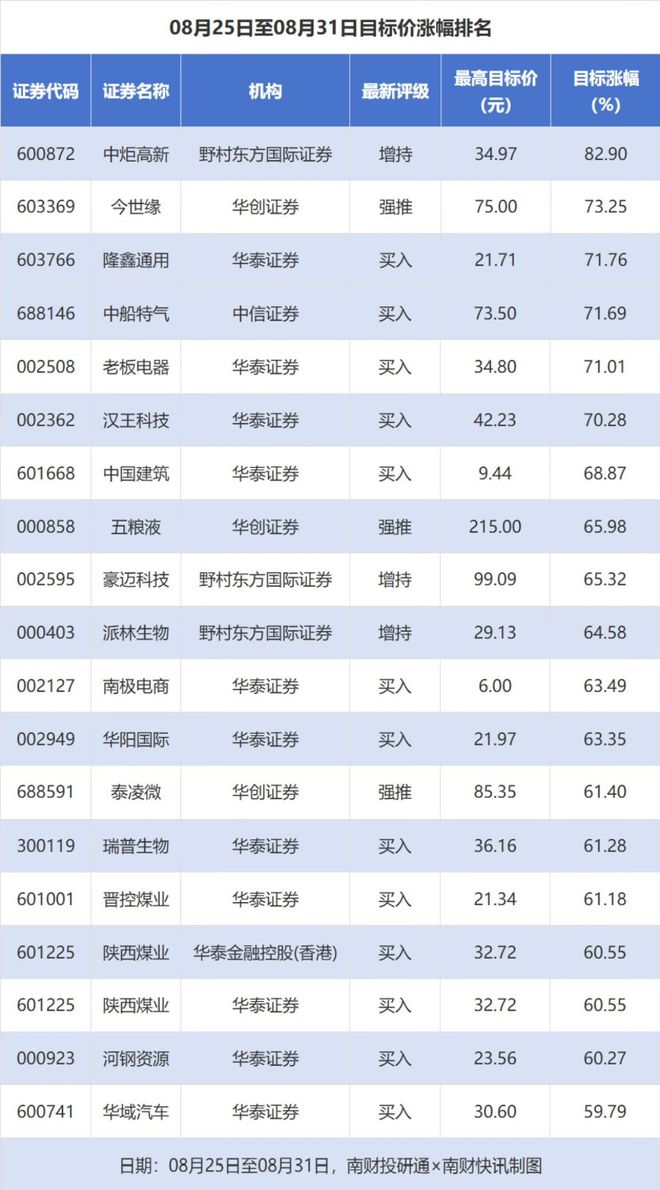
Core Insights - The report highlights significant target price increases for several companies from August 25 to August 31, with notable gains for Zhongju Gaoxin, Jinshiyuan, and Longxin General, showing increases of 82.90%, 73.25%, and 71.76% respectively [1][2]. Group 1: Target Price Increases - Zhongju Gaoxin received a target price increase to 34.97 yuan, reflecting an 82.90% rise [2]. - Jinshiyuan's target price was raised to 75.00 yuan, indicating a 73.25% increase [2]. - Longxin General's target price reached 21.71 yuan, marking a 71.76% increase [2]. - Other companies with significant target price increases include Zhongchuan Special Gas (71.69%), Boss Electric (71.01%), and Hanwang Technology (70.28%) [2]. Group 2: Broker Recommendations - A total of 1,530 companies received broker recommendations during the same period, with Jinshiyuan receiving the highest number at 25 recommendations [3][4]. - Qingdao Beer followed closely with 24 recommendations, while Wuliangye received 23 [3][4]. Group 3: Rating Adjustments - During the period, 36 companies had their ratings upgraded, including Guangfa Securities, which was upgraded from "HOLD" to "Outperform" by China International Capital Corporation [5]. - Lu'an Mining's rating was raised from "Overweight" to "Buy" by Huatai Securities [5]. - Shandong Gold's rating was also upgraded from "Overweight" to "Buy" by Industrial Securities [5]. Group 4: Rating Downgrades - A total of 44 companies experienced rating downgrades, including Postal Savings Bank, which was downgraded from "Buy" to "Overweight" by Huatai Securities [6]. - Tiandi Source's rating was lowered from "Recommended" to "Cautious Recommendation" by Minsheng Securities [6]. - Canaan Intelligent's rating was adjusted from "Buy" to "Overweight" by Guojin Securities [6]. Group 5: First Coverage - Brokers issued 146 instances of first coverage, with companies like Deepin Technology and New Construction Co. receiving "Buy" and "Overweight" ratings respectively [7]. - Zhejiang Fu Holdings was rated "Buy" by Zhongyou Securities, while Meiyingsen received a "Hold" rating from Huafu Securities [7].





偏爱金融股公募机构上半年稳字当头
Zhong Guo Zheng Quan Bao· 2025-09-01 01:21
Group 1 - The core point of the article highlights that Guotai Haitong was the most net bought stock by public funds in the first half of 2025, with a net purchase amount of 14.612 billion yuan, making it the only stock to exceed 10 billion yuan in net purchases during this period [1][2] - Other stocks that saw significant net purchases include Lanke Technology, Industrial Bank, Dongfang Wealth, and SF Express, with net purchases exceeding 3 billion yuan [1][2] - Financial stocks were favored by public funds, with several banks and insurance companies showing strong performance and stability, leading to increased net purchases [2][3] Group 2 - The most net sold stock by public funds was BYD, with a net sell amount of 16.616 billion yuan, followed by other blue-chip stocks like CATL and Midea Group [2][3] - Notable fund managers were significant sellers of these blue-chip stocks, indicating a strategic shift in investment focus [3] - The overall market is perceived to be in a favorable risk-reward zone, with improving corporate earnings and attractive long-term valuations [4][5] Group 3 - The healthcare sector is expected to maintain growth momentum in the second half of the year, driven by innovation and consumer recovery [5][6] - Investment opportunities are seen in innovative pharmaceuticals and consumer healthcare sectors, supported by policy and industry upgrades [6]





偏爱金融股 公募机构上半年稳字当头
Zhong Guo Zheng Quan Bao· 2025-08-31 23:20
Group 1: Fund Buying Trends - Guotai Haitong became the most net bought stock by public funds in the first half of 2025, with a net buying amount of 14.612 billion yuan, the only stock exceeding 10 billion yuan in net buying [1][2] - Other stocks with significant net buying include Lanke Technology, Industrial Bank, Dongfang Wealth, and SF Express, all exceeding 3 billion yuan in net buying [1][2] - Financial stocks were favored by public funds, with several banks and financial institutions among the top net bought stocks, indicating a positive outlook on the financial sector [2] Group 2: Fund Selling Trends - BYD was the most net sold stock by public funds in the first half of 2025, with a net selling amount of 16.616 billion yuan [3] - Other major net sold stocks included CATL, ZTE, and Midea Group, with many being blue-chip leaders, indicating a shift in investment strategy among fund managers [3][4] - Notable fund managers sold significant amounts of these blue-chip stocks, reflecting a cautious approach towards high-profile companies [3][4] Group 3: Market Outlook - Fund managers expressed optimism about the market, indicating that the lowest risk appetite phase has passed and corporate earnings are recovering [6][7] - The overall market valuation remains attractive, providing opportunities for long-term investors to acquire high-quality stocks at lower valuations [6] - Specific sectors such as technology, high-end manufacturing, and consumer goods are expected to perform well, with a focus on innovation and growth [7]



五粮液(000858):费投力度加大
Xin Lang Cai Jing· 2025-08-31 10:37
Core Viewpoint - The company's Q2 2025 performance met market expectations, with slight revenue growth but a decline in net profit [2] Group 1: Financial Performance - Q2 2025 revenue was 15.831 billion (up 0.10%), with net profit at 4.632 billion (down 7.58%) and non-recurring net profit at 4.618 billion (down 5.75%) [1] - H1 2025 revenue reached 52.771 billion (up 4.19%), with net profit at 19.492 billion (up 2.28%) and non-recurring net profit at 19.480 billion (up 2.86%) [1] Group 2: Revenue Breakdown - In H1 2025, the company's revenue from Wuliangye and series liquor grew by 4.6% and 2.7% respectively, driven by volume increase but price decrease [3] - Wuliangye's sales volume increased by 12.7% while the price per ton decreased by 7.2%, indicating a controlled volume strategy [3] - Series liquor saw a significant sales volume increase of 58.8% but a price decrease of 35.3%, mainly due to the expansion of mid-to-low priced products [3] Group 3: Channel Performance - In H1 2025, revenue from distribution and direct sales channels grew by 1.2% and 8.6% respectively, with direct sales accounting for 43.1% of the liquor business revenue [3] - The increase in direct sales is attributed to the establishment of a large business platform and active development of corporate group purchases [3] - The top five customers in the distribution channel saw a revenue increase of 181.0%, contributing to 57.0% of total liquor sales [3] Group 4: Profitability Analysis - Q2 2025 gross margin decreased by 0.3 percentage points, remaining stable overall, with limited impact from product mix changes [4] - Tax and additional fees, sales, and management expense ratios increased by 0.84, 1.54, and -0.04 percentage points respectively, leading to a net profit margin decrease of 2.4 percentage points to 29.3% [4] Group 5: Cash Flow and Quality - Q2 2025 sales cash collection increased by 12.0%, likely due to seasonal payment cycles, with accounts receivable financing decreasing by 15.68 billion [5] - As of the end of Q2 2025, contract liabilities decreased by 0.89 million, indicating a sufficient performance buffer [5] Group 6: Investment Outlook - The company’s marketing system reform shows initial success, with expectations for continued improvement in financial statements [6] - Revenue forecasts for 2025-2027 are adjusted to 89.85 billion, 93.59 billion, and 98.71 billion respectively, with corresponding net profit forecasts of 31.16 billion, 32.48 billion, and 34.64 billion [6] - The current stock price corresponds to a PE ratio of 16, 15, and 15 for the respective years, maintaining a "buy" rating [6]
五粮液(000858):25Q2点评:费投力度加大
Huaan Securities· 2025-08-31 09:37
Investment Rating - The investment rating for the company is "Buy" (maintained) [2][11] Core Views - The company has increased its marketing expenditure, leading to a slight decrease in gross margin by 0.3 percentage points year-on-year, with a net profit margin decrease of 2.4 percentage points to 29.3% in Q2 2025 [3][10] - The company's marketing system reform is showing initial results, and there is potential for continued improvement in market factors such as pricing and sales dynamics, which could catalyze stock price increases [4][10] - Revenue for Q2 2025 was 15.831 billion (up 0.10%), with a net profit of 4.632 billion (down 7.58%) [10] Financial Performance - For H1 2025, the company reported revenue of 52.771 billion (up 4.19%) and a net profit of 19.492 billion (up 2.28%) [10] - The sales collection in Q2 2025 increased by 12.0% year-on-year, attributed to seasonal factors, with accounts receivable financing decreasing by 15.68 billion [11] - The company has adjusted its revenue forecast for 2025-2027, expecting total revenues of 89.85 billion, 93.59 billion, and 98.71 billion respectively, with corresponding net profits of 31.16 billion, 32.48 billion, and 34.64 billion [12] Revenue Breakdown - In H1 2025, the company's revenue from its main product, Wuliangye, and series liquor increased by 4.6% and 2.7% respectively, with volume growth but price declines [10] - The direct sales channel revenue grew by 8.6%, with direct sales accounting for 43.1% of the liquor business revenue, indicating a shift towards corporate group purchases [10] Key Financial Metrics - The company’s projected gross margin for 2025 is 76.3%, with a return on equity (ROE) of 20.7% [14] - The price-to-earnings (P/E) ratio is expected to be 16 for 2025, indicating a favorable valuation compared to historical performance [12][14]
行业周报:中报承压下微光渐显,业绩分化中孕育新机-20250831
KAIYUAN SECURITIES· 2025-08-31 03:32
Investment Rating - The industry investment rating is "Positive" (maintained) [1] Core Views - The food and beverage index increased by 2.1% from August 25 to August 29, ranking 7th among 28 sectors, underperforming the CSI 300 by approximately 0.6 percentage points. The snack (+10.2%), dairy (+2.7%), and liquor (+2.1%) sectors performed relatively well [4][12] - In Q2 2025, the food and beverage sector's revenue grew by 5.6% year-on-year, showing a slight recovery compared to Q1 2025 (+4.6%). However, profits declined by 2.1%, a decrease from Q1 2025 (+0.3%). The liquor sector saw a significant revenue growth decline of -5.0% in Q2 compared to +1.7% in Q1, primarily due to the impact of alcohol bans [4][12] - The report indicates a further widening of performance differentiation among companies, with leading firms like Kweichow Moutai and Haitian Flavor Industry maintaining stable growth, while some second-tier brands experienced revenue slowdowns. This reflects an increasing market share trend for leading companies amid external pressures [4][12] - The report suggests that most industries are expected to continue a recovery process in the second half of 2025, with a potential gradual upward shift in demand curves. It recommends focusing on leading companies for investment [4][12] Summary by Sections Weekly Insights - The food and beverage index increased by 2.1%, ranking 7th among sectors, and underperformed the CSI 300 by about 0.6 percentage points. The snack, dairy, and liquor sectors showed relative strength [12][13] Market Performance - The food and beverage sector's performance was below the market average, with a 2.1% increase, while snacks, dairy, and liquor sectors outperformed [12][13] Upstream Data - Some upstream raw material prices have decreased. For instance, the price of fresh milk was 3.0 CNY/kg, down 5.6% year-on-year, while pork prices were 20.0 CNY/kg, down 27.4% year-on-year [19][22] Liquor Industry News - The 29° Wuliangye "One Heart" has begun pre-sale, with a price of 399 CNY per bottle. Kweichow Moutai also launched a high-end product priced at 998 CNY per bottle [41][42] Memorandum - Attention is drawn to the shareholder meeting of Salted Fish on September 5, 2025, along with other companies holding meetings [43][47]



宽窄研究院酒业半年报探析:头部分化明显行业共同承压,产品创新渠道变革细分赛道成为破局点
Sou Hu Cai Jing· 2025-08-30 14:48
Core Viewpoint - The Chinese liquor industry is undergoing a deep adjustment period, facing challenges such as production contraction, consumption differentiation, and weak terminal sales, leading to a shift from rapid growth to declining production and sales profits [1] Industry Overview - The release of half-year reports from listed liquor companies indicates a significant change in the industry, with increased sales expenses and fierce competition among well-known brands for first-tier markets [1][12] - The overall profitability of the industry is declining, with many companies experiencing double-digit declines in revenue and profit, alongside rising inventory pressures and deteriorating product liquidity [11] Company Performance - Guizhou Moutai reported a total revenue of 91.094 billion, a year-on-year increase of 9.16%, and a net profit of 45.403 billion, up 8.89% [3] - Wuliangye achieved a revenue of 52.771 billion, growing 4.19%, and a net profit of 19.492 billion, up 2.28% [3] - Shanxi Fenjiu's revenue reached 23.964 billion, a 5.35% increase, with a net profit of 8.505 billion, up 1.13% [3] - Luzhou Laojiao reported a revenue of 16.454 billion, down 2.67%, and a net profit of 7.663 billion, down 4.54% [5] - Yanghe's revenue was 14.796 billion, down 35.32%, with a net profit of 4.344 billion, down 45.34% [5] - Other companies like Water Well and Shede also reported significant declines in revenue and profit, indicating the widespread impact of the industry's challenges [5][6][7] Market Trends - The industry is seeing a shift towards product innovation and channel transformation, with companies launching lower-alcohol and light bottle products to attract younger consumers [12][13] - The market is characterized by a need for companies to adapt to changing consumer preferences and enhance brand influence and channel efficiency [7][12] - Analysts suggest that the current environment is not isolated, and the liquor industry will eventually recover as consumption and the economy improve [13]



全球酒业澳门交锋:茅台奔富亮相 竞逐消费新场景
2 1 Shi Ji Jing Ji Bao Dao· 2025-08-30 12:57
Group 1 - The Fourth China (Macau) International High-Quality Consumption Expo and Hengqin World Bay Area Forum will be held from September 3 to 7, showcasing a diverse array of global wine brands [1] - The event will feature a wide range of alcoholic beverages, including Chinese liquor brands like Moutai and Wuliangye, alongside international classics such as Hennessy and Penfolds, highlighting a cross-border tasting experience [1] - Despite structural adjustments in the global consumption market, the wine industry still shows significant growth potential, with a projected increase of $34 billion in the global core alcoholic beverage market by 2034 according to IWSR [1] Group 2 - The expo will serve as a key communication platform for top global wine brands, leveraging Macau's unique position as a cultural crossroads to explore new consumption scenarios and invigorate market dynamics [2]
全球酒业澳门交锋:茅台奔富亮相,竞逐消费新场景
2 1 Shi Ji Jing Ji Bao Dao· 2025-08-30 12:56
Group 1 - The fourth China (Macau) International High-Quality Consumption Expo and the Hengqin World Bay Area Forum will take place from September 3 to 7, showcasing a diverse array of global wine brands [1] - The event will feature a wide range of alcoholic beverages, including Chinese liquor brands like Moutai and Wuliangye, alongside international classics such as Hennessy and Penfolds, highlighting a competitive atmosphere among renowned brands [1] - Despite structural adjustments in the global consumption market, the wine industry still shows considerable growth potential, with a projected increase of $34 billion in the global core alcoholic beverage market value by 2034 according to IWSR [1] Group 2 - The expo will provide immersive experiences through wine displays, tastings, and cultural explorations, allowing attendees to appreciate the rich heritage and innovative spirit of both Eastern and Western wine cultures [2] - Leveraging Macau's unique position as a cultural crossroads, the event aims to serve as a significant platform for top wine brands to explore new consumption scenarios and invigorate market dynamics [2]
2天预约超万、邓紫棋倾情代言,29°五粮液·一见倾心有何魔力?
Xi Niu Cai Jing· 2025-08-30 06:11
Core Viewpoint - The launch of "29° Wuliangye · One Glance and Fall in Love" represents a strategic choice by Wuliangye to connect with younger consumers and redefine the image of high-end low-alcohol liquor, moving away from traditional business banquet associations towards self-reward and quality social interactions [2][6][10] Product Launch and Market Response - The online launch event on August 29 featured popular figures among young people, such as Ma Jianyue and G.E.M., and received significant engagement, with over 1 million likes and a peak of over 100,000 concurrent viewers [3] - Pre-sales for the product exceeded 10,000 consumers across multiple platforms, indicating strong brand appeal and consumer interest [5] Historical Context and Technical Development - Wuliangye's exploration of low-alcohol liquor dates back to 1972, making it one of the earliest companies in this field. The company overcame significant technical challenges to establish itself as a benchmark in low-alcohol liquor technology [5][6] - The successful development of the 29-degree liquor in 1986 earned Wuliangye the national "Silver Cup Award," solidifying its reputation in the low-alcohol segment [5] Consumer Insights and Target Audience - Research indicates that over 60% of young consumers aged 20-35 prefer low-alcohol beverages, reflecting a shift in drinking preferences towards self-expression and emotional experiences rather than traditional business contexts [7][10] - The product aims to resonate with the emotional and experiential needs of younger consumers, positioning itself as a "mood enhancer" in social settings [10][11] Marketing Strategy and Brand Positioning - The brand promotes a lifestyle attitude of "Enjoy Youth, I Am Willing," emphasizing individual choice and emotional connection, thus breaking away from traditional drinking norms [10][12] - Wuliangye's marketing strategy includes collaborations with popular cultural figures and events, such as G.E.M.'s concert, to enhance brand visibility and appeal to younger demographics [10][12] Systematic Approach to Young Consumer Engagement - Wuliangye's strategy encompasses a comprehensive approach to product innovation, brand building, and channel optimization, aiming for high-quality development in response to changing consumer demands [12][13] - The company is enhancing its product matrix with various alcohol levels to cater to different consumer needs, from high-end business occasions to everyday consumption [12][13] Financial Performance and Future Outlook - Wuliangye reported a revenue of 52.771 billion yuan in the first half of 2025, a year-on-year increase of 4.19%, and a net profit of 19.492 billion yuan, up 2.28%, reflecting the effectiveness of its young-oriented marketing strategies [14]