
Yanghe(002304)

Search documents
缩量时代的白酒攻防:酒企普遍增速放缓,17家存货上涨;行业头部将进一步抢占下沉市场
Sou Hu Cai Jing· 2025-05-08 09:53
Core Viewpoint - The Chinese liquor industry is entering a phase of intense competition, with companies experiencing a slowdown in growth and adjusting their strategies for more sustainable development [2][21]. Financial Performance - In 2024, 21 listed liquor companies generated revenue of 443.97 billion yuan, a year-on-year increase of 7.63%, and a net profit of 168.08 billion yuan, up 7.01% [2]. - Only five companies achieved double-digit growth in both revenue and net profit in 2024, down from 15 the previous year [3][4]. - Guizhou Moutai led the industry with a revenue increase of 15.71% to 170.90 billion yuan and a net profit growth of 15.38% to 86.23 billion yuan [4][5]. Market Trends - The industry is experiencing a shift towards "volume competition," where stronger brands are consolidating their market positions while weaker brands struggle [2][21]. - Companies are increasing their marketing expenditures to maintain market share, with 12 out of 21 companies raising their sales expenses in 2024 [10][11]. Sales and Profitability - The highest increase in sales expenses was seen in Wuliangye, which spent 10.69 billion yuan, a 37.15% increase [11]. - Several companies, including Yanghe and Jiugui, reported declines in both revenue and net profit, indicating a challenging market environment [7][18]. Inventory and Contract Liabilities - Inventory levels are rising across most companies, with Water Well's inventory increasing by 31.13% to 3.22 billion yuan, highlighting the ongoing challenge of inventory management [15]. - Contract liabilities showed a mixed trend, with some companies like Gujing Gongjiu seeing a significant increase of 150.86% [14]. Future Outlook - For 2025, companies are setting more flexible growth targets, with many aiming for single-digit growth rates [18][20]. - The market is expected to continue evolving, with a focus on high-quality development and sustainable growth strategies [20][21].






中证全指食品、饮料与烟草指数报12718.09点,前十大权重包含东鹏饮料等
Jin Rong Jie· 2025-05-08 09:07
Group 1 - The core index of the China Securities Index for food, beverage, and tobacco has shown a monthly increase of 3.51% and a quarterly increase of 6.05%, while it has decreased by 1.64% year-to-date [1] - The index is categorized into 11 primary industries, 35 secondary industries, over 90 tertiary industries, and more than 200 quaternary industries, providing a comprehensive analysis tool for investors [1] - The top ten weighted stocks in the index include Yili Group (10.62%), Kweichow Moutai (10.59%), and Wuliangye (9.22%), among others [1] Group 2 - The index's holdings show that the liquor sector accounts for 47.83%, followed by condiments and cooking oil at 12.10%, and dairy products at 12.04% [2] - The index samples are adjusted biannually, with changes implemented on the next trading day after the second Friday of June and December [2] - Adjustments to the index samples occur in response to special events affecting the companies, such as mergers or changes in industry classification [2]


派发1190亿元“红包”!上市白酒企业2024年年度分红创新高,一季度基金对白酒信心有所回暖
Mei Ri Jing Ji Xin Wen· 2025-05-08 08:36
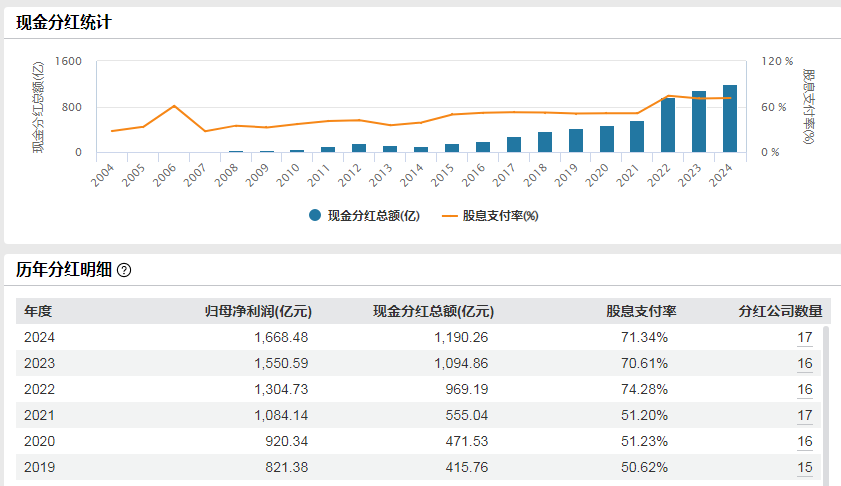
白酒:1190亿元分红创新高 所谓冰,是整个白酒板块上市企业2024年净利润增速普遍下滑;而所谓火,则是2024年年度行业分红总金额高达1190亿元,逆势创下历史新高。 在行业竞争不断加剧的背景下,白酒这张高分红的"牌"能否达到想要的效果?从2024年第四季度与2025年一季度基金的持仓态度来看,机构投资者的信心已 然回暖。 随着2024年年报披露完毕,白酒企业2024年派发"红包"金额也随之出炉,由于多家头部酒企增加了分红频次,最终让白酒企业2024年全年分红总金额定格在 1190亿元,分红总金额同比增长近10%,而整个行业股息支付率也达到71.34%,仅次于2022年的74.28%,排在历史第二。 | 年度 | 归母净利润(亿元) | 现金分红总额(亿元) | 股息支付率 | 分红公司数量 | | --- | --- | --- | --- | --- | | 2024 | 1,668.48 | 1.190.26 | 71.34% | 17 | | 2023 | 1.550.59 | 1.094.86 | 70.61% | 16 | | 2022 | 1.304.73 | 969.19 | 74.28% ...

中国消费行业2025年5月投资策略:热点增多弱化消费板块行情
Haitong Securities International· 2025-05-08 06:32
Core Insights - The report indicates that the increase in investment hotspots has weakened the performance of consumer stocks in China [1] - The consumer sector is experiencing slow growth, with a lack of fundamental catalysts in the short term, although long-term asset revaluation logic remains intact [8] Industry Overview - In April 2025, five out of eight tracked industries maintained positive growth, while two experienced negative growth and one remained flat. The industries with single-digit growth included dairy (+3.4%), dining (+3.1%), soft drinks (+2.7%), condiments (+2.3%), and frozen foods (+1.5%). The declining sectors were mass-market and below liquor (-10.7%) and mid-to-high-end liquor (-1.5%), with the beer industry remaining flat [3][10] - The revenue for the high-end liquor sector in April was 26.4 billion yuan, down 1.5% year-on-year, while the cumulative revenue for the first four months was 167 billion yuan, up 0.3% year-on-year [12] - The mass-market liquor sector saw a revenue of 15 billion yuan in April, down 10.7% year-on-year, with a cumulative revenue of 75.2 billion yuan for the first four months, down 13.9% year-on-year [13] - The beer industry reported a revenue of 14 billion yuan in April, remaining flat year-on-year, with a cumulative revenue of 60.6 billion yuan, showing a slight decline of 0.2% [14] Price Trends - In April, the wholesale prices of high-end liquor such as Feitian Moutai continued to decline, with prices for whole boxes and individual bottles down by 70 yuan compared to the previous month [4][22] - The prices of most high-end liquor remained stable, while mid-range and lower-end liquor prices saw more declines than increases [12][13] Cost Analysis - The cost indices for various products in April showed increases for beer (+2.69%), frozen foods (+1.67%), dairy (+1.09%), while condiments (-0.12%), instant noodles (-0.18%), and soft drinks (-1.58%) experienced declines [5] - The prices of packaging materials varied, with aluminum can prices rising by 8.37% year-on-year, while glass, plastic, and pulp prices fell by 23.17%, 20.90%, and 4.59% respectively [5] Investment Recommendations - The report suggests waiting for the right opportunity to increase positions in consumer stocks, particularly in the dairy sector, soft drinks, and liquor, with specific companies highlighted for potential investment [8]
白酒公司高管集体降薪,有人一年少了四百万
21世纪经济报道· 2025-05-08 03:52
Core Viewpoint - The article discusses the contrasting employment trends in the beer and liquor industries during the current adjustment period, highlighting that while beer companies have reduced their workforce significantly, liquor companies, particularly leading brands, have increased their employee numbers despite facing revenue declines [2][11]. Employment Trends in Beer Industry - Over the past year, the beer industry has seen a reduction of over 6,000 employees across 10 listed companies, with major players like Budweiser APAC and China Resources Beer each reducing their workforce by over 1,000 [5][8]. - The overall employment in the beer sector has decreased to below 300,000, primarily due to declining sales and revenue in the industry [2][5]. - The reduction in workforce is attributed to decreased demand for production and sales roles, particularly for temporary workers during peak seasons [8][9]. Employment Trends in Liquor Industry - In contrast, the liquor industry has experienced an increase of over 3,900 employees, with only 7 out of 22 listed liquor companies reporting reductions [9][12]. - Leading liquor companies such as Kweichow Moutai and Yanghe Brewery have added over 1,000 employees each, indicating a robust demand for production roles [9][12]. - The increase in employment is partly driven by the need to meet production demands and the social responsibility of state-owned enterprises to maintain employment levels [12][13]. Salary Adjustments - While the overall employment levels in liquor companies have increased, there has been a notable reduction in executive compensation, with many high-ranking officials seeing salary cuts of hundreds of thousands [16][17]. - In contrast, the average salary for non-executive employees has remained stable or even increased in some companies, such as Water Well and Kweichow Moutai, which reported a rise in average non-executive salaries [20][21]. Future Outlook - The article suggests that the current adjustment period for the liquor industry is not yet over, and further developments in cost-cutting measures and employee compensation will need to be monitored [21].



白酒2024年报及2025一季报总结:压力延续,火炼真金
Soochow Securities· 2025-05-07 13:01
Investment Rating - The report maintains an "Accumulate" rating for the liquor industry, indicating a positive outlook for the mid-term [1]. Core Insights - The liquor industry is experiencing continued pressure, with a focus on quality over speed in growth. The recovery in demand is showing signs of being uneven, leading companies to prioritize prudent growth strategies [12][18]. - The high-end liquor segment is seeing stable pricing control, while the mid-range segment is under pressure, indicating a divergence in performance across different price tiers [1][12]. Summary by Sections 1. Demand Recovery and Quality Focus - The liquor sector's revenue for FY 2024 grew by 8.2% year-on-year, with net profit increasing by 7.2%. For Q1 2025, revenue growth slowed to 2.3% and net profit to 2.6% [12][18]. - Consumer confidence remains weak, particularly in the mid to low-end segments, while high-end banquet consumption is showing signs of recovery from a low base [12][18]. 2. Revenue Trends - Revenue growth is gradually bottoming out, with increasing differentiation among companies. The high-end segment remains relatively stable, while the mid-range segment faces significant challenges [18][27]. - The report highlights that many liquor companies are tightening control over distributors and focusing on core products to drive sales [18][27]. 3. Profitability Analysis - The gross profit margin for the liquor sector in FY 2024 was 82.93%, a slight increase from the previous year. However, many companies are facing pressure on their gross margins due to pricing and product mix challenges [2][3]. - Sales and management expense ratios have seen slight increases, indicating a cautious approach to spending amid a challenging market environment [2][3]. 4. Investment Recommendations - The report suggests that leading liquor companies are expected to show resilient growth, supported by effective channel management and digital tracking strategies. Companies like Guizhou Moutai and Shanxi Fenjiu are recommended for their solid performance and valuation safety margins [3][12].

逆周期突围!洋河股份“固本正源”重塑经典产业新标杆
2 1 Shi Ji Jing Ji Bao Dao· 2025-05-07 07:18
Core Viewpoint - The Chinese liquor industry is undergoing a significant adjustment period, with major companies reporting "growth under pressure" in their financial results for 2024 and Q1 2025, highlighting increased competition and market concentration [1][4]. Industry Overview - The white liquor industry is described as facing intensified competition, with a shift from "incremental competition" to "stock competition," leading to a consensus among leading companies that "value reconstruction" will be the main battleground moving forward [1][4]. - The production capacity of white liquor has decreased from a peak of 13.58 million kiloliters in 2016 to 4.145 million kiloliters in 2024, a decline of over 60% [4]. Company Strategies - Yanghe Distillery views 2024 as a year of adjustment, with major companies like Moutai and Wuliangye emphasizing stability in their growth targets, with Moutai setting a 9% growth target for 2025, down from the previous 15% [4][5]. - Yanghe Distillery has adopted a strategy of "active deceleration and inventory reduction," focusing on long-term stability rather than short-term sales growth [5][10]. Competitive Strength - Yanghe Distillery has built a robust product matrix covering all price ranges, which serves as a strong risk mitigation barrier, allowing the company to adapt to consumer segmentation trends and maintain stable operations amid industry fluctuations [5][10]. - The company is implementing six major initiatives to strengthen its foundation, including brand renewal, product optimization, and strategic market focus [8][9]. Financial Performance and Shareholder Returns - Despite facing challenges in revenue and profit, Yanghe Distillery announced a cash dividend plan of 3.49 billion yuan, with a total cash dividend of 7 billion yuan for 2024, reflecting a commitment to shareholder returns [11][12]. - The company has maintained a consistent dividend policy since its listing in 2009, with cumulative dividends amounting to 56.34 billion yuan, representing 72% of its cumulative net profit since listing [11][12].
逆周期突围!洋河股份“固本正源”重塑经典产业新标杆
21世纪经济报道· 2025-05-07 07:04
Core Viewpoint - The Chinese liquor industry is undergoing a significant adjustment period, with major companies reporting "growth under pressure" in their financial results for 2024 and Q1 2025, highlighting increased competition and market concentration [1][3]. Industry Overview - The white liquor industry is described as facing intensified competition, with a shift from "incremental competition" to "stock competition," leading to a consensus among leading companies that "value reconstruction" will be the main battleground moving forward [1][3]. - The production capacity of white liquor has decreased from 1,358.4 million liters in 2016 to 414.5 million liters in 2024, a decline of over 60% [3]. Company Strategies - Yanghe Co. views 2024 as a year of adjustment, with many companies, including Moutai and Wuliangye, emphasizing stability in their growth targets for 2025 [3][4]. - Yanghe Co. has adopted a strategy of "active deceleration and inventory reduction," indicating a focus on long-term stability rather than short-term sales growth [3][4]. Competitive Resilience - Yanghe Co. has built a robust product matrix covering all price ranges, which serves as a strong risk mitigation strategy amid market fluctuations [4]. - The company is focusing on long-term strategies, prioritizing sustainable growth over immediate performance, and is implementing measures to control product supply and optimize market relationships [4][7]. Six Major Initiatives - At the recent T9 summit, industry leaders agreed on the need to "strengthen the foundation, reconstruct, and innovate," which Yanghe Co. has translated into six specific initiatives for 2025 [5][6]. - These initiatives include brand revitalization, product quality enhancement, and strategic market focus, particularly in key regions like the Yangtze River Delta and major cities [6][7]. Shareholder Returns - Despite facing challenges in revenue and profit, Yanghe Co. has proposed a cash dividend plan of 3.49 billion yuan for 2024, maintaining a strong commitment to shareholder returns [9]. - The company has consistently paid dividends since its listing in 2009, with cumulative dividends amounting to 56.34 billion yuan, representing 72% of its cumulative net profit [9][10].
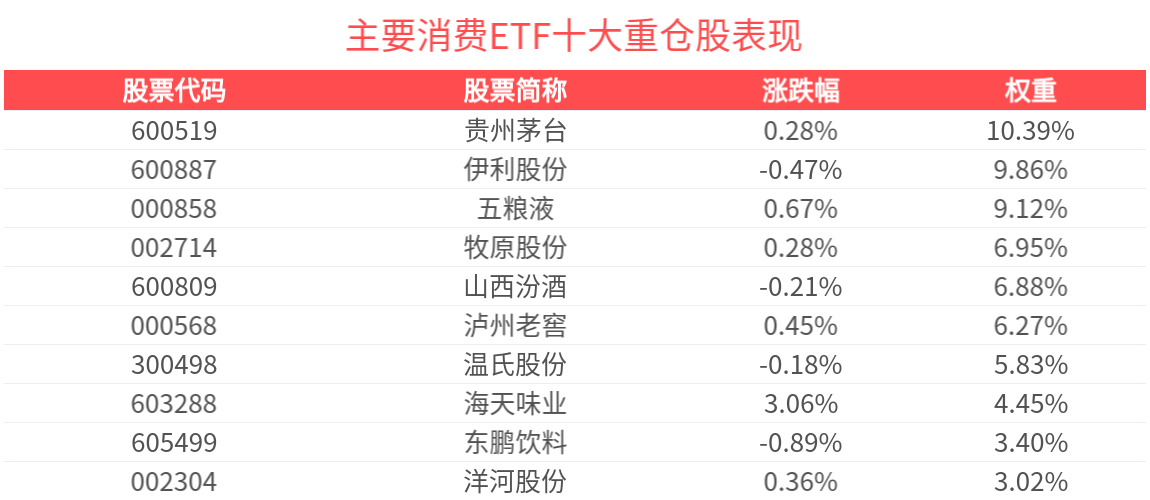
机构建议更乐观看待食品饮料今年投资机会,主要消费ETF(159672)冲击3连涨,养元饮品、海天味业涨超3%
Sou Hu Cai Jing· 2025-05-07 06:00
Group 1 - The core viewpoint emphasizes the recovery of domestic demand, suggesting a more optimistic outlook for investment opportunities in the food and beverage sector, with potential for a dual boost in fundamentals and valuations in the second half of the year [1] - The major consumption ETF has shown a year-to-date maximum drawdown of 5.57%, indicating some volatility, but it has also outperformed its benchmark with a one-year annualized excess return of 2.18% [2] - The latest price-to-earnings ratio (PE-TTM) for the major consumption index is 19.84, which is considered low compared to historical levels, indicating potential undervaluation [2] Group 2 - The top ten weighted stocks in the major consumption index account for 67.16% of the index, highlighting the concentration of investment in a few key players [3] - The performance of individual stocks within the index shows mixed results, with notable increases in stocks like Hai Tian Wei Ye (3.06%) and declines in others like Dong Peng Beverage (-0.89%) [5] - The report indicates that the liquor industry is entering a bottoming phase, with expectations for recovery as companies manage inventory more effectively in the latter half of the year [1]




食品饮料行业2024年报、2025年一季报总结:白酒渐筑底,大众迎右侧
Huachuang Securities· 2025-05-06 12:06
Investment Rating - The report maintains a "Buy" recommendation for the food and beverage industry, indicating a gradual bottoming out for the liquor sector and a positive outlook for consumer goods [2]. Core Insights - The liquor sector is showing signs of bottoming out with significant structural differentiation among companies, while the consumer goods sector is recovering from a downturn [4][7]. - The report emphasizes the importance of domestic demand recovery, suggesting that new market scenarios and product categories present structural investment opportunities [4]. Summary by Sections 1. Liquor Sector: Signs of Bottoming Out and Structural Differentiation - The liquor industry experienced a slowdown in Q4 2024, but maintained positive growth in Q1 2025 despite high base effects, with significant differentiation among companies [7]. - Major liquor companies like Moutai and Wuliangye are outperforming the market, with Moutai's revenue growth at 10.7% and profit growth at 11.6% in Q1 2025 [12][16]. - The overall revenue for the liquor sector in 2024 was 4,417.7 billion, with a growth rate of 7.7%, while Q1 2025 saw a revenue of 1,533.6 billion, reflecting a growth of 1.8% [12][15]. 2. Consumer Goods Sector: Recovery and Bright Spots - The consumer goods sector, including dairy and beer, is showing signs of recovery, with revenue and profit growth of 2.4% and 8.4% respectively in Q1 2025 [4][16]. - New channels and product categories are driving growth in snacks and beverages, with companies like Dongpeng and Nongfu showing strong performance [4][16]. - The report suggests a positive outlook for the consumer goods sector, with expectations of a dual boost in fundamentals and valuations in the latter half of the year [4][16]. 3. Investment Recommendations - The report recommends focusing on leading companies in the liquor sector, such as Moutai and Wuliangye, as they are expected to benefit from the recovery phase [4][16]. - For consumer goods, it suggests investing in snack and beverage companies that are leveraging new channels and product innovations, highlighting the potential for significant growth [4][16].
