
Yanghe(002304)

Search documents
2025中秋国庆白酒渠道反馈:行业筑底,保持耐心
Shenwan Hongyuan Securities· 2025-10-08 06:13
Investment Rating - The industry investment rating is "Overweight" [3][4][59] Core Insights - The overall demand for the liquor industry during the 2025 Mid-Autumn Festival and National Day is expected to decline by 20-30% year-on-year, with inventory increasing by 10-20% [3][7] - The industry is still in a bottoming phase, and patience is required for potential investment opportunities [3][7] - The report highlights that the stock price turning point may occur before the fundamental turning point, suggesting a need for cautious observation [3][7] Summary by Sections Industry Viewpoint - The report anticipates a significant decline in liquor demand, with banquet performance below expectations and gift demand decreasing [3][7] - The current high inventory levels in channels will require time to digest, and the consumption scenarios are still recovering, leading to weak demand [3][7] - Key recommendations include maintaining patience for high-dividend stocks and waiting for potential buying opportunities in quality stocks [3][7] Brand Performance - Moutai is performing the best, while Wuliangye is trading volume for price [8][9] - Moutai's expected sales decline is in single digits, with prices slightly down to around 1780-1835 yuan [8] - Wuliangye's sales are expected to drop by about 15%, with current prices around 810-830 yuan [8] - Guojiao 1573 is controlling inventory to maintain prices, with expected sales declines of 20-30% [8][9] Regional Liquor Situation - Feedback from various regions indicates a general decline in sales, with specific brands like Moutai and Wuliangye showing varying performance [11][19] - The report notes that the business and banquet consumption scenarios are under pressure, with overall sales expected to decline by 30-25% during the Mid-Autumn Festival and National Day [44][49] - The report emphasizes the need for careful monitoring of inventory levels and sales performance across different brands and regions [11][19] Valuation Table - The report includes a valuation table for key companies in the food and beverage sector, highlighting projected net profits and PE ratios for companies like Moutai, Wuliangye, and Luzhou Laojiao [53]




“苏超”狂飙:一场草根足球的逆袭史诗,“十三太保”背后竟藏着4万
Xin Lang Cai Jing· 2025-10-08 00:36
Core Insights - The "Su Super" amateur football league in Jiangsu has gained significant attention and sponsorship, showcasing the region's economic vitality and cultural pride [1][9][11] Sponsorship and Economic Impact - The league attracted major sponsors, including Heineken, and has a total of 19 sponsors, with 15 being publicly listed companies, representing a combined market value exceeding 4 trillion yuan [7][9] - Jiangsu's 13 cities, each with a GDP over 400 billion yuan, are projected to become the first province in China with an average GDP exceeding 1 trillion yuan per city by 2024 [7][9] - Notable sponsorships include Jiangsu Bank's 8 million yuan title sponsorship, which is viewed as a strategic investment rather than mere sponsorship [7] City Representation and Team Highlights - Each city in the league showcases its unique identity and pride, with teams like Nanjing leveraging strong local corporate support, while Suzhou operates with a more understated approach [3][5] - The South Jiangsu team has received significant insurance coverage from China Ping An, amounting to 44.6 million yuan, reflecting corporate alignment with local spirit [5] - The league has become a platform for local brands to connect with community sentiments, as seen with Yanghe's branding efforts in Suqian [5][9] Cultural and Social Significance - The "Su Super" league represents a cultural awakening and a collective expression of regional identity, moving beyond just sports to embody local pride and community engagement [9][11] - The league's popularity has sparked a sense of unity among the cities, with fans expressing a strong local identity and competitive spirit [9][11]







2025年1-7月中国白酒(折65度,商品量)产量为214.6万千升 累计下降5.2%
Chan Ye Xin Xi Wang· 2025-10-01 02:34
Core Viewpoint - The Chinese liquor industry is experiencing a decline in production, with a notable decrease in output for the year 2025, indicating potential challenges for major companies in the sector [1] Industry Summary - According to data from the National Bureau of Statistics, the production of Chinese liquor (converted to 65 degrees, in commodity volume) is projected to be 236,000 kiloliters in July 2025, representing a year-on-year decrease of 8.9% [1] - From January to July 2025, the cumulative production of Chinese liquor (converted to 65 degrees, in commodity volume) reached 2,146,000 kiloliters, showing a cumulative decline of 5.2% [1] - The report titled "2025-2031 Analysis of the Current Market Situation and Investment Prospects of the Chinese Liquor Industry" by Zhiyan Consulting highlights these trends and provides insights into the future of the industry [1] Company Summary - Major listed companies in the Chinese liquor industry include Kweichow Moutai (600519), Wuliangye (000858), Yanghe Brewery (002304), Luzhou Laojiao (000568), Shanxi Fenjiu (600809), Gujing Gongjiu (000596), Shui Jing Fang (600779), Shede Liquor (600702), Jiu Gui Jiu (000799), and Laobai Gan Jiu (600559) [1]


中国必选消费品9月价格报告:白酒批价多数下跌,大众品价格多数稳定
Haitong Securities International· 2025-09-30 11:25
Investment Rating - The report assigns an "Outperform" rating to multiple companies in the consumer staples sector, including Guizhou Moutai, Wuliangye, and others, indicating a positive outlook for these stocks [1]. Core Insights - The wholesale prices of Baijiu have mostly declined, with notable decreases in prices for Guizhou Moutai and Wuliangye, while prices for most consumer goods remain stable [4][10]. - The report highlights a significant drop in the discount rates for liquid milk products, indicating a shift in consumer purchasing behavior [6][18]. - Overall, the report suggests that the impact of funds is greater, advising attention to low-position stocks and heavyweight stocks in the consumer staples sector [8]. Summary by Sections Baijiu Pricing - Guizhou Moutai's wholesale prices for Feitian (case and single bottle) are 1790 and 1770 yuan, respectively, reflecting a decrease of 55 and 70 yuan from the previous month [4][37]. - Wuliangye's eighth-generation price is 895 yuan, down 25 yuan from last month [4][37]. - Luzhou Laojiao's Guojiao 1573 price increased by 10 yuan to 850 yuan [4][37]. Consumer Goods Pricing - The average discount rate for liquid milk products decreased from 74.8% to 69.4% since the end of August [6][21]. - Discount rates for soft drinks, condiments, instant foods, and beer remained stable, with slight variations in average and median values [19][35]. - The report notes that the discount rate for infant formula products also showed a minor decrease from 89.5% to 88.7% [21][35]. Investment Strategy - The report emphasizes the importance of monitoring low-position stocks and heavyweight stocks due to the greater impact of funds on the market [8].


中秋国庆旺季不旺?千元白酒价格跳水,酒商忙促销,出货提速
Nan Fang Du Shi Bao· 2025-09-30 09:40
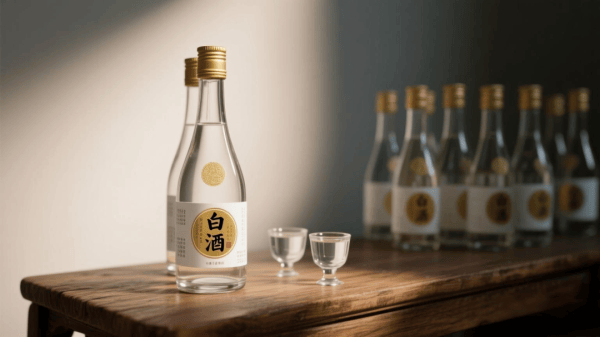
Core Insights - The white liquor market is experiencing significant price fluctuations and promotional activities as the Mid-Autumn Festival and National Day approach, leading to a general decline in product prices [2][3][18] - High-end liquor prices are mostly decreasing, with many products seeing their average retail prices drop, while some products maintain stable pricing [5][8][13] Price Trends - In Guangzhou, over half of the products have seen average prices decline, including high-end brands like Wuliangye and Moutai, with price drops ranging from a few to several dozen yuan [3][6] - The average retail price of Moutai remains stable at around 2,299 yuan in some channels, while other platforms offer it for as low as 1,799 yuan, indicating significant price variation across different sales channels [5][6] - In Shenzhen, the average retail price of Moutai has dropped to 2,038.6 yuan, with some channels reporting prices below 2,000 yuan [8][11] Promotional Activities - Various sales channels are implementing promotional activities to boost sales, leading to price reductions across multiple products, particularly in the high-end segment [10][15] - The increase in sales volume is noted, especially for products in the thousand yuan price range, as consumers purchase for gifting and gatherings [10][18] Regional Variations - In Dongguan, the average price of Moutai has decreased by approximately 74 yuan to around 2,180 yuan, driven by promotional activities [18][20] - In Foshan, while some products like Moutai have seen slight price increases, most products in the market are experiencing price declines due to promotional efforts [13][15] Overall Market Dynamics - The white liquor market is characterized by a dual nature, with some products experiencing price stability while others face significant declines, reflecting the competitive landscape and inventory management strategies among distributors [22][25] - The overall trend indicates a downward pressure on prices as the industry seeks to stimulate demand during the festive season [2][10][22]


“王健林们”退场,万亿房地产消费遇冷,中国白酒未来增量在哪?
Sou Hu Cai Jing· 2025-09-29 07:49
Core Viewpoint - The decline of the real estate industry in China has significantly impacted the high-end liquor market, leading to a need for transformation and new consumption drivers in the liquor sector [1][4][7]. Group 1: Real Estate and Liquor Industry Interconnection - The real estate sector's growth has historically driven the high-end liquor market, with a notable increase in business-related consumption [2][4]. - From 2004 to 2013, real estate investment surged over 520%, while the liquor industry experienced a "golden decade" with production up 293%, revenue up 719%, and profits soaring 1272% [5]. - The collapse of major real estate companies like Evergrande and the subsequent economic downturn have led to a significant decline in the liquor industry, which is now facing intense competition and adjustment [7][8]. Group 2: Current State of the Liquor Industry - As of early 2025, the number of large-scale liquor enterprises has decreased to 887, with a slight revenue increase of 0.19% but a significant profit drop of 10.93% [8]. - Major liquor companies have initiated strategic transformations, focusing on new consumer demographics, international markets, and affordable product lines to adapt to changing market conditions [10][11][12]. Group 3: Strategic Transformations in the Liquor Industry - Companies like Moutai are targeting new consumer groups in emerging industries and enhancing personalized service offerings [10]. - The liquor industry is also expanding its international presence, with initiatives aimed at promoting Chinese liquor globally [10]. - There is a growing emphasis on affordable products, with several brands launching new offerings to capture the mass market [11][12]. Group 4: Future Outlook and Challenges - Despite initial successes in transformation, the liquor industry faces ongoing challenges, including the need to find new consumption drivers to replace the real estate sector [14]. - The export market for Chinese liquor is still in its infancy, and the profitability of mass-market products lags behind that of premium offerings [14].
销量爆了!吃喝板块猛攻,“茅五泸汾洋”齐涨!食品ETF(515710)盘中涨超1%
Xin Lang Ji Jin· 2025-09-29 06:33
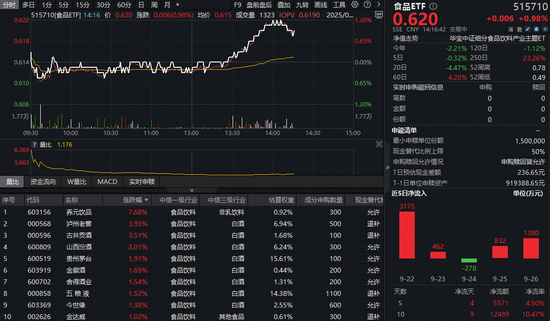
Group 1 - The food and beverage sector experienced a significant rally on September 29, with the Food ETF (515710) reaching an intraday price increase of up to 1.3% before settling at a 0.98% gain [1][3] - Key stocks in the sector showed strong performance, with Yangyuan Beverage soaring over 7%, and major liquor brands like Luzhou Laojiao and Gujing Gongji rising over 3% [1][3] - The Food ETF (515710) has seen substantial net inflows, with a total of 55.71 million yuan in net subscriptions over the last five trading days, indicating strong investor interest [3] Group 2 - Sales of popular gift items such as liquor and mooncakes surged ahead of the Mid-Autumn and National Day holidays, with liquor sales on Meituan increasing approximately eightfold year-on-year [3][4] - The current valuation of the food and beverage sector is considered low, with the food index's price-to-earnings ratio at 20.21, placing it in the lower 5.88% percentile over the past decade, suggesting a favorable investment opportunity [3][4] - Analysts predict a recovery in the liquor sector due to government policies promoting high-quality development, with expectations for Maotai's prices to rebound as market conditions improve [4][5] Group 3 - The food and beverage industry is witnessing significant policy catalysts, such as the upcoming public consultation on the national standards for prepared food safety, which may benefit leading brands [4][5] - The Food ETF (515710) is strategically positioned, with approximately 60% of its holdings in leading high-end and mid-range liquor stocks, and nearly 40% in other beverage and food segments [5] - Investors can also access core assets in the food and beverage sector through the Food ETF linked funds [5]

中经酒业周报∣8酒企上榜中国制造业企业500强,2025年IWSC首届中国区(邛崃)烈性酒大赛启动,茅台9月终端动销同比增20%
Xin Hua Cai Jing· 2025-09-28 11:16
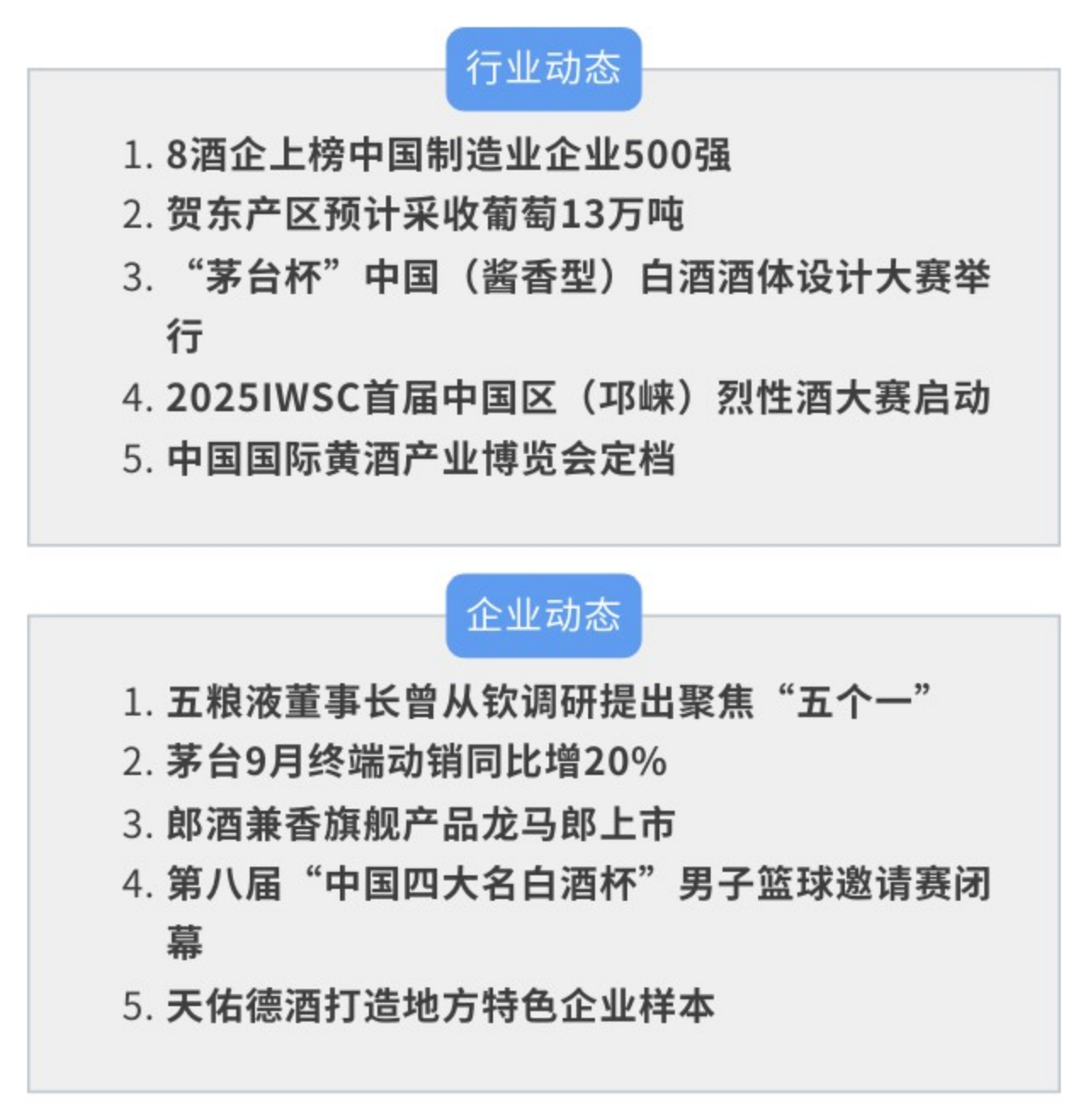
Industry Dynamics - Eight liquor companies made it to the list of China's top 500 manufacturing enterprises, including Sichuan Yibin Wuliangye Group, Guizhou Moutai, and Luzhou Laojiao [2] - The grape harvest season in the Helan Mountain East region started in mid-August and is expected to last until early October, with an estimated 130,000 tons of wine grapes to be harvested this year [3] - The "Moutai Cup" Chinese (Sauce Aroma) Baijiu Body Design Competition was held, with participants from 11 provinces, and a contestant from Guizhou Moutai winning first place [3] - The first China (Qionglai) Spirits Competition was launched, aiming to enhance the international brand recognition of Qionglai liquor [3] - The 2025 China International Huangjiu Industry Expo is scheduled for November 7-12 in Shaoxing, Zhejiang, featuring six exhibition areas and multiple related events [4] Company Dynamics - Wuliangye's chairman emphasized focusing on five strategies to enhance market presence and consumer engagement during a recent market research tour [5] - Moutai reported a 20% year-on-year increase in terminal sales for September, indicating a positive market trend [5] - Langjiu launched its flagship product "Longma Lang," which combines strong and sauce aroma techniques, as part of its ongoing product strategy [5] - The eighth "Four Famous Baijiu Cup" basketball invitation tournament concluded, with the Shaanxi team winning the championship [6] - Tianyoude Liquor, the only listed company in Qinghai's liquor industry, is focusing on local特色 and has developed a tourist attraction that has become popular among visitors [6]
文化何以成为战略
Sou Hu Cai Jing· 2025-09-28 06:45
Group 1 - The core viewpoint emphasizes the need for traditional brands to find new positioning strategies to navigate consumer cycles and for new brands to achieve rapid growth across categories [1] - Cultural strategy has become a key element in brand strategy, especially in the high-end market, where product characteristics alone are insufficient to build brand momentum [2][4] - The Chinese market shows a disparity in brand momentum between local and international brands, with examples like China Red Bull and Austrian Red Bull illustrating different market scales and brand strategies [4] Group 2 - The white liquor industry in China is experiencing a shift from quantity to quality, with market size increasing from 536.4 billion yuan in 2018 to 756.3 billion yuan in 2023, despite production halving [8] - Major liquor brands are adopting cultural strategies to connect with younger consumers, moving from traditional relationship-based consumption to self-expression and cultural values [9] - Successful brands like Moutai and Wuliangye are developing comprehensive cultural systems to enhance their brand value and consumer connection [9] Group 3 - The article discusses the pitfalls of brands that focus solely on product attributes, such as Wanglaoji and Six Walnut, which have struggled to maintain market relevance [4][5] - The case of Nongfu Spring illustrates the importance of evolving brand narratives beyond product quality to include cultural and environmental themes, leading to a resurgence in market leadership [7] - The need for liquor brands to embrace cultural strategies is highlighted, as many still rely on outdated marketing approaches that fail to resonate with modern consumers [12] Group 4 - The article notes that many liquor brands lack a strategic understanding of consumer culture, which hinders their ability to establish effective brand positioning [12] - It emphasizes the importance of emotional and ideological engagement in building brand culture, as seen in successful examples from both domestic and international markets [15] - The competitive landscape necessitates that brands connect consumer culture with added value to differentiate themselves effectively [17]



11只白酒股下跌 贵州茅台1435元/股收盘
Bei Jing Shang Bao· 2025-09-26 15:48
Core Viewpoint - The liquor sector is experiencing a decline in stock prices, with major companies like Kweichow Moutai and Wuliangye seeing decreases, while the overall cash flow situation for distributors is gradually improving despite lower order volumes [1] Industry Summary - The Shanghai Composite Index closed at 3828.11 points, down 0.65%, with the liquor sector index at 2239.12 points, down 0.41% [1] - Eleven liquor stocks reported declines, including Kweichow Moutai at 1435.00 CNY per share (down 0.28%), Wuliangye at 120.17 CNY (down 1.11%), Shanxi Fenjiu at 191.16 CNY (down 0.64%), Luzhou Laojiao at 127.58 CNY (down 1.45%), and Yanghe Brewery at 67.95 CNY (down 0.59%) [1] Company Summary - Huachuang Food and Beverage's report indicates that while liquor companies are facing damaged financial statements, they are focusing on maintaining channel ecosystems and are not aggressively pushing inventory [1] - Companies are easing the pressure on cash flow by slowing down the collection of payments, which reduces the financial burden on distributors [1] - Distributors are managing cash flow more cautiously, cleaning up accounts receivable from end customers, and requiring cash payments for purchases, leading to a gradual improvement in cash flow [1]