
BYD(002594)

Search documents
顺周期-冰火转换-时刻-策略对话汽车
2026-03-24 01:27
Summary of Key Points from the Conference Call Industry Overview - The overseas penetration rate of new energy vehicles (NEVs) is currently only 10%, with long-term potential expected to reach 50%-60%, allowing Chinese automakers to access a market capacity of approximately 40-50 million vehicles [1][4] - The global automotive market's annual sales volume is estimated to be between 80 million to 100 million vehicles, excluding the Chinese market of about 20-24 million and the U.S. market of approximately 15-16 million [3] Company-Specific Insights BYD - BYD's overseas sales are projected to reach 1.6 to 1.7 million units by 2026, contributing profits of 30-35 billion yuan, which will account for 60%-70% of the company's total profits [1][6] - The company is expected to further increase its overseas sales to 2.8 to 3.5 million units by 2027, indicating a strong growth trend [6] Geely - Geely's export volume is expected to grow from 420,000 units in 2025 to 750,000-800,000 units in 2026, with nearly 40% being NEVs [6] - The profit contribution from Geely's NEV exports is estimated to be between 6-8 billion yuan, with overall export business contributing over 50% to the company's profits [6] Chery - Chery's NEV exports are projected to exceed 600% year-on-year growth in 2025, with expected exports of 550,000-600,000 units by 2026 [1][6] Market Dynamics - The demand for NEVs in overseas markets has been positively impacted by the recent U.S.-Iran conflict, particularly in oil-sensitive regions like Europe and Singapore, where foot traffic in stores has increased by approximately 80%-90% year-on-year [2] - The penetration rate of NEVs in Europe is nearing 30% by 2025, indicating a high market acceptance compared to China's current rate of about 55% [2] Competitive Advantages - Chinese NEV manufacturers and their supply chains exhibit significant cost advantages, particularly in battery costs, with domestic battery costs at around 0.3 yuan/Wh compared to 0.8-1.0 yuan/Wh overseas [5] - The export gross margin for domestic NEV manufacturers is generally over 20%, with some regions approaching 30%, translating to a per-vehicle profit of around 20,000 yuan, which is 8-10 times higher than domestic profit levels [5] Supply Chain Beneficiaries - Companies like Fute Technology and Weimais are expected to benefit significantly from the growth in the European NEV market, with profit contributions projected at 35%-40% and over 30%, respectively [7] - Fute Technology's European NEV business is anticipated to account for 25%-30% of its total revenue [7] - Other suppliers such as United Power and Jingjin Electric are also expected to benefit from the trend of NEVs going overseas [7]


整车东南亚专家交流
2026-03-24 01:27
Summary of Conference Call Records Industry Overview - The conference call discusses the electric vehicle (EV) market in Southeast Asia, focusing on countries such as Thailand, Indonesia, Malaysia, Singapore, Vietnam, and the Philippines. The overall target for ASEAN's terminal sales in 2026 is set at 180,000 units, representing a 30% increase from previous figures [1][13]. Key Insights and Arguments Market Dynamics - **Thailand** is identified as the core growth market, with monthly orders reaching 7,000-8,000 units. Indonesia and Malaysia follow, with monthly orders of approximately 3,000 and over 2,000 units, respectively [2][1]. - The geopolitical situation has led to a 20% increase in oil prices, resulting in a 20%-30% increase in foot traffic and intention orders at dealerships [1][2]. - The Thai government has introduced a second wave of subsidies (10,000-30,000 THB) that equalizes the price of electric vehicles (EVs) with Japanese fuel vehicles [1][3]. Pricing and Product Strategy - The average price of vehicles is expected to rise above 200,000 RMB by 2026, driven by a shift towards high-end models such as the Tengshi Z9 and Yangwang U7, while new small car models are being deprioritized [1][15]. - In Singapore, the price difference between gasoline and electricity is significant, with gasoline costing about 15 RMB per liter compared to electricity at 1.5 RMB per kWh, leading to a projected EV penetration rate of 30%-40% [4][5]. Regional Market Characteristics - **Vietnam** is shifting from protecting local brand VinFast to a more open market, with plans to export through KD factories and supercharging technology [1][9]. - **Australia** has seen BYD surpass Tesla with a market share of about one-third, driven by the introduction of pickup trucks and ongoing government subsidies [1][17]. - The **Indian market** is focused on commercial vehicles, particularly electric buses, with limited growth in private passenger vehicles due to infrastructure and subsidy challenges [1][16]. Competitive Landscape - In Vietnam, the company plans to leverage local partnerships and KD factories to navigate the competitive landscape dominated by VinFast [9][11]. - The Philippines faces high energy costs, with gasoline prices around 10 RMB per liter and electricity costs nearing 2 RMB per kWh, limiting the growth of EVs despite some recent tax incentives [12][13]. Additional Important Insights - The average selling price in the ASEAN market for 2025 is projected at 180,000 RMB, with expectations for an increase in 2026 due to a shift towards higher-value models [15][16]. - The company is focusing on standardizing channel management and enhancing local service capabilities to compete with established brands like Toyota [13][14]. - The potential for growth in the Indian market is significant, but challenges remain due to a lack of strong policy support and infrastructure [16][18]. Conclusion - The Southeast Asian EV market is poised for growth, driven by government subsidies, changing consumer preferences, and competitive pricing strategies. However, regional differences in oil and electricity prices, along with varying government policies, will significantly influence market dynamics and company strategies moving forward [1][19][20].
汽车行业2026一季度业绩前瞻
2026-03-24 01:27
Summary of Automotive Industry Conference Call Industry Overview - The automotive industry is facing dual pressure on volume and profit in Q1 2026, with wholesale volume expected to decline by approximately 8% year-on-year, while new energy vehicle sales are projected to slightly decrease. Exports are the only bright spot, with a year-on-year increase of 55% [1][2][3]. Key Points Performance Expectations - **Overall Industry Performance**: Q1 2026 is anticipated to be the low point for volume and profit in the passenger car sector, with most automakers expected to see profit declines exceeding 20% year-on-year due to rising costs from copper, aluminum, lithium carbonate, and the appreciation of the RMB [1][2][3]. - **Geely Auto**: Expected to report profits exceeding 4 billion yuan, with a quarter-on-quarter increase of over 10%, driven by the high profitability of the Geely 9X model and a year-on-year export growth of 140% [1][4]. - **Heavy Truck Sector**: Strong export performance with a year-on-year increase of 30% in January-February 2026. China National Heavy Duty Truck Corporation (CNHTC) is expected to see a profit increase of 60% to 500 million yuan [1][2][3]. Segment Performance - **Intelligent Vehicle Sector**: Outperforming the overall vehicle sector, with Huayang Group expected to see a nearly 20% year-on-year growth, benefiting from Xiaomi's automotive sales and new product lines [1][7]. - **Parts Sector**: Mixed performance with leading companies like Fuyao Glass and Xingyu maintaining lower pressure due to strong overseas expansion. Companies like Kingood are expected to benefit from the rising aluminum prices [1][6]. Sales and Profitability - **Sales Disparities**: Despite overall industry decline, companies like NIO and Seres are expected to show significant sales growth due to new model launches, while BYD and XPeng are facing larger declines [2][3][4]. - **Profit Expectations**: Most passenger car companies are expected to see a year-on-year profit decline of over 20%. Geely is projected to stand out with a profit of over 4 billion yuan [4][5]. Market Trends - **Two-Wheeler Sector**: The sector continues to show strong growth in large-displacement exports, with Chuanfeng Power's exports expected to increase by 60% year-on-year, although overall performance is expected to remain flat due to tariff impacts [1][10]. Additional Insights - **Investment Strategy**: The investment strategy for 2026 focuses on performance and valuation, with recommendations in areas such as AIGC-enabled "power shortage," L4-level intelligence, and robotics. Key companies recommended include Weichai Power, Xpeng Motors, and Top Group [2]. - **Challenges**: The industry faces challenges from rising raw material costs and currency fluctuations, which are expected to negatively impact profitability in Q1 2026 [3][4]. This summary encapsulates the key insights and performance expectations for the automotive industry as discussed in the conference call, highlighting both opportunities and challenges within various segments.




泛能源板块投资机会电话会议
2026-03-24 01:27
Summary of Key Points from Conference Call Records Industry Overview - **Energy Sector**: The focus has shifted from technology stocks to energy and resource sectors due to tightening liquidity and expectations of a single interest rate cut by the Federal Reserve in 2026 [1][2][3]. Coal Sector - **Investment Logic**: Companies with coal chemical assets are recommended due to their aggressive growth potential. The rise in oil prices is expected to increase chemical product prices, benefiting companies like Guanghui Energy and Yanzhou Coal Mining [1][4][5]. - **Market Dynamics**: Despite a year-on-year decline in coal prices in Q1 2026, the average price for the year is expected to remain stable or slightly increase compared to 2025. The presence of flexible supply from domestic and Indonesian mines will help stabilize prices [5]. Energy Storage and Lithium Battery - **Growth Projections**: The energy storage sector, particularly household and commercial storage, is expected to see a growth rate of 30%-50% in 2026. Companies like Deye Technology and Jinlang Technology are highlighted as key players [1][5][6]. - **Lithium Demand**: A projected increase of over 30% in lithium battery demand in 2026 is anticipated, driven by high oil prices and the growth of the energy storage market [6][7]. Offshore Wind Power - **Market Growth**: The domestic offshore wind power market is entering a high growth phase, with installed capacity expected to reach 8-10 GW in 2026 and 13-15 GW by 2027. European projects are also accelerating due to energy security concerns [1][8]. Oil and Gas Equipment - **Capital Expenditure**: High oil prices are driving capital expenditures in North America and the Middle East, benefiting companies like Jereh and Neway. These companies are positioned well for growth due to their exposure to international oil service markets [1][10][11]. Public Utilities - **Mature Sector**: The waste-to-energy sector is entering a mature phase with significant potential for dividend increases. Companies like China Everbright Environment are expected to see substantial growth in earnings and dividends [1][12][13]. Investment Strategies - **Neutral Hedging**: Given the geopolitical uncertainties, a neutral hedging strategy is recommended, increasing allocations to the energy sector to mitigate risks associated with holding technology stocks [2][3]. Key Recommendations - **Coal Sector**: Focus on companies with coal chemical assets such as Guanghui Energy and Yanzhou Coal Mining [1][5]. - **Energy Storage**: Companies like Deye Technology and Jinlang Technology are recommended due to their strong growth prospects in the energy storage market [5][6]. - **Lithium Battery**: Ningde Times is highlighted for its strong market position and expected growth in both battery and energy storage sectors [6][7]. - **Offshore Wind**: Recommended companies include Daikin Heavy Industries and Tianjun Wind Power, which are well-positioned in the growing offshore wind market [8]. - **Public Utilities**: China Everbright Environment and Green Power Environmental are recommended for their stable earnings and dividend growth potential [12][13]. Conclusion - The energy sector, particularly coal, energy storage, and offshore wind, presents significant investment opportunities amid current geopolitical tensions and market dynamics. Companies with strong fundamentals and growth potential are well-positioned to benefit from these trends [1][2][3][4][5][6][7][8][12][13].

“开了两个加油站都没油了!”油价上调,国家临时调控稳油市
21世纪经济报道· 2026-03-24 00:08
Core Viewpoint - The article discusses the recent adjustments in domestic fuel prices in China due to the surge in international oil prices, highlighting the impact on consumers and the growing demand for electric vehicles as a result of rising fuel costs [4][5]. Fuel Price Adjustments - On March 23, the National Development and Reform Commission (NDRC) announced temporary adjustments to domestic fuel prices to alleviate the burden on consumers amid rising international oil prices. The adjustments resulted in a reduction of 1160 yuan per ton for gasoline and 1115 yuan per ton for diesel, translating to a price of approximately 0.86 yuan per liter for 89 gasoline and 0.91 yuan per liter for 92 gasoline [4]. - If the theoretical increase had been implemented, gasoline and diesel prices would have risen by 2205 yuan and 2120 yuan per ton, respectively, leading to an increase of about 1.84 yuan per liter for 92 gasoline and 1.81 yuan per liter for diesel [4]. Impact on Electric Vehicle Market - The surge in oil prices has led to a significant increase in the sales of new energy vehicles (NEVs) in China, with brands like BYD seeing a notable rise in orders both domestically and internationally. Countries such as Australia, Thailand, Singapore, and Indonesia have reported a surge in orders for Chinese NEVs [5]. - As of March 23, there are 1.5128 million existing NEV-related enterprises in China, with a steady increase in registrations over the past decade. The number of new registrations is projected to exceed 30,000 in 2024 and 2025, indicating a robust growth trend in the NEV sector [6].


全球视野看电车之五:基于能源安全视角看全球新能源增长潜力
Changjiang Securities· 2026-03-23 23:30
Investment Rating - The investment rating for the automotive and automotive parts industry is "Positive" and maintained [7] Core Insights - The rise in oil prices, influenced by the Middle East situation, has raised energy security concerns, prompting South Korea to initiate a resource security crisis alert and consider implementing vehicle restrictions [2][17] - The transportation sector accounts for a significant portion of oil consumption in many countries, and the current low penetration of new energy vehicles (NEVs) globally means that reliance on traditional fuel vehicles exacerbates risks associated with energy supply constraints. Diversifying the energy structure can mitigate these risks, and rising oil prices can accelerate the transition to NEVs in the global passenger vehicle market [2][19] - The potential for domestic NEVs to expand internationally is substantial, with projected sales for EVs, PHEVs, and HEVs in regions excluding China, the US, and Japan reaching 3.54 million, 1.4 million, and 4.62 million units respectively by 2025. If domestic NEVs capture 50%-60% of the market share in these categories, it could represent a growth potential of 4.3-5.3 times [23][24] Summary by Sections Global Energy Security Perspective - The recent increase in oil prices has raised energy security issues, with Brent crude oil futures reaching $108.65 per barrel, a 70% increase over the past two months. South Korea has raised its resource security crisis alert level and is considering measures such as vehicle restrictions to manage demand [17][19] New Energy Vehicle Market Potential - The transportation sector's oil consumption is significant, with many countries having low NEV penetration rates. High oil prices can drive the shift towards NEVs, as traditional fuel vehicles' dependence on oil resources increases risks associated with supply constraints [19][20] - Major regions for NEV exports from China include Western Europe, Southeast Asia, and Latin America, where leading companies like BYD, SAIC, and Geely are currently underrepresented in market share. As NEV penetration increases, these companies are expected to capture a larger share of the market [26][29]


60万一张车牌?新加坡车市到底多疯狂
汽车商业评论· 2026-03-23 23:06
Group 1 - The core point of the article highlights the high costs associated with car ownership in Singapore, particularly the Certificate of Entitlement (COE) prices, which are significant barriers to entry for consumers, yet the demand for cars remains strong [3][4][14]. - In the latest COE bidding, the prices for small and large cars were reported at 111,890 SGD (approximately 601,000 RMB) and 115,568 SGD (approximately 621,000 RMB) respectively, indicating the high financial commitment required for car ownership [3][9]. - Despite the high costs, the new car registration in Singapore is projected to reach 52,678 units by 2025, with electric vehicles (EVs) making up about 45% of this figure, reflecting a shift in consumer preferences towards electric options [3][17]. Group 2 - The COE system in Singapore is unique, requiring all vehicles to secure a COE before registration, which grants a ten-year ownership and road usage right [8][9]. - The government has frozen the annual growth rate of cars and motorcycles since February 2018, which will continue until early 2028, leading to increased competition for existing vehicle quotas and influencing COE prices [9][11]. - The government is also adjusting policies to accommodate electric vehicles, including raising the power threshold for EVs eligible for the A group COE and providing incentives for early adoption [12][11]. Group 3 - The article notes that the automotive market in Singapore is not just about selling cars but also about creating experiences, as evidenced by luxury brands like Porsche investing in experience centers [25][27]. - Porsche's new experience center in Singapore, set to open in 2027, will feature a 2-kilometer track and is aimed at enhancing brand engagement in the region [25][26]. - Despite high prices, luxury brands continue to invest in Singapore, indicating a belief in the market's potential and the importance of customer experience over mere sales figures [22][21]. Group 4 - The article emphasizes the growing acceptance of electric vehicles among Singaporean consumers, with brands like BYD rapidly increasing their market share, selling 3,002 vehicles in the first four months of 2025, surpassing Toyota [29][30]. - The local distribution network for BYD is expanding quickly, with multiple sales points established, indicating a strategic approach to cater to a diverse consumer base in a high-cost market [31][32]. - Overall, the article suggests that despite the high costs of car ownership, Singapore remains a viable market for investment in the automotive sector, driven by evolving consumer preferences and strategic brand positioning [32].

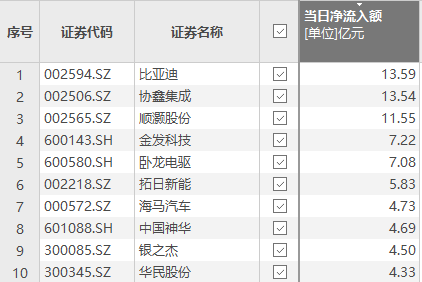
资金风向标 | 比亚迪获资金净流入13.59亿元
Shang Hai Zheng Quan Bao· 2026-03-23 12:51
Core Viewpoint - The article highlights the top ten stocks with the highest net inflow of funds on March 23, with BYD leading the list with a net inflow of 1.359 billion yuan [1]. Group 1: Top Stocks by Net Inflow - BYD (002594.SZ) received a net inflow of 1.359 billion yuan [2]. - Xiexin Integrated (002506.SZ) followed closely with a net inflow of 1.354 billion yuan [2]. - Shunhao Co., Ltd. (002565.SZ) had a net inflow of 1.155 billion yuan [2]. - Jinfat Technology (600143.SH) recorded a net inflow of 722 million yuan [2]. - Wolong Electric Drive (600580.SH) saw a net inflow of 708 million yuan [2]. - Tuojin New Energy (002218.SZ) had a net inflow of 583 million yuan [2]. - Haima Automobile (000572.SZ) experienced a net inflow of 473 million yuan [2]. - China Shenhua (601088.SH) recorded a net inflow of 469 million yuan [2]. - Yinzhi Jie (300085.SZ) had a net inflow of 450 million yuan [2]. - Huamin Co., Ltd. (300345.SZ) saw a net inflow of 433 million yuan [2].
2026/3/16-2026/3/22汽车周报:油价上涨将撬动新能源Beta,宇树IPO有望催化机器人板块-20260323
Shenwan Hongyuan Securities· 2026-03-23 11:48
Investment Rating - The report maintains a positive outlook on the automotive industry, particularly focusing on hybrid and fast-charging solutions, recommending companies like Geely and BYD, as well as the new energy supply chain [2][3]. Core Insights - The recent rise in oil prices is expected to enhance the penetration rate of new energy vehicles globally, with a focus on hybrid and fast-charging solutions [2]. - The IPO application of Yushu has been accepted, and the production release of Tesla's Optimus V3 is anticipated to catalyze the robotics sector [2]. - The report suggests continued attention to blue-chip companies with strong performance support, especially those within major indices, such as Yutong Bus and Minth Group [2]. Industry Situation Update - According to the China Passenger Car Association, the average daily retail sales of passenger cars in the second week of March were 45,000 units, a 19% decrease year-on-year but a 42% increase compared to the previous month [2]. - The price index for traditional raw materials and new energy raw materials has decreased recently, with traditional vehicle raw material prices down by 1.1% week-on-week and up by 6.1% month-on-month, while new energy vehicle raw material prices decreased by 2.7% week-on-week and increased by 2.4% month-on-month [2]. - The total transaction amount in the automotive industry this week was 349.939 billion yuan, a decrease of 8.81% compared to the previous week [2]. Market Situation Update - The automotive industry index closed at 7488.87 points this week, down 4.40%, which is a greater decline than the 2.19% drop in the CSI 300 index [12]. - Among industry stocks, 14 rose while 257 fell, with the largest gainers being Shentong Technology, Meili Technology, and Jintuo Co., which rose by 11.3%, 5.0%, and 4.9% respectively [16]. - The report highlights the importance of focusing on companies with strong performance support and potential for valuation growth, particularly in the context of AI and new energy trends [2][3]. Investment Analysis Opinions - The report emphasizes the importance of AI spillover and demand recovery, recommending a focus on intelligent and high-end directions in the automotive sector, particularly for new energy vehicle companies like Xpeng, NIO, and Li Auto [2]. - It also suggests that companies with overseas business support, such as BYD and Geely, should be monitored closely [2]. - The report identifies key trends in the robotics and data center cooling sectors, recommending companies with strong performance support and potential for valuation growth [2]. Key Events - The report reviews the "2026 Spring Automotive Industry Investment Strategy," which indicates limited impact from policy changes on automotive demand, with an optimistic view on the recovery of mid-to-high-end demand [3]. - The report notes that the penetration rate of new energy vehicles is expected to continue increasing, with a projected overseas sales volume of nearly 10 million units in five years [3]. - The report highlights the significance of robotics, low-altitude economy, and AIDC as new industry directions driven by technology [3].

汽车行业月报:淡季产销阶段性承压,车企陆续披露年报
Zhongyuan Securities· 2026-03-23 10:24
Investment Rating - The report maintains an investment rating of "Outperform the Market" for the automotive industry [4][6]. Core Insights - The automotive industry index has underperformed the Shanghai Composite Index by 5.08 percentage points, ranking 17th among 30 primary industries [4][11]. - The automotive production and sales in February 2026 were significantly impacted by seasonal factors and the Spring Festival, with production and sales down 31.7% and 23.1% month-on-month, and down 20.5% and 15.2% year-on-year, respectively [6][30]. - The market share of domestic brands in the passenger car segment has increased to 70.2%, reflecting a 3.33 percentage point rise [6][50]. - The report highlights a stable performance in the commercial vehicle market, with production and sales showing positive growth in the first two months of 2026 [6][56]. - The penetration rate of new energy vehicles reached 42.37% in February 2026, with production and sales down 21.8% and 14.2% year-on-year, respectively [6][63]. Industry Performance Review - As of March 20, 2026, the automotive industry index has decreased by 8.13%, underperforming the Shanghai Composite Index [11][20]. - The automotive sector has seen a decline in individual stock performance, with only 7% of stocks rising in March 2026 [16][17]. - The industry valuation has decreased, with a PE ratio of 31.51, ranking 15th among 30 primary industries [20][21]. Key Data Tracking - In February 2026, the automotive production and sales figures were 1.672 million and 1.805 million units, respectively, reflecting a significant decline due to various factors [6][30]. - The passenger car market faced challenges, with production and sales of 1.4 million and 1.536 million units, respectively, showing a year-on-year decline [44][50]. - The commercial vehicle market showed resilience, with production and sales of 273,000 and 270,000 units, respectively, maintaining positive growth in the first two months of 2026 [56][57]. - New energy vehicle production and sales in February 2026 were 695,000 and 765,000 units, respectively, with a year-on-year decline [63][67]. Important Company News - The report notes that NIO achieved its first quarterly profit in Q4 2025, with a significant improvement in financial health [83]. - Geely's revenue for 2025 reached 345.2 billion, with a net profit increase of 36%, driven by strong performance in its new energy brand [84]. - Chery reported a revenue of 300.3 billion for 2025, with a net profit growth of 34.6%, indicating a positive trend in its financial performance [84].