
BABA(BABA)

Search documents
三巨头增长30%,超市又行了?
和讯· 2026-01-09 09:01
Core Viewpoint - The retail industry is experiencing significant growth driven by key players like Fat Donglai, Hema, and Sam's Club, while traditional supermarkets are undergoing substantial upgrades to compete in a challenging market environment [4][19]. Group 1: Company Performance - Fat Donglai achieved a record annual sales of 23.53 billion, a 38.71% increase from 16.96 billion in 2024, with its flagship store in Xuchang generating nearly 6 billion in sales [5][6]. - Hema's overall revenue growth exceeded 40% in 2025, with a projected GMV of over 100 billion by the end of the fiscal year [11][12]. - Sam's Club reported a sales figure surpassing 140 billion, marking a 40% increase from 100.5 billion in 2024, supported by an aggressive expansion strategy [16][18]. Group 2: Industry Trends - The overall retail sector remains under pressure, with less than 40% of chain supermarkets achieving positive sales growth in 2025, highlighting a competitive landscape [19]. - The industry is witnessing a "Matthew Effect," where leading companies are gaining market share while weaker players struggle, prompting a shift from broad growth strategies to focused innovations [20][23]. - Traditional supermarkets are enhancing their offerings by improving fresh produce and convenience services, aiming to redefine their neighborhood value [21][25]. Group 3: Strategic Shifts - Companies are increasingly focusing on supply chain capabilities rather than just expanding store numbers, with strategies like Sam's global sourcing and Hema's direct supply of fresh produce [24]. - The "Fat Reform" trend is evident as traditional retailers like Yonghui and Bubugao adopt operational strategies from Fat Donglai, resulting in significant increases in customer traffic and profitability [25][26]. - The Ministry of Commerce has encouraged innovation and quality improvement in the retail sector, emphasizing the importance of supply chain optimization and digital empowerment for industry transformation [26].



大摩:中国在AI竞赛中拥有独特优势,阿里是“最佳赋能者”,腾讯具“最高2C变现潜力”
Hua Er Jie Jian Wen· 2026-01-09 08:41
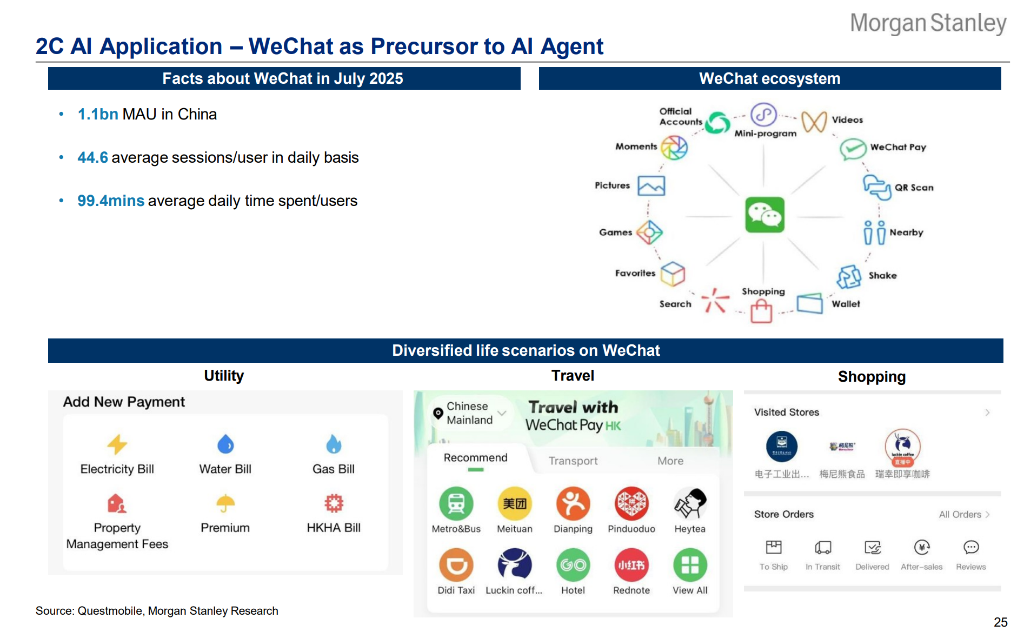
Core Insights - Morgan Stanley believes that the market is undergoing a structural transformation, with China adopting a unique "open" model strategy to counter the world's "closed" systems in the global AI race [1] - The report indicates that China has captured a significant share of the top SOTA models, with expectations that the total addressable market (TAM) for cloud AI in China will reach $50 billion by 2027 [1] - Investors should focus on the monetization capabilities and ecological barriers at the application layer rather than just the infrastructure arms race [1] Market Dynamics - China holds a comparative advantage in data volume, power supply, and engineering talent, which supports the growth of AI applications [1] - The dual-track evolution of "super apps" and "AI-native applications" is evident in the Chinese market, with WeChat emerging as a leading AI agent with 1.1 billion monthly active users and high user engagement [2][5] Application Landscape - AI-native applications from companies like ByteDance, Baidu, and Alibaba are rapidly evolving from simple chatbots to more complex emotional interactions and content creation tools [5] - The penetration of AI in enterprise sectors is reshaping industry dynamics, with strong deployment intentions for generative AI across various verticals such as advertising, healthcare, and finance [11] Competitive Positioning - Alibaba is positioned as the "best AI enabler" in China, leveraging its cloud infrastructure and integration with e-commerce and other business scenarios [14] - Tencent is recognized for its high consumer monetization potential through its WeChat ecosystem, which provides a natural barrier in content ecology [14] - ByteDance is defined as a "full-stack AI leader," with a comprehensive layout from underlying engines to various AI-native applications [14] Investment Focus - Investors are encouraged to monitor the speed at which these tech giants implement AI in their respective domains, particularly those that can translate AI technology into actual revenue and profits [15]
别低估了,淘宝闪购这一战的决心
Feng Huang Wang· 2026-01-09 08:35
Core Viewpoint - Alibaba is determined to lead the next retail revolution by significantly increasing its investment in instant retail, with a goal of market share growth by 2026 [2][4][18] Group 1: Strategic Importance of Instant Retail - The battle for instant retail is not just a business competition but a critical fight for Alibaba's future business model [5][9] - Instant retail is seen as a necessary response to the saturation of traditional e-commerce growth, with consumer demand for immediacy rapidly increasing [6] - Failure in this sector could result in Alibaba losing not just a business segment but also its influence in the evolving consumer landscape [9] Group 2: Investment Strategy - Alibaba plans to invest in three key dimensions to enhance its competitive edge: improving user and order value, expanding product categories, and optimizing fulfillment experiences [10][11] - The focus is on elevating the perception of instant retail from low-value delivery services to high-quality consumer experiences [11] - By integrating its extensive supply chain from Tmall and Hema, Alibaba aims to create a differentiated advantage in instant retail [15][17] Group 3: Efficiency and Long-term Vision - Despite a reported loss of approximately 20 billion yuan in the fourth quarter, Alibaba's loss reduction is outpacing competitors, indicating a strategic approach to spending [8][14] - The company is leveraging data and technology to ensure that every subsidy is effectively directed towards improving business fundamentals [8][14] - Alibaba's long-term strategy involves transforming instant retail into a service-oriented model, which is seen as a calculated investment for future growth [8][14][18] Group 4: Competitive Advantages - Alibaba's unique supply chain integration provides a significant barrier to entry for competitors, making it difficult for them to replicate its model [15][17] - The synergy between its physical retail networks and instant delivery capabilities enhances operational efficiency and product variety [17] - The shared consumer data across platforms allows for precise inventory management and targeted marketing, creating a more responsive retail environment [17]

CES变成中国科技秀:机器人跳舞、熊猫获奖
3 6 Ke· 2026-01-09 08:24
Group 1: Core Themes of CES 2026 - The main theme of CES 2026 is "human-centered" AI applications, marking a shift from traditional consumer electronics to AI-centric technological transformations [1] - Chinese companies are increasingly taking center stage at CES, with 942 exhibitors, accounting for approximately 22% of the total, maintaining their position as the second-largest exhibiting nation [1] - In specific sectors, Chinese firms dominate, with 55% of humanoid robot exhibitors and nearly 70% of AI glasses brands coming from China [1] Group 2: Robotics and AI Innovations - Chinese manufacturers are expected to continue leading in cost reduction and efficiency improvements in humanoid robots, showcasing their capabilities in unstructured environments [2] - Notable products include the Unitree H1 humanoid robot with advanced sensing capabilities and the latest generation of the "绝影" series robotic dogs, which excel in indoor navigation [4][11] - The "Care-bot" humanoid robot by Fourier demonstrates embodied intelligence in real-life interaction scenarios [7] Group 3: Consumer Electronics and Smart Devices - Over 80% of global smart glasses supply chain manufacturers are from China, with 16 Chinese companies showcasing their products at CES [15] - Innovations in smart home devices include the AI-driven "安安" companion robot designed for elderly and cognitively impaired individuals [16] - Companies like Alibaba and XREAL are launching advanced AI glasses, with features such as ultra-lightweight designs and integration with various AI services [19][20] Group 4: Automotive and AI Integration - The automotive industry is transitioning from "software-defined" to "AI-defined" vehicles, with companies like Geely and Great Wall showcasing new technologies [28] - Geely's G-ASD smart driving solution and Great Wall's focus on new energy technologies highlight the industry's shift towards AI integration [30][32] - New products like the AI-driven logistics solutions from New Stone and advanced lidar technology from Hesai demonstrate the growing importance of AI in transportation [34][35] Group 5: Home Appliances and AI - Hisense introduced new RGB-Mini LED display technology and AI-controlled smart refrigerators, showcasing the integration of AI in home appliances [41] - TCL's innovations in display technology, including the world's first printed OLED car screen, reflect advancements in consumer electronics [43][44] - Companies are increasingly focusing on AI capabilities in home security and smart home management systems [51][49] Group 6: Overall Impact of AI - CES 2026 emphasizes the profound impact of AI on the consumer electronics industry, with expectations for AI user numbers to grow significantly [59] - The event serves as a platform for global tech companies to set the foundation for future technological development and transformation [59] - The integration of AI into various sectors, including robotics, automotive, and consumer electronics, indicates a trend towards deeper AI adoption in everyday life [59]





AI重构营销生态 2025中国互联网广告市场规模7257亿
Jing Ji Wang· 2026-01-09 07:49
Core Insights - The report predicts that the Chinese internet advertising market will grow steadily at a rate of 11.5%, reaching a scale of 725.7 billion yuan by 2025, marking a shift from traffic expansion to "deep value creation" [1] Group 1: AI and Marketing Transformation - AI is fundamentally restructuring consumer decision-making paths, shifting the marketing battlefield from "keyword ranking" to an "AI trust system" [2] - Brands are required to optimize authoritative evaluations and structured information through Generative Engine Optimization (GEO) technology, significantly reducing marginal costs by 60% [2] - AI-driven "super dynamic ecosystems" are enhancing creative productivity by over ten times, with tools like Flixor enabling batch production of compliant marketing materials [2] Group 2: AI Industry Evolution - The AI industry is transitioning from "training competitions" to "inference optimization," with multimodal deep reasoning and adaptive learning becoming mainstream technologies [3] - The investment in embodied intelligence has exceeded 40 billion yuan, indicating a shift towards physical interactions in AI applications [3] - By 2028, it is expected that 15% of marketing decisions will be autonomously made by AI, highlighting the importance of computational infrastructure [3] Group 3: Short Video and E-commerce Integration - Short video platforms have evolved into "comprehensive digital communities," seamlessly integrating entertainment, shopping, and learning [4] - The "short drama + e-commerce" model has led to an 18.85% year-on-year growth in video information flow advertising, making it the fastest-growing advertising format [4] - Knowledge content is emerging as a new highlight in internet marketing, with platforms like Douyin and Bilibili seeing significant user engagement in knowledge-based content [4] Group 4: Market Dynamics and E-commerce Advertising - E-commerce advertising continues to lead with a 38.55% market share, with interest e-commerce growing by 18.9%, becoming a major growth engine [5] - Douyin's advertising revenue surpasses Alibaba by 32.7 billion yuan, while Xiaohongshu achieves a 23.2% growth rate through its "community + search" model [5] - AI search is reshaping traffic entry points, with traditional search engine advertising revenue remaining flat, while "platform + AI search" categories have surged by 107.4% [5] Group 5: Future Market Predictions - The market size is expected to exceed 900 billion yuan next year, driven by "agent-based AI" and "full-scene integration" [6] - AI will autonomously complete the entire process from "insight to strategy to execution," creating a "seamless marketing" experience [6] - Brand competition is shifting from traffic acquisition to "ecosystem and value battles," with companies that build AI trust assets poised to gain a competitive edge in the smart marketing era [6]
小摩:对阿里巴巴-W未来6至12个月交易前景持建设性看法 建议增持股票
Zhi Tong Cai Jing· 2026-01-09 07:12
Core Viewpoint - Morgan Stanley maintains an optimistic outlook on Alibaba's (09988) trading prospects over the next 6 to 12 months, recommending an "overweight" rating on the stock, anticipating that the share price will overcome short-term profit pressures and be re-rated once the monetization point of "cloud business + generative AI" becomes clearer [1] Group 1 - Morgan Stanley believes that the risk and reward profile for Alibaba leans towards the upside, as the potential of AI-driven cloud business and the value of platform optionality outweigh short-term investment hurdles [1] - The firm has lowered its target price for Alibaba's U.S. stock from $230 to $215, based on a 16x price-to-earnings ratio for the fiscal year 2028, and reduced the target price for its Hong Kong stock from HKD 225 to HKD 210 [1] - Despite increased investments in food delivery, instant retail, and user acquisition for generative AI native applications potentially weakening profit margins in the short term, these adverse factors are gradually being understood by the market, with investment pace largely dependent on management's self-regulation [1] Group 2 - Morgan Stanley has revised its earnings per share forecasts for Alibaba for 2027 to 2028 down by 15% and 7% respectively, reflecting increased investment in food delivery, instant retail, and generative AI user acquisition, as well as weakened monetization capabilities in the domestic e-commerce sector amid soft consumer demand [2] - The firm anticipates that as these adverse factors continue to unfold over the coming quarters, profitability may have further downside potential, leading to a more differentiated and potentially volatile trading style [2]
小摩:对阿里巴巴-W(09988)未来6至12个月交易前景持建设性看法 建议增持股票
智通财经网· 2026-01-09 07:05
Group 1 - Morgan Stanley maintains an optimistic outlook on Alibaba's (09988) trading prospects for the next 6 to 12 months, recommending to overweight the stock as it is expected to overcome short-term profit pressures [1] - The target price for Alibaba's US stock is lowered from $230 to $215, based on a 16x price-to-earnings ratio for the fiscal year 2028, while the Hong Kong target price is adjusted from HKD 225 to HKD 210 [1] - Despite short-term profit margin pressures due to increased investments in food delivery, instant retail, and generative AI applications, these negative factors are gradually being understood by the market, with investment pace largely dependent on management's self-regulation [1] Group 2 - Earnings per share forecasts for Alibaba for 2027 and 2028 are reduced by 15% and 7% respectively, reflecting increased investment in user acquisition for food delivery, instant retail, and generative AI applications, alongside weakened monetization capabilities in the domestic e-commerce sector due to soft consumer demand [2] - It is anticipated that profit margins may have further downside potential in the coming quarters as these adverse factors continue to unfold, leading to a more differentiated and potentially volatile trading style [2]
闲鱼次元年度报告发布:二次元用户突破1.6亿,“LABUBU幸运”登顶年度超热宝贝
Jin Rong Jie Zi Xun· 2026-01-09 06:34
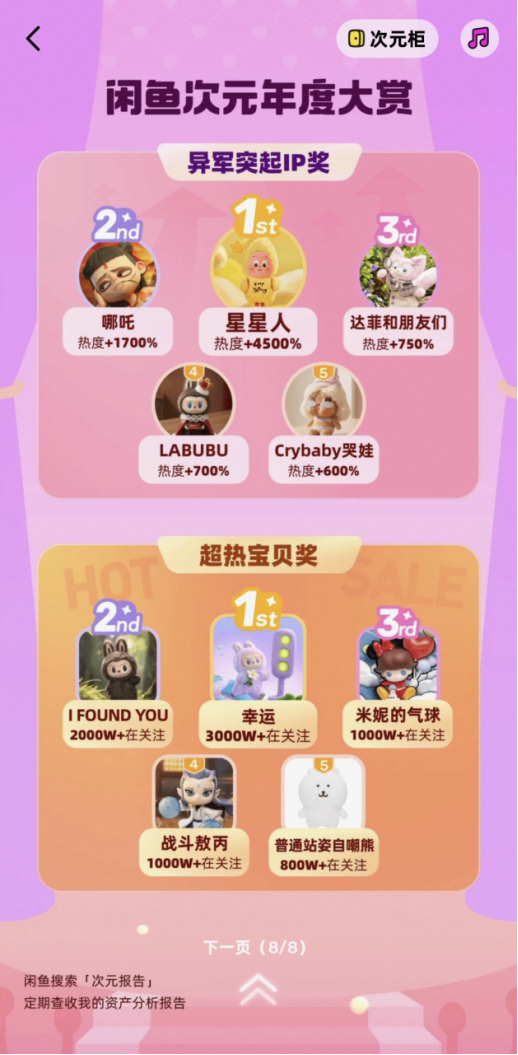
Core Insights - The "2025 Xianyu Dimension Annual Report" reveals a significant growth in the platform's two-dimensional user base, surpassing 160 million users by the end of 2025, with a 47% year-on-year increase in annual two-dimensional consumers, establishing Xianyu as a primary platform for youth interest-based consumption [1] User Behavior - Two-dimensional users on Xianyu show peak purchasing activity after work hours and late at night, with many users placing orders as late as 11 PM. Additionally, users demonstrate a strong "recovery" ability, with an average annual sale of two-dimensional items generating 2,541 yuan and an average two-dimensional appreciation income of 282 yuan, creating a unique cycle of interest-based consumption [1] Market Trends - The report highlights the most active trading categories within the two-dimensional community, including trendy blind boxes, plush toys, and various merchandise, with trendy blind boxes experiencing a remarkable 250% increase in order volume year-on-year, indicating robust community engagement [1] Awards and Recognition - The first "Xianyu Dimension Annual Awards" showcased the evolving trends in the two-dimensional consumption market, with notable IPs like LABUBU and Nezha receiving accolades for their rapid order volume growth. The "Hottest IP Award" recognized top IPs such as LABUBU and the Time Youth Team, reflecting the highest trading popularity on the platform [2] User Engagement - Following the report's release, a wave of social media activity emerged, with users sharing their annual spending experiences, highlighting a willingness to invest significantly in their interests while also achieving asset appreciation through strategic purchases [4] Personalization Features - The report introduces personalized tags for users based on their consumption behavior, allowing them to connect with classic two-dimensional characters and share their identities within the community. Users can access their annual consumption history by searching for "Dimension Report" on Xianyu [6]
传媒行业2026年度策略报告:Agent定义入口,AIGC重塑供给:AI时代的流量分发重构与内容产能爆发-20260109
Xinda Securities· 2026-01-09 06:34
Core Insights - The report emphasizes that in 2026, the media internet sector will undergo a dual reconstruction driven by the transition from AI as a "technical infrastructure" to "application deep water zone," focusing on entry form migration, distribution rule repricing, and supply-side capacity explosion [1][11] - AI Agents are set to replace traditional apps as the new super entry point, shifting the traffic distribution logic from "time capture" to "efficient execution" [1][12] - AIGC (AI-Generated Content) is expected to lead to a significant increase in content production capacity, with zero marginal cost production becoming a reality, thus redefining the value of quality data and IP [1][11] Group 1: AI Agents and Traffic Distribution - AI Agents signify a generational leap in human-computer interaction, evolving from GUI to IUI, fundamentally changing the traffic distribution logic [1][12] - The traditional "click-jump" model is being replaced by a "dialogue-execute" paradigm, where AI Agents understand user intent and execute tasks across applications [1][12] - The emergence of AI Agents is expected to create a new operational layer that could potentially replace single apps as the primary distribution entry point [1][12][19] Group 2: AIGC and Content Supply - AIGC is anticipated to transition from a phase of "cost reduction and efficiency enhancement" to a "new demand creation" explosion by 2026, significantly increasing content supply [1][41] - The production barriers for video, 3D, and gaming assets are expected to lower drastically, leading to a surge in content supply and a devaluation of mediocre content [1][41] - Content consumption is evolving from passive viewing to active engagement, with new formats like "generative interactive dramas" and "AI companion games" emerging [1][43] Group 3: Investment Recommendations - The investment strategy in the media internet sector is shifting towards high-quality assets in both traffic distribution and content supply, focusing on companies that can effectively capture user intent and provide quality content [1][41] - Companies with operational system bases or super Agent platforms are likely to gain new traffic distribution rights and bargaining power, while mid-tier apps lacking exclusive content may face risks of being "pipelined" [1][19] - Key players in the AI Agent space include Alibaba, Tencent, and ByteDance, which are actively developing their AI capabilities to secure new traffic entry points [1][25][40]




CES 2026观察:AI眼镜并没有迎来iPhone时刻
Tai Mei Ti A P P· 2026-01-09 06:23
Core Insights - The CES 2026 highlighted AI glasses as a core topic, but failed to deliver groundbreaking innovations, indicating that the industry is still struggling to transition from niche products to mainstream necessities [1] - Despite promising growth projections, the AI glasses market has not yet crossed the gap from "geek toys" to "essential consumer products," suggesting that the anticipated explosion in demand may be more of an industry fantasy [1] Group 1: Exhibition Highlights - Several manufacturers showcased their innovations at CES, revealing both strengths and limitations in the current AI glasses market [2] Group 2: Company Innovations - Meta introduced the Ray-Ban Display series, featuring a micro-display and improved voice interaction, but faced limitations in field of view and battery life, indicating a focus on incremental innovation rather than breakthrough technology [3] - Thunder Innovation launched the X3 Pro Project eSIM, enabling independent communication and AI interaction, but its weight and eSIM subscription challenges may hinder widespread adoption [4] - XREAL presented the 1S model with advanced spatial computing capabilities, but its high price point and lack of quality AR content limit its market reach [5] - Quark's AI glasses S1 integrated various Alibaba services but struggled with competitive pricing and compatibility issues, reflecting a tension between high specs and market viability [7] - Rokid's lightweight glasses achieved a record low weight of 49 grams and strong sales, but compromised on camera quality and field of view, positioning it as a smart assistant tool rather than a full-fledged device [8] Group 3: Industry Challenges - The AI glasses industry faces three main barriers: technological limitations, unclear use cases, and fragmented ecosystems, which hinder the potential for explosive growth [9][10] - The "impossible triangle" of lightweight design, long battery life, and high performance remains unsolved, with current products often falling short of user expectations [9] - The lack of a unified operating system and collaboration with traditional optical retailers further complicates market development, leading to inconsistent product quality and consumer confusion [10] Group 4: Future Outlook - The AI glasses market is expected to remain in a phase of technological iteration and market education, with significant breakthroughs potentially taking 3-5 years [11] - The development of specialized low-power chips and advancements in optical technology are seen as critical for overcoming current limitations [11] - Price reductions and increased competition from companies like Xiaomi and Quark may drive market growth and improve product affordability [11] - The industry awaits a "killer app" or a revolutionary product that combines technological innovation, practical use cases, and ecosystem compatibility to trigger widespread adoption [12]
