BIDU(BIDU)

Search documents
反转!80%美国AI初创企业弃用本土模型,转头扎进中国大模型怀抱
Sou Hu Cai Jing· 2025-12-31 10:12
Core Insights - 80% of AI startups in the US are now opting for Chinese general models instead of OpenAI's models, indicating a significant shift in preference due to the practicality and effectiveness of Chinese models [1][11][13] Group 1: Performance of Chinese AI Models - Chinese models, particularly in image generation, have established themselves at the forefront globally, with Alibaba's Image series and Tencent's Hunyuan Image models achieving top rankings [5][7] - In the image editing sector, Chinese companies hold 6 out of the top 16 positions, representing approximately one-third of the global market share [5] - ByteDance's models have notably secured the second, third, and fifth positions globally, showcasing China's strong presence in the top tier of AI models [7] - In the video model category, Chinese firms dominate with 7 out of the top 16 models, indicating a robust ecosystem outside of the US [9] Group 2: Comparison with US AI Development - The US is focusing on three core areas: advancing AI chip technology, building large-scale AI infrastructure, and developing closed-source models, aiming for high-tech breakthroughs [15][17] - In contrast, China is pursuing a more application-oriented approach, leveraging its status as the largest manufacturing and hardware nation to integrate AI across the entire industrial chain [21][23] - China's open-source model strategy encourages broader participation from enterprises and developers, facilitating rapid technological iteration and application across various industries [25] Group 3: Market Dynamics and Future Implications - The shift in preference among US startups reflects a broader trend where Chinese models are seen as more practical and adaptable to specific business needs [13][15] - The differing paths of AI development in China and the US are not a zero-sum game; rather, they may drive innovation and transformation in the global AI landscape [25][27]




AI年鉴:从“概念充血”到“产业造血” 互联网巨头锚定下一个十年
Sou Hu Cai Jing· 2025-12-31 09:42
Core Insights - The article emphasizes that AI is the only technology in China's tech landscape projected to grow exponentially, with significant investments from major players like Tencent, Alibaba, ByteDance, Baidu, and Huawei, marking AI as a critical driver for future growth [2] Investment Trends - By 2025, China's total investment in AI is expected to reach $56.8 billion, accounting for 27.4% of global AI investment, surpassing Europe for the first time [2] - Major internet companies are directing 63% of their capital expenditures towards AI capabilities, models, and applications, reflecting a 28 percentage point increase year-over-year [2] Model Development - The competition in AI models has shifted from catching up to parallel development, with significant advancements in open-source models and performance metrics [3] - Notable achievements include DeepSeek's R1 model aligning with OpenAI's capabilities at a fraction of the cost and Alibaba's Tongyi Qianwen 3.0 surpassing GPT-4 Turbo in code generation accuracy [3] Computing Power - The race for computing power is characterized by innovations such as Huawei's Ascend supernodes and Alibaba's expansion of its cloud computing capabilities [4][5] - By 2025, China's intelligent computing power is projected to reach 725 EFLOPS, a 74% increase year-over-year, with major companies building their own infrastructure [5] Application Integration - AI applications are becoming deeply integrated into various sectors, with Tencent, Alibaba, ByteDance, and Baidu reporting significant improvements in efficiency and cost reductions through AI tools [6] - For instance, Tencent's AI-generated content has increased ad click-through rates by 18%, while Alibaba's tools have significantly reduced product photography costs [6] Financial Impact - AI is reshaping traditional revenue streams in advertising, e-commerce, and gaming, with companies reporting substantial growth in customer numbers and sales due to AI-driven innovations [8] - Tencent anticipates that AI-related revenue will reach 36.2 billion yuan by 2025, constituting 12% of its total revenue [9] Policy Support - The Chinese government is actively promoting AI development through initiatives aimed at building a national integrated computing network and supporting AI applications across various sectors [10] - These policies are expected to generate over 200 billion yuan in market demand by 2026 [10] Challenges Ahead - The industry faces challenges related to energy consumption, talent shortages, and ethical concerns, with projections indicating a significant increase in energy use by AI data centers [11] - The talent gap is projected to reach 5 million by 2025, while ethical issues related to AI are becoming more prevalent [11] Future Outlook - By 2026, the core AI industry in China is expected to exceed 1 trillion yuan, with a shift from a focus on scale to efficiency in AI applications [13] - The article concludes that AI is not just a trend but a foundational element for future growth, with significant transformations anticipated across various industries [13]
AI算力方向强势收官2025!云计算ETF(159890)午后上攻强势冲击6连阳
Sou Hu Cai Jing· 2025-12-31 06:27
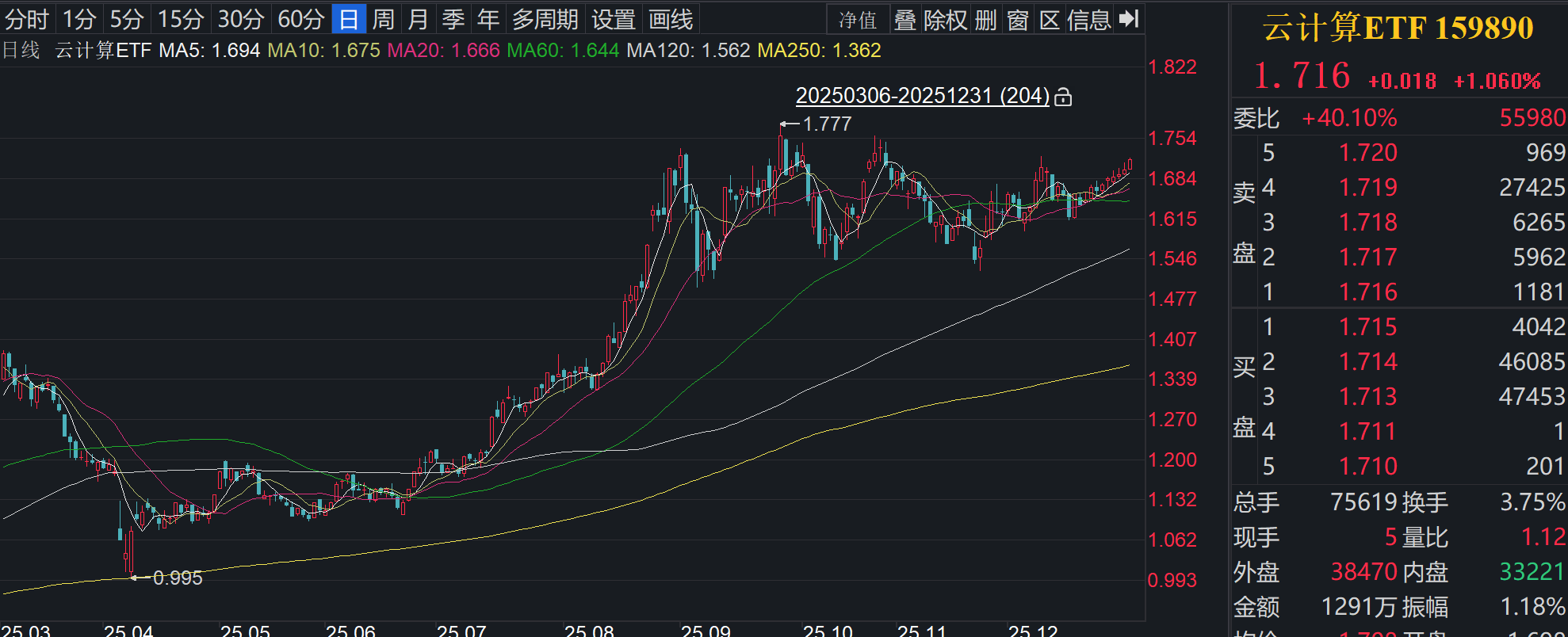
Core Viewpoint - The AI computing power sector is experiencing significant growth, driven by government initiatives and increasing demand for domestic AI chips, particularly the H200 chip, which is set to be delivered to Chinese customers soon [3][4][5]. Group 1: Market Performance - On the last trading day of 2025, AI computing stocks saw a strong afternoon rally, with the cloud computing ETF (159890) rising over 1% and achieving a six-day winning streak [1]. - Notable stock performances included a rise of 11.46% for Yidian Tianxia, over 8% for Hand Information, and more than 4% for companies like Zhongke Xingtai and Wanxing Technology [1]. Group 2: Policy and Industry Developments - A key government official announced the implementation of the "AI+" initiative, which aims to create extensive application scenarios for AI computing power chips, leading to rapid growth in demand and innovation within the sector [3]. - The conditional opening of the H200 chip to China is seen as a positive development, with major tech companies like Alibaba and ByteDance planning significant purchases to enhance their AI capabilities [4]. Group 3: Domestic Chip Strategy - Domestic companies are adopting varied strategies in response to the H200 chip's availability, with Alibaba and ByteDance pursuing large-scale purchases, while Baidu focuses on self-developed Kunlun AI chips to reduce reliance on external suppliers [4]. - Tencent is exploring indirect methods to acquire advanced computing power, aiming to secure over $1.2 billion in usage rights for the latest B200/B300 chips [4]. Group 4: Growth Projections - According to IDC and Inspur, China's intelligent computing power is projected to reach 1,037.3 EFLOPS by 2025, with a compound annual growth rate of 46.2% from 2023 to 2028 [6]. - The general computing power in China is expected to grow to 85.8 EFLOPS by 2025, with a compound annual growth rate of 18.8% during the same period [6]. Group 5: Investment Opportunities - The current landscape of the AI computing market presents numerous opportunities for investment, with a focus on domestic chip development and technological innovation [5][6]. - The cloud computing ETF (159890) tracks a diverse range of companies involved in AI infrastructure and applications, indicating a comprehensive approach to the AI computing era [6].


股票市场概览:资讯日报:中国提前下达625亿元超长期特别国债支持以旧换新-20251231
Guoxin Securities Hongkong· 2025-12-31 06:23
Market Overview - The Hang Seng Index closed at 25,855, down 0.86% for the day but up 28.89% year-to-date[1] - The Hang Seng Technology Index rose 1.74% to 5,578, with a year-to-date increase of 24.85%[1] - The Hang Seng China Enterprises Index increased by 1.12% to 8,991, with a year-to-date rise of 23.34%[1] Sector Performance - Baidu's stock surged nearly 9% due to advancements in AI and smart cloud business, with significant growth in its self-developed AI chip and smart driving orders[7] - The semiconductor sector saw strong gains, with InnoTek rising over 15% and SMIC up more than 4% following Nvidia's announcement of partnerships for a new power architecture[7] - Robotics stocks were active, with Yujing Technology up over 13% and Sanhua Intelligent Control up over 12%, supported by a significant increase in industrial robot production[7] Oil and Entertainment - Oil stocks continued to perform well, with CNOOC rising nearly 4% as international oil prices increased due to geopolitical tensions[7] - The entertainment sector saw a boost, with Emperor Culture Industries rising nearly 9% as the 2025 New Year box office surpassed 5.3 billion yuan, a near eight-year high[7] Economic Indicators - The WTI crude oil price surpassed $58 per barrel, while Brent crude approached $62 per barrel, driven by rising geopolitical risks[7] - The US Federal Reserve indicated potential future interest rate cuts if inflation continues to decline, as noted in the December meeting minutes[11]




2026两新政策发布,重在优化升级:环球市场动态
citic securities· 2025-12-31 05:17
Market Overview - A-shares experienced a slight upward trend, with the Shanghai Composite Index closing at 3,965 points, while the Shenzhen Component and ChiNext Index rose by 0.49% and 0.63% respectively, with a total market turnover of 2.16 trillion yuan[13] - The Hang Seng Index increased by 0.86%, driven by technology and semiconductor sectors, while the Hang Seng Tech Index surged by 1.74%[9] - European markets showed strength, with the Stoxx 600 index rising by 0.6%, and several markets reaching new highs despite geopolitical uncertainties[7] Economic Policies - The Chinese government announced a 625 billion yuan special bond issuance to support the "old for new" consumption policy for 2026, aiming for a retail sales growth rate of approximately 3.2%[4] - The Federal Reserve's meeting minutes revealed internal divisions regarding future interest rate cuts, with a majority favoring further reductions, although uncertainty remains[28] Commodity and Currency Movements - Silver rebounded strongly, rising over 10% after experiencing its largest single-day drop in over five years, while copper prices extended their gains for eight consecutive days, marking the longest streak since 2017[25] - The U.S. dollar index increased by 0.2% to 98.24, while the euro appreciated by 13.5% year-to-date against the dollar[24] Investment Recommendations - The report suggests focusing on AI-driven companies in the internet sector, with recommendations including Alibaba (BABA US), Pinduoduo (PDD US), and Bilibili (BILI US) as potential investment opportunities[6] - In the banking sector, the report highlights the potential for profit growth of around 5% in 2026, recommending stocks like China Merchants Bank (600036 CH) and China Construction Bank (601939 CH) for their valuation recovery potential[11]




全球80亿人都能当程序员?百度用AI打破创作壁垒 "秒哒"让创意秒变应用
Huan Qiu Wang Zi Xun· 2025-12-31 04:12
Group 1 - The core theme of the sixth Global Trends Conference is "Global Appointment, Smart Start," focusing on the globalization of Chinese technological achievements [3] - AI technology applications are experiencing a global explosion, with digital tools becoming essential for enterprises and individuals to engage in global competition [3] - The mission of Baidu's "Miao Da" product is to eliminate traditional software development barriers, allowing global users to realize their creative ideas through language expression [3]
2025 中国互联网纪事
Tai Mei Ti A P P· 2025-12-31 02:14
Group 1 - Alibaba Group announced the sale of its entire stake in Gao Xin Retail for approximately HKD 13.138 billion, marking a significant divestment from its "new retail" strategy initiated by Jack Ma in 2016 [3] - ByteDance was ordered to pay CNY 82.668 million for code plagiarism involving eight products, including Douyin and Jianying, after a three-year legal battle [7] - Baidu officially acquired YY Live for approximately USD 2.1 billion, after initially announcing the acquisition in 2020 and later terminating it due to legal disputes [7] Group 2 - Honor officially announced the departure of its former CEO Zhao Ming after multiple denials, coinciding with the company's completion of a share reform and initiation of an A-share IPO process [4] - Xiaomi's first SUV model, YU7, launched with over 200,000 pre-orders within three minutes, indicating strong market demand [19] - The Chinese stock market index, Shanghai Composite, broke the 4,000-point mark for the first time in ten years, with total trading volume exceeding CNY 4.0782 trillion for the year [34] Group 3 - The founder of Baidu, Robin Li, stated that the company would spare no effort to win the competition in the food delivery market amid a subsidy war with Meituan [16] - Xiaomi's automotive division faced backlash over a carbon fiber hood controversy, leading to an apology and compensation offers for affected customers [16] - The Chinese government announced a child-rearing subsidy of CNY 3,600 per year for families, effective from January 1, 2025, to encourage population growth [22]

2025云计算:泡沫、焦虑与改变世界的人
3 6 Ke· 2025-12-31 02:11
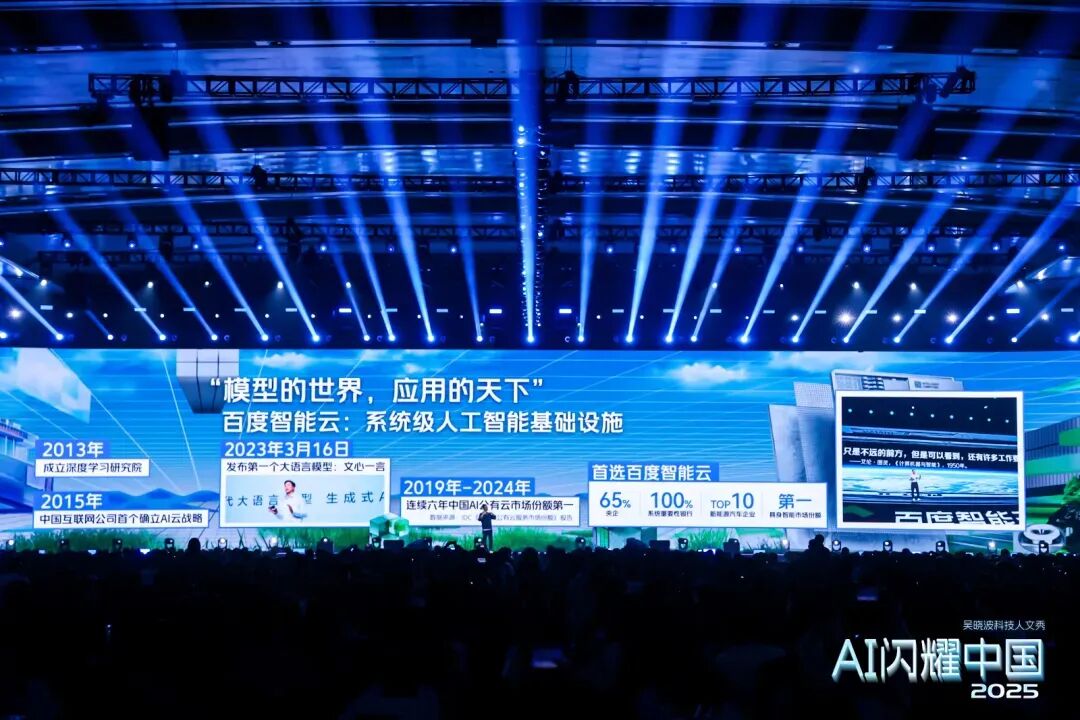
Core Insights - The article discusses the significant developments in the AI cloud computing market throughout 2025, highlighting the emergence of AI infrastructure as a crucial sector for companies like Baidu Smart Cloud [1][4][19]. Group 1: AI Cloud Market Dynamics - The AI cloud computing market experienced a transformative wave in 2025, characterized by a "price war" in the first half and a surge in demand for AI resources driven by the explosion of AI Agents in the second half [4][9]. - Major tech companies increased their capital expenditures significantly, with Amazon projecting $125 billion for AI and data center infrastructure, while Google raised its spending to between $91 billion and $93 billion [16]. - Baidu Smart Cloud led the market with 95 winning bids and a total bid amount of 710 million yuan, establishing itself as a dominant player in the AI cloud sector [11][14]. Group 2: AI Implementation and Adoption - Over 65% of central enterprises and 100% of systemically important banks in China have adopted large models using Baidu Smart Cloud, indicating a strong trend towards AI implementation across various industries [14]. - The year 2025 has been termed the "Year of the Agent," with numerous AI applications emerging in sectors such as finance, education, and entertainment, showcasing the widespread adoption of AI technologies [8][9]. Group 3: Competitive Landscape and Full-Stack Capabilities - The competition in the AI cloud market has evolved from price and performance comparisons to a focus on full-stack capabilities, where companies are expected to provide comprehensive AI solutions rather than just cloud resources [15][18]. - Baidu Smart Cloud's full-stack capabilities include advanced infrastructure such as Kunlun chips and a comprehensive AI development platform, positioning it as a leader in the AI cloud market [21][23]. - The article emphasizes that only a few players in China can achieve full-stack AI cloud capabilities, with Baidu being the most representative example [19][23].
Uber、Lyft宣布与百度达成合作 拟明年英国推Robotaxi试点
Ge Long Hui· 2025-12-31 01:40
Core Viewpoint - Uber and Lyft have announced a partnership with Baidu to launch a pilot program for autonomous taxis (Robotaxi) in the UK next year [1] Group 1: Company Initiatives - Uber plans to initiate a Robotaxi pilot project in London using Baidu's Apollo Go RT6 version, expected to start in the first half of next year and provide commercial services by the end of the year [1] - Lyft's CEO David Risher stated that the company will also utilize Apollo Go RT6 to launch several dozen taxis for testing in the UK next year, pending regulatory approval [1] Group 2: Industry Developments - The collaboration between Uber, Lyft, and Baidu signifies a growing trend in the autonomous vehicle sector, particularly in the ride-hailing industry [1] - The introduction of Robotaxi services in London represents a significant step towards the commercialization of autonomous driving technology in urban environments [1]


2025年汽车行业研究报告
艾瑞咨询· 2025-12-31 00:04
Core Insights - The automotive industry is undergoing significant transformation, with domestic brands emerging as the primary growth engine, and new energy technologies reshaping value rules and pricing strategies [1][2][4] Group 1: Domestic Brand Growth - Domestic brands have become the sole growth driver in the automotive market, with sales increasing by 20.3% year-on-year, translating to a net increase of 1.855 million vehicles, contributing to a 9.2% overall market growth [2][4] - The share of domestic brands in the market has risen significantly, with their market share increasing from 90% to 97% in the under 100,000 yuan segment [8] Group 2: Pricing and Value Restructuring - The application of new energy technologies has led to a redefinition of pricing standards, where product value now supersedes brand symbolism [4][6] - The competition landscape is shifting towards price tier management, with a focus on cost reduction and efficiency becoming a new operational challenge [9][8] Group 3: Advertising and Marketing Trends - Overall advertising investment in the automotive industry has decreased compared to the previous year, with a notable contraction in the number of advertisers [12][14] - The luxury segment (vehicles priced above 300,000 yuan) accounted for 41.3% of advertising investment, while the mainstream market (10,000-200,000 yuan) represented 38.5% [17] Group 4: AI and User Engagement - Baidu's automotive ecosystem is leveraging AI to enhance user experience and marketing workflows, with a 5.3% increase in automotive search volume and a 34.4% rise in user reading volume [25][21] - AI is transforming the search engine into an AI engine, reshaping user interaction and content consumption patterns [37][39] Group 5: User Behavior and Decision-Making - The average decision-making period for users has shortened, with a 37.5% increase in the number of models compared during the search process [48][53] - Users are increasingly favoring content that provides strong comparative references and purchase recommendations, indicating a shift towards more informed decision-making [53][48]