LI AUTO(LI)

Search documents
突发!理想基座模型一号位换帅、自驾产品负责人调整,詹锟接手基座模型
自动驾驶之心· 2026-01-15 02:55
Core Viewpoint - The article discusses recent organizational changes at Li Auto, focusing on the shift towards embodied intelligence and the integration of the VLA model for autonomous driving development [2][6]. Group 1: Organizational Changes - Li Auto is reallocating resources towards embodied intelligence as competition in automotive intelligence enters a "modeling" phase [2]. - Key personnel changes include Zhan Kun taking over the VLA integration and development work, reporting directly to the CTO, while Chen Wei, responsible for the LLM direction, is leaving the company [2][5]. - The internal restructuring reflects a preference for promoting from within, indicating strong confidence in the existing technical team [6]. Group 2: Technological Developments - Significant upgrades to the VLA model have been made in recent months, with high internal confidence in version 8.2 [6]. - The integration of robotics and autonomous driving is being coordinated under a larger embodied paradigm, with Shua Yifan now responsible for the autonomous driving product [4][5]. - The development of a new generation closed-loop system is being emphasized, combining base models, cloud, and vehicle-end technologies [8]. Group 3: Industry Trends - The trend towards integrated hardware and software solutions is expected to be a major industry focus by 2026 [10]. - The success of Horizon Robotics' HSD is noted as a contributing factor to the recent organizational adjustments at Li Auto [8].


理想调整基座模型业务:詹锟接手,VLA 研发整合
Xin Lang Cai Jing· 2026-01-15 02:34
Core Viewpoint - The appointment of Zhan Kun as the head of the foundational model business at Li Auto signifies a strategic shift in the company's approach to developing its VLA (Vision-Language-Action) foundational model, integrating technology teams to support autonomous driving, smart cockpit, and potential future robotics initiatives [1] Group 1 - Zhan Kun will oversee the development of the VLA foundational model and will integrate related technology research teams [1] - Zhan Kun's reporting structure has changed; he will now report to the CTO and head of the Systems and Computing Group, Xie Yan, instead of the Senior Vice President of Autonomous Driving R&D, Lang Xianpeng [1] - Zhan Kun will continue to be responsible for the engineering and platformization of the smart driving VLA model [1] Group 2 - The current head of the foundational model, Chen Wei, may join an entrepreneurial venture [1]
晚点独家丨理想调整基座模型业务:詹锟接手,VLA 研发整合
晚点LatePost· 2026-01-15 02:17
Core Insights - The article discusses the strategic shift at Li Auto, focusing on the integration of the VLA (Vision-Language-Action) model into its AI strategy, which aims to enhance the company's capabilities in autonomous driving and intelligent cockpit technologies [4][6]. Group 1: Leadership Changes and Organizational Structure - Jian Kun, a senior algorithm expert in autonomous driving, will take over the VLA model business, reporting directly to the CTO, Xie Yan, instead of the previous head of autonomous driving, Lang Xianpeng [4]. - The VLA model development was previously divided between two departments, with the language component led by Chen Wei and the vision and action components managed by the autonomous driving team [6]. - The VLA model has been elevated from a single project to a company-wide foundational model, indicating a clearer focus on embodied intelligence as a core part of Li Auto's AI strategy [6]. Group 2: VLA Model and Future Developments - The VLA model is designed to support embodied intelligence, with "V" representing perception, "L" for planning and decision-making, and "A" for action, applicable to both physical and digital realms [6]. - Li Auto plans to fully deploy the VLA driver model in its AD Max vehicles by September 2025, aiming for smoother longitudinal control and improved accuracy at complex intersections [8]. - The company intends to enhance language and behavioral interactions and adapt its self-developed M100 chip by 2026 [8]. Group 3: Talent Movement and Industry Context - Several technical talents have left Li Auto following the AI model boom, but some maintain close communication with the company and participate in industry sharing sessions [7]. - Chen Wei, the outgoing head of the VLA model, previously emphasized the importance of building a complete agent system centered around the VLA model, viewing all products as robotic entities [7].
车企自研、第三方合作“双轮驱动”,城市NOA规模化加速
Zhong Guo Jing Ji Wang· 2026-01-15 02:12
Core Insights - 2025 is identified as a critical year for the commercialization of urban NOA (Navigation Assisted Driving) in China, with a projected market scale growth [1] - The report indicates that from January to November 2025, the cumulative sales of passenger cars equipped with urban NOA reached 3.129 million units, with a penetration rate of 15.1%, an increase of 5.6 percentage points compared to the entire year of 2024 [1] Industry Background - NOA technology is seen as a key driver for smart connected vehicles, bridging advanced driver assistance and fully autonomous driving, which is crucial for enhancing user travel experience and asserting China's competitive voice in the global automotive industry [3] - The report highlights that among the passenger cars sold with urban NOA, domestic brands accounted for 2.5373 million units, representing 81.1% of the total, showcasing innovation and competitiveness in the smart connected vehicle sector [3] Market Dynamics - The current market for urban NOA is characterized by a dual-driven model of self-research by car manufacturers and collaboration with third-party suppliers [5] - Major players in self-research include Tesla, NIO, Xpeng, Li Auto, Xiaomi, and others, while approximately 29 brands collaborate with third-party suppliers [5] - The third-party supplier market is dominated by two key players, Momenta and Huawei, which together hold about 80% market share; Momenta's urban NOA installations reached 414,400 units, accounting for 61.06% of third-party suppliers, while Huawei's HI model accounted for 19.76% with 134,100 units [5] Technological Advancements - The rapid iteration of technology and market competition is driving systemic changes in smart driving technology, core architecture, and industrial ecology [9] - The report emphasizes that end-to-end large models are becoming the core engine for NOA technology iteration, facilitating a shift from modular architecture to integrated systems [10] - New energy vehicle manufacturers are building technological barriers through full-stack self-research, while traditional automakers are accelerating technology deployment through partnerships with third-party suppliers [10] Future Outlook - The report anticipates that by 2030, urban NOA will become a mainstream feature in both assisted and autonomous driving [10] - Recommendations for enhancing the high-quality development of NOA include improving top-level design, strengthening technological innovation, enhancing industry collaboration, and exploring global competitiveness for supply chain enterprises [11]


突发!美国白宫宣布对特定半导体等加征25%关税;大厂80亿资产遭侵吞?宝能董事长姚振华实名举报;梁文锋旗下幻方量化,去年收益率56.6%
雷峰网· 2026-01-15 00:35
Key Points - The U.S. White House announced a 25% tariff on certain imported semiconductors and related products starting January 15, 2026, following a previous statement by former President Trump regarding tariffs on chips and semiconductors [4][5] - Baoneng Group's chairman, Yao Zhenhua, accused local authorities of undervaluing assets of Qoros Auto, claiming a third-party evaluation valued the assets at approximately 8 billion yuan, while they were set to be auctioned at 1.5 billion yuan [7][8] - Ctrip Group is under investigation for alleged monopolistic practices by the State Administration for Market Regulation, with the company stating it will cooperate with the investigation [10] - RoboSense announced it expects to sell 303,000 units of its robotic lidar products in 2025, marking a 1141.8% year-on-year increase [13] - Liang Wenfeng's company, Huanfang Quantitative, achieved a 56.6% return in 2025, with assets exceeding 70 billion yuan [10][11] - Tesla will discontinue the one-time purchase option for its Full Self-Driving (FSD) software, transitioning to a subscription-only model starting February 14, 2026 [39][40] - The Chinese smartphone market saw Huawei leading in shipments with 46.7 million units, followed closely by Apple with 46.2 million units, while the overall market experienced a slight decline of 0.6% year-on-year [27][28] - Meta plans to double its production capacity for AI smart glasses to 20 million units by 2026, focusing on AI integration [46][47] - TSMC is reportedly planning to invest significantly in the U.S. by building at least five new semiconductor factories, despite facing high production costs compared to its Taiwan facilities [50]




纳指收跌1%,甲骨文、博通跌超4%
Mei Ri Jing Ji Xin Wen· 2026-01-15 00:10
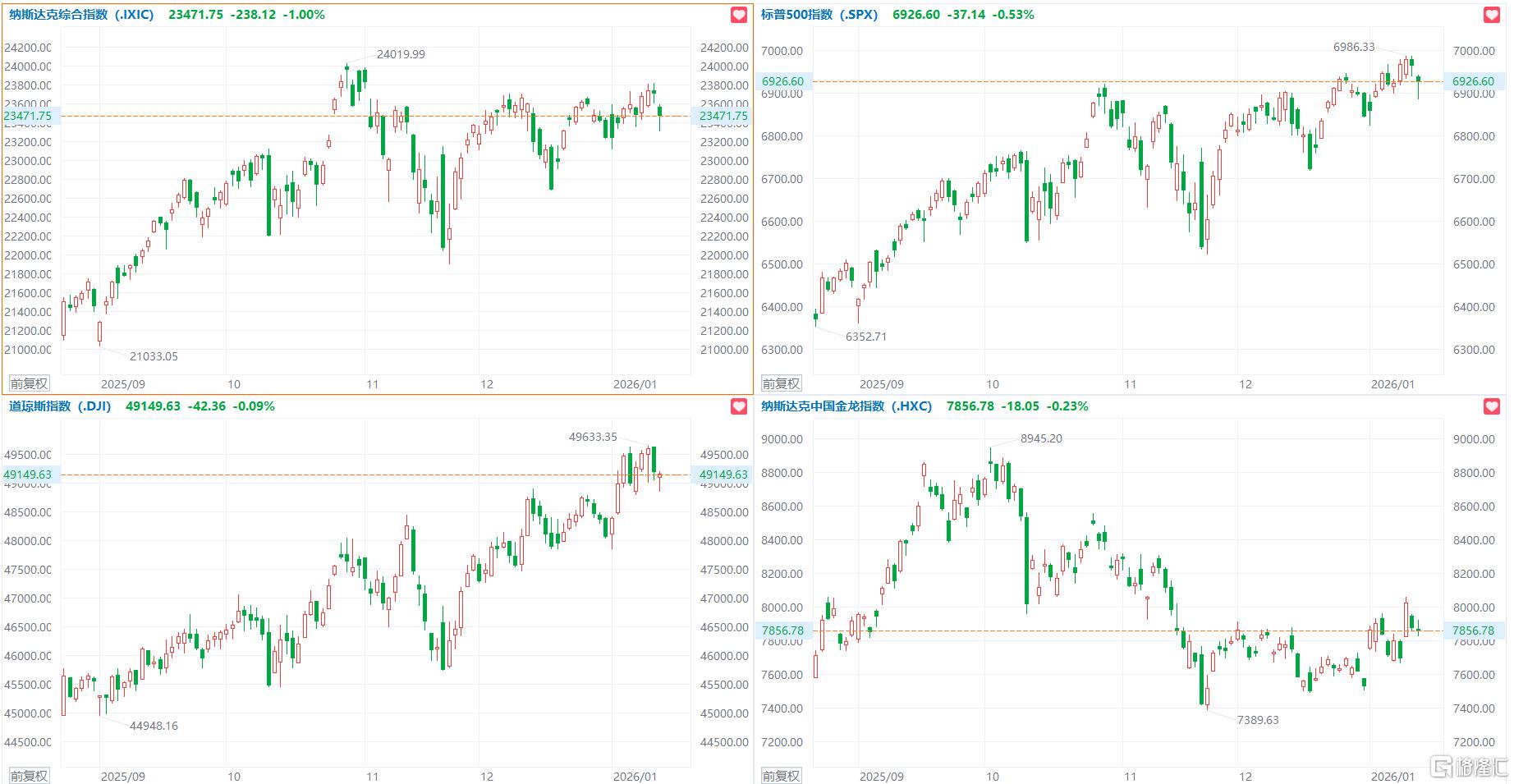
Market Overview - The three major U.S. stock indices closed lower, with the Dow Jones down 0.08%, the Nasdaq down 1.00%, and the S&P 500 down 0.53% [2] - Technology stocks experienced widespread declines, with Oracle and Broadcom falling over 4%, and Amazon, Microsoft, and Meta dropping over 2% [2] - Notably, Intel saw a contrary increase, rising over 3% [2] Chinese Stocks Performance - The Nasdaq Golden Dragon China Index decreased by 0.23%, with significant declines in several Chinese companies [2] - Ctrip fell over 17%, Pinduoduo dropped nearly 4%, and electric vehicle manufacturers such as Li Auto, NIO, and Xpeng, along with Bawang Tea, all declined over 2% [2] - In contrast, Bilibili experienced a rise of over 6% [2]


美股三大指数集体收跌,纳指跌1%,甲骨文、博通跌超4%
Ge Long Hui· 2026-01-14 23:51
Market Overview - The three major U.S. stock indices closed lower, with the Dow Jones down 0.08%, the Nasdaq down 1.00%, and the S&P 500 down 0.53% [1] - Technology stocks experienced widespread declines, with Oracle and Broadcom falling over 4%, and Amazon, Microsoft, and Meta dropping over 2% [1] - Notably, Intel saw a contrary increase, rising over 3% [1] Chinese Stocks Performance - The Nasdaq Golden Dragon China Index decreased by 0.23% [1] - Among popular Chinese stocks, Meituan fell approximately 4%, Pinduoduo dropped 3.9%, and Netease, Li Auto, NIO, and Xpeng all declined over 2% [1] - Conversely, Baidu rose by 0.8%, Tencent increased by 1%, and several companies including WeRide and Pony.ai saw gains of 1.3% and 1.8% respectively, while Alibaba increased by 1.9% [1]




汽车冲焊零部件核心供应商 理想汽车“小伙伴”今日上市 | 打新早知道
2 1 Shi Ji Jing Ji Bao Dao· 2026-01-14 23:10
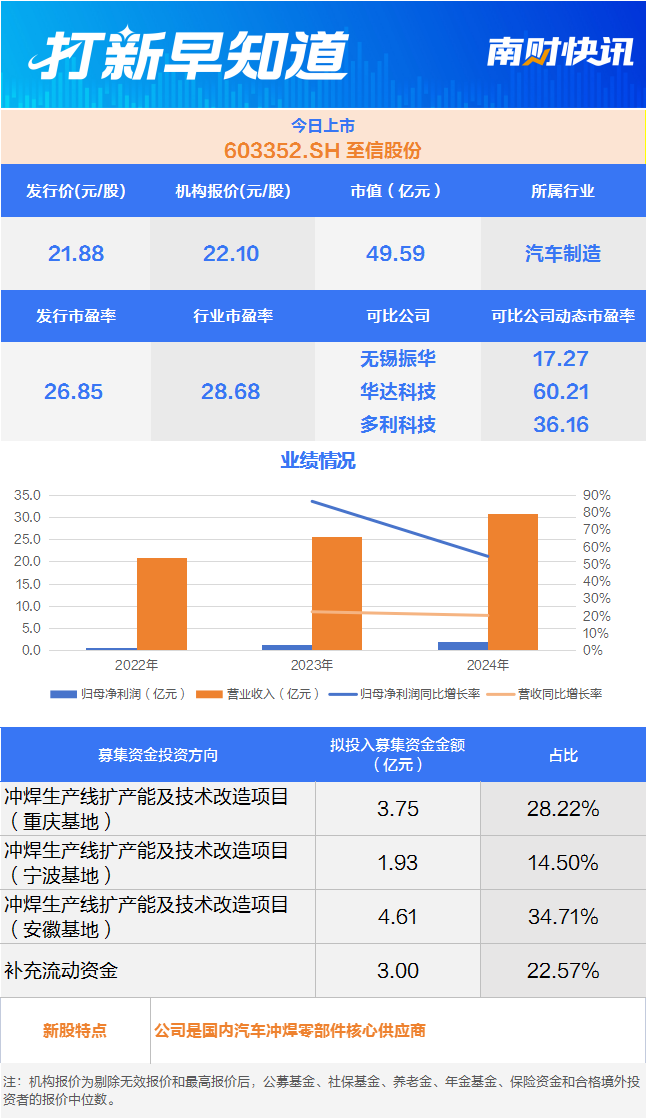
Group 1 - The core viewpoint of the article is the listing of Zhixin Co., Ltd. (603352.SH) on the Shanghai Stock Exchange, focusing on its business in automotive stamping parts and related molds [1][2]. - Zhixin Co., Ltd. was established in 1995 and is headquartered in Chongqing Liangjiang New Area, specializing in the development, processing, production, and sales of automotive stamping parts, including cold stamping parts, hot-formed parts, welding assemblies, and molds [1][2]. - The company has a market capitalization of 4.959 billion yuan and an issuance price of 21.88 yuan per share, with an issuance price-to-earnings ratio of 26.85, compared to the industry average of 28.68 [2]. Group 2 - The company plans to invest a total of 10.29 billion yuan in expanding production capacity and technological upgrades for its stamping production lines across various bases, including Chongqing, Ningbo, and Anhui [4]. - Zhixin Co., Ltd. has established itself as a significant player in the automotive parts sector in Southwest China, with a competitive edge in the market [8]. - The company is actively expanding its business in the new energy vehicle sector, collaborating with traditional clients like Changan Automobile and Geely, as well as new brands such as BYD and NIO [8]. Group 3 - The company has a high customer concentration risk, with sales to its top five customers accounting for 73.86%, 79.77%, 74.82%, and 68.00% of its revenue from 2022 to the first half of 2025 [9].
汽车冲焊零部件核心供应商,理想汽车“小伙伴”今日上市 | 打新早知道
2 1 Shi Ji Jing Ji Bao Dao· 2026-01-14 23:07
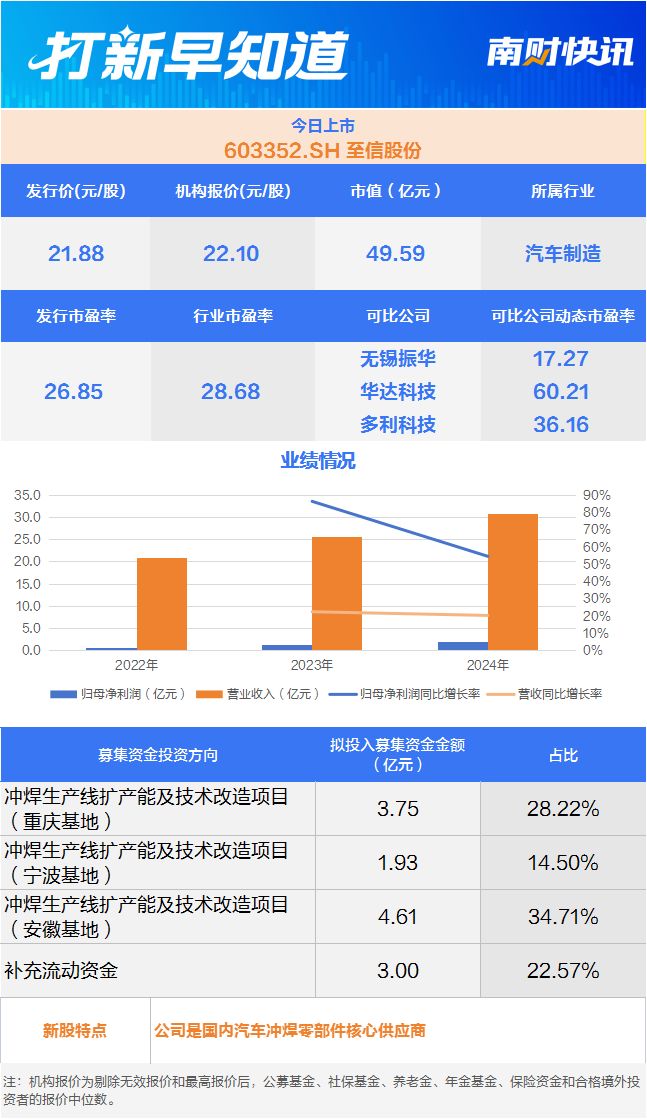
Core Viewpoint - Zhixin Co., Ltd. (603352.SH) has been listed on the Shanghai Stock Exchange, focusing on the development, processing, production, and sales of automotive stamping parts and related molds, with a significant market presence in the southwest region of China [1][4]. Company Overview - Established in 1995 and headquartered in Chongqing Liangjiang New Area, Zhixin Co., Ltd. specializes in cold stamping parts, hot-formed parts, welding assemblies, and molds [1]. - The company has become one of the larger private automotive parts manufacturers in southwest China, with a strong competitive position in the automotive stamping parts sector [4]. Financial Information - The initial public offering (IPO) price was set at 21.88 yuan per share, with an institutional offering price of 22.10 yuan per share, resulting in a market capitalization of 4.959 billion yuan [2]. - The company's earnings per share (EPS) is projected with a price-to-earnings (P/E) ratio of 26.85, compared to comparable companies such as Wuxi Zhenhua (17.27) and Huada Technology (60.21) [2]. Market Position and Growth - By mid-2025, Zhixin Co., Ltd. is expected to capture market shares of 6.21%, 4.85%, and 4.59% in cabin, side, and floor products, respectively [4]. - The company has actively expanded into the new energy vehicle (NEV) sector, collaborating with traditional clients like Changan Automobile and Geely, as well as new brands such as BYD and NIO [4]. Client Concentration Risk - The company faces a significant client concentration risk, with sales to its top five customers amounting to 1.544 billion yuan, 2.045 billion yuan, 2.310 billion yuan, and 1.091 billion yuan from 2022 to the first half of 2025, representing 73.86%, 79.77%, 74.82%, and 68.00% of total revenue, respectively [5].
“活着就有机会”,冬天里的造车新势力
汽车商业评论· 2026-01-14 23:07
Core Viewpoint - The article discusses the recent milestones achieved by Chinese electric vehicle manufacturers NIO, Xpeng, and Leap Motor, highlighting their growth and strategic directions in the evolving automotive market, particularly in the context of the 2026 automotive landscape [3][5][8]. Group 1: Milestones and Achievements - NIO reached a significant milestone of producing 1 million vehicles on January 6, 2026, marking a critical point in its growth trajectory [8][12]. - Xpeng and Leap Motor also achieved the 1 million vehicle production mark in late 2025, with Xpeng hitting this milestone on November 21, 2025, and Leap Motor on September 25, 2025 [11][12]. - The time taken for each company to reach 1 million vehicles varied, with NIO taking approximately 7 years and 8 months, while Leap Motor achieved it in about 6 years [12]. Group 2: Strategic Directions - NIO's focus for 2026 includes launching larger, high-margin vehicles, with a goal of achieving profitability [13][27]. - Xpeng is expanding its range of extended-range vehicles, with plans for multiple new models, indicating a shift in strategy to meet market demands [15][30]. - Leap Motor aims for aggressive growth, setting a sales target of 1 million vehicles for 2026 and aspiring to reach an annual sales volume of over 4 million vehicles in the next decade [32]. Group 3: Market Context and Competition - The article notes that the competition among the new energy vehicle manufacturers has intensified, with each company striving to establish a strong market presence [7][19]. - Leap Motor emerged as the top seller among new energy vehicle manufacturers in 2025, delivering 596,555 vehicles, a 103% increase year-on-year [19][21]. - Xpeng and NIO also reported significant growth, with Xpeng delivering 429,445 vehicles (up 126%) and NIO delivering 326,028 vehicles (up 46.9%) [21]. Group 4: Future Outlook - Industry leaders express cautious optimism for 2026, with NIO's management indicating a focus on steady growth rather than ambitious targets [27][28]. - Xpeng's CEO emphasizes the importance of maintaining a balanced approach while capitalizing on global market opportunities [30]. - Leap Motor's CEO envisions a future where multiple Chinese manufacturers achieve significant sales volumes, potentially capturing a large share of the global automotive market [32].