
万华化学

Search documents
天然气、硝酸等涨幅居前,建议关注进口替代、纯内需、高股息等方向
Huaxin Securities· 2025-11-10 13:28
Investment Rating - The report maintains a recommendation for investment in sectors focusing on domestic demand, high dividends, and import substitution [1]. Core Viewpoints - The report highlights that the chemical industry is currently experiencing a mixed performance, with some products seeing significant price increases while others are declining. It emphasizes the importance of focusing on sectors like glyphosate, fertilizers, and high-dividend assets amid a backdrop of fluctuating oil prices and uncertain international conditions [6][23]. - The report suggests that the international oil price is expected to stabilize around $65 per barrel, influenced by rising U.S. oil inventories and geopolitical uncertainties [6][24]. Summary by Relevant Sections Chemical Industry Investment Suggestions - The report recommends focusing on sectors likely to enter a growth cycle, such as glyphosate, which is showing signs of recovery with decreasing inventory and rising prices [23]. - It also suggests selecting stocks with strong competitive positions and growth potential, particularly in the lubricant additives and coal-to-olefins sectors [23]. - The report highlights the importance of domestic demand in the chemical fertilizer sector, particularly nitrogen and phosphate fertilizers, which are expected to maintain stable demand [23]. Price Movements of Chemical Products - Significant price increases were noted for natural gas (up 30.25%), nitric acid (up 20.59%), and liquid chlorine (up 10.27%) [20][21]. - Conversely, products like ammonium chloride and butadiene experienced substantial declines, with drops of -13.33% and -12.66% respectively [20][21]. Market Trends and Analysis - The report indicates that the chemical industry is currently in a weak overall performance phase, with mixed results across different sub-sectors due to past capacity expansions and weak demand [21][23]. - It emphasizes the need to pay attention to high-quality assets in the oil sector, particularly state-owned enterprises like Sinopec, which are expected to benefit from lower raw material costs due to declining oil prices [23].






逆势新高,资金大举入场
3 6 Ke· 2025-11-10 12:31
Core Viewpoint - The traditional sectors such as food and beverage, tourism, chemicals, and energy are experiencing a strong rebound in the A-share market, contrasting with the significant pullback in popular technology growth sectors. The Chemical 50 ETF (516120) has seen a 2.08% increase today, marking a four-day winning streak and a year-to-date gain of 35.01%, leading among similar indices [1][3][4]. Group 1: Market Performance - The chemical sector, one of the most adjusted industries over the past three years, is recovering alongside the A-share market's rise, with both performance and valuation improving in the first three quarters of the year [3][4]. - The recent market dynamics reflect a shift from event-driven trading in technology sectors to a focus on fundamental performance and valuations in traditional industries [4]. - The "white liquor stocks" have surged nearly 4.7%, with notable gains from second-tier brands and leading brands like Kweichow Moutai and Wuliangye [4]. Group 2: Economic Indicators - The overall surge in the consumer sector is attributed to three main favorable factors: the Ministry of Finance's report on consumption policies, positive signals from macroeconomic data, and the upcoming significant closure of Hainan Island [7][8]. - The CPI data shows a month-on-month increase of 0.2% and a year-on-year increase of 0.2%, indicating a gradual improvement in the traditional industry's profitability environment [8]. Group 3: Chemical Sector Insights - The chemical sector related to lithium batteries has seen significant gains, with the phosphate chemical sector rising by 2.48% and fluorochemical by 1.83% [9]. - The explosive growth in the new energy vehicle and energy storage sectors has driven a surge in lithium battery demand, with domestic sales of new energy vehicles reaching 987,000 units in October, a year-on-year increase of 35.2% [9][10]. - The prices of key materials for lithium batteries, such as lithium carbonate, have been steadily rising, with futures prices increasing by 7.36% recently [10][13]. Group 4: Financial Performance - The basic chemical industry achieved total revenue of 171.01 billion yuan in the first three quarters of 2025, a year-on-year increase of 3.79%, with net profit rising by 10.56% [15][18]. - The overall gross margin and return on equity in the chemical sector have seen slight increases compared to last year, indicating a positive trend in financial performance [17]. Group 5: Investment Trends - The chemical sector is experiencing a significant influx of capital, with net inflows of 225.15 billion yuan into the chemical raw materials sector over the past five days, reflecting strong market interest [20][21]. - The Chemical 50 ETF (516120) has seen a remarkable increase in shares, up 394.59% this year, indicating strong investor interest in the sector [22][23].


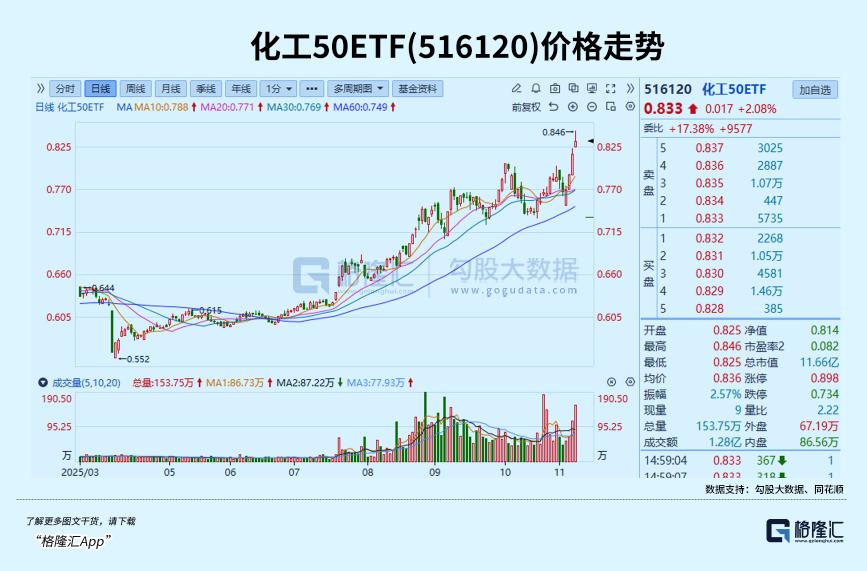
逆势新高!资金大举入场!
Ge Long Hui· 2025-11-10 11:31
Core Viewpoint - The A-share market is experiencing a significant divergence, with traditional sectors like food and beverage, tourism, chemicals, and energy showing strong gains while technology growth sectors are undergoing corrections [1][5]. Group 1: Traditional Industry Recovery - Traditional industries are collectively rebounding, reflecting a shift in market logic from event-driven trading to performance and valuation-driven trading [5]. - The chemical sector, which has seen deep adjustments over the past three years, is recovering alongside the broader market, with performance and valuation improvements noted in the first three quarters of the year [3][4]. Group 2: Catalysts for Growth - The overall rise in the consumer sector is attributed to three main catalysts: the continuation of consumption-boosting fiscal policies, positive macroeconomic signals such as CPI increases, and the upcoming significant trade facilitation in Hainan [8]. - The chemical industry is benefiting from improved macroeconomic data, with rising CPI and PPI indicating a better profit environment for traditional industries [9]. Group 3: Chemical Sector Performance - The chemical sector has seen a notable increase in prices for key raw materials, driven by surging demand in the lithium battery and energy storage sectors [10][13]. - The prices of various chemical products have risen significantly, with lithium carbonate futures experiencing a strong increase of 7.36% recently [10][14]. Group 4: Financial Metrics and Trends - The basic chemical industry reported a total revenue of 1710.073 billion yuan in the first three quarters of 2025, marking a year-on-year increase of 3.79%, with net profits rising by 10.56% [15][18]. - The overall gross margin and return on equity in the chemical sector have shown slight increases compared to the previous year, indicating a positive trend in financial performance [17]. Group 5: Investment Trends - The chemical sector is attracting significant capital inflows, with major funds and institutions increasing their positions in leading stocks, reflecting a strong market interest [20][22]. - The Chemical 50 ETF has seen a substantial increase in shares, indicating heightened investor interest in the sector, particularly in core areas of the chemical industry [22][24].

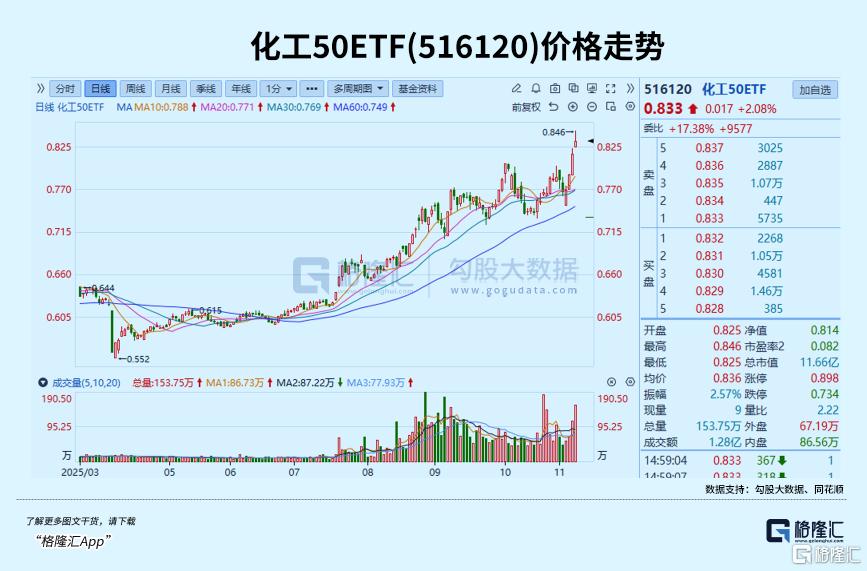
逆势新高!资金大举入场!
格隆汇APP· 2025-11-10 11:29
Core Viewpoint - The A-share market is experiencing a significant divergence, with traditional sectors like food and beverage, tourism, chemicals, and energy showing strong performance, while technology growth sectors are undergoing a substantial correction [1][6]. Group 1: Market Performance - On November 10, the Shanghai Composite Index rose by 0.53%, while the ChiNext Index fell by 0.92% [1]. - The Chemical 50 ETF (516120) increased by 2.08%, marking a four-day winning streak and a year-to-date gain of 35.01%, leading among similar indices [1][3]. Group 2: Industry Recovery - The chemical sector, one of the most adjusted industries over the past three years, is witnessing a recovery in both performance and valuation as the A-share market rises [3][18]. - Positive macroeconomic signals, such as CPI and PPI increases, indicate an improving profitability environment for traditional industries, including chemicals [10][18]. Group 3: Catalysts for Growth - The overall rise in the consumer sector is attributed to three main catalysts: continued fiscal policies to boost consumption, positive basic economic signals, and the upcoming significant closure of Hainan Island, which is expected to accelerate economic development [9][8]. - The demand for lithium batteries and energy storage is surging, driven by the explosive growth in the new energy vehicle sector, with domestic sales of new energy vehicles reaching 987,000 units in October, a year-on-year increase of 35.2% [11][10]. Group 4: Price Increases in Chemical Products - Since October, various chemical products have begun to rise in price, with lithium hexafluorophosphate increasing by 13.02% since the beginning of the month, and other related materials also seeing significant price hikes [14][16]. - The chemical price index has risen by 40.24% since the beginning of the year, indicating a recovery from a deep adjustment phase [18]. Group 5: Financial Performance - In the first three quarters of 2025, the basic chemical industry achieved total revenue of 1.71 trillion yuan, a year-on-year increase of 3.79%, and a net profit of 104.48 billion yuan, up 10.56% [21][20]. - The operating cash flow for the basic chemical industry increased by 22.26% year-on-year, reflecting strong financial health [20][21]. Group 6: Investment Trends - The chemical sector is attracting significant capital inflows, with the Chemical Raw Materials Index seeing a net inflow of 225.15 billion yuan over the past five days, indicating strong market interest [24][23]. - The Chemical 50 ETF has seen a substantial increase in shares, with a 394.59% rise in new shares issued this year, reflecting growing investor interest in the sector [25][26].


价值投资的对立面不是“小登科技”
点拾投资· 2025-11-10 11:00
Core Viewpoint - The article discusses the relationship between value investing and technology investment, emphasizing that they are not opposites. Value investors can participate in the benefits of the AI era by applying their investment principles to technology sectors [1][20]. Group 1: Value Investing Principles - Value investing is defined as earning returns from the long-term cash flows of companies, without being restricted to specific industries [1][20]. - The core of value investing is to avoid permanent loss of capital, and careful evaluation may lead to missed opportunities, but value investors can still act decisively when confident [2][20]. - Value investors like Tian Yu focus on long holding periods, high concentration in a few stocks, and the importance of a company's competitive advantages [1][2]. Group 2: Technology Investment Insights - Tian Yu has been researching AI and its implications for value assessment early on, indicating that value assessment does not differentiate between emerging and traditional industries [2][4]. - The evaluation framework for technology companies includes understanding demand limits, assessable business models, and identifiable competitive advantages [4][6]. - The semiconductor industry, particularly wafer foundries, is analyzed through a physical perspective, highlighting the challenges and opportunities in advanced process technologies [5][10]. Group 3: Market Dynamics and Investment Strategy - The demand for AI has increased the value of competitive advantages in technology sectors, as performance differences become more significant [6][10]. - Tian Yu's investment strategy involves a dynamic view of future cash flows rather than static earnings, allowing for investments in companies that may not currently be profitable but have strong long-term potential [7][8]. - The article highlights the importance of understanding the underlying business models and competitive dynamics in technology sectors, which can be complex and require specialized knowledge [6][11]. Group 4: Portfolio Management - Tian Yu maintains a concentrated portfolio with a high percentage of top holdings, reflecting a strategy of focusing on quality investments [16][17]. - The portfolio is diversified across different sectors, including technology and chemicals, to mitigate systemic risks while maintaining a focus on companies with strong supply-side competitive advantages [17][18]. - The article emphasizes that value investing is not limited to traditional industries and can adapt to modern technological advancements, allowing investors to benefit from current market trends [20][22].

合成橡胶:震荡偏弱
Ning Zheng Qi Huo· 2025-11-10 10:09
1. Report Industry Investment Rating - The investment rating for the synthetic rubber industry is "Oscillating Weakly" [2] 2. Core Viewpoints of the Report - The synthetic rubber market is expected to remain weak due to supply pressure from domestic raw material production increases and lackluster demand. Tire companies face shipment pressure, with under - performing foreign trade orders. In November, some companies plan to reduce production or conduct maintenance, which will limit the overall capacity utilization rate. Key factors to track include the bottoming point and timing of butadiene prices, the price spread between natural and synthetic rubber, and the performance of natural rubber after the harvest season [2][28] 3. Summary by Directory Chapter 1: Market Review - The synthetic rubber market showed a weak trend. The 01 contract opened at 11,125 yuan/ton in October, reached a high of 11,285 yuan/ton, a low of 10,175 yuan/ton, and closed at 10,550 yuan/ton, with a monthly decline of 560 yuan or 5.04% [3] Chapter 2: Analysis of Price - Influencing Factors 2.1 Butadiene Capacity Expansion - From 2021 - 2025, China's butadiene capacity has been increasing year - by - year, with the growth rate first decreasing and then increasing. In 2025, domestic capacity expansion is concentrated, with the capacity growth rate reaching 14.16%, a five - year high. By the end of 2025, China's total butadiene capacity will reach 7.577 million tons/year [5][6] 2.2 High Butadiene Operating Rate and Import Growth - In October, butadiene production was 457,300 tons, a year - on - year increase of 14.49%. From January to October, production was 4.472 million tons, a year - on - year increase of 15.46%. The capacity utilization rate in October was 66.48%. In September 2025, butadiene imports were 56,000 tons, a year - on - year increase of 25.09%. From January to September, imports were 393,600 tons, a year - on - year increase of 54.8% [7][8][10] 2.3 High Growth in Butadiene Imports - The import volume of butadiene has been growing rapidly, as shown by the data from January - September and September 2025 [10] 2.4 Pressure on Butadiene Prices and Profits - The total inventory of domestic butadiene samples fluctuated slightly this period, with a 1.67% week - on - week decrease. The theoretical production profits of different butadiene production processes decreased. As of October 29, the weekly average profit of the C4 extraction process was 1,265 yuan/ton, a decrease of 578 yuan/ton from the previous period [13] 2.5 Sufficient Synthetic Rubber Capacity Expansion and High Production Growth - New synthetic rubber capacities have been put into production, such as Yulong Petrochemical's 150,000 tons/year nickel/neodymium - based cis - butadiene rubber capacity and Zhejiang Petrochemical's 100,000 - ton device. In September, synthetic rubber production was 774,000 tons, a year - on - year increase of 13.50%. From January to September, production was 6.616 million tons, a year - on - year increase of 11.20% [15][17] 2.6 High Growth in Imports of Natural and Synthetic Rubber (Including Latex) - In September 2025, China imported 742,000 tons of natural and synthetic rubber (including latex), a 20.8% increase compared to the same period in 2024. From January to September, imports were 6.115 million tons, a 19.2% increase year - on - year [19] 2.7 Tire Production Growth Slows - In September 2025, China's rubber tire outer - tube production was 103.487 million pieces, a year - on - year increase of 0.2%. From January to September, production was 899.386 million pieces, a 1.5% increase year - on - year, far lower than the 9.59% growth rate in 2024. The export market growth rate declined, and the replacement market performed poorly [22][25] 2.8 Tire Inventory Needs to be Reduced and Operating Rate Increase is Limited - The capacity utilization rate of China's semi - steel tire sample enterprises was 72.12%, a week - on - week decrease of 0.72 percentage points. The capacity utilization rate of full - steel tire sample enterprises was 65.34%, a week - on - week decrease of 0.53 percentage points. Tire finished - product inventory needs to be reduced [26] 2.9 Weak Supply - Demand Drivers and Synchronous Decline of Raw Materials and Cis - Butadiene Rubber - Due to weak supply - demand drivers, raw materials and cis - butadiene rubber prices declined synchronously, with butadiene having a larger and faster decline [27] Chapter 3: Market Outlook and Investment Strategy - The synthetic rubber market is expected to remain weak due to supply pressure on the raw material side and lack of demand - side support. Key factors to monitor include the bottoming point and timing of butadiene prices, the price spread between natural and synthetic rubber, and the performance of natural rubber after the harvest season [28]

化学制品板块11月10日涨1.66%,东岳硅材领涨,主力资金净流出15.74亿元
Zheng Xing Xing Ye Ri Bao· 2025-11-10 08:42
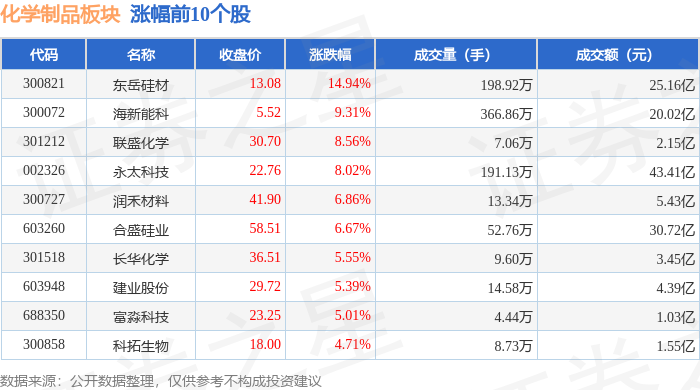
Core Insights - The chemical products sector experienced a rise of 1.66% on November 10, with Dongyue Silicon Materials leading the gains [1] - The Shanghai Composite Index closed at 4018.6, up 0.53%, while the Shenzhen Component Index closed at 13427.61, up 0.18% [1] Stock Performance - Dongyue Silicon Materials (300821) closed at 13.08, with a significant increase of 14.94% and a trading volume of 1.9892 million shares, amounting to a transaction value of 2.516 billion [1] - Other notable gainers included: - Moxin Energy Technology (300072) at 5.52, up 9.31% [1] - Liansheng Chemical (301212) at 30.70, up 8.56% [1] - Yongtai Technology (002326) at 22.76, up 8.02% [1] Fund Flow Analysis - The chemical products sector saw a net outflow of 1.574 billion from institutional investors, while retail investors contributed a net inflow of 1.424 billion [2] - Key stocks with significant fund flows included: - Wanhua Chemical (600309) with a net inflow of 2.30 billion from institutional investors [3] - Juhua Co. (600160) with a net inflow of 1.14 billion from institutional investors [3] - Yahua Group (002497) with a net inflow of 773.36 million from institutional investors [3]
涨停潮,A股盘中集体拉升
Zheng Quan Shi Bao· 2025-11-10 08:41
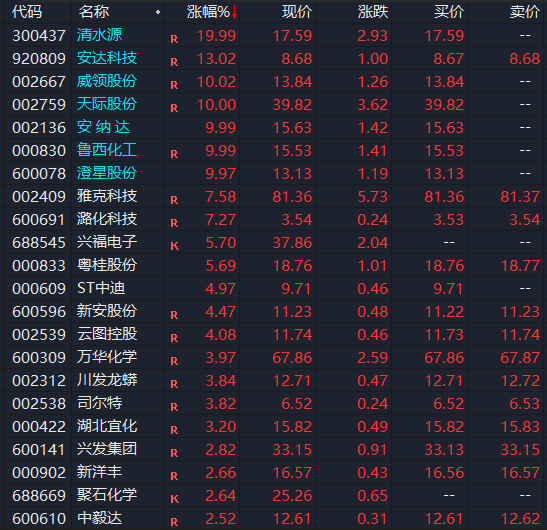
Group 1: Phosphate Chemical Sector - The phosphate chemical sector has seen a significant surge, with stocks like Chengxing Co. and Qingshuiyuan achieving three consecutive trading days of涨停 (limit up) [1][3] - Lithium hexafluorophosphate, a key material for electrolytes, has experienced a price increase of over 100% in the past month, reaching 124,000 yuan per ton as of November 10 [4][5] - The supply-demand situation for iron phosphate is tightening, with the domestic operating rate reaching 81.6%, up 30.1 percentage points year-on-year, and inventory decreasing to approximately 24,500 tons [6] Group 2: Coal Sector - Coal stocks have become active again, with Antai Group hitting涨停 and other companies like Xinji Energy and Zhongmei Energy also seeing gains [1][8] - The coal supply-demand balance is expected to remain tight, with both thermal coal and coking coal prices having upward elasticity due to strong demand and limited supply growth [8][9] - The coal mining industry is characterized by high asset quality and cash flow among leading companies, presenting a favorable investment opportunity [8][9]


东海研究 | 石油石化:原油供给宽松,叠加需求淡季,油价测试底部
Xin Lang Cai Jing· 2025-11-10 08:31
Core Viewpoint - The report discusses the factors influencing oil prices, including geopolitical tensions, OPEC production decisions, and global economic conditions, predicting fluctuations in oil prices between $50 and $70 per barrel in Q4 2025, with a potential drop to $40 in 2026 [16][11][8]. Oil Price Influencing Factors - Geopolitical conflicts and OPEC+ production cuts have supported oil prices, while U.S. shale production and global demand fluctuations have created volatility [8][11]. - OPEC+ is expected to increase production by 137,000 barrels per day in November, with further increases planned for December [28][16]. - The U.S. commercial crude oil inventory as of October 24, 2025, was 416 million barrels, down 9.54 million barrels year-on-year, and 5.91% lower than the five-year average [17][24]. Global Oil Supply and Demand - Global oil demand is projected to grow, with the EIA forecasting an increase of 300,000 barrels per day in 2025 and 240,000 barrels per day in 2026 [7][16]. - The IEA predicts a similar growth trajectory for global oil and liquid production, with increases of 270,000 and 130,000 barrels per day respectively [7][16]. - China's industrial crude oil processing volume increased by 6.8% year-on-year in September 2025, indicating a recovery in demand [24]. Economic Indicators - The U.S. 10-year Treasury yield was approximately 4.11% as of October 31, 2025, with expectations of a potential interest rate cut by the Federal Reserve in December [16][34]. - The manufacturing PMI in China for October 2025 was reported at 49.0%, indicating a contraction in the manufacturing sector [47]. Inventory and Production Insights - As of October 31, 2025, the number of active oil rigs in the U.S. was 546, a decrease of 39 rigs year-on-year, with production remaining stable at 13.64 million barrels per day [24][17]. - Global oil inventories are expected to increase, with a projected average growth of 2.6 million barrels per day in Q4 2025 [16]. Price Predictions and Market Outlook - The Brent crude oil price is expected to average $69 per barrel in 2025, with a decline to $52 per barrel in 2026 [16][7]. - The report highlights the potential for oil prices to test lower levels due to increasing supply and geopolitical uncertainties [16][11].

聚烯烃周报:产业链累库,弱势震荡-20251110
Zhong Hui Qi Huo· 2025-11-10 08:00
1. Report Industry Investment Rating No relevant content provided. 2. Core Viewpoints of the Report - For plastics, the supply is under pressure, the market may continue to seek a bottom weakly. With the restart of devices and the increase in domestic and foreign supplies, while the demand side has insufficient restocking power and high inventory, the fundamentals have no upward driving force, so the previous short positions should be held, and short - selling on the short - term single side is not recommended [4]. - For PP, the weak fundamentals remain unchanged, and it will run weakly following the cost side. With high inventory, increasing supply, and weakening demand, there is a high de - stocking pressure in the future [9]. 3. Summary According to Relevant Catalogs 3.1 Plastic and PP Market Review - **Plastic**: This week, plastics opened high and closed low, with two consecutive negative weekly lines. It opened 16 points higher at 6915 on Monday, reached a weekly high of 6939, then fell unilaterally to a weekly low of 6745 on Thursday morning, and finally closed at 6802, down 97 points or 1.4% from last week's closing. The weekly amplitude was 194 points [3][13]. - **PP**: This week, PP also opened high and closed low, with two consecutive negative weekly lines. It opened 10 points higher at 6600 on Monday, reached a weekly high of 6629, then fell unilaterally to a weekly low of 6415 on Thursday morning, and finally closed at 6464, down 126 points or 1.9% from last week's closing. The weekly amplitude was 214 points [8][16]. 3.2 Valuation - For plastics, the basis and monthly spread are running weakly, and the single is at a year - on - year high. The oil - based valuation is at a medium level, and LLDPE is at a medium position in the same period [19][26][28]. - For PP, the valuation is moderately high [34]. 3.3 Production Capacity and Supply - **Production Capacity**: In 2025, the planned PE production capacity is 613 tons (year - on - year + 17%), with 463 tons already put into production from January to October and 120 tons remaining. The planned PP production capacity is 511 tons (year - on - year + 11%), with 456 tons already put into production from January to October and 45 tons remaining. In 2026, it is still in a high - production - capacity cycle, and the probability of PP device delay is relatively high, so the opportunity to shrink LP05 can be concerned [35]. - **Supply**: In November, the start - up rate shows an upward trend. The domestic polyethylene supply is increasing, with some devices planned to restart and new devices continuously ramping up production. This week, the PE output is 66 tons, with a capacity utilization rate of 83%. Since mid - September, the output has rebounded from a low level. The PP output this week is 80 tons, with a capacity utilization rate of 78%, and it is expected to continue to increase next week [36][38][46]. 3.4 Import and Export - **PE**: From January to September 2025, the cumulative import volume is 1000 tons (year - on - year - 1.8%), and the import volume in September is 102 tons (year - on - year - 10%, month - on - month + 8%). The export volumes in October and November are expected to be 110 and 116 tons respectively [41]. - **PP**: From January to September 2025, the cumulative import volume is 246 tons (year - on - year - 9%), and the import volume in September is 29 tons (year - on - year - 3%, month - on - month + 17%). The cumulative export volume is 234 tons (year - on - year + 28%), and the export volume in September is 24 tons (year - on - year + 22%, month - on - month - 14%) [49][52]. 3.5 Demand - **PE**: This week, the downstream capacity utilization rate of PE is 45%, showing a continuous two - week decline. From January to September 2025, the apparent consumption of PE is 3358 tons (cumulative year - on - year + 11%) [55]. - **PP**: This week, the downstream start - up rate of PP is 53%, showing a continuous three - week increase. From January to September 2025, the apparent consumption of PP is 2981 tons (year - on - year + 13%), with a year - on - year increase of 12% in September [58]. - **Plastic Products**: From January to September 2025, the cumulative export value of plastic and products is 831 billion US dollars (year - on - year + 1.2%), and the export value in September is 119 billion US dollars (year - on - year + 5.1%) [60]. 3.6 Inventory - **Upstream Inventory**: As of November 7, the polyolefin petrochemical inventory of the two major oil companies is 66.5 tons (month - on - month - 2.5, year - on - year + 1%). This week, the PE enterprise inventory is 49 tons (week - on - week + 7.4), reaching a high level in the same period of previous years, and the PP enterprise inventory is 60 tons (week - on - week + 0.5), showing a slight inventory accumulation [63]. - **Social Inventory**: This week, the PE social inventory is 51 tons (week - on - week - 2), with different performances among varieties. The PP trader inventory is 23 tons (week - on - week + 1.5), remaining at a high level in the same period [66]. 3.7 Strategies - **Plastic**: For the single - side strategy, due to weak fundamentals, hold short positions, and focus on the range of [6700 - 6900] for L2601. For the arbitrage strategy, hold the long LP01 arbitrage. For the hedging strategy, industrial customers can choose the opportunity to sell - hedge [5][7]. - **PP**: For the single - side strategy, due to weak supply and demand, hold short positions, and focus on the range of [6400 - 6600] for PP2601. For the arbitrage strategy, short the MTO (05) profit when the price is high. For the hedging strategy, upstream and traders can sell - hedge when the price is high [10].