
万华化学

Search documents
基金老将,买胜宏科技、新易盛狂赚20亿
Sou Hu Cai Jing· 2025-11-03 05:46
Core Viewpoint - The performance of large-scale funds has shown significant divergence this year, with the top fund outperforming the bottom fund by nearly 70% [6]. Fund Performance Summary - The top-performing fund, Ruiyuan Growth Value A, has achieved a return of 68.09% year-to-date as of October 30 [2][4]. - Other notable funds include: - Dongfang New Energy Theme Fund with a return of 60.5% [3]. - Galaxy Innovation Growth A with a return of 57.91% [3]. - Zhongou Times Pioneer A with a return of 53.05% [3]. - Several funds have underperformed, with eight funds yielding less than 30%, including: - E Fund Consumer Industry with a return of -1.2% [5]. - Invesco Great Wall Emerging Growth A with a return of only 0.46% [5]. Ruiyuan Growth Value A Fund Analysis - Ruiyuan Growth Value A was established on March 26, 2019, and is managed by well-known fund managers Fu Pengbo and Zhu Lin [8]. - The fund experienced a significant decline of 53% over four years after an initial surge of 114% [11][12]. - The fund's strategy shifted towards technology stocks, leading to a substantial recovery with a 90.61% increase from April 8 to October 29, 2025 [13]. Investment Strategy and Holdings - The fund's recent performance is attributed to a focus on technology stocks, including PCB manufacturers and AI chip leaders [13][16]. - Key holdings include: - Xinyisheng, with a market value of approximately 2.2 billion yuan [14]. - Ningde Times, valued at around 2.15 billion yuan [14]. - Tencent Holdings, valued at about 2.08 billion yuan [14]. - The fund manager has expressed confidence in the growth potential of high-tech sectors, citing the rapid development of AI and automotive electronics [16]. Future Outlook - The fund manager anticipates a shift from broad market rallies to a focus on individual stock fundamentals due to high valuations across most sectors [16][17]. - There is a strategy in place to reduce holdings in overvalued stocks, indicating a cautious approach moving forward [17].


“国家队”资金 最新持仓曝光
Zhong Guo Zheng Quan Bao· 2025-11-03 04:54
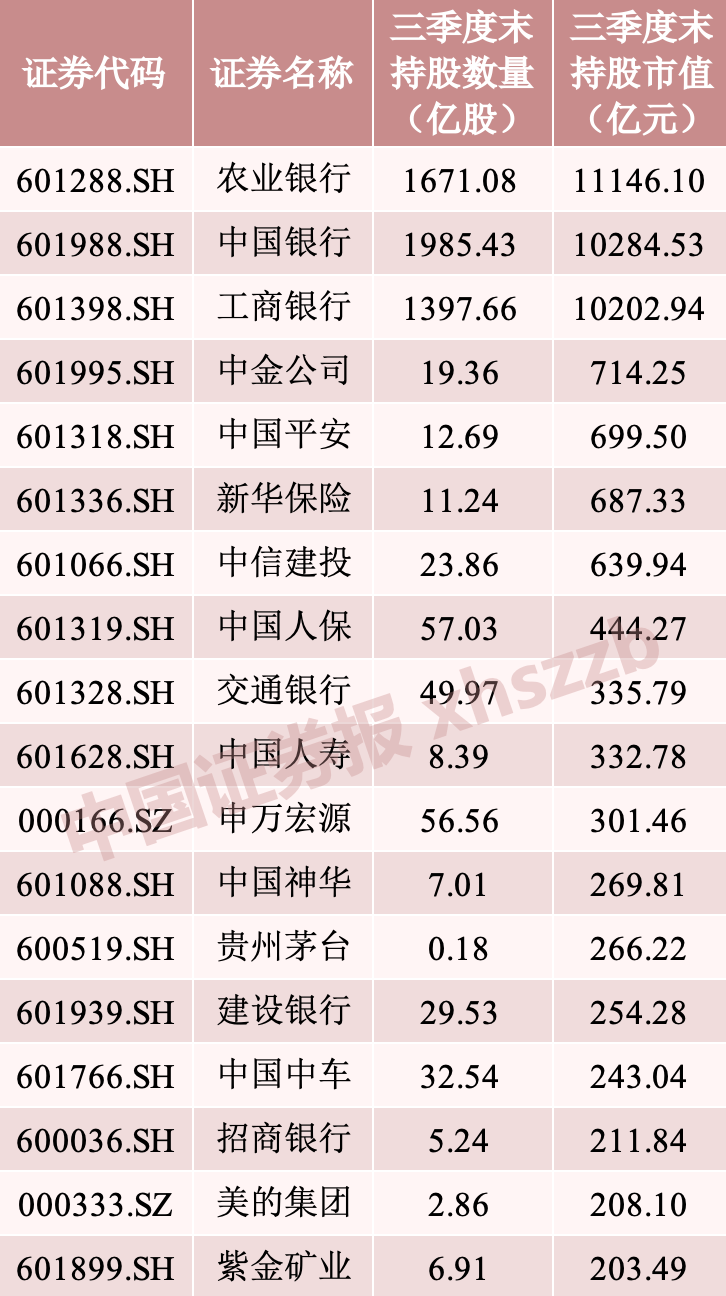
Core Insights - "National Team" funds held over 800 A-shares as of the end of Q3, with significant investments in Agricultural Bank of China, Bank of China, and Industrial and Commercial Bank of China, each exceeding 1 trillion yuan in market value [1][3] - The "National Team" increased holdings in sectors such as insurance, resources, consumer goods, electronics, and telecommunications, with some stocks doubling in price during Q3 [1][8] - The funds exited from the top ten shareholders in sectors like securities, banking, electricity, real estate, and pharmaceuticals [1][8] Holdings Overview - As of the end of Q3, "National Team" funds were among the top ten shareholders in over 800 A-share companies, with 33 companies having a market value exceeding 10 billion yuan [3] - The top three holdings by market value were Agricultural Bank of China (1.11 trillion yuan), Bank of China (1.03 trillion yuan), and Industrial and Commercial Bank of China (1.02 trillion yuan) [3][5] - Other significant holdings included China International Capital Corporation, China Ping An, and New China Life Insurance, each with market values above 60 billion yuan [3][5] Sector Adjustments - In Q3, "National Team" funds entered the top ten shareholders of nearly 180 new listed companies, with notable investments in Mindray Medical, Giant Network, and Unisoc, each exceeding 1 billion yuan in market value [6] - The funds increased their positions in financial stocks such as New China Life Insurance and China Pacific Insurance, as well as resource stocks like Baosteel and China Aluminum [8] - Growth-oriented stocks that saw increased holdings included electronic companies like Pengding Holdings and Sanan Optoelectronics, with some stocks like Deep South Circuit and EVE Energy experiencing price increases around 100% [9]






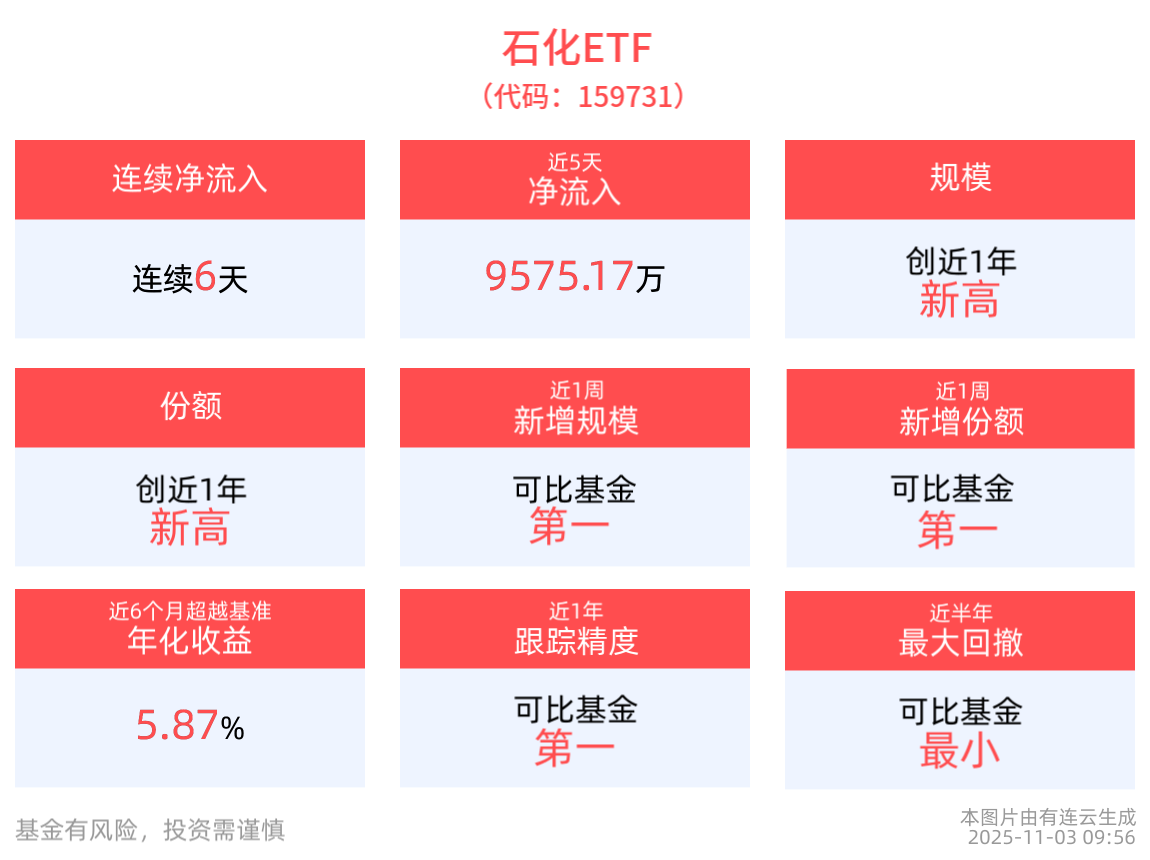
石化ETF(159731)连续6天净流入,规模创近1年新高
Sou Hu Cai Jing· 2025-11-03 02:16
Core Insights - The China Petroleum Industry Index has seen a slight increase of 0.08% as of November 3, 2025, with leading stocks including China National Offshore Oil Corporation (CNOOC), China National Petroleum Corporation (CNPC), and Baofeng Energy [1] - The Petrochemical ETF (159731) has risen by 0.25%, reaching a latest price of 0.8 yuan, and has experienced a total net inflow of 100 million yuan over the past six days [1] - The Petrochemical ETF has achieved a new high in both share count (186 million shares) and total scale (149 million yuan) over the past year [1] Performance Metrics - As of October 31, 2025, the Petrochemical ETF has recorded a net value increase of 23.51% over the past six months [3] - The ETF's highest single-month return since inception is 15.86%, with the longest consecutive monthly gain being six months and an average monthly return of 5.06% [3] - The ETF has outperformed its benchmark with an annualized excess return of 5.87% over the last six months [3] Risk and Tracking - The maximum drawdown for the Petrochemical ETF in the last six months is 6.47%, which is relatively low compared to a benchmark drawdown of 0.14% [3] - The ETF has the highest tracking accuracy among comparable funds, with a tracking error of 0.037% over the past year [3] - The top ten weighted stocks in the China Petroleum Industry Index account for 56.05% of the index, with major companies including Wanhua Chemical, CNPC, and Sinopec [3]
趋势研判!2025年中国生物基产品行业政策、产业链、市场规模、竞争格局及开发方向分析:市场规模有望达到231亿美元,约占全球52.73%[图]
Chan Ye Xin Xi Wang· 2025-11-03 01:27
Core Viewpoint - Biobased products are considered "carbon neutral" and are essential for addressing climate change by replacing fossil-based products, especially in the context of dwindling petrochemical resources and global warming [1][5]. Market Overview - The global biobased products market is projected to grow from $22.8 billion in 2020 to $42.1 billion in 2024, with China leading the market at $19.9 billion, accounting for 47.27% of the global share [5][6]. - By 2025, the global market is expected to reach $48.1 billion, with China's share increasing to $23.1 billion, or 48.02% [5][6]. - The market is anticipated to exceed $80 billion within the next five years [5]. Industry Definition and Classification - Biobased products are defined as products derived from biomass (including plants, animals, and microorganisms) or biological processes (such as fermentation) [2]. - They can be categorized into two main types: biobased energy (solid, liquid, and gas forms) and biobased materials (macromolecular and small molecular biochemicals) [2][3]. Industry Chain - The biobased products industry chain includes upstream raw materials (crops, plant waste, and biomass), midstream processing companies that convert these materials into biobased products, and downstream applications in various sectors such as packaging, textiles, and transportation [6][7]. Policy Environment - The Chinese government has implemented various policies to promote the development of biobased products, emphasizing the reduction of fossil resource dependency and the promotion of a green economy [8][9]. Competitive Landscape - The biobased products industry in China is characterized by a diverse and tiered competitive landscape, with key players including Fengbei Bio, Kaisa Bio, Jindan Technology, and Wanhua Chemical [10][11]. - Notable companies like Anhui Huaheng Bio and Shanghai Kaisa Bio have established themselves as leaders in the biobased product sector, focusing on research, production, and sales of biobased materials [11][12]. Development Directions - The increasing global energy demand and the finite nature of conventional energy resources highlight the significance of biobased products as a sustainable alternative [13][14]. - The industry is seen as a crucial pathway towards achieving carbon neutrality, with ongoing technological advancements and cost reductions enhancing market prospects [15].


1300余项创新产品与解决方案亮相智能建造产业博览会
Zhong Guo Jing Ji Wang· 2025-11-02 23:51
Group 1 - The 2025 International (Wuhan) Smart Construction Industry Expo, themed "Developing Industrial Internet and Building 'Good Houses'", was held, attracting nearly 200 units from 13 countries and showcasing over 1,300 innovative smart construction products and solutions, with a total signing amount exceeding 5 billion yuan [1][2] - The exhibition covered an area of approximately 20,000 square meters, featuring seven major exhibition areas, including "Good Products, Good Design, Good Materials, Good Construction, Good Operation, Good Urban Areas, and Internationalization" [1] - The event included participation from renowned universities and major Chinese enterprises, covering the entire smart construction industry chain [1][2] Group 2 - The launch of the Hubei Province Smart Construction Industry Internet Platform was announced, emphasizing innovation as the primary driving force for the development of smart construction [1][2] - The conference highlighted the importance of integrating modern industrial concepts and promoting high-quality building products through policy guidance and innovation in design, construction processes, materials, and operational models [2] - Key industry leaders shared insights on the development path of the smart construction industry, advocating for user-centered innovation and the integration of various chains to drive industry transformation [2][3] Group 3 - A product launch event showcased ten innovative products, including an AI sharing platform and self-repairing concrete materials, with collaborative research agreements signed among 20 enterprises and academic institutions [3] - The total signing amount for innovative product agreements reached over 260 million yuan, indicating strong market interest and investment in smart construction technologies [3]
十五五规划建议点评:供需优化,向新变强
Yin He Zheng Quan· 2025-11-02 14:52
Investment Rating - The report maintains a "Recommended" rating for the basic chemical industry [1] Core Insights - The "14th Five-Year Plan" has highlighted the need to eliminate "involution" in the chemical industry, which has led to a significant decline in profitability during the previous five years. The new plan aims to create a healthy competitive environment that promotes sustainable high-quality development in the chemical sector [4] - The report emphasizes the transition of China's chemical industry towards a global leadership position, with expectations for continued quality upgrades and increased competitiveness on the global stage during the "15th Five-Year Plan" [4] - The focus on new demands and the development of strategic emerging industries such as new energy and new materials is expected to drive innovation and growth in the chemical sector [4] - The report identifies green and low-carbon initiatives as long-term development directions for the chemical industry, with a focus on clean energy utilization and carbon emission control [4] - Investment opportunities are highlighted in five key areas: improvement of profitability through reduced competition, sustained demand in specific chemical sectors, opportunities in high-end chemical materials, green energy chemical opportunities, and the expansion of Chinese companies in the global market [4][5] Summary by Sections - **Investment Opportunities**: The report suggests focusing on sectors such as polyester filament, organic silicon, pesticides, and spandex, with specific companies like New Fengming, Tongkun, and Jiangshan being highlighted [4] - **Supply and Demand Dynamics**: The report indicates that the supply-demand structure in the chemical industry will be optimized during the "15th Five-Year Plan," presenting a critical historical opportunity for growth [4] - **Emerging Technologies**: The report points out that new technologies related to biomanufacturing and hydrogen energy will be crucial for the development of high-end chemical materials [4]
铬盐价格上行,关注振华股份:基础化工行业周报-20251102
Guohai Securities· 2025-11-02 13:03
Investment Rating - The report maintains a "Recommended" rating for the chemical industry [1] Core Views - The chemical industry is expected to experience a recovery in demand, driven by government policies aimed at stabilizing growth and transforming the industry [4][5] - The demand for chromium salts is anticipated to rise significantly due to increased orders for gas turbines and commercial aircraft engines in Europe and the US, leading to a projected supply gap by 2028 [8] - The report highlights the potential for high dividend yields and improved cash flow for leading companies in the chemical sector as capacity expansion slows down globally [4] Summary by Sections Industry Performance - The basic chemical sector has shown a performance increase of 23.0% over the past 12 months, outperforming the CSI 300 index [2] Government Initiatives - A joint announcement from seven government departments outlines a plan for stable growth in the petrochemical industry, targeting an average annual growth of over 5% in value-added output from 2025 to 2026 [5] Market Dynamics - The price of chromium salts is on the rise, with significant increases noted in the prices of chromium metal and chromium oxide in October 2025 [8][18] - The report indicates that the chemical industry is transitioning from a "cash-consuming" phase to a "cash-generating" phase, with a focus on high-quality development and innovation [4][5] Investment Opportunities - Key investment opportunities identified include low-cost expansion in leading companies, improving market conditions for chromium salts, and high dividend yields from state-owned enterprises [9][10][11]






能源化工合成橡胶周度报告-20251102
Guo Tai Jun An Qi Huo· 2025-11-02 12:23
1. Report Industry Investment Rating No relevant content provided. 2. Core Viewpoints of the Report - The synthetic rubber market is expected to experience weak performance due to cost reduction. Short - term butadiene weakness will drive down the dynamic valuation range of butadiene rubber. In the context of a neutral fundamental pattern of butadiene rubber itself, the futures price reflects the expectation of profit contraction. With weakened macro - drivers and a weak industrial chain fundamental background, butadiene rubber will operate weakly. The main focus in the future is whether the supply - demand pattern of butadiene rubber will improve periodically under the background of concentrated maintenance in November and a high NR - BR spread [4]. - In the medium to long term, the supply pressure of butadiene remains the main contradiction, and the fundamental pressure is still relatively large. It is expected to maintain a weak pattern in the medium term [5]. 3. Summaries Based on Relevant Catalogs 3.1 This Week's Viewpoints on Synthetic Rubber Supply - During the current cycle, the butadiene rubber plants of Yangzi Petrochemical, Zhejiang Petrochemical, and Sichuan Shun were shut down for maintenance, while the butadiene plant of Qilu Petrochemical restarted. The production capacity utilization rate decreased significantly. The output of high - cis butadiene rubber was 26,900 tons, a decrease of 1,900 tons compared to last week, a month - on - month decrease of 6.64%. The production capacity utilization rate was 66.95%, a month - on - month decrease of 4.76 percentage points. In the next cycle, it is expected that Zhenhua New Materials' plant will be shut down for maintenance, and there are expectations of maintenance for Maoming's butadiene plant and Zhejiang Transfar's 120,000 - ton/year rare - earth butadiene rubber plant in November. The short - term shortage of some spot goods is expected to continue [4]. Demand - In terms of rigid demand, the production capacity utilization rate of tire sample enterprises decreased slightly during the cycle. It is expected that the production capacity utilization rate of sample enterprises will fluctuate slightly in the next cycle, with most enterprises maintaining their current production schedules. The resumption of production by maintenance enterprises will drive up the production capacity utilization rate. However, in November, the overall shipment pressure remains high, and foreign trade orders are under - performing. Some enterprises have plans to reduce production or conduct maintenance, which will limit the increase in the overall production capacity utilization rate. In terms of substitution demand, the spread between the NR - BR main contracts remains at a high level, and the substitution demand remains high. Therefore, the overall demand side of butadiene rubber maintains a high year - on - year growth rate [4]. Inventory - As of October 29, 2025, the domestic inventory of butadiene rubber was 30,900 tons, a decrease of 2,300 tons compared to the previous cycle, a month - on - month decrease of 6.90%. During this cycle, some production enterprises shut down or prepared to shut down, and the significant weakening of the raw material side led to the gradual restoration of production profits, driving some private production enterprises to sell at low prices. At the same time, affected by the approaching month - end and the weak future market, the negotiation focus of the spot side gradually declined, and the inventories of sample production enterprises and sample trading enterprises both decreased significantly [4]. Valuation - Currently, the static valuation range of butadiene rubber futures fundamentals is 9,500 - 11,000 yuan/ton. Due to the increase in butadiene arrivals, the dynamic valuation is expected to gradually decline. The upper limit of the fundamental valuation for the market is around 11,000 - 11,100 yuan/ton. When the main BR2512 contract has a premium of about 100 yuan/ton over the market price in Shandong (with a single - month holding cost of around 90 yuan/ton), there is a risk - free arbitrage opportunity for holding spot goods and short - selling in the futures market, and hedging positions will gradually increase the pressure on the upper space of the market. The theoretical lower limit of the valuation range is 9,500 - 9,700 yuan/ton, as butadiene is expected to support the butadiene rubber price from the cost side. The theoretical full cost of butadiene rubber is mainly estimated based on butadiene price * 1.02+(auxiliary agents + labor)=7,500 * 1.02 + 2,500≈10,200 yuan/ton. In terms of actual full cost, the fixed costs range from 1,500 to 2,500 yuan/ton depending on the factory, so the minimum cost is about 9,500 yuan/ton (7,500 * 1.02+1,800). Due to the significant contradictions in the short - term butadiene industry and the continuous decline of the price center, the lower limit of the dynamic valuation range of butadiene rubber continues to decline [4]. Strategy - Unilateral: Adopt a medium - term strategy of shorting on rallies without chasing short positions. The market may show wide - range fluctuations due to capital games during the day. The upper pressure level is 11,000 - 11,100 yuan/ton (mainly following the trend of butadiene rubber spot), and the lower support level is 9,500 - 9,700 yuan/ton (anchored by the butadiene cost of butadiene rubber) [4]. - Cross - variety: The spread between NR - BR is at a high valuation, but due to insufficient drivers, it is expected to fluctuate [4]. 3.2 This Week's Viewpoints on Butadiene Supply - During the current cycle (October 24 - 30, 2025), the estimated weekly output of Chinese butadiene industry sample enterprises was 104,200 tons, an increase of 2,200 tons compared to the previous cycle, a month - on - month increase of 2.19%. During the week, plants such as Nanjing Chengzhi, Sierbang, Yanshan Petrochemical, Jilin Petrochemical Phase I, Guangzhou Petrochemical, Zhenhai Refining & Chemical, Fushun Petrochemical, and Sichuan Petrochemical remained shut down, but the output of Beifang Huajin, Qilu Petrochemical, and a Shandong petrochemical plant No. 2 resumed, leading to an increase in production. Next week, it is expected that the weekly output of Chinese butadiene sample enterprises will be about 106,300 tons, continuing to increase compared to the current cycle. Sichuan Petrochemical is expected to restart after a short - term shutdown, and attention should be paid to the output of Fushun Petrochemical and the commissioning of new production capacity in South China. It is expected that domestic production will increase slightly [5]. Demand - In the synthetic rubber sector, the medium - term operating rates of butadiene rubber and styrene - butadiene rubber remain high, and the demand for butadiene maintains a high year - on - year level. In the short term, with the maintenance of butadiene rubber plants in November, it is expected that the rigid demand for butadiene in synthetic rubber will decrease. In the ABS sector, due to high inventory pressure, the demand for butadiene is expected to remain at a constant level with limited incremental demand. In the SBS sector, the operating rate increased slightly, and the demand for butadiene remained at a rigid level with little change [5]. Inventory - During the current cycle (October 23 - 29, 2025), the total inventory of domestic butadiene samples increased, with a month - on - month increase of 14.23% compared to last week. Among them, the inventory of sample enterprises increased slightly by 1.47% compared to last week, and the enterprise inventory fluctuated slightly due to limited plant changes during the cycle. The inventory of sample ports increased significantly by 30.08% compared to last week. There were imported vessels arriving at ports during the week, and the rapid decline in the market led to slow turnover of some trade volumes, resulting in a significant increase in inventory. At the same time, the market expects that the import volume will still be abundant from October to November, so attention should be paid to inventory changes [5]. Viewpoint - In the medium to long term, the supply pressure of butadiene remains the main contradiction, and the fundamental pressure is still relatively large. It is expected to maintain a weak pattern in the medium term [5]. 3.3 Butadiene Fundamentals - Butadiene is currently in the stage of supply - demand pricing and has a low correlation with the raw material side [8]. - To support the expansion of downstream industries such as ABS, SBS, styrene - butadiene, and butadiene rubber, butadiene production has been continuously expanding, and the expansion speed and amplitude are slightly faster than those of downstream industrial chains at certain stages [10]. - From 2024 to 2025, many enterprises have added or are expected to add butadiene production capacity, with a total of 380,000 tons added in 2024 and 860,000 tons expected to be added in 2025 [12]. 3.4 Synthetic Rubber Fundamentals Supply of Butadiene Rubber - The production and operating rates of butadiene rubber plants of various enterprises have changed. Some plants are shut down for maintenance, some are restarted, and some have future maintenance plans. For example, Yangzi Petrochemical's plant is shut down for maintenance, Qilu Petrochemical's plant has restarted, and Maoming Petrochemical plans to shut down for maintenance in November [41]. - The theoretical production cost, profit, and gross profit margin of butadiene rubber have shown certain trends over time [42][43][44]. - The import and export volumes of butadiene rubber have their own characteristics over different time periods, and the weekly apparent demand also shows corresponding changes [45][46][47]. - The inventory of butadiene rubber includes enterprise inventory, futures inventory, and trader inventory, and these inventories have changed over time [49][50][51]. Demand for Butadiene Rubber - The demand for butadiene rubber is mainly related to the tire industry. The inventory and operating rates of full - steel and semi - steel tires in Shandong Province have shown certain trends over time [53][54].
权益ETF系列:市场短期有调整需求,但空间相对有限
Soochow Securities· 2025-11-02 09:03
Market Overview - The A-share market is expected to experience short-term adjustments, but the adjustment space is relatively limited[2] - The macro timing model for November 2025 has a score of -5, indicating a high probability of adjustment for the entire A-index[19] Index Performance - The top three broad-based indices from October 27 to October 31, 2025, were: North China 50 (7.52%), CSI 1000 (1.18%), and CSI 500 (1.00%); the bottom three were: Sci-Tech 50 (-3.19%), Shanghai 50 (-1.12%), and Sci-Tech Composite Index (-0.67%)[9] - The top three style indices were: ChiNext Small Cap (1.47%), Small Cap Growth (1.45%), and Small Cap Value (1.37%); the bottom three were: Financial (CITIC Style) (-1.33%), ChiNext Large Cap (-0.73%), and Large Cap Growth (-0.40%)[10] Sector Analysis - The top three sectors in the Shenwan first-level industry index were: Power Equipment (4.29%), Nonferrous Metals (2.56%), and Steel (2.55%); the bottom three were: Communication (-3.59%), Beauty Care (-2.21%), and Banking (-2.16%)[13] Fund Allocation Recommendations - It is recommended to adopt a balanced ETF allocation strategy due to the anticipated wide fluctuations in the market and the continuation of structural trends[4] - The risk factors include potential model failure based on historical data, macroeconomic underperformance, and unexpected macro events[4]
基础化工周报:VA、VE价格止跌反弹-20251102
Soochow Securities· 2025-11-02 08:46
Investment Rating - The industry investment rating is "Overweight," indicating an expected outperformance of the industry index relative to the benchmark by more than 5% in the next six months [74]. Core Insights - The report highlights a rebound in prices for Vitamin A (VA) and Vitamin E (VE), with VA priced at 62.6 yuan/kg and VE at 49.5 yuan/kg, reflecting increases of 0.9 yuan/kg and 6.0 yuan/kg respectively [10][59][63]. - The polyurethane sector shows varied price movements, with pure MDI averaging 18,414 yuan/ton (+214 yuan/ton), polymer MDI at 14,293 yuan/ton (+7 yuan/ton), and TDI at 13,341 yuan/ton (-108 yuan/ton) [2][16]. - In the oil, coal, and gas olefin sector, ethane and propane prices are reported at 1,296 yuan/ton (-68 yuan/ton) and 3,934 yuan/ton (+157 yuan/ton) respectively, while the average price of polypropylene is 6,600 yuan/ton (-80 yuan/ton) [2][24]. - The coal chemical sector shows mixed results, with synthetic ammonia at 2,151 yuan/ton (-3 yuan/ton) and urea at 1,615 yuan/ton (+19 yuan/ton) [2][40]. - Key listed companies in the chemical sector include Wanhua Chemical, Baofeng Energy, Satellite Chemical, Hualu Hengsheng, New Chemical, and Andisu [2]. Summary by Sections 1. Polyurethane Sector - Average prices for pure MDI, polymer MDI, and TDI are 18,414 yuan/ton, 14,293 yuan/ton, and 13,341 yuan/ton respectively, with corresponding gross profits of 5,400 yuan/ton, 2,279 yuan/ton, and 1,918 yuan/ton [2][16]. 2. Oil, Coal, and Gas Olefin Sector - Ethane and propane average prices are 1,296 yuan/ton and 3,934 yuan/ton, with theoretical profits for polyethylene production from ethane at 947 yuan/ton [2][24][33]. 3. Coal Chemical Sector - Average prices for synthetic ammonia, urea, DMF, and acetic acid are 2,151 yuan/ton, 1,615 yuan/ton, 3,943 yuan/ton, and 2,330 yuan/ton respectively, with gross profits of 121 yuan/ton, -69 yuan/ton, -151 yuan/ton, and 80 yuan/ton [2][40][44]. 4. Animal Nutrition Sector - VA and VE prices are reported at 62.6 yuan/kg and 49.5 yuan/kg, with recent increases noted [10][59][63].


