
小米

Search documents
星源卓镁20250919
2025-09-22 01:00
Summary of Key Points from the Conference Call of Xingyuan Zhuomei Company Overview - Xingyuan Zhuomei is one of the few high-tech enterprises in China capable of developing a full range of magnesium alloy precision castings, with products supplied to renowned brands such as Tesla, BMW, and Audi [2][4] - The company was established in 2003 and went public on the A-share Growth Enterprise Market in December 2022 [4] Industry Insights - The magnesium alloy market is positioned to gradually replace aluminum in various applications, particularly in the robotics sector, as the industry develops [2][5] - Magnesium alloys are currently less utilized in robotics due to manufacturers' uncertainty regarding material performance, but they have significant potential for future adoption [2][7] - In the automotive sector, magnesium alloys are already widely used in interior components and can replace aluminum parts, leading to cost reductions [11] Financial Performance - The company's overall gross margin is maintained at around 30%, benefiting from high-value parts and export products [3][21] - The completion of a recent capital increase is expected to significantly enhance production capacity, with a new factory projected to be operational by Q1 2026 [3][22] Product Development and Supply Chain - The company is currently focused on producing motor housings for clients such as Zhiji, Jike, and BYD, with a customization design cycle of 6 months to 1 year [14][15] - The time from order receipt to product delivery and testing typically spans 6 months to 1 year, with ongoing efforts to improve yield rates [15][16] Market Trends and Future Outlook - Magnesium alloy applications are expanding beyond high-end vehicles to more affordable models, with brands like Geely and BYD beginning to adopt these materials [17] - The company anticipates significant growth in demand for motor housings and display backs in the next two years, indicating a robust market outlook [18][28] - Future large parts such as door inner panels and seat frames are expected to penetrate the market rapidly, with existing orders already in place [19][20] Technological Advancements - The company is utilizing a 6,000-ton magnesium alloy die-casting machine, which is among the largest in the industry, to produce large automotive components [25] - Semi-solid forming technology is being adopted in the new factory, which is expected to improve surface quality and internal structure [26] Challenges and Considerations - The development of thick base plates faces challenges related to material strength, but advancements in alloy formulations are expected to address these issues in the near future [12] - The company is also exploring opportunities in the two-wheeled electric vehicle market, although it is still in the early stages of development [27] Competitive Landscape - The company is accelerating its layout in Thailand to recover lost orders in North America due to trade tensions, which is expected to contribute to growth [30] - The magnesium supply landscape is stable, with major producers like Baowu Group holding a significant market share, ensuring that production demands can be met even with increased demand [29] Conclusion - Xingyuan Zhuomei is well-positioned for growth in the magnesium alloy market, with a strong focus on innovation, expanding applications, and a solid financial foundation. The company is optimistic about future demand and technological advancements that will enhance its competitive edge in the industry [28]
“一页纸”吃透人形机器人产业链
Hu Xiu· 2025-09-21 23:51
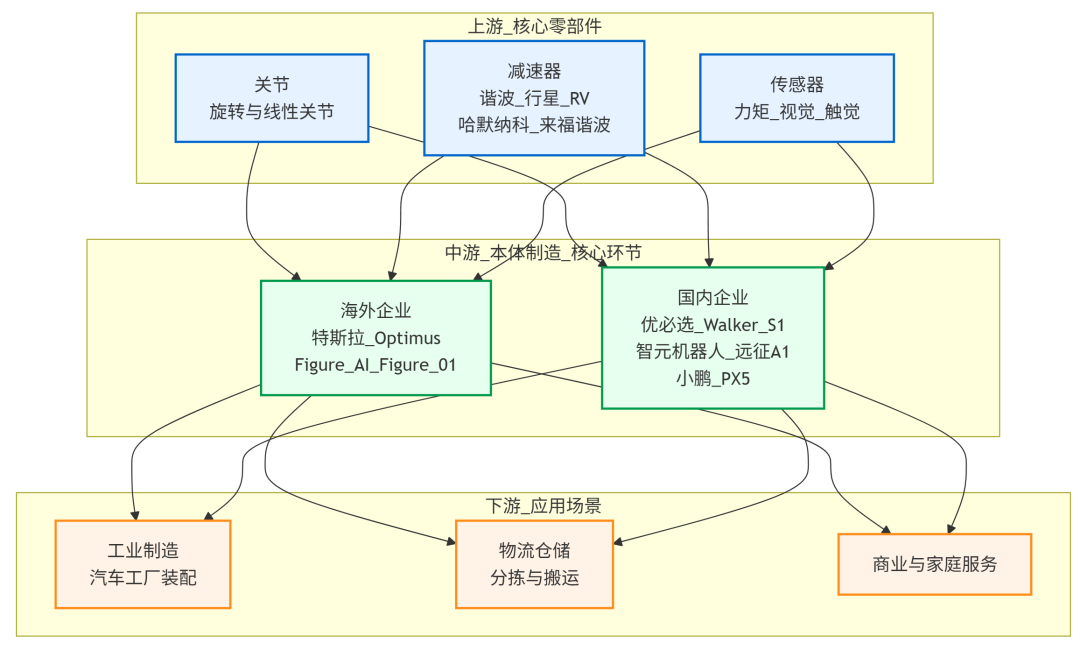
Core Insights - The humanoid robot industry is at a critical turning point, transitioning from research and demonstration to mass production [2][3] - The period of 2025-2026 is seen as a key window for scaling and accelerating commercialization, driven by leading companies like Tesla and Figure AI [3][4] Industry Overview - The humanoid robot sector is characterized by simultaneous advancements in "hardware cost reduction" and "software intelligence enhancement," primarily driven by B-end industrial applications, especially in automotive manufacturing [4][5] - Global competition is forming, with overseas giants like Tesla and Figure AI leading in AI algorithms and system integration, while domestic companies leverage China's robust automotive and 3C supply chains for cost control and rapid iteration [6][7] Industry Structure - The humanoid robot industry chain can be divided into three main segments: upstream core components, midstream body manufacturing, and downstream application scenarios [7][8] - Midstream body manufacturers play a central role, akin to "OEMs" in the automotive industry, responsible for technology integration and large-scale production [8] Upstream Components - The value in upstream components is highly concentrated in three key parts: joints, reducers, and sensors [10][12] - Joints are essential for movement, while reducers ensure precision, with mainstream options including harmonic and planetary reducers [11] Midstream Manufacturing - Both domestic and international companies are accelerating their layouts, leading to a competitive technological landscape [13][14] - Notable domestic players include UBTECH and ZhiYuan Robotics, while companies like Xiaomi and XPeng are also entering the market [14] Downstream Applications - Current commercialization focuses on B-end applications, particularly in industrial manufacturing, with robots like UBTECH's Walker S1 already in use in automotive factories [15][39] - Logistics and warehousing are emerging as significant markets, with future expansion expected into commercial services and home scenarios [16][39] Challenges and Solutions - The humanoid robot industry faces challenges in hardware and software, including high costs, insufficient mass production capabilities, and limited battery life [20][21][24] - Solutions are being pursued through supply chain collaboration, core component localization, and innovations in large model architectures [36] Market Size and Projections - The humanoid robot market is on the brink of commercialization, with 2025 anticipated as the "year of mass production," marking a pivotal shift from prototypes to large-scale deployment [38] - Long-term projections suggest a global shipment of over 70 million units and a market size exceeding 10 trillion yuan [38] Key Players - The industry features a diverse competitive landscape, categorized into four main groups: overseas giants, domestic startups, cross-industry automotive companies, and technology giants [42] - Notable overseas leaders include Tesla and Figure AI, while domestic leaders like UBTECH and ZhiYuan Robotics are rapidly emerging [43][44] Future Outlook - The humanoid robot industry is expected to follow a progression from industrial manufacturing to commercial services and eventually to household applications [39] - The market is projected to see significant growth, with advancements in technology and cost reductions enabling broader adoption [38][39]


国新办9月22日举行发布会,潘功胜、吴清等出席
2 1 Shi Ji Jing Ji Bao Dao· 2025-09-21 23:08
Group 1: Government Policies and Regulations - The State Council meeting emphasized the implementation of domestic product standards in government procurement as a significant measure to improve the procurement system and ensure fair competition for all business entities [1] - The National Healthcare Security Administration announced the optimization of price difference control "anchor points" for the 11th batch of centralized procurement, moving away from simply selecting the lowest bid to ensure fair pricing [1] Group 2: Industry Development Plans - The Ministry of Industry and Information Technology is preparing the "14th Five-Year" new battery industry development plan to prevent low-level repeated construction and strengthen industrial planning [2] - The report from China Galaxy Securities highlights four investment opportunities in the construction industry during the "14th Five-Year" period, focusing on urban renewal and infrastructure demand driven by global industrial transfer [8] Group 3: Market Trends and Performance - The State Administration of Foreign Exchange reported stable net inflows in goods trade and overall net foreign investment in domestic stocks and bonds, indicating a balanced foreign exchange market [3] - Zhongyuan Securities noted that domestic manufacturers are making significant advancements in computing power chips, with companies like Alibaba and Huawei leading the market, suggesting a positive outlook for China's AI and computing industry [9]


【重磅深度】AI智能车时代是【产品为王】
东吴汽车黄细里团队· 2025-09-21 15:16
Core Viewpoints - The AI era emphasizes "product supremacy" rather than "traffic supremacy," marking a shift from the PC and mobile internet eras where user scale and network effects were paramount [4][14][25] - AI agents are expected to emerge across various subfields, focusing on task complexity and revenue generation rather than user numbers [4][25] Investment Opportunities in AI Smart Vehicles - AI smart vehicles represent a significant investment opportunity, potentially greater than that seen during the internet era, with China expected to innovate at the foundational level, leading to globally competitive companies [6][17] - The Robotaxi industry chain is identified as the best investment theme for the next five years, with various categories of companies involved, including integrated models, technology providers, and traditional ride-hailing services transitioning to smart vehicles [8][19][20] Valuation Methods for AI Smart Vehicles - The valuation approach for AI smart vehicles may differ from previous eras, with a focus on "smart agent revenue valuation," where the revenue potential is determined by the number of smart agents and their capability levels [7][20] Key Investment Targets in the AI Smart Vehicle Industry Chain - The investment landscape includes various categories such as integrated models (e.g., Tesla, Xiaopeng), technology providers (e.g., Horizon Robotics, Baidu), traditional ride-hailing companies (e.g., Didi), vehicle manufacturers (e.g., BAIC BluePark), and core hardware suppliers (e.g., chip manufacturers) [8][19][21][10] - The Robovan industry chain is also highlighted as a significant opportunity, with lower technical barriers and faster commercialization potential compared to Robotaxi [9][21] Consumer Market for L4 Smart Vehicles - The consumer market for L4 smart vehicles is expected to emerge later than the B2B market but could present substantial investment opportunities once it gains traction [10][21]



国新办9月22日举行发布会,潘功胜、吴清等出席|周末要闻速递
2 1 Shi Ji Jing Ji Bao Dao· 2025-09-21 14:46
Group 1: Government Procurement and Policies - The State Council meeting emphasized the importance of implementing domestic product standards in government procurement as a significant step to improve the procurement system and ensure fair treatment for foreign enterprises [1] - The meeting highlighted the need to categorize domestic product standards reasonably and set specific requirements for key components and processes [1] - There will be a focus on listening to various opinions and providing a reasonable transition period to support enterprises in their industrial layout and investment plans [1] Group 2: Healthcare and Price Control - The National Healthcare Security Administration announced the optimization of price control "anchors" for the 11th batch of centralized procurement, moving away from simply selecting the lowest bid [2] - This change aims to prevent abnormal low pricing from disrupting normal bids and will set the price control anchor at 50% of the average winning bid if the lowest bid is below that threshold [2] Group 3: Battery Industry Development - The Ministry of Industry and Information Technology is working on the "14th Five-Year" new battery industry development plan to prevent low-level redundant construction [3] - The focus will be on strengthening industrial planning and promoting regional coordinated development in the lithium battery sector [3] Group 4: Monetary Policy Adjustments - The People's Bank of China has adjusted the 14-day reverse repurchase operations to fixed quantity, interest rate bidding, and multiple price-level bidding to maintain liquidity in the banking system [4] Group 5: Foreign Exchange Market Stability - The State Administration of Foreign Exchange reported stable net inflows in the goods trade for August, with a total cross-border capital net inflow of $3.2 billion [5] - The foreign exchange market remains active, with a year-on-year increase of 8% in cross-border receipts and payments by non-bank sectors [5] Group 6: IPO Developments - The Shanghai Stock Exchange announced that the IPO of Moore Thread Technology will be reviewed on September 26, 2025 [6] Group 7: Financial Fraud and Regulatory Actions - Four A-share companies, including Fudan Forward and Creative Information, will face risk warnings and trading suspensions due to financial fraud [7] Group 8: Immigration Policy Changes - The U.S. administration has signed an executive order imposing a $100,000 annual fee for H-1B visa applicants to ensure that only highly skilled foreign workers are brought in [8][9] Group 9: Investment Opportunities in Construction - China Galaxy Securities recommends four investment themes in the construction industry during the "14th Five-Year" period, focusing on major engineering projects, overseas expansion, and sectors like low-altitude economy and clean energy [17] Group 10: Electronics Sector Trends - CITIC Securities reports that the electronics sector is experiencing strong demand, particularly in AI computing and storage, with expectations of continued growth through the traditional peak season [18] Group 11: Domestic Computing Chip Advancements - Zhongyuan Securities highlights that domestic firms are making significant strides in computing chips, with advancements in cluster computing and technology breakthroughs in HBM [19]
手机屏幕之变:厂商与面板巨头捆绑改写行业规则
2 1 Shi Ji Jing Ji Bao Dao· 2025-09-21 12:41
Core Insights - The article discusses the emergence of a new collaboration paradigm between smartphone manufacturers and panel suppliers, moving from a traditional "buyer-supplier" relationship to a more integrated "co-creation" model [2][9] - This shift is driven by the need for differentiation in a saturated smartphone market, where screen quality and experience are critical competitive factors [1][10] Group 1: Industry Dynamics - Smartphone manufacturers are increasingly engaging in the definition, research, and production of display technologies, forming strategic partnerships with panel manufacturers for joint development and exclusive supply [2][10] - The traditional supply chain structure is evolving from a linear "pyramid" model to a more networked "industry alliance," allowing for greater collaboration and shared risk [9][10] - The rise of Chinese panel manufacturers like BOE, TCL Huaxing, and Tianma is changing the competitive landscape, with predictions that their market share in the global smartphone panel market will exceed 70% by 2025 [9][10] Group 2: Case Studies - OPPO has invested over 1 billion yuan to establish its own "display science production line," allowing it to control the entire process from design to production, thus creating a significant technological barrier [5][10] - Xiaomi and TCL Huaxing have developed a "Joint Innovation Laboratory" to streamline the process from technology research to mass production, enhancing their collaborative capabilities [5][10] - The relationship between Apple and Samsung exemplifies a unique "co-opetition" dynamic, where Apple drives Samsung to innovate through stringent standards and large orders, influencing industry-wide technology trends [7][10] Group 3: Technological Advancements - The focus of competition has shifted from macro parameters like resolution and refresh rates to micro-level technologies, such as precise light control algorithms developed by Tianma and OPPO [10][11] - The collaborative model allows for faster alignment of market needs with technological capabilities, significantly reducing the time from research to market [11] - However, the deep customization and joint development require substantial upfront investment, raising questions about potential impacts on product pricing and consumer repair costs [11][12]

一周重磅日程:“美联储最爱”的通胀指标,“金融三巨头”发布会,阿里云栖大会
华尔街见闻· 2025-09-21 11:25
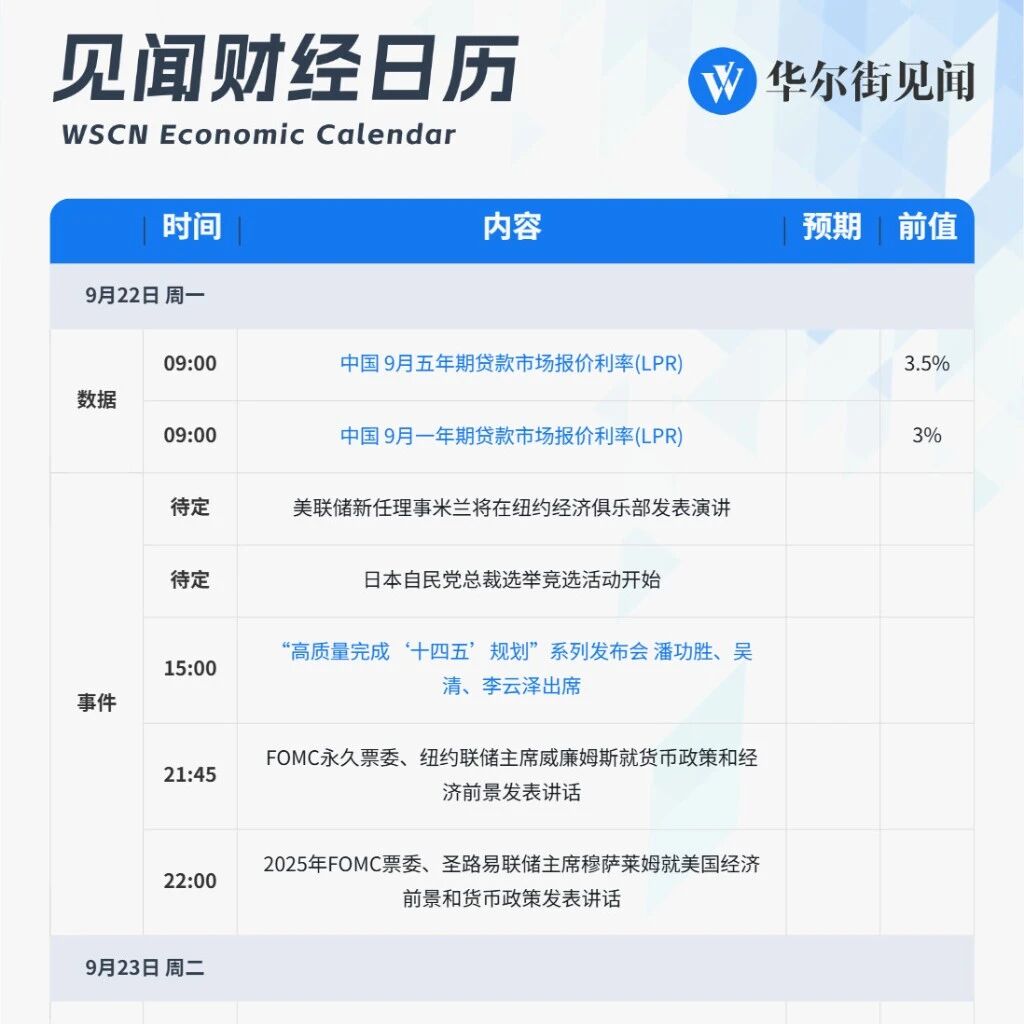
同时,日本自民党总裁选举竞选活动将正式开始。 经济指标 "美联储最爱的通胀指标"——8月PCE物价指数 继美联储于9月17日进行了今年首次降息25个基点后,市场目光迅速转向即将发布的"美联储最爱的通胀指标"——8月PCE,以寻求美联储后续货币政策走向的更 多线索。 华尔街见闻写道,鲍威尔在记者会上已预先透露,预计美国8月PCE通胀率同比上升2.7%,核心PCE同比上升2.9%。这一预测与此前7月核心PCE同比回升至2.9% 的趋势一致,显示出通胀的顽固性,特别是服务业成本上涨的推动作用。 | 时间 | | 内容 | 预期 前值 | | --- | --- | --- | --- | | 9月22日 周一 | | | | | 数据 | 09:00 | 中国 9月五年期贷款市场报价利率(LPR) | 3.5% | | 09:00 | | 中国 9月一年期贷款市场报价利率(LPR) | 3% | | 事件 | 待定 | 美联储新任理事米兰将在纽约经济俱乐部发表演讲 清、李云泽出席 | | | 待定 | | 日本自民党总裁选举竞选活动开始 | | | 15:00 | | "高质量完成'十四五'规划"系列发布会 潘功胜 ...
智驾平权系列五:智驾与机器人共振,激光雷达乘风起势
Changjiang Securities· 2025-09-21 10:12
Investment Rating - The report maintains a "Positive" investment rating for the industry [13] Core Insights - The dual drivers of advanced intelligent driving and robotics are expected to significantly boost the demand for LiDAR, which is a core component of perception systems. The trend towards affordability is likely to accelerate market penetration [4][11] - Domestic leaders in the LiDAR market, such as Suoteng and Hesai Technology, are well-positioned to benefit from technological advancements in digitalization and solid-state solutions, with multiple competitive products being launched [4][11] Summary by Sections LiDAR: Core Component of Perception Systems - LiDAR, known as the "mechanical eye," is essential for high-precision perception in advanced driving systems. Its applications have expanded from military and research to autonomous driving, robotics, and smart security [7][20] - The multi-sensor fusion approach, which includes LiDAR, emphasizes redundancy and safety, making it a dominant choice in high-level driving solutions [7][36] Market Potential - The combination of intelligent driving and robotics presents a vast market opportunity, with LiDAR demand expected to grow rapidly. The penetration rate for advanced driving in passenger vehicles is projected to reach between 10% and 50% [8][41] - The Robotaxi and specific commercial applications are anticipated to further expand the LiDAR market, with the number of LiDAR units per vehicle typically exceeding that of passenger cars [8][49] Competitive Landscape - Chinese companies are leading the LiDAR market, with domestic firms expected to capture over 90% of the global market share by 2024. Major players include Suoteng and Hesai Technology, with a combined market share exceeding 95% [9][41] - The report highlights the strong competitive positioning of Suoteng and Hesai, with projected market shares of 33.5% and 25.6% respectively by 2024 [9] Trends and Innovations - The report identifies a shift towards digitalization and solid-state LiDAR technologies, which are expected to enhance performance while reducing costs. The introduction of next-generation digital SPAD-SoC LiDAR products is underway [10][11] - The affordability trend in LiDAR is driven by technological advancements and economies of scale, with significant cost reductions expected as solid-state solutions replace traditional mechanical systems [11][53] Investment Recommendations - The report suggests that the dual drivers of advanced intelligent driving and robotics will create substantial growth opportunities for LiDAR, with domestic leaders poised to benefit from ongoing technological transformations [11][41]
港股在降息潮中表现出色的原因分析
Xin Lang Cai Jing· 2025-09-21 09:18
Group 1: Market Performance - The Hong Kong stock market has shown a significant rebound in September, with the Hang Seng Index achieving a cumulative increase of 5.85%, contrasting with a 0.98% decline in the Shanghai Composite Index during the same period [1] - The unique offshore market characteristics and high foreign capital participation of the Hong Kong stock market have made it increasingly attractive amid a global interest rate cut environment [1] - Historical data indicates that preemptive interest rate cuts tend to have a positive impact on stock assets, emphasizing the resilience of the Hong Kong stock market [1] Group 2: AI Industry Impact - The development of the AI industry has been a crucial driver for the rise of the Hong Kong stock market, with significant advancements in both hardware infrastructure and software applications since 2025 [2] - Major internet companies in Hong Kong have begun self-developing chips for AI training, achieving performance levels comparable to overseas counterparts [2] - Alibaba's cloud computing revenue growth rate reached 26%, Tencent's profit increased by 16%, and Xiaomi's automotive business revenue hit 21.3 billion yuan with a year-on-year growth of 234%, providing strong support for the tech sector in Hong Kong [2] Group 3: Capital Inflows - Net inflows of southbound funds have exceeded 1.1 trillion Hong Kong dollars this year, marking a record high since the establishment of the mutual market access mechanism [2] - The narrowing of the Hong Kong-US interest rate differential has led to a gradual recovery of the Hong Kong dollar, prompting international investment banks to upgrade their ratings for Hong Kong stocks [2] - Major investment banks like Goldman Sachs, Standard Chartered, and Morgan Stanley have given positive evaluations of the Hong Kong stock market, particularly in sectors like AI and semiconductors [2] Group 4: Valuation Advantage - As of September 17, 2023, the price-to-earnings ratio of the Hang Seng Tech Index was only 24.24 times, significantly lower than the NASDAQ Tech Index at 36.66 times and the STAR 50 Index at 177.25 times, highlighting the valuation advantage of Hong Kong tech stocks [3] - The Hang Seng Tech ETF (513130) has a strong liquidity profile, with an average daily trading volume of 4.8 billion Hong Kong dollars over the past three months, making it suitable for investors focusing on the AI industry [3] - The Hong Kong Stock Connect Tech ETF (513150) focuses on internet, new energy vehicles, and biotechnology sectors, offering a cost-effective and policy-friendly investment option for long-term investors [3]
短期科技承压,市场震荡中低位蓝筹配置窗口逐步打开
Haitong Securities International· 2025-09-21 08:03
Group 1 - The report indicates that A-shares are expected to consolidate to digest previous gains, while Hong Kong stocks may continue to benefit from positive sentiment following the Fed's rate cut [1][7] - Following the Fed's 25 basis point cut on September 17, the dollar rebounded, gold prices fell, and emerging markets experienced a retreat [1][7] - The Shanghai Composite Index fell by 1.3%, while the ChiNext Index rose by 2.3% after an initial spike and pullback [1][7] Group 2 - The report highlights a relatively positive tone from the recent U.S.-China presidential phone call, with a meeting scheduled for the APEC summit in late October [2][8] - However, no substantial breakthroughs were made on critical issues such as fentanyl and tariffs, suggesting that the bilateral relationship will likely remain stable in the near term [2][8] - The next catalysts for the Chinese market are expected to come from domestic policy, particularly the drafting of the 15th Five-Year Plan focusing on new energy vehicles and advanced manufacturing [2][8] Group 3 - A-shares have shown volatility with active fund flows and sector rotations, particularly in technology and financial sectors [3][9] - The financial sector has continued to lag, impacting the overall index, while coal and other lagging sectors have shown gains [3][10] - Daily trading volume remained high at RMB 2.5 trillion, indicating active market participation [3][11] Group 4 - In Hong Kong, market sentiment remained strong, driven by significant gains in Alibaba and Baidu due to advancements in AI technology [4][12] - However, currency fluctuations have started to exert pressure on the market, with the AH premium index declining to 117 [4][13] - Southbound capital inflows decreased to HKD 36.9 billion, with notable investments in Alibaba and Meituan, while Tencent and Xiaomi experienced outflows [4][13] Group 5 - The report suggests that Hong Kong equities may enter a consolidation phase alongside A-shares, with technology facing short-term pressure [4][14] - Non-bank financials, after significant corrections, are now viewed as attractive investment opportunities [4][14] - There is increasing interest in property and consumption-related sectors, as well as themes related to anti-involution [4][14]