
今世缘

Search documents
破局存量竞争,从头部酒企经销商大会看2026白酒行业新航向
Sou Hu Cai Jing· 2026-01-06 13:14
Core Insights - The white liquor industry in 2025 is characterized by both "pain and transformation," with high inventory levels and price inversions affecting the market, leading some companies to engage in "price reduction for volume" strategies [2] - The trend of rational consumption is deepening, with "face consumption" giving way to "self-enjoyment drinking" [2] Group 1: Industry Trends - The industry is transitioning from a phase of scale pursuit to a "medium-low growth era," where leading companies must find a balance between "progress" and "stability" [4] - Major companies like Moutai and Wuliangye are focusing on long-term strategies, emphasizing market stability and adapting product offerings to align with consumer demand [4][6] - The white liquor sector has moved away from expansion, prioritizing "healthiness first" in a competitive environment [9] Group 2: Company Strategies - Moutai aims to enhance market stability by reducing the volume of high-value products and dynamically balancing product supply based on market demand [4][9] - Wuliangye has defined 2026 as a year for "marketing innovation," focusing on balancing short-term and long-term strategies, supply and demand, and development and safety [4][11] - Other companies like Jinshiyuan and Gujing Gongjiu are also emphasizing market breakthroughs, brand enhancement, and structural upgrades in their strategic plans for 2026 [6][8] Group 3: Consumer Focus - Moutai is shifting towards a consumer-centric approach, promoting a multi-channel sales model and focusing on new consumption scenarios [14] - Wuliangye is targeting new consumer demographics, including younger and female consumers, to expand its market base [14][20] - Gujing Gongjiu is integrating health products into its strategy, aiming to create new consumer experiences and lifestyle offerings [15][21] Group 4: Product Innovation - The industry is witnessing a generational shift in consumer preferences, with younger consumers showing less interest in traditional liquor [17] - Wuliangye is launching lower-alcohol products and innovative experiences to attract younger consumers [17][20] - Gujing Gongjiu has introduced a "light degree" concept with new product lines aimed at younger audiences, enhancing its retail experience [21] Group 5: Collaborative Ecosystem - Companies are moving towards a collaborative ecosystem, viewing distributors as integral to brand development rather than mere sales channels [11][13] - The focus is on building a "shared destiny" between manufacturers and distributors, emphasizing risk-sharing and mutual benefits [11][13]




华创证券:元旦假期白酒需求弱复苏 越临近春节催化越足
Zhi Tong Cai Jing· 2026-01-06 09:17
Core Viewpoint - The demand for liquor during the New Year holiday was weak, with feedback indicating a year-on-year decline of over 20%, although there was slight improvement compared to November and December. The supply side is adjusting with lower targets from liquor companies, and channel inventory is expected to ease. The overall demand for the Spring Festival is anticipated to decline by double digits, but the drop is expected to be less severe than during the New Year holiday. High-end liquor prices are under pressure due to continuous shipments from Moutai and upcoming deliveries from traditional channels, with expectations of price stabilization after a decline [1][2][3][4]. Demand Analysis - The New Year demand was weak, with a year-on-year decline of over 20%, but there was a slight month-on-month improvement from November and December. The industry is still in the off-season, and consumer gatherings were limited. The estimated industry shipment volume during the New Year is expected to decline by over 10%, with significant reductions in business banquets and group purchases. High-end liquor prices have dropped by over 10%, while mid-range liquor prices have generally decreased by 5-10%. However, there are signs of resilience in mass consumption, particularly in regions like Sichuan and Anhui [2][3]. Supply Side Insights - Liquor companies are lowering their targets, and channels are expected to further reduce inventory pressure. Many companies have not met their initial collection targets for the year, leading to more conservative growth targets for 2026. The requirement for Spring Festival returns has been lowered to 30-40%, and companies are slowing down their shipment pace to manage channel inventory effectively. The willingness to collect payments is cautious, focusing on cash flow protection and maintaining core brand distribution rights [3][4]. Price Dynamics - High-end liquor prices are expected to remain under pressure, with Moutai's continuous shipments and upcoming deliveries affecting the market. The price of Moutai is anticipated to face marginal pressure, while Wuliangye's promotional activities may slightly stimulate sales. The price of mid-range liquor is at a relatively low level, with channel profits thinning, and prices are expected to stabilize at low levels during the Spring Festival [4][5]. Company Strategies - Moutai is advancing its marketing transformation and reducing distribution pressure by creating a pyramid product system and launching digital initiatives to stimulate consumer demand. Wuliangye is focusing on maintaining market order and enhancing channel incentives, while also pushing for improved sales and market share. Luzhou Laojiao is adjusting its product structure and promoting low-alcohol products, and Fenjiu is enhancing regional coverage for its products. Other companies like Gujing and Yanghe are also focusing on market penetration and channel management to improve sales performance [5][6]. Investment Recommendations - The pessimistic factors have been priced in, and as the Spring Festival approaches, demand recovery is expected. Moutai is recommended for its strong fundamentals, while Gujing is highlighted for its potential growth in the mass market segment. Other companies like Wuliangye, Shanxi Fenjiu, and Luzhou Laojiao are also under observation for their inventory clearance strategies. Innovative products like Zhenjiu Lidu are noted for their market potential [7].

華創證券:元旦假期白酒需求弱復甦 越臨近春節催化越足
智通财经网· 2026-01-06 09:15
Core Viewpoint - The demand for liquor during the New Year holiday was weak, with feedback from multiple regions indicating a year-on-year decline of over 20%, although there was slight improvement compared to November and December. The supply side is adjusting with lower targets from liquor companies, and channels are expected to further relieve inventory pressure. The overall demand for the Spring Festival is expected to decline in double digits, but the rate of decline is anticipated to narrow compared to the New Year holiday. High-end liquor prices are under pressure, particularly for Moutai, which is expected to continue facing marginal price pressure due to ongoing shipments and traditional channel arrivals. Looking ahead to 2026, liquor companies are shifting from passive responses to proactive adjustments, with opportunities arising after Moutai's prices stabilize [1][2][3][4][8]. Demand Analysis - The New Year demand was weak, with a year-on-year decline of over 20% reported in multiple regions, although there was slight month-on-month improvement from November and December. The industry is still in the off-season, and consumer gatherings were generally underwhelming. The estimated industry shipment volume during the New Year is expected to decline by over 10%, with significant reductions in business banquets and group purchases. High-end liquor prices have dropped by over 10%, while mid-range liquor prices have generally decreased by 5-10%. However, there are positive signs in mass consumption, particularly in regions like Sichuan and Anhui, where mass banquets and gatherings performed relatively well [2][3]. Supply Side Insights - On the supply side, liquor companies are lowering their targets, and channels are expected to further relieve inventory pressure. Many liquor companies have not met their initial collection targets for the year, leading to more conservative growth targets for 2026. The requirements for Spring Festival collections have been lowered, with most companies aiming for 30-40% collection rates. The shipment pace from liquor companies is slowing, with channels halting shipments when inventory exceeds a certain level, alleviating channel pressure [3][5]. Price Trends - High-end liquor prices are expected to remain under pressure, with Moutai's prices facing continued marginal pressure due to ongoing shipments and upcoming arrivals in traditional channels. The price of Wuliangye is expected to slightly decline, but this may stimulate sales. For mid-range liquor, prices are already at relatively low levels, and the channels are experiencing thinner profits, with expectations of stabilization at low levels during the Spring Festival [4][5]. Company Strategies - Moutai is advancing its market-oriented transformation in 2026, creating a pyramid product system and eliminating distribution policies to ease channel pressure. Wuliangye is focusing on maintaining market order and enhancing channel incentives, while also pushing for collection during the Spring Festival. Luzhou Laojiao is adjusting its product structure and increasing promotional efforts, with its high-end product prices maintaining around 830 yuan, although sales are declining in double digits. Fenjiu is enhancing regional breakthroughs for its premium products and focusing on key markets to improve sales rates [5][6][7]. Investment Recommendations - The pessimistic factors have been priced in, and as the Spring Festival approaches, demand is expected to recover. Moutai is recommended due to its strong certainty and high dividend yield. The mass market liquor segment, particularly Gujing Gongjiu, is highlighted as a key recommendation due to recent price corrections. Attention is also drawn to Wuliangye, Shanxi Fenjiu, and Luzhou Laojiao regarding their clearance rhythms, along with innovative products like Zhenjiu Lidu [8].
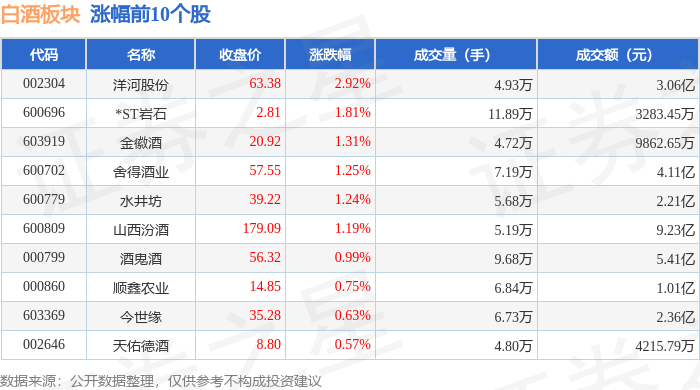
白酒板块1月6日涨0.39%,洋河股份领涨,主力资金净流出3701.37万元
Zheng Xing Xing Ye Ri Bao· 2026-01-06 08:56
Core Viewpoint - The liquor sector experienced a slight increase of 0.39% on January 6, with Yanghe Co. leading the gains, while the overall market indices also showed positive performance [1] Group 1: Market Performance - The Shanghai Composite Index closed at 4083.67, up by 1.5% [1] - The Shenzhen Component Index closed at 14022.55, up by 1.4% [1] - Yanghe Co. saw a closing price of 63.38, with a rise of 2.92% [1] Group 2: Liquor Sector Stock Performance - The following stocks in the liquor sector showed notable performance: - Yanghe Co.: 63.38, +2.92%, volume 49,300, turnover 306 million [1] - ST Yanshi: 2.81, +1.81%, volume 118,900, turnover 32.83 million [1] - Quan Huijiu: 20.92, +1.31%, volume 47,200, turnover 98.63 million [1] - Shede Liquor: 57.55, +1.25%, volume 71,900, turnover 411 million [1] - Shui Jing Fang: 39.22, +1.24%, volume 56,800, turnover 221 million [1] - Shanxi Fenjiu: 179.09, +1.19%, volume 51,900, turnover 923 million [1] - Jisi Xing: 56.32, +0.99%, volume 96,800, turnover 541 million [1] - Shunxin Agriculture: 14.85, +0.75%, volume 68,400, turnover 10.1 million [1] - Jinshiyuan: 35.28, +0.63%, volume 67,300, turnover 23.6 million [1] - Tianyoude Liquor: 8.80, +0.57%, volume 48,000, turnover 42.16 million [1] Group 3: Capital Flow Analysis - The liquor sector experienced a net outflow of 37.01 million from main funds, while retail funds saw a net inflow of 128 million [1] - The following stocks had significant capital flow: - Shanxi Fenjiu: main net inflow 80.70 million, retail net outflow 48.88 million [2] - Luzhou Laojiao: main net inflow 64.98 million, retail net outflow 11.30 million [2] - Yanghe Co.: main net inflow 19.22 million, retail net outflow 7.69 million [2] - Jinshiyuan: main net inflow 11.97 million, retail net outflow 6.72 million [2] - Shui Jing Fang: main net inflow 11.36 million, retail net outflow 6.97 million [2]



大众价格带韧性较强:白酒行业周报(20251229-20260104)-20260105
Huachuang Securities· 2026-01-05 10:13
Investment Rating - The report maintains a "Recommendation" rating for the liquor industry, indicating an expectation that the industry index will outperform the benchmark index by more than 5% in the next 3-6 months [21]. Core Insights - The report highlights that the demand for liquor is showing weak recovery, with a year-on-year decline of over 20% during the New Year period, although there is a slight month-on-month improvement from November and December [4]. - The report notes that the high-end liquor prices are under pressure, with a decline of over 10% for high-end products and 5-10% for mid-range products, while the mass consumption segment remains resilient [4]. - The report anticipates a narrowing of the decline in demand for the upcoming Spring Festival, with expectations of a double-digit decline but less severe than during the New Year [4]. - The report emphasizes that the pricing for high-end liquor will remain under pressure, with expectations of continued marginal declines in prices [4]. Industry Overview - The liquor industry consists of 20 listed companies with a total market capitalization of 288.22 billion yuan and a circulating market value of 288.18 billion yuan [1]. - The report provides a comparative performance analysis, indicating absolute performance declines of -6.0% over one month, -1.4% over six months, and -9.9% over twelve months [2]. Company Feedback and Strategies - Moutai is focusing on market-oriented transformation and has introduced a digital platform to stimulate consumer demand [5]. - Wuliangye is emphasizing sales growth and market order maintenance, with a strategy to enhance market share in the 800 yuan price range [5]. - Luzhou Laojiao plans to increase subsidies and rebates to ensure consumer affordability while maintaining its brand position [5]. - Shanxi Fenjiu is focusing on key markets and maintaining growth momentum for its premium products [5]. - Yanghe is adjusting its sales strategies based on terminal orders and distributor inventory, with a focus on maintaining reasonable inventory levels [5]. - Jinsiyuan is experiencing growth in its mass price segment, which is expected to continue contributing to overall growth [5]. Investment Recommendations - The report suggests that pessimistic factors have been priced in, and as the Spring Festival approaches, demand is expected to recover, particularly for Moutai and Gujing [4]. - The report recommends focusing on Moutai for its high certainty and dividend yield, while also highlighting Gujing as a key player in the mass price segment [4].
华创证券:维持今世缘“强推”评级,目标价45元-56元
Xin Lang Cai Jing· 2026-01-05 07:41
华创证券研报指出,近期今世缘召开以"向新奋进,向质图强"为主题的2026今世缘发展大会,回顾总 结"十四五"发展成果,谋划部署"十五五"重点工作。展望春节,公司要求回款进度45%,预计整体销售 额或因消费结构下移、单品价格回落而有所下滑,但开瓶数有望持平或微降,主要系"乡镇精耕"带来的 下沉市场渗透、以及苏中与省外市场的拓展,预计淡雅在春节期间可贡献更多增量。锚定百亿规模稳中 求进,维持"强推"评级。公司年内主动调节报表释放节奏,以缓解渠道库存与价盘压力,省内动销和份 额仍优于竞品。发展大会上公司目标稳中求进、布局保持积极,努力维持"十五五"期间省内优势。结合 公司运营情况,该行维持25-27年EPS预测值为2.17/2.24/2.48元。考虑外部需求压力持续较大,给予26年 20x-25xPE,调整目标价至45元-56元,维持"强推"评级。 ...
大消费行业周报:市场稳健,板块分化-20260105
Ping An Securities· 2026-01-05 03:05
Investment Rating - The industry investment rating is "stronger than the market," indicating that the industry index is expected to outperform the market by more than 5% within the next six months [24]. Core Insights - The overall market performance is stable, with significant differentiation within the consumer sector. The upcoming New Year holiday is expected to boost certain segments, supported by favorable macro consumption policies that may lead to a recovery in consumer demand [3][4]. - The tourism sector shows potential for growth, with leading companies like Ctrip and Huazhu Hotels responding quickly to changing consumer demands. The retail tourism industry is stabilizing, with expectations for sales recovery [3][8]. - The beauty industry is experiencing steady growth, with a focus on companies that can quickly adapt to market dynamics and integrate products, brands, and channels [3]. - The film industry saw a strong performance during the New Year holiday, with box office revenues reaching 734 million yuan, led by the film "Zootopia 2" [14]. - In the food and beverage sector, the home dining market is expanding, with companies like Guoquan showing strong growth potential. The dairy supply-demand relationship is improving, and the restaurant supply chain is stabilizing [3][18]. - In the liquor segment, major companies are experiencing deeper profit adjustments, but leading brands are expected to maintain or increase market share due to superior management and branding [3][19]. Summary by Sections Social Services - The tourism sector is evolving, with a notable increase in travel demand during the New Year holiday, driven by a surge in ticket bookings and hotel reservations [8]. - Turkey has announced visa-free entry for Chinese passport holders, which is expected to enhance tourism flows [8]. Media - The film industry achieved a record box office during the New Year holiday, indicating strong consumer interest and spending in entertainment [14]. Food and Beverage - General - The home dining market is expanding, with companies like Guoquan leading the way. The dairy industry is seeing improved supply-demand dynamics, while the restaurant supply chain is stabilizing [3][18]. Food and Beverage - Alcohol - Major liquor companies are adjusting their profit margins, but leading brands are expected to capture more market share due to their strong brand presence and management capabilities [3][19].

食品饮料行业:2026年白酒经销商大会跟踪
GF SECURITIES· 2026-01-04 13:44
Core Insights - The report emphasizes the need for major liquor companies to focus on supply-demand matching and price-volume balance, especially in light of the weak demand and inventory reduction strategies being adopted by distributors [8][15][16] - The overall investment recommendation for the liquor sector remains "Buy," with a focus on companies that are expected to achieve a dual bottom in valuation and performance [8][9] Group 1: Industry Overview - The 2026 liquor distributor conference highlighted that major liquor companies like Kweichow Moutai and Wuliangye are setting more pragmatic growth targets for 2026, with a general trend of lower revenue growth expectations compared to previous years [8][15] - The report notes that the liquor industry is increasingly emphasizing the importance of core products within various price segments, with clearer distinctions between product price bands [16][19] - Companies are prioritizing the interests of distributors, focusing on price order reinforcement and inventory management, while also exploring new sales models such as consignment and instant retail [16][19] Group 2: Company-Specific Strategies - Kweichow Moutai is focusing on market-oriented reforms to ensure consumers can access its products fairly and quickly, while also maintaining a stable supply of its flagship products [19][20] - Wuliangye aims to achieve high-quality sales through a focus on core products and enhancing brand value, with a strategy that includes performance evaluations and a mechanism for eliminating underperforming distributors [22][23] - Shanxi Fenjiu is pursuing a dual strategy of national expansion and targeting younger consumers, while also enhancing its brand collaboration across its product lines [24][25] Group 3: Market Performance and Valuation - The food and beverage sector experienced a decline of 0.6% in the week of December 29 to January 2, underperforming the CSI 300 index by 1.7 percentage points [31][34] - As of January 2, the food and beverage sector's PE-TTM valuation stands at 21.1X, while the liquor sector's PE-TTM is at 18.3X, indicating a relative valuation of 1.49 and 1.29 times compared to the CSI 300 [47][52] - The report tracks the pricing of key liquor products, noting a decrease in the price of Moutai and an increase in the price of Wuliangye, reflecting market dynamics [53]
今世缘打响四大攻坚战
2 1 Shi Ji Jing Ji Bao Dao· 2026-01-04 11:34
Core Viewpoint - The company, with a market value of 43 billion, aims to continue its growth story and become one of the most innovative and growth-oriented enterprises in the Chinese liquor industry by 2026 [2][12]. Group 1: Company Performance - In the past five years, the company has doubled its key performance indicators, with revenue surpassing 10 billion [2]. - For the first nine months, the company reported revenue of 8.881 billion and a net profit of 2.549 billion, both showing a double-digit decline year-on-year [6]. - The company's market share in Jiangsu province is 17%, second only to Yanghe's 24%, indicating limited growth potential in the region [6]. Group 2: Strategic Focus - The company is currently prioritizing market share over absolute revenue targets, reflecting a more pragmatic approach [4]. - The company plans to achieve a revenue target of 15 billion by 2025, although achieving this goal is considered unlikely due to declining sales and high inventory levels in the liquor industry [5][6]. - The company is focusing on both domestic and e-commerce channels for coordinated development and has seen significant results in large customer development [8]. Group 3: Market Strategy - The company is in a critical phase of "guarding the province and breaking through outside," emphasizing the importance of boosting confidence among stakeholders [7]. - The company aims to deepen its market presence in Jiangsu while continuing its national expansion strategy, particularly in the Yangtze River Delta and surrounding provinces [10][11]. - The core strategy for provincial expansion involves growing alongside distributors, enhancing their operational capabilities, and strengthening regional brand recognition [11]. Group 4: Future Outlook - The company plans to tackle four major challenges in market, brand, organization, and manufacturer collaboration to achieve breakthroughs [10]. - The focus will be on enhancing brand recognition and operational capabilities of distributors, with an emphasis on building a "shared destiny" with manufacturers [11]. - The overarching theme for the future is "reform and innovation," with a focus on qualitative improvements and reasonable quantitative growth [12].
弱复苏低通胀强补贴下的内需主线
2025-12-31 16:02
Summary of Key Points from Conference Call Records Industry Overview - The focus is on the domestic consumption sector, with policies aimed at boosting consumer spending through increased household income, including minimum wage hikes and corporate salary increases [1][4][5] - The service consumption sector is expected to benefit from reforms in pricing mechanisms, particularly in healthcare, transportation, and public utilities [1][6] - The retail sector, especially offline retail, is seen as a crucial driver for domestic demand, supported by policies for updating commercial facilities [1][12] Core Insights and Arguments - **Consumer Policy Effectiveness**: The effectiveness of consumer promotion policies is anticipated to exceed market expectations, with significant increases in minimum wage across provinces, averaging over 8% [4][5] - **Service Sector Reforms**: Reforms in service pricing, particularly in healthcare, are expected to enhance the income of service providers while controlling costs for consumers [6] - **Product Innovation**: In the goods consumption sector, companies that excel in innovation and new supply offerings are likely to thrive, moving away from traditional consumer upgrade logic [7] - **Tourism and Local Policies**: Local government competition is expected to stimulate tourism, benefiting cultural and agricultural sectors [1][7] Important but Overlooked Content - **Retail Performance**: The first quarter of 2026 is projected to be crucial for leading regional retail companies, with expectations of strong performance during the extended Spring Festival [12] - **Cross-Border E-commerce**: Currency fluctuations have a limited impact on leading cross-border e-commerce companies, with exchange rate losses being a minor portion of profits [13] - **Household Appliances and Smart Hardware**: The government has initiated a subsidy plan for key household appliance categories, with a total subsidy of approximately 250 billion for 2026, focusing on six core categories [19][20] - **Food and Beverage Sector**: The food and beverage sector is expected to hit a performance bottom in Q1 2026, with a gradual recovery anticipated in Q2 [22] Future Outlook - **Economic Rebalancing**: The macroeconomic narrative is shifting towards economic rebalancing, with a cautious optimism for 2026 as supply-demand dynamics are expected to improve [8][9] - **Investment Opportunities**: Key investment opportunities are identified in sectors benefiting from government support, particularly in smart home and wearable technology, with a focus on companies like Midea, Haier, and TCL [20][21] - **Pork Market Expectations**: The pork market is showing signs of recovery, with prices expected to stabilize and improve, leading to a more optimistic outlook for the industry [16] This summary encapsulates the essential insights and projections from the conference call records, highlighting the key themes and potential investment opportunities across various sectors.