蜜雪冰城

Search documents
从蜜雪冰城到泡泡玛特,河南品牌全球征战,“中原生长模式”为什么赢麻了?
3 6 Ke· 2026-01-09 00:24
Core Insights - The article highlights the rise of Henan brands in the consumer market, emphasizing their deep integration into daily life and their unique growth model rooted in local consumer needs [3][4][10]. Group 1: Brand Performance - The sales of the retail chain "胖东来" (Pang Dong Lai) have shown significant growth, with projected sales reaching 235.31 billion yuan by 2025, marking a 38.71% increase [6]. - "胖东来" achieved approximately 70 billion yuan in sales in 2022, increasing to about 107 billion yuan in 2023, and expected to reach 170 billion yuan in 2024 [7]. - "巴奴火锅" (Ba Nu Hot Pot) is positioned as a high-end brand with a customer unit price of 138 yuan, significantly higher than competitors like 海底捞 (Haidilao) at 97.9 yuan [8]. Group 2: Global Expansion - "蜜雪冰城" (Mixue Ice City) opened its first store in Los Angeles, marking a significant step in its global strategy, with a total of 53,014 stores worldwide as of mid-2025 [12]. - "泡泡玛特" (Pop Mart) has expanded its global presence with over 500 stores across more than 80 countries, reporting a 365%-370% increase in overseas revenue in Q3 2025 [15]. Group 3: Supply Chain and Production - Henan's agricultural strength supports its brands, with the province producing 1/10 of the country's grain and housing major companies like 牧原股份 (Muyuan Food) and 双汇集团 (Shuanghui Group) [10][18]. - "蜜雪冰城" operates five production bases, with the largest capable of supplying 121 million tons of beverage ingredients annually, supported by a logistics system that can deliver within 12 hours [18]. Group 4: Consumer Behavior and Market Positioning - Henan brands cater to a large population, with a focus on cost-effective products that resonate with local consumers' practical spending habits [19]. - The founders of these brands often come from humble beginnings, which helps them understand consumer needs and market dynamics better [20]. Group 5: Challenges and Market Dynamics - Despite their success, brands like "巴奴" and "胖东来" have faced scrutiny over product quality and service, highlighting the challenges of maintaining trust during rapid expansion [25][26]. - The article emphasizes the need for these brands to balance fast growth with product integrity and consumer trust in a changing market landscape [27].


被传港股IPO 霸王茶姬:暂无计划
Mei Ri Jing Ji Xin Wen· 2026-01-08 14:05
每经记者|王帆 范芊芊 每经编辑|王帆 1月8日,有市场传闻称霸王茶姬将在港股二次上市。对此,公司回应《每日经济新闻》记者称:"暂无 此计划。"目前,新茶饮企业在港股市场十分热闹,上市公司包括蜜雪冰城、古茗、奈雪的茶、沪上阿 姨等。 2025年4月,霸王茶姬已在美国纳斯达克上市。截至2025年9月末,霸王茶姬全球门店数达到7338家, 第三季度总GMV达79.30亿元,净收入32.08亿元。 ...
茉酸奶收购酸奶罐罐,成为行业“新发展”缩影
Mei Ri Jing Ji Xin Wen· 2026-01-08 13:48
Group 1 - The acquisition of the yogurt brand "酸奶罐罐" by "茉酸奶" reflects the ongoing capital restructuring in the ready-to-drink tea and coffee industry, as the market transitions from high growth to a phase of stock competition [1] - In 2025, key events in the tea and coffee market included several brands going public and the rise of instant retail platforms, which significantly impacted sales but also created challenges for franchisees [1][3] - The market size of the new-style tea market reached 374.93 billion yuan in 2025, growing by 5.7% year-on-year, indicating a slowdown compared to previous years [7] Group 2 - The intense subsidy war initiated by instant retail platforms led to a significant increase in transaction volume but a decrease in average order value, with tea and coffee market consumption growing by 39.2% and 42.6% respectively, while average prices fell by 16.3% and 10.7% [3] - Franchisees are becoming more cautious in their investments, focusing on prime locations, cost control, and partnering with leading brands, as the market becomes increasingly competitive [7][8] - The trend of product homogenization continues, with fewer collaborations between brands and IPs, indicating a need for differentiation and stability in supply chains [8][10]

中国消费的“K型分化”:“该省省、该花花”
Soochow Securities· 2026-01-08 12:55
Group 1: Key Insights on "K-Shaped Consumption" - China's consumption market is experiencing a "K-shaped differentiation," characterized by high-end quality consumption on one end and high cost-performance consumption on the other[1] - The shift in consumer behavior reflects a growing emphasis on emotional value alongside practical value, moving away from a purely utilitarian perspective[1] - High-end luxury consumption is seeing significant growth, with Beijing SKP achieving a record revenue of 26.5 billion yuan in 2023, reflecting a compound annual growth rate of approximately 7.5%[13] Group 2: Factors Driving "K-Shaped Differentiation" - The change in consumer ideology is driven by generational shifts and macro policies that increasingly focus on "investing in people" rather than just material goods[3] - The Z generation and younger elderly populations are becoming the main consumer force, prioritizing emotional satisfaction over mere functionality in their purchasing decisions[23] - Retailers are adapting to this differentiation by offering both high-end and low-cost products, as seen with brands like Xiaomi and BYD, which cater to both ends of the market[21] Group 3: Implications and Risks - The "K-shaped differentiation" is reshaping the underlying logic of China's consumption market, influencing regional economic growth and industrial structure adjustments[11] - Risks include potential delays in supportive policies for new consumption, exacerbated impacts from real estate adjustments, and slowing growth in household income affecting overall consumption[36]
茶饮六小龙掀起EGC整顿风暴
3 6 Ke· 2026-01-08 09:54
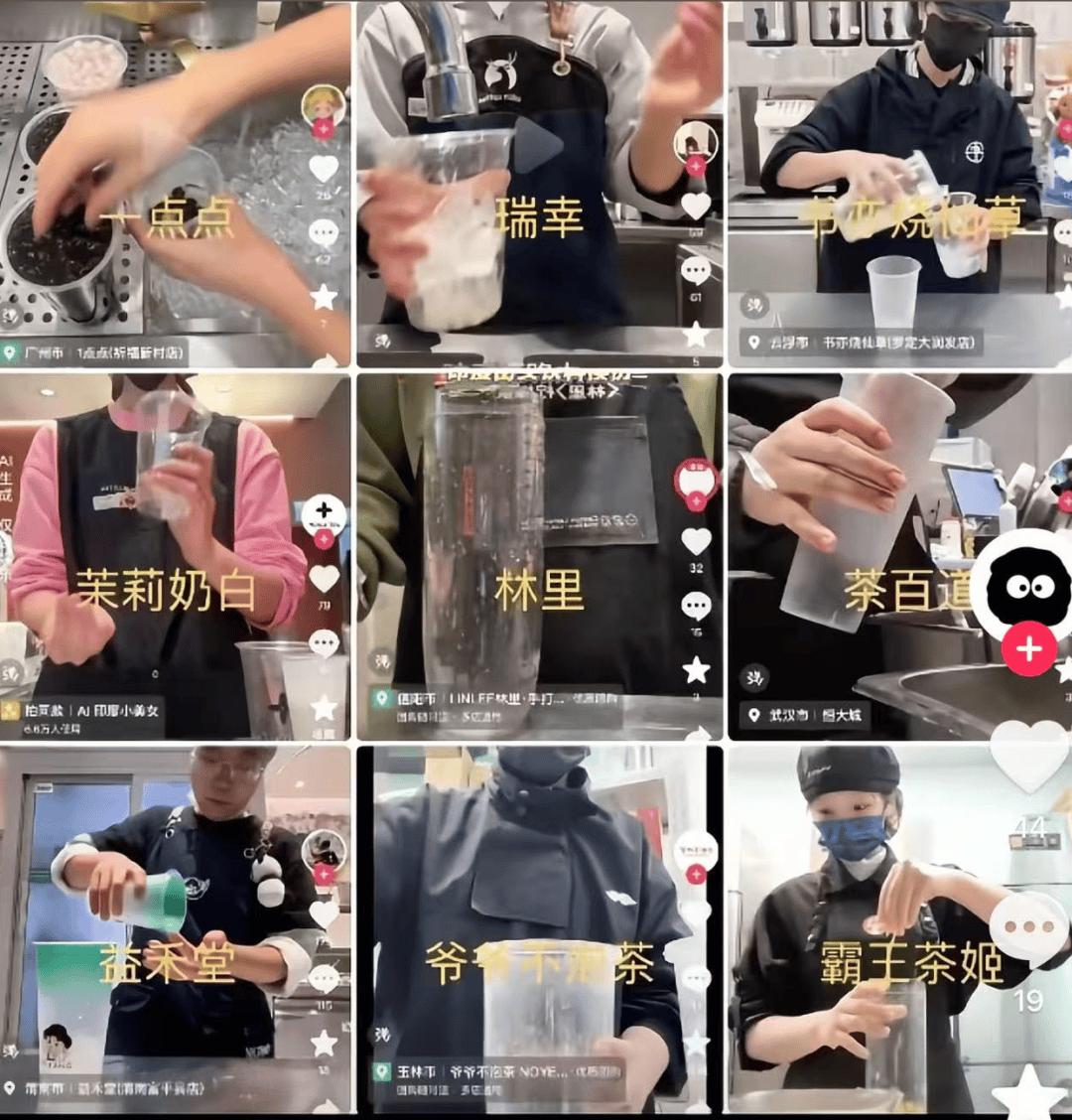
Core Viewpoint - The incident involving "Bawang Tea Ji" and its apology for a video depicting "making milk tea with bare hands" has triggered a rapid response across the tea beverage industry, leading to a collective halt on employee-generated content (EGC) and a wave of internal investigations among brands like Gu Ming, Starbucks, and Luckin Coffee [1][5][10]. Group 1: Industry Response - Following the incident, several tea brands initiated immediate internal checks, prohibiting employees from filming videos and issuing rectification notices [1][8]. - The rapid response indicates a shift from encouraging employee-generated content to a more cautious approach, reflecting the industry's concern over potential risks associated with such marketing strategies [4][10]. - The incident has led to a broader industry-wide self-examination regarding the management of employee-generated content, with brands now prioritizing compliance and risk management [10][17]. Group 2: Employee-Generated Content (EGC) Dynamics - EGC, which allows employees to share their perspectives on daily operations and product creation, was previously seen as a cost-effective and engaging marketing strategy [2][3][12]. - The recent backlash against EGC highlights the dual-edged nature of this marketing approach, where the potential for brand exposure is countered by the risks of unregulated content creation [12][17]. - The industry is now grappling with the challenge of balancing the benefits of EGC with the need for stricter content management to avoid reputational damage [17][18]. Group 3: Brand Management and Governance - The incident has exposed weaknesses in brand governance and the ability to manage decentralized content creation effectively, as many brands lack the tools to oversee employee-generated content [17][18]. - There is a growing recognition that as brands expand and employee-generated content becomes more prevalent, companies must develop clearer guidelines and frameworks to manage content risks [18]. - The need for a more structured approach to content creation is evident, as brands seek to maintain consumer trust while allowing employees some creative freedom [17][18].
马斯克旗下xAI公司完成200亿美元融资,英伟达参与投资|首席资讯日报
首席商业评论· 2026-01-08 04:27
Group 1 - xAI, an AI startup founded by Elon Musk, has completed a $20 billion financing round with investors including Nvidia, Cisco Investments, and Qatar Investment Authority [2] - The financing round has been in preparation for several months, with Nvidia initially planning to invest up to $2 billion [2] - Specific contributions from each investor and the debt-to-equity ratio of the financing have not been disclosed [2] Group 2 - JD.com has established a new cultural tourism development company in Beijing, which will engage in tourism, entertainment, and cultural exchange activities [3] - The new company is wholly owned by Beijing JD Century Trading Co., Ltd [3] Group 3 - Lei Jun, founder and CEO of Xiaomi, announced that the new generation of the SU7 model is expected to launch in April, featuring fully equipped advanced driver assistance systems [4] - The new model is anticipated to set a new benchmark in the market [4] Group 4 - AMD is planning to "revive" its older AM4 platform products in response to soaring DDR5 memory prices and ongoing chip shortages [5] - The current chip crisis and irrational price increases for DDR5 memory have significantly raised the cost of building new computers [5] Group 5 - Xiaomi has terminated the employment of personnel involved in a recent controversy regarding interactions with KOLs and has penalized relevant leadership by deducting their annual performance bonuses [8] - This action serves as a warning for internal management practices [8] Group 6 - JPMorgan is optimistic about the semiconductor industry's prospects in 2026, highlighting Nvidia's competitive edge in the robotics sector [9] - The report emphasizes the growing demand for computing power and the opportunities in "physical AI" for robotics and autonomous driving [9] - Compared to AMD, Nvidia appears to have a stronger position in gaining market share [9] Group 7 - Ford reported a 6.0% year-on-year increase in U.S. market sales for 2025, with total sales reaching 2,204,124 vehicles [8] - The fourth quarter of 2025 saw a 2.7% increase in sales compared to the previous year [8] Group 8 - In 2025, the number of new A-share accounts opened reached 27.4369 million, with December alone seeing 2.5967 million new accounts, a month-on-month increase of 9% [10] - The total new accounts opened in 2025 represented a year-on-year growth of approximately 9.75% [10] Group 9 - Global power battery installations exceeded 1000 GWh from January to November last year, with a year-on-year growth of 32.6% [11] - Six of the top ten companies in global power battery installations are from China, including CATL and BYD [11] Group 10 - A media report regarding Samsung's chairman purchasing 100 Labubu figures was clarified by Samsung, stating that the visit was for market inspection and no purchases were made [12] - The incident has sparked discussions and speculation in the media [12] Group 11 - The Henan Provincial Cultural and Tourism Department is seeking opinions on a plan to create 20 new commercial and cultural tourism integration consumption scenarios, leveraging brands like Pang Donglai and Mixue Ice City [13] - The initiative aims to promote the development of night economy and large-scale commercial cultural tourism complexes [13]



厦门门店全关,被“匠心”耽误的米其林奶茶店
3 6 Ke· 2026-01-08 01:48
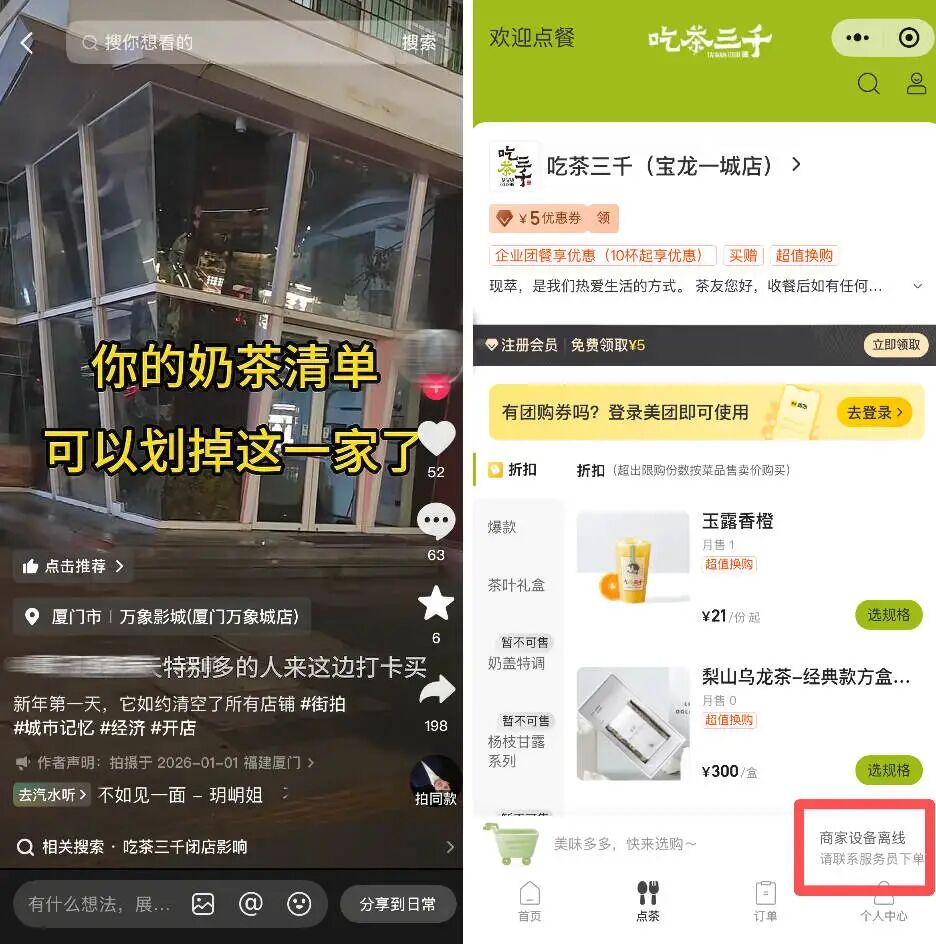
米其林三星茶饮品牌,吃茶三千厦门门店全关 曾被誉为茶饮行业"米其林标杆"的吃茶三千,正迎来大规模门店收缩。 2025年年末,有网友在社交媒体上爆料,吃茶三千将于2025年12月31前关闭厦门的所有门店。消息一出,不少消费者纷纷赶往门店打卡下单,想要赶在在 闭店前喝上最后一杯。其中,吃茶三千万象城店一度因爆单暂停了外卖业务,全力应对线下订单。 至2026年1月1日,网友实地探访发现,吃茶三千厦门万象城店设备全部搬空,招牌也已经撤掉了。厦门其他门店如禾祥西店、宝龙一城店,小程序线上点 单界面显示"商家设备离线"。品牌官方小程序显示,目前吃茶三千仅剩上海金鹰国际店一家门店。 事实上,吃茶三千在厦门的全面撤退并非毫无征兆。在此前的一两年里,吃茶三千已陆续关闭了福州、北京等多个核心城市的门店,收缩战线早已开始。 而当我们将视角拉回几年前,彼时的吃茶三千,正处于高速扩张的黄金时期。品牌的前身,是1998年创立的台湾连锁茶饮品牌喫茶小铺。自创立以来,该 品牌就强调"匠心做茶、真材实料",以"现场鲜萃茶叶"为核心卖点,招牌产品有国王珍珠奶茶、熔岩黑糖波霸鲜奶等。 与同期茶饮品牌不同的是,吃茶三千不使用市面上普遍的大桶泡茶,而 ...
市值蒸发超120亿!门店超8000家的茶百道,为何难获市场青睐?
Sou Hu Cai Jing· 2026-01-08 01:45
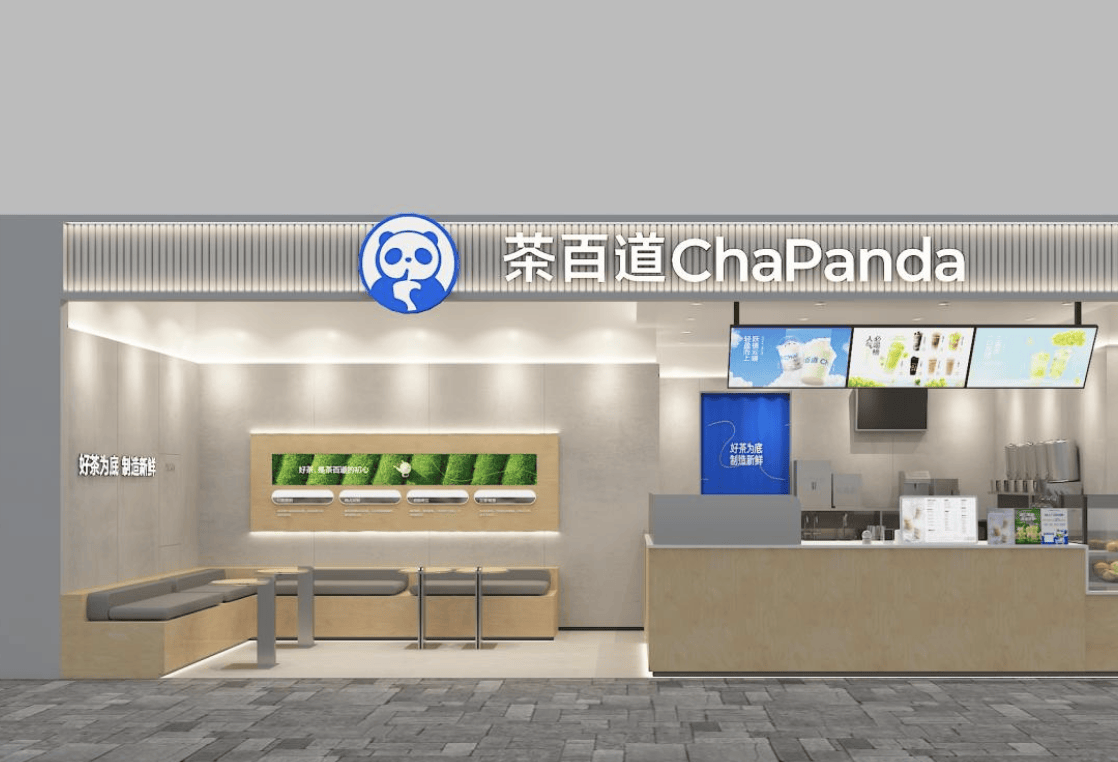
Core Viewpoint - The new tea beverage market is entering a phase of elimination, with Cha Bai Dao, known as the "second stock of new tea drinks," facing significant challenges in growth compared to competitors like Mi Xue Bing Cheng and Gu Ming [1][3]. Financial Performance - In the first half of 2025, Cha Bai Dao achieved a revenue of 2.5 billion yuan, a year-on-year growth of 4.33%, and a net profit of 352.9 million yuan, with a year-on-year increase of 37.48% [1]. - In contrast, Gu Ming reported a revenue of 5.663 billion yuan with a growth rate of 41.24%, and a net profit of 1.625 billion yuan, showing a remarkable increase of 121.51% [3]. Market Position and Stock Performance - Cha Bai Dao's stock price closed at 6.44 HKD per share, with a total market value of 9.5 billion HKD, reflecting a significant decline from its historical high of 15.196 HKD per share, resulting in a market value loss exceeding 12 billion HKD [3]. Business Model and Expansion - Cha Bai Dao, founded in 2008, shifted to a franchise model in 2016, leading to rapid expansion, with the number of franchise stores increasing tenfold to 5,070 by 2021 [4]. - As of 2024, the total number of franchise stores reached 8,376, with a market share of 6.8% in China's ready-to-drink tea market, which was valued at 247.3 billion yuan in 2023 [4]. Supply Chain Challenges - Over 99% of Cha Bai Dao's stores are franchises, and the company has shifted its focus from selling tea to selling raw materials to franchisees, with raw material sales accounting for 94.78% of its revenue [5]. - The company faces significant supply chain issues, relying heavily on external suppliers for key ingredients, which has led to food safety concerns and operational challenges [5][6]. Competitive Landscape - Cha Bai Dao's main price range of 10-20 yuan is highly competitive, facing pressure from brands like Mi Xue Bing Cheng and Gu Ming, resulting in a high franchisee attrition rate of 16.61% and a closure rate of 10.62% in 2024 [6]. Supply Chain Improvements - In response to supply chain issues, Cha Bai Dao has slowed its store expansion, adding only 49 new stores in the first half of 2025, compared to previous years [7]. - The company has increased its logistics capabilities, with 93.8% of stores achieving next-day delivery and improving its fruit supply chain efficiency [7][8]. International Expansion - Cha Bai Dao is exploring international markets, having opened over 10 stores in South Korea, aiming to tap into the growing Southeast Asian ready-to-drink tea market, which is projected to grow from 32.9 billion yuan in 2023 to 78.3 billion yuan by 2028 [10]. Future Outlook - Despite current challenges, there is optimism that improvements in supply chain capabilities will enable Cha Bai Dao to achieve greater success in the future [11].
都市农业强市的活力和蓝图
Zheng Zhou Ri Bao· 2026-01-08 00:59
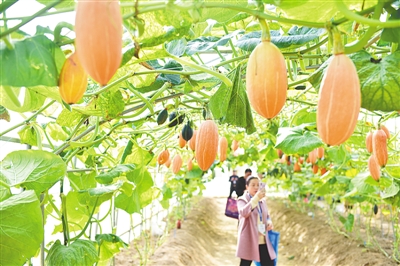
Core Viewpoint - Zhengzhou is focusing on building a modern agricultural city, emphasizing food security, technological innovation, and industrial upgrading to promote high-quality agricultural development [2][3][9] Group 1: Food Security - Zhengzhou's grain production capacity has steadily improved, maintaining an annual grain output of over 1.5 million tons, with a projected increase to 1.518 million tons in 2024, reflecting a 1.2% annual growth since 2020 [3] - The city has stabilized its grain planting area at approximately 4.46 million acres, ensuring a total grain output of over 2.9 billion pounds [3] - During the 14th Five-Year Plan, the supply of vegetables, fruits, and meat products has remained stable, with annual vegetable production around 2 million tons and meat, egg, and milk production around 250,000 tons [3] Group 2: Technological Empowerment - Zhengzhou is enhancing agricultural support through technology, focusing on smart agriculture, facility agriculture, and efficient agriculture, establishing a collaborative innovation framework [4][5] - The city has seen the widespread application of advanced technologies such as irrigation robots and drones, with over 50 agricultural technology enterprises and several research centers established [5] - The agricultural sales revenue is projected to reach 5 billion yuan in 2024, driven by the implementation of the seed industry revitalization plan [5] Group 3: Agricultural Industry Chain Extension - The Central Plains Modern Food Industry Park is set to boost the pig industry, with an expected annual output of 2.8 million pigs upon full completion [6] - Zhengzhou is promoting agricultural industrialization clusters, enhancing deep processing of agricultural products, and aiming for an agricultural processing output value exceeding 180 billion yuan in 2024 [6][7] - The city is implementing a plan to support the growth of leading agricultural enterprises, targeting the cultivation of over 100 key enterprises by 2030 with a combined revenue exceeding 350 billion yuan [7] Group 4: Strengthening Specialty Agriculture - Zhengzhou is optimizing its agricultural specialty layout, focusing on developing green and organic product brands, with significant contributions from strawberry farming in Zhongmu [8] - The city is promoting rural tourism and integrating agriculture with tourism, with plans to develop over 400 beautiful rural areas and 12 premium leisure tourism routes by the end of 2025 [8][9] - The agricultural development strategy includes creating a vibrant agricultural landscape that supports farmer income and enhances rural living conditions [9]
2026年的暴富密码,藏在2025的“意想不到”中
Sou Hu Cai Jing· 2026-01-07 08:56
Group 1 - The film "Nezha 2" achieved a record-breaking box office of 15.4 billion, ranking among the top five globally, showcasing the high industrial standards of Chinese animation and promoting Chinese culture [1][4] - The rapid adoption of artificial intelligence (AI) throughout the year has transformed various industries, with significant advancements in AI applications such as healthcare, education, e-commerce, and finance [3][4] - China has become the world's largest exporter of new energy vehicles, with domestic brands increasing their market share in Europe and Southeast Asia [5][6] Group 2 - The competitive landscape in the food delivery sector intensified as major internet companies engaged in aggressive subsidy wars, leading to significant price reductions for consumers [6][8] - The tea beverage industry saw a surge in IPOs, with brands like Mixue Ice City and others expanding internationally, indicating a strong growth trend in the sector [6][8] - The financial sector experienced a slight increase in average salaries among listed banks, while the total number of employees in major state-owned banks decreased [9] Group 3 - The A-share market saw an 18% increase, reaching a ten-year high with total market capitalization surpassing 100 trillion [9] - The micro-short drama industry surpassed the film industry, achieving a scale of 50 billion, indicating a shift in consumer entertainment preferences [9][11] - Predictions for 2026 include continued growth in AI integration across industries, increased exports of new energy vehicles, and the emergence of new popular IPs in the cultural sector [11][12]