三星

Search documents
从“猎奇”到“信赖”:折叠屏手机用户发展洞察报告
艾瑞咨询· 2026-02-05 00:00
Core Insights - The global foldable smartphone market is experiencing continuous growth, particularly in China, driven by technological advancements and an improved supply chain, leading to product diversification [1] - China has emerged as the main growth engine for the global foldable smartphone market, with Huawei maintaining a significant market share [1][18] - User willingness to purchase foldable smartphones is increasing, with higher expectations for product functionality and experience [1] Market Overview - The global smartphone market has transitioned into a saturated phase since 2017, with annual shipment volumes declining by approximately 2.52%, projected to reach 1.22 billion units by 2024 [2] - The foldable smartphone segment is seen as a strategic direction to overcome market growth bottlenecks, with expected high growth in shipments from 2022 to 2024 [5] Competitive Landscape - The foldable smartphone industry chain includes upstream raw material supply, midstream design and manufacturing, and downstream sales [7] - Chinese manufacturers, led by Huawei and Samsung, are driving the industry forward through strong technological capabilities and market influence [7][8] User Behavior and Preferences - The user demographic for foldable smartphones shows a preference among high-education individuals, with over 75% of users holding a bachelor's degree or higher [20] - The majority of users spend between 5,000 to 9,000 yuan on foldable smartphones, with Huawei being the most popular brand, accounting for 62.3% of usage [22] - Key reasons for purchasing foldable smartphones include a stronger sense of technology and innovation, with 44.7% of users citing this as a primary factor [24] Brand Recognition and Perception - Huawei leads in brand recognition across various metrics, significantly ahead of competitors like Samsung, Xiaomi, and OPPO [26] - In terms of brand image, Huawei excels in high-end perception, business appeal, and innovation, reinforcing its leadership in the foldable smartphone sector [28] User Satisfaction and Future Intentions - User satisfaction is highest for Huawei, indicating strong brand loyalty, followed by Xiaomi and Samsung [30] - Over 90% of consumers are considering purchasing a foldable smartphone for their next device, with a focus on reliability and battery life [41] Market Transition - The foldable smartphone market is transitioning from a niche segment to mainstream practicality, driven by hardware maturity and software ecosystem improvements [43] - The hardware is evolving from merely functional to providing a comprehensive user experience, with innovations in hinge and screen technology [45] - Consumers are shifting from "novelty" to "regular use," with 95.5% expressing willingness to switch to foldable smartphones in the future [47]


中信建投:出海红利与变革周期为家电板块两条投资主线
智通财经网· 2026-02-04 23:49
Core Viewpoint - The home appliance sector is expected to underperform the CSI 300 index in 2025 due to tariff increases, fluctuations in the trade-in policy, and high base expectations in the second half of the year. Long-term competitiveness will return to product innovation and efficiency advantages, with two main investment themes: overseas expansion as a key growth source and transformation dividends [1]. Group 1: Black Goods Market - Domestic demand is gradually under pressure, while Chinese companies accelerate overseas expansion and enhance their positions in high-end markets. The internal sales stimulus effect is weakening, and external sales expectations are improving. The overall shipment volume of the Chinese television market is projected to decline by 6.8% year-on-year in 2025, with retail sales expected to drop by about 10% [2]. - The "national subsidy" policy's continuation is uncertain, and if no alternative stimulus is provided, the shipment volume in 2026 may decline by over 10%. However, the upcoming sports events in 2026 are expected to boost overseas television demand, making overseas market expansion a priority for Chinese television companies [2]. Group 2: Market Share and Competition - TCL and Hisense have increased their domestic and international market shares, with both companies exceeding 13 million units in global shipments in the first half of 2025, achieving a global market share of over 14%. Hisense's domestic and overseas market shares are 21.1% and 12.7%, while TCL's are 18.9% and 13.8% respectively [3]. - The competitive landscape is shifting as Samsung's market share has decreased, providing Chinese brands with significant opportunities to capture market share. Hisense and TCL are expected to lead the global market within three years, with a focus on maintaining growth in global market share [3]. Group 3: High-End Market Trends - The high-end television market is experiencing a recovery, with global high-end television shipments and revenue increasing by 40% and 21% year-on-year respectively in Q2 2025. The average size of televisions shipped globally has also increased, indicating a trend towards larger screens [4]. - MiniLED technology is gaining traction in the high-end market, with its shipment volume and revenue growing by 101% and 66% year-on-year in Q2 2025, respectively. This trend is reducing the importance of OLED technology in the high-end segment, benefiting Chinese brands that promote MiniLED televisions [4]. Group 4: Profitability and Structural Upgrades - Chinese brands are capturing more high-end market share, with TCL's global shipments of televisions 65 inches and above increasing by 26.9% year-on-year in Q2 2025. The average size of TCL's global shipments has risen to 53.4 inches, with significant growth in quantum dot and MiniLED television shipments [5]. - The shift towards larger and higher-end televisions is a key factor in improving profitability for brands like Hisense and TCL, as they leverage their advantages in MiniLED technology and competitive pricing in the LCD segment [5].

被中国杀手锏打痛,特朗普开启120亿美元新计划,开启稀土争夺战
Sou Hu Cai Jing· 2026-02-04 20:49
Core Points - The "Treasury Plan" is a strategic mineral reserve project signed by President Trump, totaling $12 billion, aimed at establishing a strategic reserve of critical minerals for U.S. manufacturers to mitigate supply chain disruption risks, particularly in response to China's rare earth control during the 2025 U.S.-China trade conflict [1][3] Group 1: Plan Overview - The plan is financed by a $10 billion loan from the Export-Import Bank of the United States, along with approximately $2 billion in private capital, covering critical minerals such as rare earths, copper, and lithium [3] - The goal is to create a 60-day emergency mineral reserve, with participation from major companies like General Motors, Boeing, and Google [3] - The operational mechanism allows companies to withdraw minerals from the reserve at predetermined prices, helping them avoid price volatility without needing to stockpile [5] Group 2: Market Context - As of 2024, the U.S. is entirely reliant on imports for 12 critical minerals, with over 50% import reliance for an additional 29 minerals, highlighting vulnerabilities in the U.S. critical mineral supply chain [5] - The plan's funding structure indicates that the $10 billion loan is for 15 years, significantly larger than previous transactions by the Export-Import Bank [7] Group 3: Technical Challenges - The main challenges for the "Treasury Plan" include the need for technology and capacity expansion in rare earth separation and refining, where China currently holds a dominant position [9] - China accounts for over 90% of global rare earth refining capacity and holds 85% of patents in heavy rare earth separation technology [9] Group 4: Military and Industrial Implications - Rare earths are critical for military applications, with over 78% of materials used in U.S. military equipment sourced from China [11] - The 2025 export control measures by China on rare earths have significantly impacted U.S. industries, including automotive and high-tech sectors, leading to price surges in rare earth elements [11] Group 5: Broader Industry Movements - The U.S. government has been actively investing in domestic rare earth producers, with significant funding directed towards companies like Mountain Pass Materials and American Lithium [12] - The global distribution of rare earth resources is heavily skewed towards China, which holds about 23% of global reserves but supplies over 90% of the market [14][16]

西安加速布局“新赛道” 培育新质生产力引领高质量发展
Zhong Guo Xin Wen Wang· 2026-02-04 14:18
Core Insights - Xi'an High-tech Zone has achieved steady economic growth since the 14th Five-Year Plan, with industrial output increasing from 203.5 billion to 421.1 billion, averaging a growth rate of 15% annually [1][2] Economic Performance - The industrial output of Xi'an High-tech Zone rose from 203.5 billion to 421.1 billion, with an annual growth rate of 15% [1] - The zone has ranked among the top ten in the national "High-Quality Development Top 100 Parks" for three consecutive years and is projected to be fifth in the national comprehensive evaluation of high-tech zones in 2024 [1] Technological Innovation - The zone has gathered advanced technologies, including femtosecond lasers and high-precision ground timing systems, and hosts the first national-level innovation platform in the new materials sector [2] - Over 6,000 national-level technology-based SMEs and high-tech enterprises have been cultivated, including 99 national-level specialized and innovative "little giant" enterprises [2] Industry Layout - Advanced manufacturing output has grown at an average rate of 15.6% during the 14th Five-Year Plan, with the digital economy's core industry scale surpassing 280 billion [2] - Emerging industries such as photonics, integrated circuits, new materials, and low-altitude economy are rapidly developing, with the photonics industry alone hosting 183 companies and generating over 20 billion in output [2] Key Sectors - The high-performance integrated circuit sector focuses on chip design and wafer manufacturing, leveraging leading companies like Samsung and ASE, and aims to create a world-class semiconductor industry cluster [2] - The high-end new materials sector, led by institutions like the Shaanxi Nonferrous Institute, aims to develop advanced rare metal materials and 3D printing materials [2] Low-altitude Economy - The low-altitude economy is centered around companies like Inno Aviation and Aerospace Power Research Institute, focusing on technologies such as turbofan engines and drone clusters [3] - The sector aims to establish a nationally influential low-altitude economic industrial cluster [3] High-end Medical Devices - The high-end medical device sector integrates technologies like 3D printing, photonics, and AI, collaborating with companies such as Juzhi Bio and Kangtuo Medical [3] - The goal is to create a comprehensive industrial base that facilitates the last mile of technology transfer [3] Support Measures - Five major support measures have been introduced to ensure the rapid growth of new tracks, including a dedicated mechanism for each track and annual funding of 100 million for future industries [3] - By 2028, the target for annual revenue growth in new tracks is set at 20%, aiming to strengthen technological breakthroughs and enterprise cultivation [3]
国运的杠杆不是AI,是生育率
虎嗅APP· 2026-02-04 14:07
Core Viewpoint - The article discusses the shifting dynamics of geopolitical power and military capability, emphasizing that true national strength is determined by production capacity and population rather than mere wealth [6][11][30]. Group 1: Military and National Power - Palmer Luckey's company Anduril has reached a valuation of $30.5 billion, highlighting the growing importance of military technology in the current geopolitical climate [6]. - The article illustrates that despite significant financial support for Ukraine, the actual military production capabilities of Western nations are limited compared to Russia, which has a substantial advantage in artillery and personnel [11][12]. - The production capacity of artillery and tanks is critical in traditional warfare, as evidenced by the comparison of annual production rates between Russia and Western nations [12]. Group 2: Demographic Challenges - South Korea's total fertility rate is currently at 0.67, significantly below the replacement level of 2.1, indicating a looming demographic crisis that could lead to a drastic reduction in military personnel [12][13]. - Projections suggest that by 2070, North Korea could have a 2:1 advantage in eligible military personnel over South Korea, which could escalate to a 4:1 advantage by 2100 [15][16]. - The article argues that a declining population not only affects military capacity but also economic vitality, as fewer young people will be available to drive innovation and production [30]. Group 3: Societal Implications of Low Birth Rates - The article highlights the societal pressures that prevent open discussions about declining birth rates, which are seen as a critical issue for the future of nations like South Korea [22][24]. - It posits that once a society's birth rate falls below replacement levels, reversing this trend becomes exceedingly difficult, leading to a long-term demographic imbalance [25][26]. - The political landscape will shift as older populations gain more voting power, potentially prioritizing their welfare over that of younger generations [24][27]. Group 4: Geopolitical Strategy and Future Outlook - The long-term geopolitical influence of a nation is defined by its productivity, population base, and time, which are crucial in the context of the U.S.-China rivalry [28]. - The article warns that while the U.S. currently has a diverse population, a declining birth rate could undermine its economic and strategic resilience in the future [30][31]. - The decisions made today regarding family support and population growth will significantly impact the geopolitical landscape in the coming decades [32].
AI需求增长挤压产能 2026年汽车内存芯片面临涨价
Zhong Guo Jing Ying Bao· 2026-02-04 12:20
"内存芯片价格还会涨" "今年最大的成本压力是内存涨价""存储芯片供应满足率不足"。 存储芯片(又称"内存芯片")涨价的风从AI赛道"卷"到了汽车行业。近期,小米、理想、蔚来等多家汽 车厂商反映,存储芯片涨价,汽车行业面林成本压力。 目前,存储芯片领域有两大主要产品:DRAM(动态随机存取存储器)和NAND Flash(非易失性存储 器)。据摩根士丹利最新研报:服务器DRAM涨了近70%,NAND合约价上涨20%—30%。 根据行业数据,全球DRAM内存芯片市场的竞争高度集中:SK海力士、三星、美光这三家厂商的合计 市场份额高达约90%。 "AI服务器的需求大增, 晶圆厂和封测厂的产能都排满了。"一位芯片厂商销售人士告诉《中国经营 报》记者。记者采访了解到,与2021年芯片短缺有所不同,此次芯片短缺是由于人工智能(AI)产业 需求增长挤压产能。 记者从TrendForce集邦咨询分析师黃郁琁获悉,目前汽车行业在全球DRAM市场中的份额约占3%。在 AI需求呈爆发式增长的背景下,全球主要内存制造商正将产能优先分配给AI相关领域。黄郁琁指 出,"这是由于AI领域未来增长潜力巨大,且其所需的存储器件通常具备更高的利 ...

Omdia:2025年全球平板市场继续复苏 出货量同比增长9.8%达1.62亿台
智通财经网· 2026-02-04 11:00
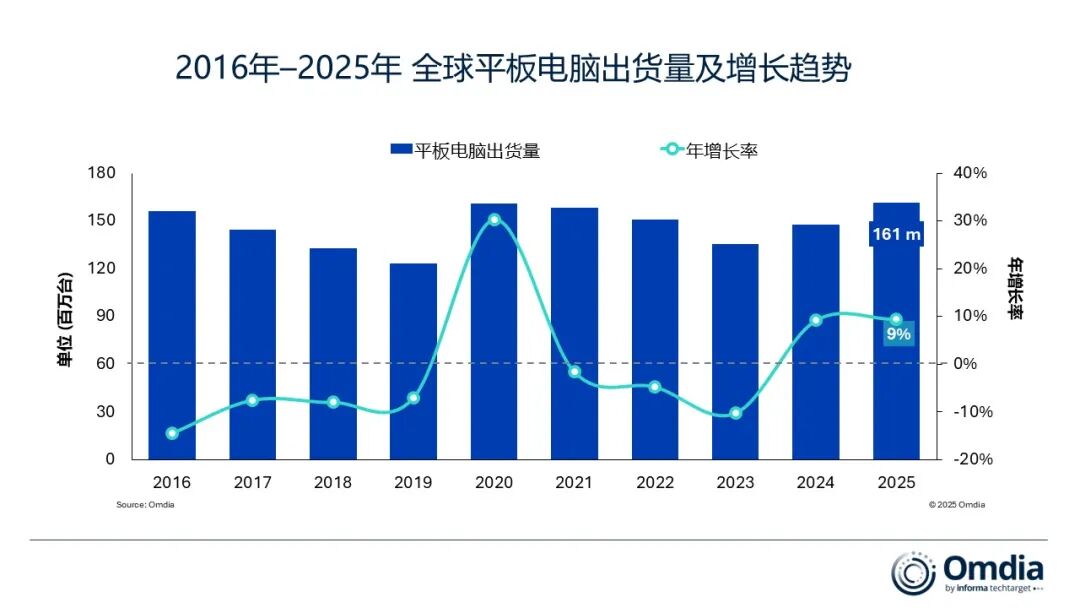
Core Insights - The global tablet market is projected to recover in 2025, with a year-on-year shipment increase of 9.8%, reaching 162 million units [1][3] - The Central and Eastern Europe region is expected to be the fastest-growing market in 2025, followed by the Asia-Pacific region [1] - Despite a slight decline in North America, all regions except North America are anticipated to achieve double-digit growth [1] Market Performance - In Q4 2025, global tablet shipments are expected to reach 44 million units, marking a 10% year-on-year increase [6] - Apple leads the market with iPad shipments of 19.6 million units, a 16.5% increase, driven by strong demand for the iPad Air and M5 chip-equipped iPad Pro [6][7] - Samsung ranks second with 6.4 million units shipped, experiencing a 9.2% decline due to overall market slowdown [6][7] - Lenovo shows the fastest growth among major manufacturers, with shipments of 3.9 million units, a 36% increase [6][7] - Huawei and Xiaomi follow with shipments of 3 million and 2.8 million units, reflecting year-on-year increases of 14.8% and 10.1%, respectively [6][7] Future Outlook - The tablet market is expected to face increasing pressure in 2026, with manufacturers needing to balance competitiveness and profitability amid potential disruptions in the memory market [3] - Growth opportunities are likely to be limited, focusing on high-end and flagship model refresh cycles in developed markets, as well as education demand supported by public sectors in emerging markets [3] - Manufacturers are anticipated to shift their product positioning and marketing strategies, emphasizing tablets as central devices within ecosystems, incorporating cross-operating system functionalities and AI-driven experiences [3]

Omdia:2025年,全球平板出货量增长10%,市场增速接近放缓
Canalys· 2026-02-04 10:25
Core Insights - The global tablet market is expected to recover in 2025, with a year-on-year shipment growth of 9.8%, reaching 162 million units [2] - The strongest performance is anticipated in the fourth quarter of 2025, with shipments reaching 44 million units, also reflecting a 9.8% year-on-year increase [2] - The Central and Eastern Europe region is projected to be the fastest-growing market in 2025, followed by the Asia-Pacific region [2] Market Performance - In Q4 2025, the global tablet market is expected to grow by 10% year-on-year [7] - Apple is projected to lead the market with shipments of 19.6 million iPads, a 16.5% increase driven by strong demand for the iPad Air and M5 chip-equipped iPad Pro series [7] - Samsung, despite being second, is expected to see a 9.2% decline in shipments to 6.4 million units due to overall market slowdown [7] - Lenovo is anticipated to have the fastest growth among major manufacturers, with shipments of 3.9 million units, a 36% increase [7] - Huawei and Xiaomi are also expected to show growth, with shipments of 3 million and 2.8 million units, reflecting increases of 14.8% and 10.1% respectively [7] Manufacturer Strategies - Manufacturers are advised to balance competitiveness and profitability, as potential disruptions in the memory market could affect supply availability and increase prices [4] - Growth opportunities are expected to be limited, focusing on high-end and flagship model refresh cycles in developed markets, as well as education demand supported by public sectors in emerging markets [4] - Product positioning and marketing strategies are anticipated to evolve, with manufacturers aiming to position tablets as central devices in ecosystems, incorporating cross-operating system functionalities and AI-driven experiences [4]



存储巨头,发2964%绩效奖金
半导体芯闻· 2026-02-04 10:17
如果您希望可以时常见面,欢迎标星收藏哦~ SK 海力士去年取得了有史以来最高的业绩,决定向员工发放相当于基本工资 2964%(年薪的二十 分之一)的绩效奖金,这是有史以来最高的奖金。 据业内人士2月4日透露,SK海力士将今年的"利润分享(PS)"支付比例设定为2964%,支付日期 为2月5日。PS是SK海力士的绩效奖金制度,根据年度业绩,以10%的营业利润为资金来源,每年 一次性支付一定比例的年薪。 从今年SK海力士的绩效奖金发放开始,公司开始实施去年下半年劳资双方达成一致的新绩效奖金 发放标准。新标准取消了之前的绩效奖金发放上限(最高1000%),并以上一年营业利润的10%作 为资金来源。公司决定将此标准维持10年。 每位员工计算出的绩效奖金的 80% 在当年支付,剩余的 20%(每年 10%)分两年支付。 SK海力士,利润翻倍 韩国SK海力士此前公布,2025年全年利润创历史新高,营业利润翻了一番多,原因是人工智能相 关存储芯片短缺推高了价格,帮助该公司超出市场预期。 这家内存芯片制造商在12月季度也公布了创纪录的收入和利润,该公司正与竞争对手三星争夺全 球顶级内存生产商的头衔。 与此同时,SK海力士宣布 ...

存储成本逼近整机一半,中小手机厂商还有生路吗?
雷峰网· 2026-02-04 10:05
" 「老机套新壳」与「全线降配」背后的无奈选择。 " 作者丨 杨依婷 编辑丨 包永刚 "现在做产品规划,最大的风险不是判断错方向,而是判断刚做完就失效。"一位头部手机厂商的产品规划 师这样形容最近几个月的状态。 在手机行业,原本按季度、按年度推进的节奏,正在被一次次突如其来的涨价打碎,所有人都被迫进入一 场没有暂停键的拉锯战。 如果说未发布的新机还能通过调整配置和定价勉强应对,那么 真正让厂商进退失据的,是那些已经上市、 价格却难以回调的老产品 。 尽管有业内人士提及,少数巨头可以通过集团内部的" 动态总包 "库存管理模式来缓冲压力,即所有项目 共享库存。 但对于大部分品牌来说,"怎么把老产品的价格涨上去,是现在最核心的问题,这直接决定还能不能赚 钱。"为了对冲存储成本上行,部分厂商开始用"老机套新壳"的方式,寻找价格调整的空间。本质上,这 "不做",正在成为消费电子中小厂商对抗成本侵蚀的现实选择。 01 消费存储市场剪刀差:端侧需求激增,上游减产 近两年,随着AI逐渐向手机、电脑、穿戴设备等消费电子终端渗透,存储需求发生了显著的升级。 长期以来,Windows 11的最低存储配置要求是64GB SSD和4G ...