
陕西煤业

Search documents
【华鑫固收&资配】流动性高点确认,关注事件性冲击——资产配置周报
Xin Lang Cai Jing· 2025-12-08 01:33
Group 1: National Balance Sheet Analysis - The latest data shows that the growth rate of liabilities in the real sector for October 2025 is recorded at 8.7%, slightly down from the previous value of 8.9%, which is in line with expectations. It is anticipated that the growth rate will stabilize around 8.7% in November and trend downward, returning to a contraction phase by year-end, with an expected decline to approximately 8.2% [1][10][56] - The government work report for 2025 emphasizes aligning the growth of social financing and money supply with economic growth and price level expectations, indicating that the direction of stabilizing the macro leverage ratio remains unchanged. China is still in a marginal contraction phase, which reduces the probability of large-scale defaults and liquidity risks, thereby enhancing overall societal expectations [1][10][56] Group 2: Fiscal and Monetary Policy - In the last week, the net increase in government debt (including national and local bonds) was 16 billion yuan, exceeding the planned net decrease of 73.3 billion yuan. It is planned that next week, government debt will decrease by 510.2 billion yuan. The growth rate of government liabilities at the end of October 2025 was 13.9%, down from 14.5%, and is expected to continue declining to around 13.1% in November, with a projected year-end rate of approximately 12.0% [2][11][56] - Weekly average calculations indicate that the volume of funds traded increased week-on-week, while the price of funds decreased. The overall liquidity remains marginally relaxed. The one-year government bond yield fluctuated slightly, closing at 1.40%, with an estimated lower bound of around 1.3% and a central tendency near 1.4% [2][11][56] Group 3: Economic Outlook and Industry Recommendations - The economic data for October shows a continued weakening trend compared to September, with a focus on when the economy may stabilize or show marginal improvement. The annual economic growth target for 2025 is set at around 5%, with a nominal growth target of 4.9% derived from the deficit and deficit ratio [3][12][57] - In the context of a contraction phase, the price-performance ratio between stocks and bonds is expected to favor equities, particularly those with value characteristics. Recommended stocks should not expand their balance sheets, have good profitability, and be sustainable. The A+H dividend stock combination includes 13 stocks, with a focus on sectors such as banking, telecommunications, oil and petrochemicals, and transportation [7][49][56]


迎接煤炭新周期 - 煤价回落,后市怎么看?
2025-12-08 00:41
Summary of Coal Industry Conference Call Industry Overview - Recent decline in coal prices, with port coking coal prices dropping to 1,630 RMB/ton and pithead prices for thermal coal decreasing by approximately 20 RMB/ton [1][2] - National power plant inventory remains stable year-on-year, but daily consumption has decreased, leading to an increase in available days, indicating reduced purchasing enthusiasm due to warmer winter weather [1][2] - Hydropower generation has increased by 34.5% year-on-year, while wind and solar power generation has grown by 14.5%, creating competitive pressure on thermal power [1][5] Key Insights - Short-term weather conditions are crucial for the coal market; a cold front could increase electricity demand in southern regions, potentially leading to a rebound in coal prices [1][8] - An estimated 100 million tons of pre-contract capacity is expected to exit the market starting January, tightening supply and demand dynamics, with coal prices projected to stabilize around 800 RMB/ton [1][9] - Power generation growth for January to October is approximately 2.3%-2.5%, while electricity consumption growth is at 5.1%. If overall power generation growth exceeds 3% next year, coal demand is expected to increase [1][10] Market Dynamics - Despite the drop in coal prices, companies like China Shenhua and Yanzhou Coal Mining have seen stock price increases of over 30%, attributed to marginal pricing and increased demand for undervalued, high-dividend assets [3][12] - The current market environment suggests a focus on high-frequency data, including price trends and inventory changes, as well as the impact of alternative energy developments on traditional thermal power [6][7] Investment Recommendations - Long-term investment strategies should consider companies with stable earnings and dividend potential, such as China Shenhua, China Coal Energy, and Shaanxi Coal and Chemical Industry [3][13] - Companies in the thermal coal sector with significant price elasticity include Lu'an Mining, Shanxi Coal International, and Jincheng Anthracite Mining, which may see substantial performance improvements with price rebounds [15] - For coking coal, recommended companies include Hebei Mining, Shanxi Coking Coal, and Panjiang Coal, with a particular focus on Yongtai Energy due to its growth potential despite past issues [17] Additional Considerations - The overall commodity market shows some resonance effects, with WTI crude oil prices increasing by 2.3% and 2.7%, while European thermal coal futures rose by 1.4% [4] - The impact of weather on coal procurement decisions remains uncertain, emphasizing the need for careful monitoring of short-term forecasts [8]
铜、白银新高,周期怎么看?
2025-12-08 00:41
Summary of Key Points from Conference Call Records Industry Overview Aviation Industry - The adjustment of the China-Japan route impacts airlines and ticket prices, with the route accounting for 3% of the total market share. The removal of flights has led to a shift in capacity to domestic flights, causing ticket prices to stabilize or slightly decline from previous growth of 2-3% [2] - Airlines have extended the free ticket refund period for the China-Japan route until March 31, 2026, resulting in short-term disruptions but overall limited impact due to the small number of flights removed [2] - The recommendation for airline stocks includes China Southern Airlines, China Eastern Airlines, and Air China, followed by Huaxia Airlines, Juneyao Airlines, and Spring Airlines [2] Retail and Duty-Free Market - The Shanghai Airport duty-free store bidding process has sparked discussions, with potential new operators being introduced as existing shareholders oppose the bid. This could lead to increased revenue for Shanghai Airport [4] - The bidding process may benefit Shanghai Airport regardless of the outcome, as the expected revenue from the bidding exceeds investment returns [4] Shipping and Bulk Freight - The Baltic Dry Index (BDI) reached a two-year high of 2,854 points, driven by the upcoming production of the West Manganese Mine and concentrated shipments from Australian mines [5] - The outlook for the bulk shipping market remains positive, with recommendations for stocks such as Haitong Development, Pacific Shipping, and China Merchants Energy [5] Express Delivery Industry - Jitu's volume growth in Southeast Asia reached 78% during the Double Eleven shopping festival, with new market growth at 83%, indicating strong performance [6] - The express delivery sector is experiencing a shift, with leading companies increasing market share while lower-tier companies see declines. Zhongtong has returned to double-digit growth in October and November, making it an attractive investment opportunity [7] Commodity Market Insights Metal Market - The commodity cycle since 2020 is not yet halfway through, with expectations for a bull market in 2026 driven by a weakening dollar and supply chain disruptions [8] - The investment strategy for 2026 focuses on energy metals, nickel, cobalt, gold, copper, aluminum, and strategic metals, influenced by energy revolutions and geopolitical tensions [11] - Specific insights include: - Nickel and cobalt prices are expected to remain high due to quota systems and unexpected demand for energy storage [8] - Copper's supply issues are critical, with both financial and commodity attributes driving its value [8] - Aluminum is anticipated to break out of a three-year range due to low inventory and increased demand from industrial and energy sectors [8] Coal Market - The coal market is currently under pressure, with prices for Shanxi coal dropping by 27 yuan, and overall coal inventory rising but still below last year's levels [13][14] - Electricity consumption has decreased year-on-year, but there is a seasonal uptick in demand [15] - The national coal market conference indicated a balanced supply-demand outlook for 2026, with a focus on long-term contracts and import controls to stabilize prices [16] Future Projections - The overall sentiment for the metal sector in 2026 is optimistic, emphasizing the importance of energy revolutions and geopolitical factors for long-term investment opportunities [9]
广发策略:牛市产业主线,如何跨年、如何躁动?
Xin Lang Cai Jing· 2025-12-07 13:30
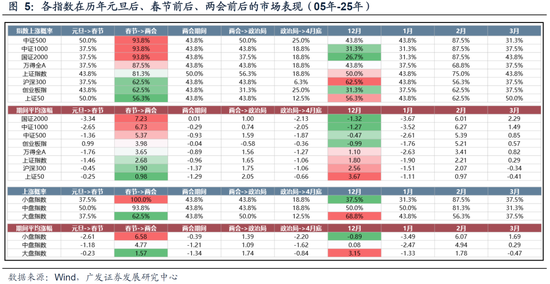
炒股就看金麒麟分析师研报,权威,专业,及时,全面,助您挖掘潜力主题机会! 来源:晨明的策略深度思考 在上周周报中,我们讨论了《2026年春季躁动前瞻》,总结了基于历史规律的春季躁动几个关键结论: 春季躁动的强弱由何决定?什么情况下,春季躁动会提前?春季躁动对当年行情,有指示意义吗?春季 躁动期间,业绩增长不重要了吗?业绩雷落地后,是否会演绎"利空出尽"? 本周我们进一步讨论:如果一轮产业主线已经确立(例如今年的AI产业链),那么相关行业在历史上 的跨年阶段、春季躁动时期,有何表现? 一、我们再总结一下,岁末年初,指数及风格表现的历史规律: 11月:对机构最不利的一个月已经过去,11月份市场涨跌和基本面关联度最弱,主题活跃、轮动加快。 12月:过去20年,指数在12月涨跌各半,不过基本面定价的有效性较11月增强;风格方面,大盘优于小 盘,红利占优,金融板块涨幅居前,港股红利也迎来一年中日历效应最强的时段。 1月:指数在1月的上涨概率仅43%,小盘股上涨概率仅31%,主要受年报预告压制风险偏好影响。 春节前后、2月:一年当中风险偏好最高的区间,小盘股胜率超过90%,成长风格、电子/计算机/非银等 行业的平均涨幅最 ...
煤炭行业周报(12月第1周):保供政策提升库存,库存涨煤价跌-20251207
ZHESHANG SECURITIES· 2025-12-07 12:30
Investment Rating - The industry rating is "Positive" [1] Core Viewpoints - The coal sector has seen a rise, but it underperformed compared to the CSI 300 index, with a weekly increase of 0.77% against the CSI 300's 1.28% [2] - Inventory levels are increasing due to supply policies, while coal prices are declining rapidly. Despite increased production, supply constraints are expected to persist, leading to potential coal shortages in certain regions [6][32] - The report anticipates a rise in the coal price center in the fourth quarter, with current coal asset dividends being reasonable [6][32] Summary by Sections Coal Market Performance - As of December 5, 2025, the coal sector's performance was 0.77% up, lagging behind the CSI 300 index by 0.51 percentage points. A total of 21 stocks rose, while 14 fell, with New Dazhou A showing the highest increase of 14.98% [2] Key Data on Coal Sales and Inventory - The average daily coal sales for monitored enterprises from November 28 to December 4, 2025, were 6.98 million tons, down 5% week-on-week and down 9.5% year-on-year. Total coal inventory was 24.67 million tons, a decrease of 0.3% week-on-week and 20.5% year-on-year [2][30] Price Trends in Coal Types - As of December 5, 2025, the price of thermal coal (Q5500K) was 706 CNY/ton, up 1.15% week-on-week, while the price of imported thermal coal fell by 4.69% to 874 CNY/ton. Prices for coking coal and anthracite also showed declines [3][4] Investment Recommendations - The report suggests prioritizing investments in high-dividend thermal coal companies such as China Shenhua, Shaanxi Coal, and others. For coking coal, companies like Huaibei Mining and Shanxi Coking Coal are recommended. Additionally, companies with improved profits in the coking sector are highlighted [6][32]



行业研究|行业周报|煤炭与消费用燃料:美国缺电将拉动多大煤炭消费量?-20251207
Changjiang Securities· 2025-12-07 12:16
Investment Rating - The report maintains a "Positive" investment rating for the coal industry [8] Core Insights - The rapid development of the AI industry in the U.S. has led to electricity shortages, which are expected to drive an increase in coal consumption. By 2025, domestic coal demand in the U.S. could rise to between 547 million and 640 million tons, representing an annual growth of 27% to 48% compared to 2025 levels. This shift may significantly reduce U.S. coal exports and disrupt the global coal trade balance, providing marginal support for coal prices globally and in China [2][6][21] Summary by Sections Coal Consumption and Production - In the first nine months of 2025, U.S. coal consumption reached 197.09 million tons, a year-on-year increase of 13.5%. Coal production during the same period was 236.29 million tons, up 5.0% year-on-year. Coal imports surged by 53.1% to 1.2 million tons, while exports fell by 11.4% to 42.45 million tons [6][16][26] Market Performance - The coal index in the Yangtze River region increased by 1.25%, underperforming the CSI 300 index by 0.03 percentage points. The price of thermal coal at Qinhuangdao port was 785 RMB per ton, down 31 RMB from the previous week. The price of coking coal at Jingtang port was 1,630 RMB per ton, also down 40 RMB [5][28][51] Future Outlook - The report suggests that the coal market may remain robust due to strict safety regulations and low inventory levels at mines and ports. If cold weather increases daily consumption, coal prices could rise further. The report emphasizes the need to monitor extreme weather, procurement rhythms, and port inventory changes [5][29][45]
煤炭开采行业周报:12月煤价仍有上涨动能-20251207
Guohai Securities· 2025-12-07 10:33
Investment Rating - The report maintains a "Recommended" rating for the coal mining industry [1] Core Viewpoints - The coal price has upward momentum in December, driven by seasonal demand increases and supply constraints [4][7] - The coal mining industry is characterized by high asset quality and strong cash flow among leading companies, indicating a favorable long-term outlook for coal prices [7] Summary by Sections 1. Thermal Coal - As of December 5, the price of thermal coal at northern ports is 785 RMB/ton, a decrease of 31 RMB/ton week-on-week [14] - Production in the Sanxi region has seen a slight decrease in capacity utilization, down 0.61 percentage points [14][21] - Coastal and inland power plants have increased daily coal consumption by 7.3 and 35.3 thousand tons respectively [14][23] - The inventory of power plants in 25 provinces is 136.12 million tons, down 115 thousand tons year-on-year [14][34] 2. Coking Coal - The capacity utilization rate for coking coal mines has decreased by 0.17 percentage points to 84.5% [5][40] - The average crossing volume at Ganqimaodu port has increased, indicating stable import levels [5][44] - The price of main coking coal at ports is 1,630 RMB/ton, down 40 RMB/ton week-on-week [5][41] 3. Coke - The production rate of independent coking plants has increased slightly to 72.66% [53][59] - The average profit per ton of coke has decreased to approximately 30 RMB/ton, down 16 RMB/ton week-on-week [57] - The price of coke at Rizhao port is 1,630 RMB/ton, a decrease of 50 RMB/ton week-on-week [54] 4. Anthracite - The price of anthracite remains stable, with the small block price at 930 RMB/ton [69] 5. Key Companies and Profit Forecasts - Key companies to focus on include China Shenhua, Shaanxi Coal, and Yanzhou Coal, all rated as "Buy" [9]


行业ETF配置模型2025年超额16.4%
GOLDEN SUN SECURITIES· 2025-12-07 10:20
Quantitative Models and Construction Methods 1. Model Name: Industry Mainline Model (Relative Strength Index, RSI) - **Model Construction Idea**: The model aims to identify leading industries by calculating their relative strength index (RSI) over different time frames[1][9] - **Model Construction Process**: 1. Use primary industry indices as configuration targets, totaling 31 primary industries 2. Calculate the price changes over the past 20, 40, and 60 trading days for all industries, obtaining the cross-sectional rankings of these changes, then normalize all rankings to get RS_20, RS_40, and RS_60 3. Calculate the average of these three rankings to get the final industry relative strength index: $$ RS = \frac{RS_{20} + RS_{40} + RS_{60}}{3} $$ 4. If an industry shows an RS signal greater than 90% before the end of April, it is likely to be a leading industry for the year[9] - **Model Evaluation**: The model effectively identified leading industries in 2024, such as coal, power and utilities, home appliances, banks, oil and petrochemicals, communications, non-ferrous metals, agriculture, forestry, animal husbandry, and fishery, and automobiles[1][9] 2. Model Name: Industry Rotation Model (Prosperity-Trend-Crowding Framework) - **Model Construction Idea**: The model uses a three-dimensional framework of prosperity, trend, and crowding to recommend industry allocations[1][2][6] - **Model Construction Process**: 1. Define two industry rotation schemes: "strong trend-low crowding" and "high prosperity-strong trend" 2. Allocate industry weights based on the framework: Media 16%, Agriculture, Forestry, Animal Husbandry, and Fishery 15%, Non-bank Financials 12%, Computers 12%, Home Appliances 9%, Coal 9%, Building Materials 7%, Banks 7%, Light Industry Manufacturing 7%, Retail 6% 3. Recommend ETFs tracking indices such as CSI Steel, CSI Agriculture, Securities Companies, Communication Equipment, CSI Media, Sub-segment Chemicals, CS Artificial Intelligence, Animation Games, Sub-segment Machinery, All Information, Building Materials, etc.[2][6][15] - **Model Evaluation**: The model performed well in 2025, with an excess return of 16.4% relative to the CSI 800 index and 4.2% relative to the Wind All A index[2][6][18] 3. Model Name: Left-Side Inventory Reversal Model - **Model Construction Idea**: The model aims to capture the reversal of industries in distress by analyzing sectors with low inventory pressure and long-term analyst optimism[24] - **Model Construction Process**: 1. Identify sectors currently or previously in distress with potential for inventory replenishment 2. Analyze sectors with low inventory pressure and long-term analyst optimism 3. Recommend sub-sectors such as cloud services, other light industries, oil service engineering, components, agricultural chemicals, animal husbandry, consumer electronics, special materials, and biomedicine[24][25] - **Model Evaluation**: The model achieved an absolute return of 25.4% in 2025, with an excess return of 5.4% relative to the industry equal weight index[24][27] Model Backtest Results 1. Industry Mainline Model (RSI) - **Absolute Return**: Various industries showed significant returns after the RSI signal appeared, such as banks (32.1%), communications (24.0%), home appliances (25.8%), and automobiles (12.8%)[10][12] 2. Industry Rotation Model (Prosperity-Trend-Crowding Framework) - **Annualized Return**: 21.7% - **Excess Annualized Return**: 13.8% - **Information Ratio (IR)**: 1.5 - **Maximum Drawdown**: -8.0% - **Monthly Win Rate**: 67% - **Excess Return in 2023**: 7.3% - **Excess Return in 2024**: 5.7% - **Excess Return in 2025**: 4.2%[13][14] 3. Left-Side Inventory Reversal Model - **Absolute Return in 2023**: 13.4% - **Excess Return in 2023**: 17.0% - **Absolute Return in 2024**: 26.5% - **Excess Return in 2024**: 15.4% - **Absolute Return in 2025**: 25.4% - **Excess Return in 2025**: 5.4%[24][27]
印尼明年或将开始征收煤炭出口税
GOLDEN SUN SECURITIES· 2025-12-07 08:24
Investment Rating - The report maintains an "Increase" rating for the coal mining industry [4] Core Viewpoints - Indonesia plans to impose a coal export tax starting in 2026 to increase national revenue, which has faced strong opposition from the coal mining association [2][8] - The report recommends companies with strong earnings elasticity such as Yancoal Energy, Jinkong Coal Industry, and focuses on Keda Automation in the smart mining sector [2] - Key companies to watch include major state-owned enterprises like China Coal Energy and China Shenhua, as well as turnaround candidates like China Qinfa [2] Summary by Sections Industry Overview - Global energy prices have shown mixed trends, with Brent crude oil futures at $63.75 per barrel (+0.87%) and WTI at $60.08 per barrel (+2.61%) as of December 5, 2025 [1] - Coal prices have seen slight adjustments, with Newcastle coal at $109.5 per ton (-1.44%) and South African Richards Bay coal at $90.8 per ton (+5.13%) [1][36] Key Companies and Recommendations - Recommended stocks include: - China Coal Energy: Buy with EPS estimates of 1.46, 1.21, 1.29, and 1.39 for 2024A to 2027E [7] - China Shenhua: Buy with EPS estimates of 2.95, 2.56, 2.71, and 2.86 for 2024A to 2027E [7] - Jinkong Coal Industry: Buy with EPS estimates of 1.68, 1.23, 1.47, and 1.62 for 2024A to 2027E [7] - Yancoal Energy: Buy with EPS estimates of 1.44, 0.99, 1.18, and 1.37 for 2024A to 2027E [7] - China Qinfa: Buy with EPS estimates of 0.20, 0.06, 0.27, and 0.47 for 2024A to 2027E [7] Market Trends - The coal industry is facing challenges due to the proposed export tax, which may impact its competitiveness in the global market [2][8] - The report highlights the importance of monitoring coal demand and pricing trends as the industry navigates these changes [2][36]


需求偏弱震荡或延续,供给约束深跌亦难为
Xinda Securities· 2025-12-07 07:53
Investment Rating - The investment rating for the coal mining industry is "Positive" [2] Core Viewpoints - The current phase is seen as the beginning of a new upward cycle for the coal economy, with a resonance between fundamentals and policies, making it an opportune time to accumulate coal sector investments [11][12] - The supply side constraints are expected to support prices despite high inventory levels and mild weather conditions, with coal prices anticipated to exhibit a bottoming and oscillating trend [11][12] - The underlying investment logic of coal capacity shortages remains unchanged, with a balanced short-term supply-demand scenario and a long-term gap still present [11][12] Summary by Sections Coal Price Tracking - As of December 6, the market price for Qinhuangdao port thermal coal (Q5500) is 791 RMB/ton, down 27 RMB/ton week-on-week [30] - The international thermal coal FOB price for Newcastle (NEWC5500) is 85.5 USD/ton, down 1.8 USD/ton week-on-week [30] - The price for coking coal at Jing Tang port is 1650 RMB/ton, down 60 RMB/ton week-on-week [32] Supply and Demand Tracking - The capacity utilization rate for sample thermal coal mines is 91.5%, an increase of 0.2 percentage points week-on-week [48] - The daily coal consumption in inland 17 provinces has increased by 32.10 thousand tons/day, a rise of 9.07% week-on-week [47] - The daily coal consumption in coastal 8 provinces has increased by 10.70 thousand tons/day, a rise of 5.72% week-on-week [47] Inventory Situation - The coal inventory in inland 17 provinces has decreased by 100.60 thousand tons, a decline of 0.99% week-on-week [47] - The coal inventory in coastal 8 provinces has increased by 51.10 thousand tons, an increase of 1.48% week-on-week [47] Company Performance - The coal sector has shown a positive performance with a 0.77% increase, although it underperformed compared to the broader market [14][17] - Key companies to focus on include China Shenhua, Shaanxi Coal, and Yanzhou Coal, which are noted for their stable operations and strong performance [12][13]

